A court tossed out a lawsuit filed by Elon Musk’s X that accused big advertisers like Mars, Lego, and Nestlé of illegally boycotting the platform.
A US District Court judge in Texas dismissed the case, citing a lack of jurisdiction and X’s failure to state an antitrust claim.
X sued several major brands in August 2024, alleging their participation in an ad industry initiative called the Global Alliance for Responsible Media, GARM, was tantamount to a conspiracy to “collectively withhold billions of dollars in advertising” from X after Musk’s takeover of the company, then known as Twitter. It later added other brands to the suit.
X claimed the alleged boycott made it less competitive than other platforms in winning advertisers and user engagement.
Other plaintiffs named in the suit were the World Federation of Advertisers, CVS Health, Ørsted, Twitch, Abbott Laboratories, Colgate-Palmolive, Pinterest, Tyson, and Shell.
Every time Lucia publishes a story, you’ll get an alert straight to your inbox!
Stay connected to Lucia and get more of their work as it publishes.
WFA shut down GARM, its initiative, after the suit was filed, citing limited resources.
The suit was partly spurred by an investigation by the chairman of the House Judiciary Committee, Jim Jordan, into whether advertisers were illegally banding together to demonetize conservative platforms and voices in violation of antitrust law.
The plaintiffs fought back, calling the lawsuit “an attempt to use the courthouse to win back the business X lost in the free market when it disrupted its own business and alienated many of its customers.”
X’s relationship with advertisers has been fraught since Musk bought the platform in 2022. Advertisers left en masse as X loosened moderation and account-verification rules and reinstated the banned accounts of some provocative figures.
EMARKETER, Business Insider’s sister company, estimated its revenue would reach $2.2 billion in 2026, below its pre-acquisition level of $4.5 billion.
X has tried to win back advertisers by underscoring its commitment to brand safety and promoting its use of block lists that let advertisers avoid showing up around certain topics.
X did not immediately respond to a request for comment from Business Insider.
Mayer Mizrachi, the 38-year-old mayor of Panama City, wants Elon Musk to build him a pedestrian tunnel under the Panama Canal. And Musk’s Boring Company recently announced it just might.
Panama City this week was named one of 16 finalists — the only one outside the United States — in the company’s Tunnel Vision challenge, which offers the winning municipality a free tunnel that can be used for freight, pedestrians, water, utilities or Loop — the electric, underground system that uses Tesla vehicles to transport people.
Mizrachi’s idea is a 0.6 mile pedestrian tunnel under the Panama Canal, which would give city residents a chance to “live” its history and take advantage of the vital maritime trade route that is critical to the global economy. More recently, the canal has been the subject of geopolitical tensions as President Donald Trump threatened to take control of the waterway because, he said, the US was being ripped off by high fees and that it had come under Chinese influence. In February 2025, Panama withdrew from China’s Belt and Road initiative.
The winner will be announced on March 23. Of the 16 finalists, half were in Tennessee or Texas, where the Boring Company is headquartered and where Mizrachi recently went to make his pitch. The project, if chosen, has the potential to tie together Mizrachi, the former DOGE leader, and the Panama Canal that Trump once fixated on seizing.
Mizrachi, the youngest mayor in the city’s history, founded Criptext, a secure email platform, and, like Trump, has styled himself as an outsider. Like Musk, he came to office looking to cut government in the name of efficiency and insists he has succeeded.
In an interview with POLITICO, which is, along with Business Insider, part of the Axel Springer Global Reporters Network, Mizrachi said the tunnel proposal began as a last-minute response to a Boring Company social media post and ballooned from there.
This interview has been edited for length and clarity.
How did the tunnel idea begin, and what exactly was your pitch to The Boring Company?
Mizrachi: I merely just ran into a tweet by the Boring Company in January, and they had this tunnel vision challenge, and they were offering a free tunnel up to a mile long anywhere around the world to the best idea. I did a visit in January to the existing tunnel that’s being built for a subway station in Panama City, and I said, “What if we built a pedestrian tunnel crossing the canal with parks on either side? You can tell the story of how the canal was built and the history of the country, and the biodiversity.”
City planners started working on a proposal, and they kind of really brought the plane in for a landing with a beautiful proposal, and we submitted that on the last minute of the last day.
What did you learn in Texas about how The Boring Company would approach this project?
Mizrachi: We met with Jim Fitzgerald, the VP for global, and we kind of took a 101 on how a Boring Company project works. Tunnels are freaking expensive. But it turns out that the way that they do it makes it actually feasible, and it’s quite a wonder the way that they have put this together.
And as I told Jim, I said, “Listen, I know this is very preliminary, and here are many other projects that they’re considering, but you know, it would be quite a marvel that 100 years ago, you know, the US built the canal, and then 100 years later, that they would build a tunnel that crosses the canal in a modern marvel of engineering in the way that they do it.”
They reuse their tunneling machines. Whereas typically, the tunneling machines are built specifically for a given project, and then they get buried with the project.
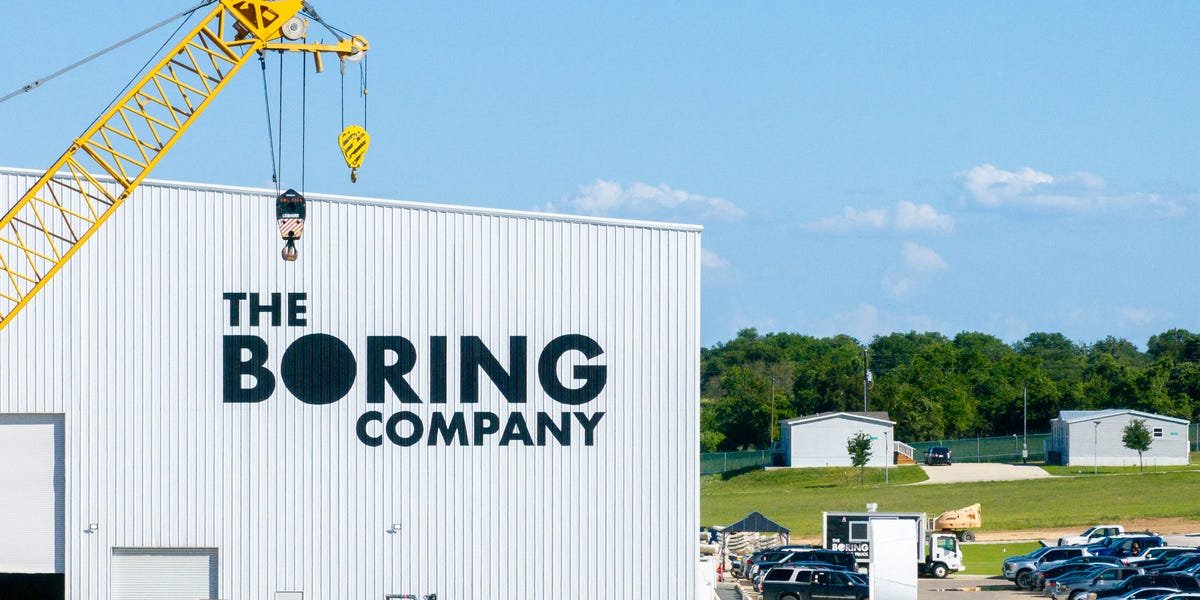
The Boring Company’s headquarters in Texas.
Brandon Bell/Getty Images
What would this tunnel mean for Panama, especially at a moment when the canal is caught up in broader geopolitical tensions?
Mizrachi: First of all, Panamanians, we’re really proud of the canal, its management, its history, but we seldom get to live it. So it’s like the rest of the world uses the canal. But you know, Panamanians, we don’t live the canal. You could go to the Miraflores Locks, and you go to the tourist center. You can maybe see a ship, but we don’t really live it.
So the vision here is you create a public space where you integrate families, tourists, and they can cross the canal themselves with an underground tunnel that’s 0.6 miles, the distance. It’s quite short, and I can only imagine it being almost an educational experience, where you can have screens, very thin screens, because the space is not that big, but thin screens that are showing the story, the history of how the canal was built, the biodiversity of Panama, and then stats on the canal, the impact that it has on world trade, etc. It started as an idea, but it’s shaping up. And I think it goes above my pay grade. I spoke to the president [of Panama] about this. This needs to be handled by a task force designated by the president in representation with the entire country.
Why do you think Panama City could beat out American cities for this project?
Mizrachi: Well, there’s one very unique thing about this. They don’t have a canal. The Boring Company has never bored underwater, much less crossing a canal. And I think it’s part of the value proposition to show themselves as engineers, how far they can go with their mindset, with their methodology and their ingenuity.
Also it’s a pedestrian tunnel. So it’s not a loop tunnel that is managed and operated by the Boring Company. So if you think of Vegas, they operate the Loop itself. So, here, it’s a lot more hands off. They build a tunnel, and they don’t have to have an active operation.
The Boring Company-built tunnel at the Las Vegas Convention Center.
AaronP/Bauer-Griffin/GC Images
You’ve drawn comparisons between your work and DOGE-style cost cutting in Washington. How do you describe your governing approach?
Mizrachi: I mean, honestly, I still consider myself an outsider. I am not subscribed to any political party, and I still very much employ the mindset of the tech entrepreneurial efficiency and try things before you scale things, which is uncommon in politics.
As soon as I came into office in July 2024, I realized people’s money was being wasted on a scale that I was just shocked to see. So we were able to reduce the size of City Hall personnel by 50% so it used to have 6,500 people. We reduced it to about 3,500 people. And by all counts, City Hall is operating faster and better with more impact, tangible, visible impact, with less people. And also, we reduced the budget by about 32%, so we did the biggest budget reduction in the history of the city as well.
This story originally ran in POLITICO’s West Wing Playbook and appears on Business Insider through the Axel Springer Global Reporters Network. The network publishes major stories from the Axel Springer network of publications, a worldwide group of news outlets that includes Business Insider.
A “decoy” Tesla distracted a scrum of photographers trying to get a good shot of Elon Musk as he entered a San Francisco courthouse on Wednesday, two cameramen on the scene told Business Insider.
“100% a decoy. 100%,” said David Morris, a frustrated yet impressed Bloomberg News photographer. “They had us. It was done very well, actually.”
The Tesla CEO was expected to arrive at the San Francisco federal courthouse on Wednesday to testify in a trial over a lawsuit brought by former Twitter shareholders. They alleged the billionaire violated securities laws in 2022 by driving down the share price of Twitter before he bought it and renamed it X. Musk has said he complied with the law in his communications about the social media company.
According to two photographers on a stakeout outside the courthouse, a Tesla pulled up on the curb, and security guards stepped out to surround it.
As soon as the group of news photographers coalesced around the Tesla — anticipating Musk would step out — an SUV that had been parked a short distance away pulled up right in front of the courthouse door, the photographer said. Musk and his security team ran out of the car and up the courthouse steps, they said.
“He was like probably at least a hundred feet away from us,” Morris said. “And then we noticed that. And it was like three seconds — out of the car, in the door.”
Elon Musk, center, arrives for a Twitter shareholder trial at the US District Court for the Northern District of California, Wednesday, March 4, 2026, in San Francisco.
AP Photo/Godofredo A. Vásquez
The photographers ultimately got only a handful of pictures of Musk, on the steps entering the courthouse and going through the metal detectors.
“There was security standing in front of him to try to make it so it was hard to get a good photo,” Josh Edelson, a freelance photographer working for Getty Images, told Business Insider.
Musk didn’t make it easy, Edelson said.
“He didn’t look at us. He kept his head looking to the side, so he didn’t look very good,” he said. “It was just a profile shot. It was very obviously a position where he wanted to make it hard for us.”
The entire scene was captured by NBC journalist Scott Budman, who posted a video on X.
Watch: Elon Musk sends A DECOY TESLA AND GUARDS to try and fool the press as he enters the SF courtroom today for the Twitter buyout trial. (Keep going .. we found him). pic.twitter.com/dV0c3sIxty
Elon Musk’s X is promoting itself to potential advertisers with a new deck that underlines its commitment to brand safety, according to the leaked deck shared with Business Insider.
It comes after the AI chatbot shared “deepfake” sexualized images of women and children — a practice it stopped in late January after a backlash. The company said it would no longer generate AI images of real people in sexualized clothing.
The deck shows X is also promoting its use of “blocklists.” A blocklist is a list of sites or accounts that advertisers explicitly prevent their ads from appearing on. In the past, Musk’s X has taken legal action against advertisers who have used such tools to safeguard their ad placements.
X touts its use of Grok to make the platform safe for advertisers.
X
In the deck, X said it had achieved a nearly 100% perfect “brand safe” or suitable scores using Grok, as measured by tech companies IAS and DoubleVerify.
It mentions ways it uses Grok to review posts and users’ profiles for brand suitability. For instance, if a user regularly posts about sensitive topics, the system can block ads from appearing alongside that user. X said it can target up to 4,000 keywords and 2,000 author handles this way.
Every time Lucia publishes a story, you’ll get an alert straight to your inbox!
Stay connected to Lucia and get more of their work as it publishes.
The deck also promotes X as a place for brands to manage crises in real time.
X didn’t comment on the deck when reached by Business Insider.
X says its blocklists stop ads from appearing on up to 50 specific publishers per ad group.
X
The deck was shared at an event for clients and agencies on February 26. The 2026 Brand Suitability Webinar was billed as “empowering brands with new tools for safety & reach on X.”
It’s unclear if X’s newest charm offense will sway advertisers.
X is one of the smallest social media platforms by ad spending, with EMARKETER estimating it has less than 1% of worldwide digital ad revenue. It has an outsized influence because of its use by public figures and as a news channel.
Since Elon Musk bought X, formerly known as Twitter, in 2022, its relationship with advertisers has been fraught, with Musk publicly criticizing advertisers that cut or limited advertising on the platform.
The deck details what X says it’s done to be brand-safe.
X
Advertisers left en masse after Musk’s acquisition. EMARKETER estimated its revenue would reach $2.2 billion in 2026, below its pre-acquisition level of $4.5 billion.
In 2023, Musk lashed out at advertisers, using an expletive on stage at an event directed toward those who had left.
And X is suing an advertiser trade group, alleging that its members conspired to boycott the platform in contravention of antitrust laws. The group denied it violated antitrust laws. The case is pending, with the last filing occurring on February 19.
X has also been criticized for loosening moderation and account-verification rules and for reinstating some banned accounts of provocative figures.