

Matthew Loh Headshot

New Ukrainian method of catching enemy drones looks like a fishing rod in the sky

Ukrainian troops appear to be testing a new drone attachment that uses a cord or line to disable enemy propeller drones in the sky.

The tactic can be seen in a video posted on Monday by the 46th Separate Air Mobile Brigade, which published a video montage of its recent attacks against Russian infantry, vehicles, and drones.

In a caption, the brigade highlighted a “new way of capture of enemy drones in the air.”

As seen from the first-person-view camera of the Ukrainian drone, the new contraption features a rod protruding from the interceptor’s chassis.

Thin rope or cord dangles from the rod, pulled taut by a small weight that sways into view as the Ukrainian drone flies high above the battlefield.

The brigade’s drone then appears to fly over its target — a small quadcopter — entangling the opposing device’s propellers with the attached line.

The brigade published footage of two such interceptions, as well as a third clip of a drone with the rod-like attachment attempting to crash into a fixed-wing drone.

The third target was likely a Russian Molniya one-way attack loitering munition. It’s unclear if the interception in the third clip was successful.

The novel, fishing rod-style device is another example of how the war is pushing militaries to develop new methods of physically disrupting drones as electronic warfare technology adapts.

Ukrainians and Russians have been experimenting with similar counterdrone tactics as a response to anti-jamming features on small attack drones, deploying fishing nets both on the ground and testing them on interceptors.

Some Western companies have also begun trialing drone-mounted and handheld net launchers as a defense against small quadcopters.

As Russia increasingly relies on large-scale attacks with fixed-wing Geran drones that typically fly at speeds of up to 115 mph, and in some cases even 230 mph, the war has led to the growing popularity of small, fast, and inexpensive drones acting as interceptors.

The 46th Separate Air Mobile Brigade’s fishing line apparatus, however, appears to be more suited to disabling quadcopters.


Source link

A-US-aircraft-carriers-hard-turn-to-avoid-enemy-fire.jpeg

A US aircraft carrier’s hard turn to avoid enemy fire surprised sailors and sent a jet with bad brakes into the sea

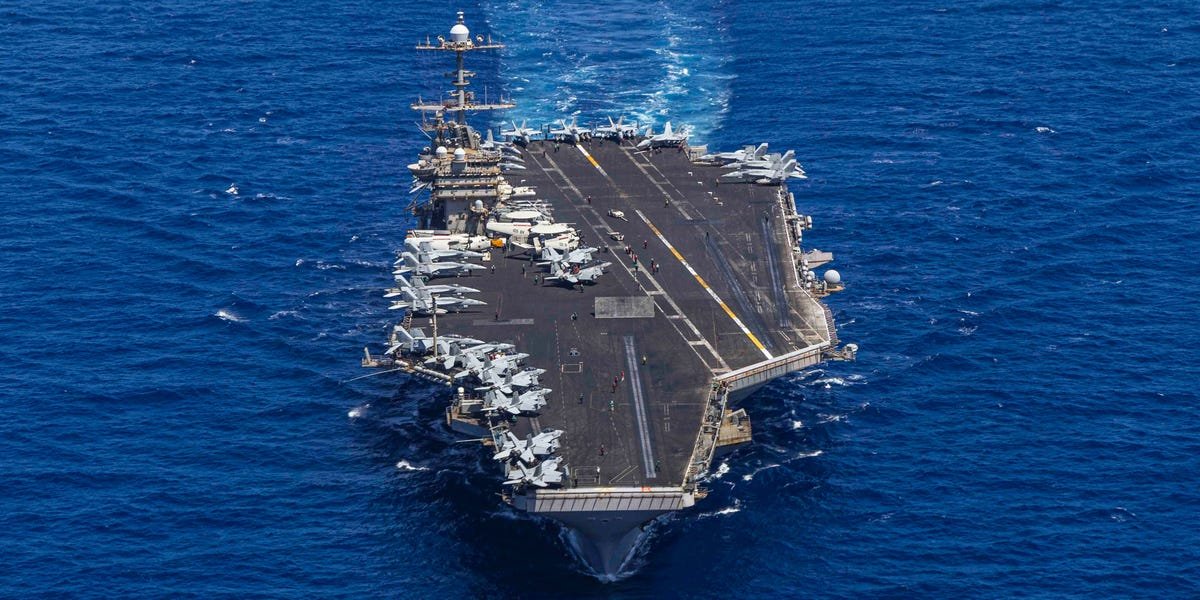
A US Navy aircraft carrier’s hard evasive turn to avoid enemy missile fire caught crewmembers off guard and sent a $60 million F/A-18 Super Hornet rolling off the deck and into the Red Sea, an investigation into the fighter jet loss revealed.

The fighter’s brakes weren’t functioning properly, investigators found, allowing the jet to slide across the deck when the carrier USS Harry S. Truman abruptly changed course during the late April action.

Poor communication, bad brakes, and a slippery surface all contributed to the loss.

A tow tractor also fell into the water alongside the expensive F/A-18 fighter jet, the second of three that the Truman lost during a monthslong Middle East combat deployment. When it went over, it nearly took sailors overboard as well.

Evading enemy fire

During their deployment, the Truman and its strike group led Navy combat operations against the Houthis, the heavily armed Iran-backed rebel group in Yemen that spent more than a year attacking key Middle East shipping lanes.


Three F/A-18 Super Hornets prepare to launch from the flight deck of the Nimitz-class aircraft carrier USS Harry S. Truman, December 21, 2021.

An F/A-18 fell overboard the Truman while the carrier took a hard turn.

US Navy Photo by Mass Communication Specialist 3rd Class Abbigail Beardsley


On April 28, the move crew lost control of an F/A-18 under tow in the Truman’s hangar bay, a maintenance area below the flight deck, the Navy reported at the time, and both the jet and its tow tractor tumbled into the Red Sea.

Right before it fell in, a sailor jumped from the cockpit, suffering minor injuries. The Navy didn’t share information or insight into the warship’s situation at the time of the plane loss.

According to the command investigation, the fighter jet and the tractor fell overboard while the Truman was conducting evasive maneuvers to avoid an incoming medium-range ballistic missile fired by the Houthis, a detail that had been reported but not confirmed at the time.

The move crew, which was preparing the F/A-18 from Strike Fighter Squadron 136 (VFA-136), the “Knighthawks,” for planned flight operations, didn’t hear the announcement that the ship was making a hard turn and was caught unaware when the ship began to tilt.

Sailors had removed the chocks and chains to pull the F/A-18 into the hangar bay. With the brakes engaged but not actually working, there was nothing to hold the aircraft in place when the carrier heeled in an evasive turn.


Two US Navy Aviation Ordnancemen transport ordnance across the hangar bay aboard the Nimitz-class aircraft carrier USS Harry S. Truman in the US Central Command area of responsibility.

The hangar bay is an area underneath the flight deck where aircraft receive maintenance.

US Navy photo


It slid backward toward the deck edge, dragging the tow tractor behind it. The crew moving the Super Hornet abandoned their posts just before the fighter jet fell into the sea.

Bad brakes

The command investigation put the blame for the incident primarily on the fighter jet’s inadequate brake engagement and the lack of communication from the Truman’s bridge to flight deck control and the hangar bay.

Leadership also said that the non-skid, a rough, high-friction coating applied to the decks of Navy ships to keep people, vehicles, and aircraft from slipping on smooth steel surfaces, was ineffective, having not been replaced since 2018.

These problems, the investigation said, cost the Navy an F/A-18, a multirole fighter made by the US aerospace giant Boeing that has been in service with the Navy for decades.

The April incident was one of four major mishaps that the Truman and its strike group suffered during their deployment.

In December, the cruiser USS Gettysburg accidentally shot down one of the Truman’s F/A-18s in what the military described as a friendly fire incident. In February, the carrier collided with a cargo ship. And in May, the ship lost its third fighter jet after a landing failure caused it to slide off the flight deck and plunge into the sea.


Source link