This story is available exclusively to Business Insider
subscribers. Become an Insider
and start reading now. Have an account? .
Used Tesla prices are rising as the secondhand EV market booms following the end of the $7,500 tax credit.
That’s a relief for Tesla owners, who have seen resale prices plunge in the past few years.
The Model S and X saw the largest price hikes. Elon Musk said Tesla would discontinue them to build its Optimus robots.
The market for used Teslas is heating up.
A booming secondhand EV market is pushing used Tesla prices up even as other electric vehicles get cheaper.
The average price of a used Tesla has climbed 4.3% since the end of the $7,500 tax credit for new electric vehicles in September, according to data from used car seller iSeeCars.
The two used EVs with the largest rise in prices were Tesla’s luxury Model S and X vehicles. Musk announced in January that both models would be discontinued in the coming months to make room for the company’s Optimus robot.
The spike comes as other used EVs get cheaper. The average price of used non-Tesla EVs fell 3.6% between September and January, per iSeeCars data. The exception was the Porsche Taycan, which was the only non-Tesla model to see used prices rise.
With the auto industry in the grip of an EV winter as prices soar and automakers cancel new models after the end of the tax credit, electric vehicle buyers are turning to the used-car market.
Sales of used battery-powered vehicles surged 21% in January from the previous year, per data from Cox Automotive, even as sales of new EVs fell nearly 30%.
That’s good news for Tesla. The brand dominates the used EV market in the US, with used Teslas outsellingAudis, the second-largest retailer, by more than 10,000 vehicles in January, per Cox figures.
It’s also a relief for Tesla owners, who have seen their resale values collapse in recent years.
Used Tesla prices have been in freefall since 2022 and hit new lows last year amid backlash over CEO Elon Musk gutting government spending through his role at DOGE, which he has since left.
Tesla fans disappointed that the company never made its long-promised $25,000 EV do have a consolation prize — a secondhand Model 3 now sells for an average price of $25,700.
When automakers went electric, they also went sleek and digital.
Climate control knobs disappeared. Door handles tucked themselves into body panels. Audio volume dials became haptic sliders.
Now, as automakers face regulatory pressures and customer blowback, some of the industry’s biggest names are reversing course and reintroducing physical buttons.
Audi’s upcoming 2027 e-tron updates promise a more “tactile” interior experience. Ferrari’s first EV — designed in collaboration with former Apple design chief Jony Ive — is filled with physical controls. Even Tesla is redesigning its flush door handles.
“We will never, ever make this mistake anymore,” Andreas Mindt, the head of design at Volkswagen, told AutoCar last year when asked about filling cars with digital screens.
Every time Ben publishes a story, you’ll get an alert straight to your inbox!
Stay connected to Ben and get more of their work as it publishes.
“Honestly, it’s a car. It’s not a phone: it’s a car.”
How the touchscreen took over
Ferrari’s newest interior design mixes several standard buttons and control knobs with digital displays.
Ferrrari
The move to giant screens was about aesthetics, economics — and influence.
Sam Abuelsamid, co-host of the Wheel Bearings podcast, told Business Insider it all started with Tesla’s lead.
Tesla’s Model S, its first-ever ground-up design, centered much of its interface around a 17-inch touchscreen.
“It gives cars a more high-tech look and feel,” Abuelsamid said. “Also, it cut costs. It costs a lot of money to develop and validate physical controls.”
When Tesla’s sales started to take off, the industry tried to mimic the sleek styling. Throughout the industry, the influence of Tesla’s pared-down approach was evident.
Volkswagen’s ID.4 never had climate knobs. Rivian’s door handles electronically slid inside the door frame. Ford added huge tablets to the center of its Mustang Mach-E and F-150 Lightning.
Even Tesla took it a step further, removing the physical turn-signal stalks from the Model 3 — before bringing them back.
At first, the tech-forward approach worked for the target audience.
“It goes back to the types of consumers who adopt these technologies,” Eleftheria Kontou, an assistant professor in civil and environmental engineering at the University of Illinois, said to Business Insider.
“Environmentalists and technically-inclined shoppers are the most common EV buyers,” Kontou added. “They want a new tech gadget, so EVs are a very attractive option.”
But as EVs moved beyond tech enthusiasts and into the broader market, expectations shifted.
The usability problem
Tesla led the EV industry with its sleek door handle and screen-centric design.
Sjoerd van der Wal/Getty Images
As EVs went mainstream, the downside of screen-heavy cabins became harder to ignore.
“The core safety concern isn’t mechanical reliability — it’s distraction,” Spencer Penn, a former Tesla Model 3 engineer and now CEO of sourcing platform LightSource, told Business Insider. “Touchscreens require visual attention and lack haptic feedback.”
The advantage of physical controls, he said, is ergonomic and psychological immediacy rather than mechanical redundancy.
That usability tension has begun drawing regulatory scrutiny.
China recently moved to ban certain flush and hidden door handle designs over safety concerns. In the US, the National Highway Traffic Safety Administration has investigated complaints involving electronic door mechanisms. And in 2024, the European Transport Safety Council said it would not afford five-star safety ratings to vehicles with too many screens.
A course correction
The EV revolution was built on the promise that cars could function more like smartphones — constantly updated, endlessly configurable, and increasingly software-driven.
That vision isn’t disappearing — and touchscreens aren’t going anywhere.
General Motors is building subscription revenue around digital features. Tesla continues to push new full self-driving updates. Ford’s next generation of EVs will rely heavily on cloud-connected systems.
Instead, they’re restoring some physical controls for high-frequency or safety-critical functions — volume, climate adjustments, hazard lights, windshield wipers — while leaving navigation, media, and ambient light settings to digital menus.
The 2027 Audi e-tron brings back the scroll wheel on its steering wheel.
Audi
“Inspired by the functional aesthetic of the well-received Audi Concept C and the tactile experience of its physical controls reflecting mechanical quality, the familiar scroll wheel returns, permitting operation of various functions and replacing the previous touch-sensitive interface controlling volume and MMI menu selection,” Audi says about its 2027 e-tron.
But even in a software-defined future, drivers still expect something smartphones don’t require: the ability to drive down the road without looking at a screen.
“It is less expensive when you remove dozens of switches with a singular screen panel,” Penn said. “However, it’s more expensive if you misalign yourself with the voice of the customer.”
This story is available exclusively to Business Insider
subscribers. Become an Insider
and start reading now. Have an account? .
The EV industry has some problems: tax credits were cancelled, US sales dipped, and prices are still too high for many car buyers.
Automakers are readying a new slate of new EVs — including 10 with base prices below $50,000.
Four out of the 10 upcoming more affordable EVs are a result of a joint venture between two Japanese behemoths.
It’s expected to be a difficult year for electric vehicles.
Federal tax credits ended months ago, US sales have cooled, and automakers are shelving models that lost billions.
But there’s a new guard of EVs priced at less than $50,000 right around the corner that could test that prediction.
Major automakers are launching or re-releasing roughly 30 EVs in the US this year, Business Insider found — and yes, there’s plenty of higher-priced luxury offerings in the lineup, from a high-powered Ferrari to Jaguar’s controversial new coupe.
But 10 of those new or refreshed EVs start below $50,000 — the average price of a new vehicle in the US in December.
“The price for EVs has been too high,” Kevin Roberts, CarGurus’ director of market intelligence, told Business Insider. “As you see more practically-priced EVs, that’s where you’ll see growth in demand.”
These more affordable vehicles will test if lower prices are enough to convince Americans to jump on the EV bandwagon, or whether the market will continue to fizzle.
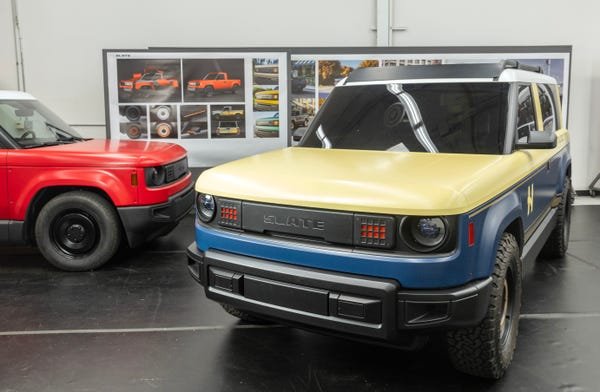
Slate Truck — mid-$20,000s, expected late 2026
Slate’s sales pitch is an ultra-customizable pickup truck with bare-bones features. Pricing is expected to start in the mid-$20,000s. Myung J. Chun / Los Angeles Times via Getty Images
Slate is selling a stripped-down modular car that owners can design for themselves. It’s like if IKEA got into the car business.
The car company is entering the market with a deliberately bare-bones truck: we’re talking two cloth seats, no infotainment system, no speakers, crank windows, and only enough juice in the battery for 150 miles of range.
From there, buyers can add an extra row of seats, an SUV-style bed cover, or brightly colored exterior decals to cover up the slate gray exterior.
Expected to start in the mid-$20,000s, the Jeff Bezos-backed startup is pitching minimalism as an alternative to the expensive, feature-stuffed EV market.
Kia EV3 — $35,000, expected early 2026
Kia’s diminutive electric SUV is finally coming stateside. It blends design cues from its older siblings, the mid-sized EV6 and the three-row EV9. Sjoerd van der Wal/Getty Images
Kia already sells a broad lineup of electric vehicles globally, but only a small handful have reached the US so far. The EV3, expected to arrive in early 2026, has already been on sale in Europe and Asia for nearly two years.
It could be the company’s most important American addition yet.
Roughly the size of a Toyota RAV4, the EV3 blends the sporty proportions of the EV6 with the boxy, upright design language of the three-row EV9.
Pricing will start around $35,000, and the five-seater is expected to cover roughly 300 miles with a full battery.
Rivian R2 — $45,000, expected early 2026
Rivian shrunk its popular three-row luxury SUV and slapped on R2 badging. The 5-seater with a $45,000 price is the company’s biggest bet. PATRICK T. FALLON/AFP via Getty Images
Rivian faces a critical 2026, and the lower-cost R2 is at the center of its bet.
Since 2022, the startup has introduced itself through the high-end R1S — a powerful, three-row SUV with a starting price north of $70,000.
The R2 is meant to pull Rivian into the mass market.
Like Kia’s EV3, R2 promises roughly 300 miles of range and seating for five, putting it squarely in RAV4 territory. But, unlike the Kia, its outdoorsy, gear-forward aesthetic targets a different buyer: more REI than retro-modern.
Whether that identity can drive real sales — despite Rivian’s $10,000 premium compared to other cars on this list — is the question hanging over the R2.
Toyota C-HR — $35,000, expected early 2026
Toyota is rebooting the C-HR in the US market this year. This time, it’s a $35,000 EV. Toyota Motor USA
Toyota’s next EV comes with a familiar name.
From 2018 to 2022, the automaker sold the C-HR as a small, angular gas-powered SUV in the US — before pulling it after weak sales.
Now the nameplate is back, reimagined as an electric vehicle.
Arriving in 2026, the electric C-HR is a five-seat SUV expected to deliver about 290 miles of range.
It will become Toyota’s second EV in the US, following the bZ4X — recently renamed the bZ — which has quietly emerged as a surprise hit in the EV market.
But, like the other cars on this list, the lower price could make the C-HR the mass-market play.
Subaru Uncharted — $35,000, expected early 2026
The Uncharted is Subaru’s lowest-cost EV. It’s a re-skinned Toyota C-HR. Josh Lefkowitz/Getty Images
Look familiar?
Since 2019, Toyota and Subaru have been locked in a joint development contract for all EVs. When Toyota’s bZ4X launched in mid-2022, so did the nearly-identical Subaru Solterra.
The EV equivalent of twinning continues with the Uncharted. It’s essentially the same as the Toyota CH-R, but with Subaru badging.
Pricing, range, and seating are all the identical, too: $35,000, 290 miles, room for five butts.
Subaru Trailseeker — $40,000, expected early 2026
Subaru debuted the Trailseeker, a wagon-like EV SUV, during the New York Auto Show in 2025 Josh Lefkowitz/Getty Images
Subaru’s Trailseeker looks like a throwback.
The company has been building all-wheel-drive wagons for the US market since the mid-1970s. That tradition continues with the Trailseeker in 2026: but now, it’s powered by electricity, not gas.
Priced in the low-$40,000s, it’s slotted above the Uncharted, and still has seating for five.
But the athletic numbers show off the Trailseeker’s improvements.
The Trailseeker’s battery makes 375 horsepower, jolting the car from standing to 60 mph in just over four seconds — that’s nearly a second quicker than the lower-priced Subaru.
Toyota bZ Woodland — $40,000, expected early 2026
Toyota’s bZ Woodland also comes out of the joint venture with Subaru. It’s a re-badged Trailseeker. Josh Lefkowitz/Getty Images
Does this also look familiar?
Like the Uncharted and the C-HR, Toyota’s bZ Woodland comes out of the company’s joint venture with Subaru.
The new EV is nearly identical in size, price, and capability to Subaru’s wagon-like Trailseeker.
The differences are subtle: a Toyota-specific front design, and a badge that lacks Subaru’s long history selling wagons in the US. Whether that matters to buyers remains the car’s main question.
Nissan Leaf — $30,000, already available
The Nissan Leaf was re-imagined as a crossover SUV with a $30,000 starting price and 300 miles of range. Tayfun Coskun/Anadolu via Getty Images
When the Nissan Leaf launched in the US in December 2010, it was a breakthrough as the first modern, mass-market electric vehicle sold nationwide.
But the Leaf aged quickly. In 2020, Tesla introduced the Model Y, a similarly priced electric crossover with far more range. Leaf sales collapsed as the EV market moved on.
Now, Nissan is giving the Leaf a long-overdue reset. For around $30,000, the redesigned 2026 Leaf returns as a fast-charging, five-seat electric SUV with an estimated 300 miles of range — finally aligning the once-pioneering nameplate with today’s EV expectations.
Chevy Bolt — $30,000, expected mid-2026
The Chevy Bolt is returning with the same silhouette and price — but now it gets more electric range. Josh Lefkowitz/Getty Images
Like the Leaf, Chevy is also returning the once-iconic Bolt in 2026.
For years, the Bolt was America’s entry-level EV. Drivers were able to nab the five-seater for as little as $30,000. But, it was discontinued in 2023.
Now, the diminutive, low-priced SUV is expected to relaunch in Chevy showrooms this summer. It looks nearly identical to its outgoing version, but comes with an upgraded battery that can propel the car for 260 miles.
Lucid crossover — high-$40,000s, expected late 2026
Lucid has remained tight-lipped about its lowest-cost SUV. It’s likely hitting US dealerships in the back half of the year. Lucid Motors
Like Rivian, Lucid has also rushed onto the scene with two luxury-priced cars — the high-end Air sedan and lofty Gravity SUV.
This year, it’s expected to release its first mass-market vehicle: likely a five-seater crossover SUV with a base price in the high $40,000s.
Details remain sparse. But Lucid released the image above with the rumored car’s silhouette darkened out. It’s also trademarked the name “Earth” for a potential upcoming vehicle.
Rivian’s CEO and founder, RJ Scaringe, said the US needs a lot more cheap electric vehicles.
Speaking at the Fortune Brainstorm AI conference in San Francisco on Tuesday, Scaringe said a lack of choices was the reason for low EV penetration in the US.
He said that electric vehicle adoption in the US, at 8%, is significantly lower than in the rest of the world.
“I really think the constraint isn’t the demand side, I think it’s the supply side,” Scaringe said. “I think there’s a shocking lack of choice, that there are much better choices in Europe. And by far, there’s the most choice in China.”
He said that for consumers interested in EVs, there were “well under five great choices” at a price point close to the average price of a new car in the US.
He added that, within a price range of $50,000, there was only one compelling choice of EV: a Tesla. In October, Tesla unveiled its most affordable models to date: the $36,990 Model 3 Standard and the $39,990 Model Y Standard.
“And that’s not a reflection of a healthy market with lots of choice,” Scaringe said. “If you think of it as a consumer, you have 300 different internal combustion engine choices at that price or lower, and you have maybe one highly compelling EV choice.”
Rivian is working to provide cheaper EV alternatives. It is gearing up to start production on its cheapest EV to date, the R2 model, a $45,000 SUV.
In the interview, Scaringe also said he agrees with the Trump administration’s push to bring manufacturing back to the US.
“I think the push to industrialize in the United States is appropriate, and it’s something we’re very aligned with the administration on,” he said.
The US EV industry comprises Rivian, Tesla, Ford, General Motors, Hyundai, BMW, and Kia, among others.
Brands like Volkswagen, BMW, Mercedes-Benz, and Tesla dominate the EV market in Europe. Chinese brands like BYD, NIO, and MG also sell on the continent.
Meanwhile, the EV industry in China is seeing fierce competition. BYD, Tesla’s biggest global rival, saw its sales fall 12% in October compared to the same period a year earlier, as it faces a tough fight from local EV startups Xpeng, Nio, and Leapmotor.
Other players, such as smartphone manufacturer-turned EV maker Xiaomi, are also seeing success in the country with strong sales.