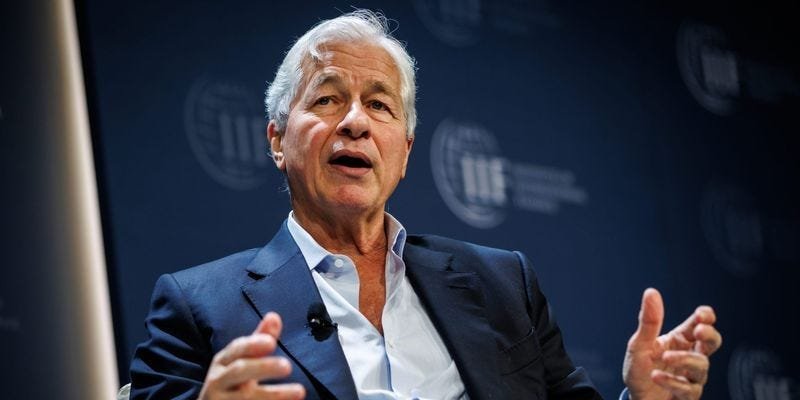
As several Wall Street banks reported first-quarter earnings on Tuesday, executives had to answer for their exposure to the private credit market, which has been under a microscope recently.
CFO Jeremy Barnum estimated the bank’s exposure to private credit funds was $50 billion.
“We’re broadly comfortable with it,” Barnum said on a call with analysts. He explained that the $50 billion is part of approximately $160 billion worth of broader exposure to non-bank financial institutions. The private credit market has been under heightened scrutiny for the quality of its loans and for exposure to companies that could be vulnerable to AI disruption. As a result, some retail-oriented investment funds have had higher redemption requests.
When answering a question on private credit, Barnum said that though nothing JPMorgan does is without risk, “this is a space that we’re quite comfortable with as a function of very close scrutiny on the way that we do the business and ensuring that the underwriting is high quality and that we’ve got a bunch of structural protections in place.”
On the call, Dimon said he doesn’t think the risks to the private credit market are systemic, echoing his comments in his annual letter to shareholders earlier this month.
“You have to have very large losses in private credit before, at least it looks like, banks are going to get hit,” he said on Tuesday’s call with analysts. “It doesn’t mean you won’t feel some stress and strain, and that you might have to do something about it, but I’m not particularly worried about it.”
Dimon said that the bigger risk, as he sees it, is how a credit cycle will filter through the economy. He predicted that losses would be worse than people anticipate when there is an eventual credit cycle.
Wells Fargo and Citi, which both reported first-quarter earnings on Tuesday, also revealed their exposure to private credit firms. Wells Fargo estimated that its exposure was around $36.2 billion, and Citi said its exposure was $22 billion in their respective earnings presentations.
Many banks also offer investment vehicles for customers who want to invest directly in private credit. JPMorgan is planning to launch the JPMorgan Public and Private Credit Fund, an interval fund open to retail investors that allows quarterly redemptions of 7.5%, according to an SEC filing from last month. Many of the largest private credit managers have recently capped their quarterly withdrawals at 5%, despite investors requesting higher withdrawals.
In 2021, the Barclays Center arena — home to the Brooklyn Nets and concerts ranging from Disney on Ice to Bad Bunny — decided to switch from Ticketmaster to another ticketing company, SeatGeek.
The switch didn’t go well.
Ticketmaster retaliated hard, a federal jury in Manhattan heard on Wednesday, as testimony began in a high-stakes government effort to split the ticketing giant from parent company Live Nation.
“Ticketmaster pulled up the drawbridge behind them,” refusing to help with the transition to SeatGeek, testified John Abbamondi, Barclay’s then CEO.
And soon, Live Nation retaliated as well, Abbamondi testified, supporting the federal antitrust allegation that any venue that refused to use Ticketmaster would be threatened or punished.
Every time Laura publishes a story, you’ll get an alert straight to your inbox!
Stay connected to Laura and get more of their work as it publishes.
After booting Ticketmaster in October 2021, the 18,000-seat arena saw a dramatic drop in Live Nation-promoted concerts, Abbamondi told the jury — from more than 20 a year to fewer than eight.
Abbamondi cited a Billie Eilish concert as one example of what he called “smoking gun” evidence: that Barclays was punished for quitting Ticketmaster.
Word got back to Abbamondi, he testified, that Live Nation pulled a planned Barclays concert featuring the Grammy-winning artist. A concert date for Eilish, who was promoted by Live Nation, was switched from Barclays to the USB Arena near JFK Airport in Queens, Abbamondi said.
“It was Live Nation’s decision,” Abbamondi said an Eilish manager told one of his executives of the Barclays snub.
John Abbamondi in 2019.
Dave Reginek/NHLI via Getty Images
Live Nation’s retaliation campaign did not come without warning, Abbamondi told jurors.
The ex-Barclays CEO said that six months before the switch to SeatGeek, he received a cautionary text from his friend, Patti Kim, a Live Nation vice president.
In the text, Kim warned that he “should think about the bigger relationship with Live Nation” before going with SeatGeek, according to a copy of the exchange shared with jurors.
Kim’s email was signed with “a winky face emoji,” Abbamondi noted.
“I took this as a friendly warning to me that I was about to make a big mistake,” he told jurors.
When Abbamondi called two Live Nation executives weeks later to break the news that Barclays still planned to switch ticketers, the profanities flew, he said.
Joe Berchtold, Live Nation’s Chief Financial Officer, “dropped an F-bomb on me,” Abbamondi said, when a government lawyer asked how he knew the CFO was angry.
“He told me it was going to be difficult to put concerts in Barclays Center,” Abbamondi told jurors.
Asked to elaborate on his retaliation concerns, Abbamondi said “I would describe it as a widely-shared concern in the industry.”
The answer was stricken from the record as unsupported hearsay, as was Abbamoni’s reference to a Eilish manager saying Live Nation had pulled her concert from Barclays.
Abbamondi’s testimony also supported the government’s contention that Ticketmaster’s technology is “held together by duct tape,” as a government attorney had told the ten-woman, two-man jury on Tuesday.
In his opening statements, Assistant US Attorney David Dahlquist pointed to Ticketmaster’s Taylor Swift Eras Tour crash in 2022 as evidence that a lack of competition let Live Nation get away with foisting an inferior product on fans, artists, and concert venues.
In his own opening remarks, Live Nation attorney David R. Marriott called Ticketmaster “the highest quality product that there is on this planet in terms of delivering quality ticketing services.”
But in his testimony Wednesday, Abbamondi told jurors that the decision to switch was clinched by SeatGeek’s superior technology. At one point, Abbamondi likened SeatGeek’s tech to “the Mac OS,” while Ticketmaster was more like “Windows 95.”
Abbamondi joked from the witness stand that the blinking green cursor he would see when running the Ticketmaster venue interface was “like something out of the 1980s.”
The Department of Justice has joined with a consortium of attorneys general from 39 states and the District of Columbia in pressing for the Ticketmaster-Live Nation split.
The feds say Live Nation holds a monopoly in the live music industry, which it uses to compete unfairly with its much-smaller competitors— and that Barclays’ experience is a case in point.
“They lost concerts, they lost profits, they lost revenue as a result of the move” to SeatGeek, Dahlquist told jurors in opening statements.
“And of course, because the Barclays Center wants to succeed, to be successful, they’re forced to go back,” to Ticketmaster, he said. “So today, they are a Ticketmaster entity.”
Marriott countered in his own opening statement that Barclays’ return to Ticketmaster, two years after the switch to SeatGeek, was based not on retaliation, but on Live Nation’s superior product.
“They came back to Ticketmaster not because of any threats, but because SeatGeek fell down on the job,” Marriott said.
Lawyers for Live Nation say that yes, they compete aggressively — but they do so fairly. Artists remain free to choose promoters, and arenas and venues remain free to choose who does their ticketing, they argued.
The civil antitrust trial, the culmination of a May 2024 federal and state lawsuit, is expected to last six weeks.