
At-a-BI-roundtable-event-HR-execs-shared-a-growing.jpeg

At a BI roundtable event, HR execs shared a growing concern around AI costs rising without clear ROI

As companies find more tasks AI can tackle, it’s costing some employees their jobs. This increased use of AI is also costing something else: money.

“Tokens, seats, we have all these enterprise tools we haven’t basically budgeted for, and it’s expensive,” said Katya Laviolette, Chief People Officer at 1Password.

Business Insider invited Laviolette, along with 13 other executives, to participate in a roundtable discussion titled “Futureproofing Your Workforce in the Age of Ai,” presented by Indeed.

Others at the table agreed that as more employees experiment with AI tools, the costs of using those tools is skyrocketing. That presents a challenge for companies. Experimentation is needed to unlock new paths to productivity. But at some point leaders must prove the new workflows are paying off financially.

“At one point, the investors are going to say, “Are you gonna produce some profit?” Laviolette pointed out. “Because it’s one thing to grow your top line, but your OPEX is really, really important.”

The solution to this problem does not automatically lead to layoffs, according to BMO Financial Group’s CHRO, Technology & Operations, Jay Ferguson.

“You can take cost out, or you can give augmentation and multipliers to every person you have,” Ferguson said. “So hypothetically, if we looked around this table and we said, ‘Okay, well, I can take 30% out of my business,’ you could do that. Short-term thinking in my view, because I still think that if I can increase everyone’s productivity by 30%, we win on both the revenue side and the cost side.”

Here are other insights executives raised during the almost two-hour conversation.

While it makes sense to have all employees use AI, senior leaders must identify the tools’ true ROI


Man in glasses holding a microphone and seated at a long table speaks to a group.

“We found you need the senior levels of the organization to find the right problem for AI to solve,” said Kyle Trahair, Managing Director & Partner, BCG. 

Lenny Poplianski


Kyle Trahair, Managing Director & Partner, BCG: What we’ve seen is there is a lot of benefit in AI-upskilling at the lower ranks of an organization. You tend to get improvements in employee experience. You get less toil, more joy because some of the more monotonous aspects of the job go away.

But what we typically hear at the CFO level is, ‘Yes, I’m hearing all those hours saved. I’m not seeing any change in the results.’

We found you need the senior levels of the organization to find the right problem for AI to solve that is sufficiently ambitious, that it’ll make a meaningful P&L impact. But they can’t do that without the AI literacy needed to understand what the art of the possible is.

It’s not just entry-level jobs that may be threatened by AI


Woman in glasses holding microphone and sitting at a long table speaks to a group.

“It isn’t just re-engineering the way we’ve always done things, it’s totally reinventing the way we do things,” said Angella Alexander, Chief Human Resources Officer, ATS Corporation. 

Lenny Poplianski


Angella Alexander, Chief Human Resources Officer, ATS Corporation: At some point the level of experience that our middle management has will quickly become irrelevant experience. The way they’re accustomed to doing things and the way they’re accustomed to thinking about things will not flex sufficiently. And so we’re thinking that it’s probably that middle layer that’s going to start to vanish because you’re going to need these new talents coming in who have this ability to do all these amazing things and move quickly, but it requires you to think about process totally differently.

So it isn’t just re-engineering the way we’ve always done things, it’s totally reinventing the way we do things.

Many employees need a push to start using AI


Woman in white blazer holding a microphone and sitting at a table speaks to a group.

“Our CTO said, ‘I’m going to clear everybody’s calendar one afternoon and everyone’s gonna do a Claude installation party,'” said Olivia Chiu, Head of Talent Management, Wealthsimple, 

Lenny Poplianski


Olivia Chiu, Head of Talent Management, Wealthsimple: Our CTO said, ‘I’m going to clear everybody’s calendar one afternoon and everyone’s gonna do a Claude installation party.’

And so they did that and the objective was, ‘We’re going to teach you how to use Claude and your job is to actually solve a real client problem that you have seen in your day-to-day.’

And so that in itself — when everybody’s doing it at the same time, that connectivity and what they saw they were able to do in an afternoon that would’ve (taken) them a week — is change management.

Tiny teams are a growing trend


Dark-haired woman holding a microphone and sitting at a long table speaks to a group.

“(People) are building companies with much less workforce,” said Sanjana Basu, Partner, Radical Ventures. 

Lenny Poplianski


Sanjana Basu, Partner, Radical Ventures: Today, we don’t have bloated 30-people teams that are pitching to us for funding. We have one person, we have 16 year-olds, 20 year-olds, 23 year-olds pitching to us all day, every day. And they are building companies with much less workforce.

I think that’s another massive change we’re going to see in the ecosystem, which is you will see people with much more high-agency autonomy who will either build their own companies, leveraging all of these AI tools in a much leaner fashion, and those same people will probably be hired into the larger companies because they can really move the needle.


Source link

Meet-Molly-OShea-the-VC-turned-podcaster-who-gets-execs-like-Alex.jpeg

Meet Molly O’Shea, the VC-turned-podcaster who gets execs like Alex Karp and Palmer Luckey talking

Molly O’Shea is a name-dropper. There’s good reason for that.

I count 29 big names in tech mentioned over our hourlong call. She told me about recently moderating a panel with Kalshi cofounders Tarek Mansour and Luana Lopes Lara. Ken Griffin took the stage after her. O’Shea breezily referenced talking about the state of new media with the TBPN bros in Peter Thiel’s house.

But it’s O’Shea’s access to executives like these that keeps her audience coming back. The podcaster is deeply immersed in Silicon Valley culture, having several years of venture capital experience under her belt.

“I am institutionally trained not to get canceled,” she said. “A lot of these people really trust me. I think it’s a wonderful component that I come in from the industry.”

Her podcast’s name, Sourcery, references “sourcing deals,” but it better represents O’Shea’s talent herself. She’s clearly sourced up, sporting an ever-growing rolodex of tech’s biggest names.

After buzzy interviews with Palantir CEO Alex Karp and Anduril cofounder Palmer Luckey, O’Shea’s platform has quickly grown. So have her critics, some of whom say she should ask tougher questions.

But her core audience — investors in the world of tech and finance — seem to love that she’s in the know.

From in-house VC newsletter to ‘monk mode’

O’Shea considers herself the first of her family to chase a “capitalistic pursuit.”

“It’s funny, there’s not many business-oriented people in my family,” she said. “My dad had a marketing agency for most of my life, but again, it was a marketing agency. My mom is a home designer and she used to be a creative director.”

She went to New York University for studio art but pivoted to entrepreneurship after learning how low the average artist’s salary was. Eventually, she narrowed in on venture capital.

O’Shea got her start working for the father of a college friend, a secondaries investor for a family office. She moved to Miami to work for him before coming back to New York as an analyst at the Global Public Offering Fund.

She then went to the seed and Series A investment firm TMV — then called Trail Mix Ventures — as an associate. She started Sourcery there as an in-house newsletter, but only made it public when she started at New York Life Ventures as a senior associate. She shared it with friends, and it eventually grew a readership.

Then Upfront Ventures’ Greg Bettinelli reached out with a job offer.

“I was a reader of her email newsletter,” Bettinelli later wrote when asked about the offer. “We were looking to hire a new investor for Upfront Ventures and I reached out as I appreciated what she built as what I think was a side project at the time.”

O’Shea said she was on a boat in the Mediterranean when she got Bettinelli’s offer. She met him in the Hamptons. “It’s like the bougiest story ever,” she said.

O’Shea moved to Los Angeles for Upfront Ventures. She’s stayed in the city and prefers it to New York. “You get so much more for your money,” she said. “I have a hot tub!”


Sourcery host Molly O'Shea is pictured.

Before O’Shea was a full-time podcaster, she worked for TMV, New York Life Ventures, and Upfront Ventures.

Molly O’Shea


Then Elon Musk took over X, partially open-sourced the algorithm, and launched ad-revenue share programs. O’Shea said, “Game on.”

She started posting more, and her follower count grew. Erik Torenberg of the podcast network Turpentine asked if she wanted to start a podcast about deals, linked to her newsletter.

While O’Shea declined to disclose exactly how much she earns, she said the Sourcery newsletter began generating revenue when it added subscriptions. That includes a $600 “I can expense it” annual tier she said “plenty of people” were willing to pay for.

Sourcery is now her full-time job and a top-200 podcast in Apple Podcasts’ investing category. She employs a “lean team” to help her film, edit, and promote.

The Palantir and Anduril interviews helped generate more interview interest. (Her next guest: Jake Paul.)

After an “insane” end to 2025, O’Shea said she spent January locked-in and focused on laying the foundation for the rest of the new year.

“I’m going into monk mode.”

Getting Karp and Luckey to say yes

O’Shea’s network is big, and her show keeps making it bigger.

Andreessen Horowitz’s Alex Immerman told her he watched her Kalshi video before investing in the company, she said. “I know plenty of people — I won’t name them — that have put millions of dollars into these companies that I’ve profiled,” she said.

That seems to be how O’Shea lands many of her guests: knowing the right people. I spoke to two early interviewees. Oden Technologies cofounder Willem Sundblad was introduced to O’Shea through an investor. Contrary general partner Kyle Harrison met her in 2018 and once considered hiring her while at Coatue Management.

“A lot of these relationships start first as friendships,” Harrison said. “We’ve enjoyed talking to each other off the record, so talking on the record is just as much fun.”

The Karp interview was a right-place, right-time situation. She was at the Hill and Valley Forum in 2025, where Karp was speaking. O’Shea said Palantir’s Eliano Younes recognized her from Pirate Wires and introduced her to Shyam Sankar, the company’s CTO.

Then she published a list of her 100 dream guests. Listed No. 1 was Ivanka Trump. Palantir staff noticed Karp wasn’t on the list, O’Shea said, and she amended it, making him 1B. That set the interview in motion.


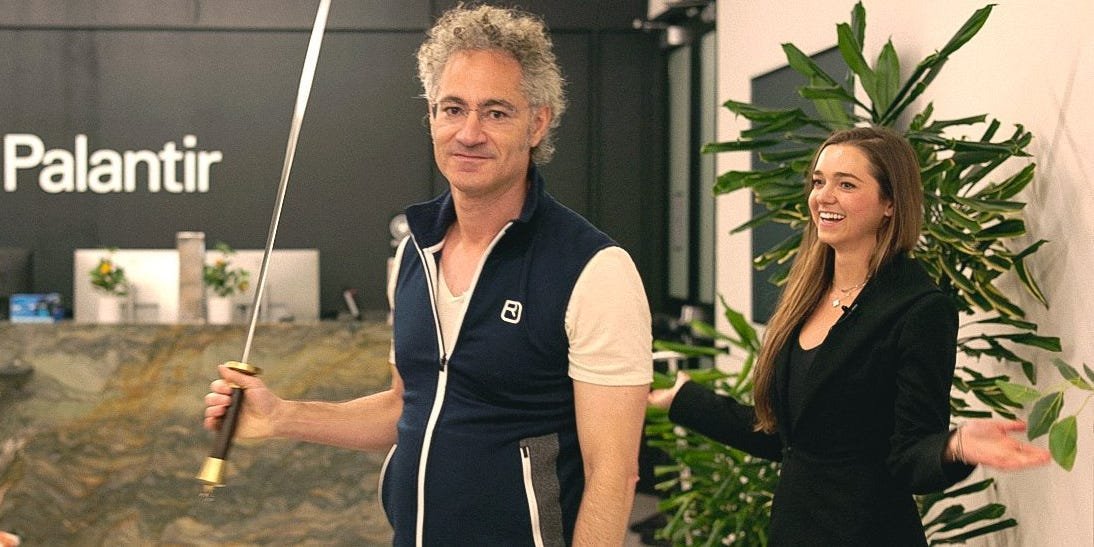
Molly O'Shea is pictured with Palantir CEO Alex Karp

A clip of Karp brandishing a sword thrust O’Shea’s podcast into the limelight — and got the trolls commenting.

Molly O’Shea


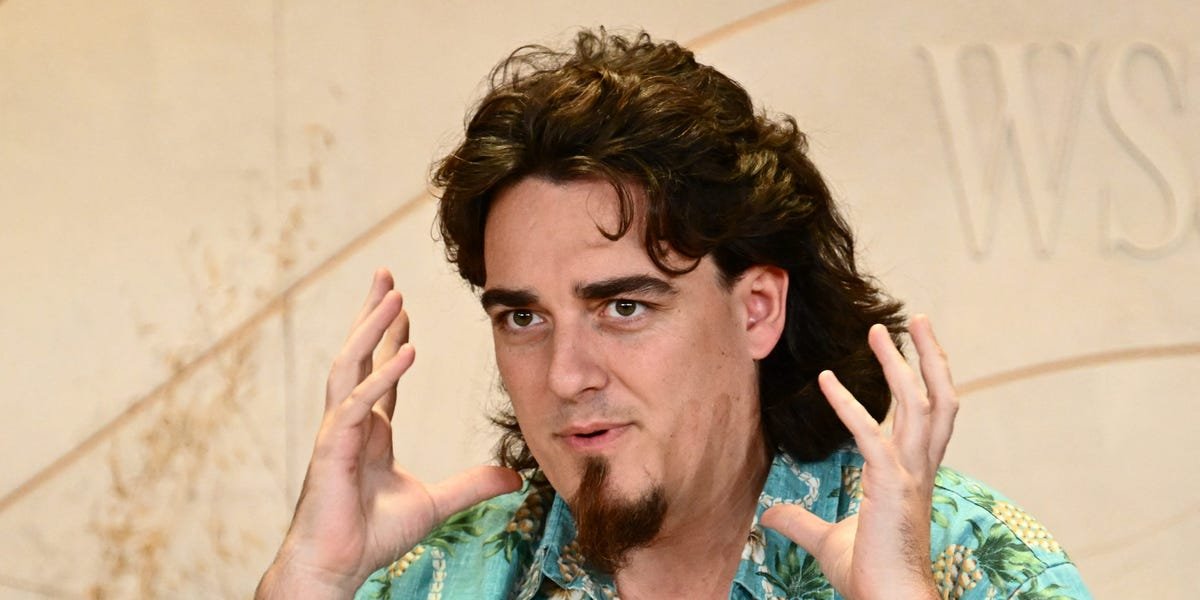
Her Anduril series also sprang from the Sourcery 100 list. She put Anduril cofounders Palmer Luckey and Trae Stephens on the list. Matt Grimm commented and helped her set up an interview.

The Karp interview was her biggest by far. The full-length podcast has 4.3 million views on X — and that’s not including the various clips she publishes separately.

It also made her confront the challenges of being on camera.

She published the video on a Tuesday in the back of a taxi in London. She went offline on Wednesday and woke up to hundreds of texts on Thursday asking if she was OK.

In the interview, O’Shea wore an Alaïa dress her friend had lent her. She said she liked being able to “show some femininity and personal style.” Some X users mocked her attire. (Others pointed out that Karp was wearing a t-shirt.)

O’Shea said she was glad to be offline at the time and not glued to her phone watching the comments, and grateful for the women who reached out.

“There were a lot of really horrible tweets, and a lot of really disgusting things that I wish I did not see,” she said. “The internet is a scary place.”

The ‘tough questions’ question

In November, The Guardian published a feature about the “friendly media bubble” that turns CEO interview subjects into stars. O’Shea was the lead anecdote. The piece closed with her asking Karp what type of cupcake he would want to be.

O’Shea knows that some people want her to ask “harder questions.” Her response: “If you want to have criticism of a company, how about do some research on it.”


Molly O'Shea

What does O’Shea say to those who think she went too easy on Karp? “How about read the biography,” she said. “That’s a good starting point.”

Sourcery/Molly O’Shea


That doesn’t mean she won’t ask the kind of in-the-weeds technical question about deal structure or strategy that you’d expect from someone with VC roots. The conversations can also veer off of investment talk.

Take a recent interview with the lightning rod venture capitalist Shaun Maguire of Sequoia — who generated widespread backlash after saying Zohran Mamdani was a secret “Islamist” who “comes from a culture of lying.” At one point, she’s asking him about the economics of telecommunications. At another, Maguire is calling Mamdani a communist and a terrorist-supporter.

O’Shea maintains that hard questions aren’t the purpose of her podcast. She’ll sprinkle one in every so often, she said, but the goal is mostly to be a resource. Sourcery is a place for investors to get information about a subject’s views — don’t expect O’Shea to dig in on a guest’s recent scandal or push back on a controversial position.

“If you want to know about lawsuits, I don’t know, go read lawsuits,” she said.

O’Shea is clearly proud of her work. She described a recent nap, dozing off to the “All-In” podcast. She woke up to a new podcast on, and thought: “Holy crap, what is this amazing interview?” It was her own.

Ending our call, I asked if she had a media analogy for herself. TBPN is often called the “SportsCenter of Silicon Valley.” What is Sourcery?

She waffled back and forth; maybe she’s “30 for 30,” maybe she’s Martha Stewart.

Later that day, she emailed me her answer: Barbara Walters, who, incidentally, was famous for her hard-hitting questions.

“Absolute legend,” O’Shea wrote.


Source link

Ashley Stewart Business Insider

Salesforce is replacing 5 high-profile leaders who have left since December with 6 new execs

  • Salesforce has appointed new leaders in an executive shake-up.
  • Six new hires and promoted executives will lead businesses like Agentforce and Slack.
  • The executives replace five high-profile leaders who have announced departures since December.

Salesforce has hired or promoted six new leaders, replacing five high-profile leaders who have announced departures from the company since December, according to a person familiar with the changes.

  • Iain Mulholland is the company’s new chief security officer, joining from Google. Mulholland most recently worked as the deputy chief information security officer for Google Cloud and Technical Infrastructure. He replaces Brad Arkin, who left Salesforce at the end of January after serving for just over two years.
  • Patrick Stokes, a longtime Salesforce executive, is the company’s new chief marketing officer. Stokes replaces Ariel Kelman, who left on Monday to join chipmaker AMD.
  • Dave Ward is Salesforce’s new chief architect. He joined from Lumen Technologies, where he was chief technology officer.
  • Joe Inzerillo, the company’s chief digital officer, is now president of enterprise and AI technology, overseeing both Slack and Agentforce. Agentforce has become one of Salesforce’s most important new AI services. CEO Marc Benioff has even suggested he might rename the company after Agentforce.
  • Salesforce promoted executives Rob Seaman, now executive vice president and general manager for Slack, and Madhav Thattai, executive vice president and general manager for Agentforce.

“Salesforce has always been a talent engine,” a Salesforce spokesperson said in a statement. “Our deep bench and proactive succession planning ensure that our strategy is institutionalized, not individualized. We’re confident in the leaders stepping into these roles and are excited for what’s ahead in FY27.”

Salesforce’s new fiscal year started on February 1. Some of the changes are yet to be announced widely internally.

Besides Arkin and Kelman, other high-profile executives have left Salesforce recently. The previous head of Agentforce, Adam Evans, announced his departure on Sunday.

“I’ve decided it’s time to start my next chapter outside Salesforce – returning to what I love most: building startups,” Evans wrote in a LinkedIn post. Evans spoke to Business Insider late last year for a story on Agentforce’s challenges.

Ryan Aytay, CEO of Salesforce’s Tableau business, announced his departure last week, and Slack CEO Denise Dresser departed in December to become OpenAI’s chief revenue officer.

Salesforce stock has been taking a beating among other software companies as investors fear competition from AI companies.

Have a tip? Contact this reporter via email at astewart@businessinsider.com or Signal at +1-425-344-8242. Use a personal email address and a nonwork device; here’s our guide to sharing information securely.


Source link

Ashley Stewart Business Insider

Amazon execs say layoffs are part of turning the company into the ‘world’s largest startup’

Internal memos from Amazon executives explained the company’s decision to lay off 16,000 corporate workers as necessary to become the “world’s largest startup,” according to the messages viewed by Business Insider.

“Our ambition is to be the world’s largest startup,” Amazon executives wrote in two such memos viewed by Business Insider. “That means doubling down on a culture of ownership, speed, and experimentation — which requires us to continue evolving how we’re structured.”

The “world’s largest startup” has become a common refrain under Amazon CEO Andy Jassy, who repeatedly referenced the company’s ability to operate like a startup in his latest shareholder letter.

The memos viewed by Business Insider, written by Amazon Web Services vice president Prasad Kalyanaraman and senior vice president Colleen Aubrey, include other similarities, providing insight into how Amazon likely directed its top executives to communicate about the layoffs:

  • Notifications within the teams in the US and Canada have been completed.
  • Identical language stating, “Please take care of yourselves and each other,” and that “the Employee Assistance Program (EAP) is available 24/7 for free and confidential support.”
  • Acknowledging that changes are difficult and ending with a forward-looking statement about what remaining teams can accomplish.

Greg Pearson, another AWS VP, also addressed layoffs in a memo and urged staff to “use technology to simplify work,” Business Insider previously reported. Amazon also shared more information for laid-off employees in an FAQ and emails from Amazon HR chief Beth Galetti.

Internal Slack messages viewed by Business Insider suggest affected teams include those within the company’s AWS cloud unit, such as the AI cloud service Bedrock, the cloud data warehouse service Redshift, and the ProServe consulting team, as well as retail business teams such as the Prime subscription service and the last-mile Delivery Experience team.

Amazon did not immediately respond to a request for comment from Business Insider.

Read the memos below:

Prasad Kalyanaraman, VP of AWS Infrastructure:

Team,
I want to provide an update on the organizational changes that Beth Galetti shared in her A to Z post earlier today. As Beth noted, these decisions are part of our ongoing effort to position the organization for the future while staying nimble and focused on delivering for our customers. Our ambition is to be the world’s largest startup. That means doubling down on a culture of ownership, speed, and experimentation—which requires us to continue evolving our structure.
The notifications to impacted colleagues in our organization who are based in the U.S. and Canada, have now been completed. In other regions, we are following local processes, which may include time for consultation with employee representatives and possibly result in longer timelines to communicate with impacted employees.
First and foremost, I want to thank the impacted colleagues who have worked tirelessly for our customers. I want to acknowledge that changes like this can be hard on our entire team. These decisions are difficult and are made thoughtfully as we position our organization for future success. Changes like these are difficult, especially when they affect colleagues we value. These decisions don’t diminish what we’ve built together; rather, they’re about positioning us to sustain and extend that impact as we continue to build the foundation for the future.
I also want to recognize what our team has accomplished this past year as we’ve made tremendous progress on scaling to meet unprecedented customer demand. These results reflect the talent, dedication, and collaboration across the breadth of our very diverse organization that must work together seamlessly — and those are qualities that will remain our foundation as we move forward.
Please take care of yourselves and each other. Remember that the Employee Assistance Program (EAP) is available 24/7 for free and confidential support.
Thank you for your resilience and continued focus on delivering for our customers. I’m confident in our team’s ability to navigate this transition and emerge stronger.
I’m looking forward to what we’ll accomplish together in the months ahead.
Prasad

Colleen Aubrey, SVP of Applied AI Solutions:

Hi,
I wanted to follow up on Beth Galetti’s post about organizational changes to A to Z earlier today. As Beth noted, this is a continuation of the work we’ve been doing for more than a year to strengthen the company by reducing layers, increasing ownership, and removing bureaucracy, so that we can move faster for customers. Our ambition is to be the world’s largest startup. That means doubling down on a culture of ownership, speed, and experimentation—which requires us to continue evolving how we’re structured.
Our organization plays a critical role in putting AI to work for our customers, transforming how companies deliver value to their customers, and these changes will help us sharpen our focus. I’ve seen how this team innovates and collaborates to solve real-world business challenges through applied Al. These strengths will be essential as we move forward with focus and clarity.
The notifications to impacted colleagues in our organization who are based in the U.S., Canada, and Costa Rica have now been completed. In other regions, we are following local processes, which may include time for consultation with employee representative bodies and possibly result in longer timelines to communicate with impacted employees. Changes like this are hard on everyone. These decisions are difficult and are made thoughtfully as we position our organization and AWS for future success. Please take care of yourselves and each other. The Employee Assistance Program (EAP) is available 24/7 for free and confidential support.
Thank you for your continued focus on delivering for our customers. I’m confident in our team’s ability to navigate this transition and emerge stronger, and I am positive that we’ll accomplish great things together in the months ahead.
Colleen

Have a tip? Contact Ashley Stewart via email at astewart@businessinsider.com or Signal at +1-425-344-8242. Use a personal email address and a nonwork device; here’s our guide to sharing information securely.


Source link

China-is-going-after-US-defense-firms-and-execs-over.jpeg

China is going after US defense firms and execs over weapons sales to Taiwan — and Palmer Luckey’s on the list

China announced sanctions against 20 US defense companies and 10 senior executives on Friday, citing US arms sales to Taiwan as its motive.

In a statement, China’s foreign ministry said its assets within China, including movable and immovable properties, would be frozen and that domestic organizations and individuals would be prohibited from doing business with them.

Individuals named on the list would also be denied visas and entry to the country, the ministry added.

The sanctions list includes Northrop Grumman Systems Corporation, Boeing’s St. Louis branch, Epirus, and Anduril Industries founder Palmer Luckey.

In a statement, a spokesperson for the foreign ministry said: “We stress once again that the Taiwan question is at the very core of China’s core interests and the first red line that must not be crossed in China.”

“Any company or individual who engages in arms sales to Taiwan will pay the price for the wrongdoing,” they added.

When reached for comment, Anduril pointed Business Insider to an X post from Luckey in which the CEO joked that he was honored.

“I want to thank my family, my team, and my Lord Jesus Christ for this award,” Luckey wrote on X. “Anduril has been sanctioned for a while now, as have many of my peers, but it means so much to finally have my non-existent Chinese assets seized and repurposed.”

China’s sanctions follow the US announcement of a $11 billion military package for Taiwan last week.

The deal, which includes self-propelled Howitzers and HIMARS rocket launchers, still needs to be approved by Congress — but it drew a swift response from Beijing.

Lin Jian, a spokesperson for the foreign ministry, said in a statement at the time that China “strongly deplores and firmly opposes” the sales.

China regards Taiwan as a breakaway province that will one day come under Beijing’s control, and Chinese President Xi Jinping has refused to rule out an invasion of the island. Taiwan’s ruling Democratic Progressive Party views Taiwan as separate from China.

Under the Taiwan Relations Act, the US is obligated to assist Taiwan in defending itself.

Beijing has ramped up pressure around the island in recent years, holding frequent military exercises in the surrounding skies and waters.

A 2024 report by the Washington, D.C.-based think tank the Center for Strategic and International Studies suggested that China may be able to exert power over Taiwan without launching an invasion.

The report said China could impose a quarantine of the island using its coast guard.

“The purpose of a quarantine is not to completely seal Taiwan off from the world but to assert China’s control over Taiwan by setting the terms for traffic in and out of the island,” it argued.

“A key goal is to compel countries and companies to comply with China’s terms.”


Source link

photo-of-Ana-Altchek

Executive ghostwriter gives LinkedIn makeovers to execs. Here are 4 ways to brag more effectively on your profile.

This as-told-to essay is based on a conversation with Jillian Richardson, a 31-year-old ghostwriter for executives. She’s based in Brooklyn. The following has been edited for length and clarity.

I’m a ghostwriter focused on helping executives and founders grow their presence on LinkedIn.

I offer LinkedIn profile polishes for executives, as well as people looking for a new job or trying out self-employment. After helping a number of people edit their profiles, one of my takeaways is that people need to brag more. They are not hyping themselves up nearly enough.

LinkedIn is the place where it’s socially acceptable to brag. The point is to discuss your career and where you’re going next in life. LinkedIn is also a sea of people, and if you don’t share what makes you unique, you won’t stand out. People also assume you just need to share something about yourself once, and that’s it, but things get lost on social media, so you can share the same thing a few times.

I recently talked to a colleague, and we both have the same experience with ghostwriting clients. When they start posting more on LinkedIn, they’ll receive a text from a friend calling them a try-hard or poking fun at them.

The idea that social media is not entirely real and only shows everyone’s best side is what’s called “discernment.” You’re not going to be sharing every horrible moment of your life on social media. If you did, you probably wouldn’t be in a super stable place. There are only parts of yourself that you want to share on the internet, and that’s up to you. I wouldn’t say that’s inauthentic. That’s just having boundaries.

There are a lot of places in the profile where the bragging — or lack of it — can show up. These are my suggestions to showcase your accomplishments more effectively:

The ‘Headline’

The headline is one of the places people share accomplishments. I always recommend that when people write their headline, they think about using the language they would if they were speaking to an individual customer.

You want to use the headline to let the reader know how you can support them. Just write it as a single sentence. Don’t use those divider lines that chop up everything because that’s when people get carried away, and then they have 10 different accomplishments that don’t connect to the person reading it.

The ‘About’ section

I can’t tell you the number of founders I’ve talked to who literally don’t have anything in their ‘About’ section. If I looked at their LinkedIn, I would assume their company doesn’t even exist.

In the ‘About’ section, you should share statistics of how you help your customers. This is the place to really brag about how you help people succeed; why people should trust you; and what makes you different from other people in your industry. You should also use client case studies and share testimonials.

The ‘Featured’ section

I always recommend that people pin a newsletter, a landing page, or a website that brings people outside LinkedIn, where you can collect their email so you can be in contact with them in another place, and continue to have them get familiar with you.

For example, you could feature a social media moment that you had. Recently, I was featured in Forbes, so I have that there to look like I’m a trustworthy human being. Or, I can pin a LinkedIn post that performed really well to demonstrate my industry expertise.

The ‘Recommendations’ section

The Recommendations section is located toward the bottom of the profile, and many people don’t pay attention to it. However, people really look at this section when considering hiring someone. Many people already have testimonials on their website, so I usually suggest asking for recommendations from those people by saying something like, “Hey, you said this exact thing to me. Would you be willing to copy and paste this on LinkedIn?”

Or, if somebody just said something nice to you on a call that they maybe didn’t write down, just email them being like, “Hey, I’m looking for recommendations on my LinkedIn. I remember you so generously said this thing. Would you be willing to copy and paste this as a LinkedIn recommendation?”

Most people will say yes, including a former boss or colleague. As long as you have a good relationship with them, why not reach out and ask? Everybody wants to see their team members succeed, hopefully.


Source link