

Bankrupt-luxury-retailer-Saks-wants-to-shed-a-6-million.jpeg

Bankrupt luxury retailer Saks wants to shed a $6 million executive perk to cut costs

Bankrupt luxury retailer Saks Global is looking to shed a high-end executive perk — its sole corporate jet.

In a recent court filing, Saks Global, the owner of department stores Saks Fifth Avenue, Neiman Marcus, and Bergdorf Goodman, detailed its plan to sell its 2003 Gulfstream G400 jet for $6 million to a private buyer.

The jet, which can carry up to 16 passengers and is powered by two Rolls-Royce engines, was primarily used by Saks executives for business travel and to “meet operational needs,” attorneys for the retailer said in the Sunday filing.

When the jet was not in use for business purposes, Saks “allowed certain current and former executives and directors” of the company to use the aircraft for personal travel under time-sharing agreements, the court papers said.

The proposed sale, which requires approval from the federal Texas bankruptcy court where Saks filed for Chapter 11, would “enhance” Saks’ liquidity “by eliminating unnecessary costs and expenses,” the retailer’s attorneys wrote in the filing.

Saks hired aviation broker Guardian Jet to market the aircraft after the luxury giant filed for Chapter 11 bankruptcy protection in January, the court filing said.

The broker and Saks negotiated with prospective buyers and ultimately secured the “best and highest sale price” from the buyer, identified in the court documents as Jones Aviations LLC.

Under the terms of the agreement, the buyer would put down a $250,000 refundable deposit. The deal also includes a $210,000 broker fee for Guardian Jet.

A Saks spokesperson told Business Insider in a statement on Tuesday that the retailer’s “leadership has made the decision to sell the company’s legacy plane as it continues prioritizing the disciplined use of capital.”

“This action represents another deliberate step to direct investments toward the areas of the business that will drive meaningful growth for a stronger Saks Global,” the spokesperson said.

Saks filed for Chapter 11 on January 13 after missing payments to vendors and building a precarious debt load. At the time, Saks owed hundreds of millions of dollars to creditors, including Chanel and LVMH.

The cost cutting started almost immediately. In February, Saks said it would shutter nearly all of its discount Saks Off Fifth and Neiman Marcus Last Call locations, as well as several Saks Fifth Avenue locations. The next month, the company announced more closures.

Following the move, 15 Saks Fifth Avenue locations and 33 Neiman Marcus locations remain.

The retailer expects to emerge from bankruptcy during the summer.

While Saks said in the Sunday court filing that selling off the Gulfstream jet would “maximize value for the benefit of all creditors,” won’t cover much. Roughly two weeks of Saks’ legal bills in January totaled $7.2 million, court papers showed.



Source link

A-top-Salesforce-executive-says-Benioffs-ICE-jokes-were-not.jpeg

A top Salesforce executive says Benioff’s ICE jokes were ‘not OK’

Salesforce cofounder Parker Harris addressed the controversy over CEO Marc Benioff’s ICE jokes in an internal meeting, saying he was “not OK with it,” Business Insider has learned.

“Marc made a very bad joke,” Harris, who is the company’s chief technical officer, said. “But that’s something that Marc did, and I’m not gonna call him out in public out on the internet.”

A transcript of Harris’ remarks at a meeting of the product and tech team last week was posted by an employee to a Slack channel. Business Insider verified that the transcript was accurate.

Salesforce did not respond to a request for comment. Benioff has not spoken about the jokes or the company’s reaction to them.


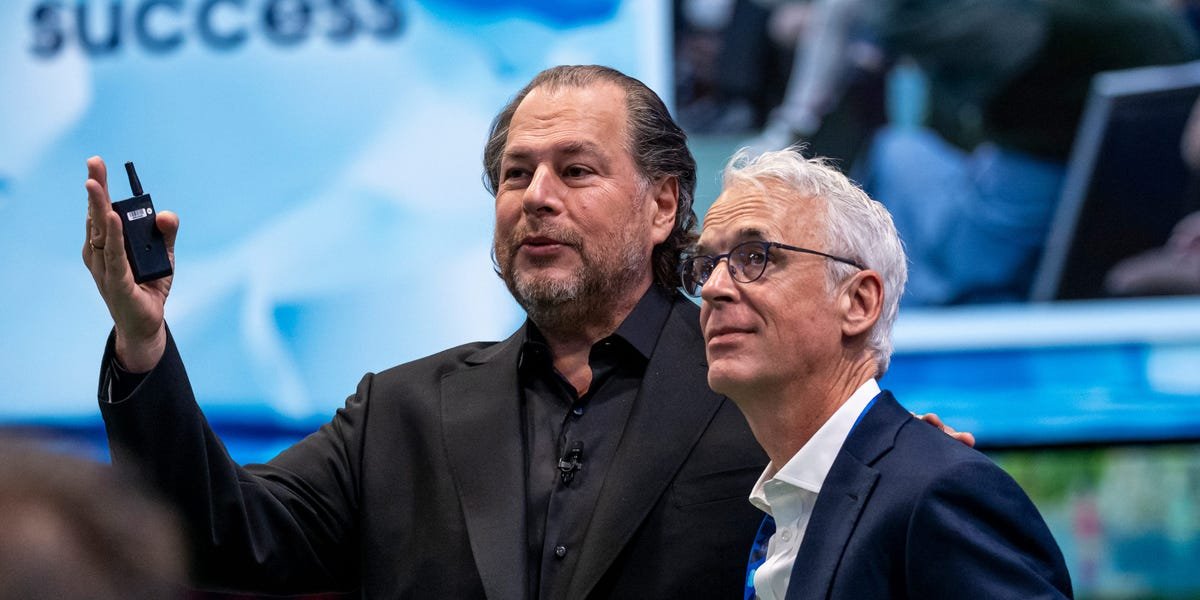
Marc Benioff wearing a blue suit and white shirt

Marc Benioff has not addressed the internal uproar over his ICE jokes.

Santiago Mejia/San Francisco Chronicle via Getty Images


In his meeting, Harris began by addressing a question about why many company leaders had not addressed Benioff’s comments at Salesforce’s employee-only company kickoff in Las Vegas last Tuesday.

“So I’ll start by saying that somebody already has, and it was immediately leaked,” Harris said, referring to a Business Insider story about another executive who criticized Benioff’s jokes.

“Let’s talk about it with each other and not out to Business Insider and other places because it doesn’t do us any good,” he said, adding, “It’s a violation of the Code of Conduct, and it’s a fireable offense. And if we do catch you, we will fire you.”

At the kickoff, Benioff made “multiple” jokes about ICE, including one about agents surveilling Salesforce employee travel, employees told Business Insider at the time.

Workers reacted with anger on Slack, which is owned by Salesforce. Slack General Manager Rob Seaman posted a comment saying he could not “defend or explain” his boss’ comments.

“They do not align with my personal values and I know this to be the case for many of you as well,” he wrote.

Craig Broscow, a Salesforce VP, acknowledged the “deep disappointment” in his own Slack message after the kickoff remarks.

“It would be a step in the right direction and for Marc to acknowledge as soon as possible — ideally publicly — that his attempted joke was extremely upsetting to large segments of his employee base,” Broscow said.

Speaking to his team, Harris said Seaman got in hot water for his post.

“I’ll tell you personally, and this is what Rob said as well, and I respect Rob for saying that, but he got in big trouble ’cause it went out on the internet,” Harris said. “Personally, I’m not OK with that joke.”

Harris went on to say that “it’s hard right now with what is going on [in] the US” and “what’s going in, like, Minneapolis is not about our software. Our software is not being used there.”

Harris said Salesforce is “not a political organization” and encouraged employees to make their views known at the ballot box.

“I’m going to use my democratic right to vote, and that’s how I’m gonna take action against some of the things that I’m not okay with,” he said.

He closed with saying, “So that’s my statement. It may not make you feel better. So I’m sorry if it doesn’t make you feel better. I think we should keep talking about it. I’m totally fine talking about it more. Please keep it confidential.”

Have a tip? Contact this reporter via email at astewart@businessinsider.com or Signal at +1-425-344-8242. Use a personal email address and a nonwork device; here’s our guide to sharing information securely.


Source link

Tesla-loses-another-sales-executive.jpeg

Tesla loses another sales executive

Raj Jegannathan, who was once tasked with managing Tesla’s sales and service team in North America, announced his departure from the company on Monday.

Jegannathan, Tesla’s vice president of IT, took over the sales organization shortly after Troy Jones, the former vice president of North America sales and service, left the company in July. During his time on the team, Jegannathan worked to incorporate more AI tools in sales and service team workflows, five people with knowledge of the issue told Business Insider.

“A comprehensive end-to-end understanding of the business has been essential—enabling the team to harness AI effectively to achieve meaningful outcomes across products and customer support,” Jegannathan wrote on LinkedIn on Monday.

The executive, who reported directly to Tesla CEO Elon Musk, left the company over the weekend, a person with knowledge of the issue told Business Insider. Jegannathan has not been active on internal company systems since late January, and he has not worked closely with the sales team for a few months, people with knowledge of the issue said.

Prior to taking over leadership of the sales team, Jegannathan worked in engineering and IT, rather than sales. He has worked at Tesla for over 13 years. Shortly after he took the reins, he became known for responding to sales and service requests on X.

Jegannathan has led the company through a tumultuous sales period. Tesla reported in January that its delivery numbers fell for the second year in a row. The carmaker reported a 16% year-over-year decline in deliveries during the quarter. Jegannathan led the sales efforts while Musk worked with the federal government as a part of the Department of Government Efficiency, before the organization was dismantled.

Several of Musk’s direct reports have left the company over the past year. One of Musk’s top lieutenants, Omead Afshar, parted ways with the carmaker in June, and Milan Kovac, the head of Tesla’s robotics division, left the company that same month.

Tesla and Jegannathan did not immediately respond to a request for comment from Business Insider

Do you work for Tesla or have a tip? Contact this reporter via email at gkay@businessinsider.com or Signal at 248-894-6012. Use a personal email address, a nonwork device, and nonwork WiFi; here’s our guide to sharing information securely.


Source link

photo-of-Ana-Altchek

Executive ghostwriter gives LinkedIn makeovers to execs. Here are 4 ways to brag more effectively on your profile.

This as-told-to essay is based on a conversation with Jillian Richardson, a 31-year-old ghostwriter for executives. She’s based in Brooklyn. The following has been edited for length and clarity.

I’m a ghostwriter focused on helping executives and founders grow their presence on LinkedIn.

I offer LinkedIn profile polishes for executives, as well as people looking for a new job or trying out self-employment. After helping a number of people edit their profiles, one of my takeaways is that people need to brag more. They are not hyping themselves up nearly enough.

LinkedIn is the place where it’s socially acceptable to brag. The point is to discuss your career and where you’re going next in life. LinkedIn is also a sea of people, and if you don’t share what makes you unique, you won’t stand out. People also assume you just need to share something about yourself once, and that’s it, but things get lost on social media, so you can share the same thing a few times.

I recently talked to a colleague, and we both have the same experience with ghostwriting clients. When they start posting more on LinkedIn, they’ll receive a text from a friend calling them a try-hard or poking fun at them.

The idea that social media is not entirely real and only shows everyone’s best side is what’s called “discernment.” You’re not going to be sharing every horrible moment of your life on social media. If you did, you probably wouldn’t be in a super stable place. There are only parts of yourself that you want to share on the internet, and that’s up to you. I wouldn’t say that’s inauthentic. That’s just having boundaries.

There are a lot of places in the profile where the bragging — or lack of it — can show up. These are my suggestions to showcase your accomplishments more effectively:

The ‘Headline’

The headline is one of the places people share accomplishments. I always recommend that when people write their headline, they think about using the language they would if they were speaking to an individual customer.

You want to use the headline to let the reader know how you can support them. Just write it as a single sentence. Don’t use those divider lines that chop up everything because that’s when people get carried away, and then they have 10 different accomplishments that don’t connect to the person reading it.

The ‘About’ section

I can’t tell you the number of founders I’ve talked to who literally don’t have anything in their ‘About’ section. If I looked at their LinkedIn, I would assume their company doesn’t even exist.

In the ‘About’ section, you should share statistics of how you help your customers. This is the place to really brag about how you help people succeed; why people should trust you; and what makes you different from other people in your industry. You should also use client case studies and share testimonials.

The ‘Featured’ section

I always recommend that people pin a newsletter, a landing page, or a website that brings people outside LinkedIn, where you can collect their email so you can be in contact with them in another place, and continue to have them get familiar with you.

For example, you could feature a social media moment that you had. Recently, I was featured in Forbes, so I have that there to look like I’m a trustworthy human being. Or, I can pin a LinkedIn post that performed really well to demonstrate my industry expertise.

The ‘Recommendations’ section

The Recommendations section is located toward the bottom of the profile, and many people don’t pay attention to it. However, people really look at this section when considering hiring someone. Many people already have testimonials on their website, so I usually suggest asking for recommendations from those people by saying something like, “Hey, you said this exact thing to me. Would you be willing to copy and paste this on LinkedIn?”

Or, if somebody just said something nice to you on a call that they maybe didn’t write down, just email them being like, “Hey, I’m looking for recommendations on my LinkedIn. I remember you so generously said this thing. Would you be willing to copy and paste this as a LinkedIn recommendation?”

Most people will say yes, including a former boss or colleague. As long as you have a good relationship with them, why not reach out and ask? Everybody wants to see their team members succeed, hopefully.


Source link

Trump-signs-executive-order-restricting-states-ability-to-regulate-AI.jpeg

Trump signs executive order restricting states’ ability to regulate AI

President Donald Trump signed an executive order on Thursday that limits states’ ability to regulate AI individually.

In the 2025 legislative session, more than 1,000 AI-related bills were proposed across all 50 states. The executive order signed by Trump aims at establishing a federal framework for regulating AI, rather than requiring tech companies to comply with various state laws.

“It’s a massive industry. We’re leading China. We’re leading everybody by a tremendous amount,” Trump said during the signing. “But one of the things that it has is you have to have a central source of approval. When they need approvals on things, they have to come to one source. They can’t go to California, New York, and various other places.”

Trump said on Monday, prior to the signing, that the order aimed to ensure there’s only one “One Rulebook” for AI in the US, stating that the technology would be “destroyed in its infancy” if companies had to comply with different regulations across all 50 states.

“We are beating ALL COUNTRIES at this point in the race, but that won’t last long if we are going to have 50 States, many of them bad actors, involved in RULES and the APPROVAL PROCESS,” Trump wrote on Truth Social. “You can’t expect a company to get 50 Approvals every time they want to do something. THAT WILL NEVER WORK!”

While the full text of the order had not yet been released at the time of publication, a draft executive order seen by Business Insider last month would have directed the Department of Justice to sue states for having “onerous” AI laws.

One thing is clear: Trump is likely to provoke backlash from members of his own party if he follows through with this, as many Republicans have been eager to protect states’ rights when it comes to AI.

The fault lines on this issue became clear over the summer, when Republicans tried to enact a 10-year moratorium on state-level AI regulations via the “Big Beautiful Bill.”

That provision was ultimately watered down over time before being stripped from the bill in a 99-1 vote in the Senate during the final hours before passage.

Trump recently called for Republicans to include a version of that provision in a must-pass annual defense bill, but that didn’t come to pass. On Sunday, lawmakers released the text of that bill, and it did not include the provision.

In the meantime, the Trump administration has sought other ways to prevent states from enacting AI laws. An “AI Action Plan” released by the White House in July calls for withholding federal funding from states with “burdensome” AI laws.


Source link