
A-week-of-taking-care-of-my-8-and-2-year-old.jpeg

A week of taking care of my 8 and 2-year-old grandkids left me exhausted. It also taught me we all need a little grace.

On day five of caring for my 2-year-old and 8-year-old grandsons full-time, I almost snapped.

I had slept just a few hours and woke up dehydrated, my tongue dry and sticky, my head aching. In the bathroom, I noticed yellow specks on the porcelain rim. Not surprising with a 2-year-old in the house.

But then, at 7 a.m., there it was: a puddle circling the toilet with a musty odor rising from it. I flicked on the fan, reached for a paper towel to sop up the mess, and cautioned myself against overreacting.


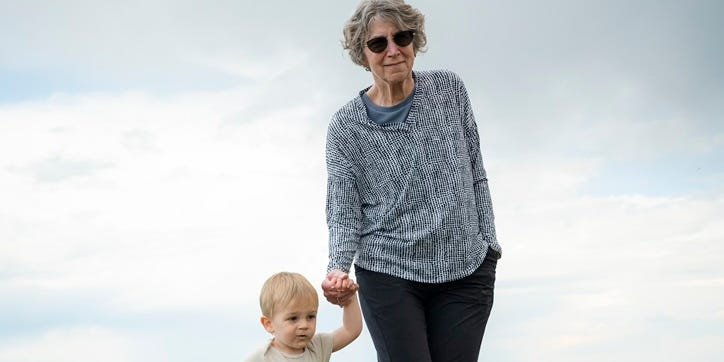
Grandma and grandchild walking

The author took care of her grandsons for a week.

Courtesy of Kenny Withrow


My grandson said he could do things himself

Throughout the week, I had offered to help, but George always said he could do it himself. Then, he’d slam the door into its frame.

That puddle challenged my composure. “Keep calm,” I told myself. “He’s only 2, and at least you’re not changing poopy diapers.”

George knocked and asked if I was taking a shower. I stepped into the hallway and let him know I wasn’t happy.

No answer.

I told him there was pee all over the floor.

Both Grandpa and his older brother, Stanley, had shown him how to pee in a toilet, but apparently, George liked to lift the seat and aim for the circular opening. I’d watched him steer an RC car through impossible turns, so aiming into a toilet shouldn’t have been difficult.


Grandparents with grandchidlren

The youngest grandson is a grandpa boy.

Courtesy of Kenny Withrow


George dropped his head. This non-stop chatterer went silent. He turned toward the wall and buried his face in his shoulder.

After breakfast, George became his talkative self again as he drove trucks through kinetic sand, performed somersaults off the couch, and wheeled his scooter from room to room. When he needed a bathroom break, he opted for nature pees in the backyard.

But then, as I made lunch, George scooted into the bathroom and slammed the door.

I gave him some time, then slowly, silently, peeked inside. He wasn’t sitting. He wasn’t standing. He was kneeling — reaching toward the back wall with a gigantic wad of toilet paper. The bowl was clogged with more paper — voluminous amounts of it.

What I wanted to say: WE TALKED ABOUT THIS!

What I actually said: Nothing. I just sighed.

My grandkids taught me an important lesson

That’s when big brother Stanley intervened. During the day, George followed Stanley around, imitating his every move. At night, they shared a bedroom. They had bunk beds, but instead of using the top and bottom, George and Stanley chose to sleep side by side, arms around each other, in the bottom bunk.

Stanley took one look at George on his knees, flashed a big smile, and suggested I praise him for his good work.


Family brushing teeth together

The author learned an important lesson from her grandkids.

Courtesy of the author


Then Stanley looked right at George and told him what a good boy he was. No mention of clogging the toilet. No scolding that the mess was unnecessary. No criticism of the sticky wet floor. Not even a reminder to wash his hands. Just arms open for a hug.

I stood there speechless for a few seconds. Where I saw disaster, Stanley saw effort. While I considered a lecture, he opened his arms.

I herded both boys to the sink for hand washing before lunch. After a bite to eat, we played with Monster Trucks, and when George got cranky, I put him in bed for a nap. Then I played cards with Stanley and cleaned the bathroom with chlorine bleach.

When George woke up, my husband suggested an hour at the park. With Stanley at a friend’s house, George, Grandpa, and I headed off on foot.

They taught me we all need a little grace

George is Grandpa’s boy. Every sentence begins, “Grandpa, watch…” or “Grandpa, look at this…” or “Grandpa, can I….” He holds Grandpa’s hand in every parking lot and sits in Grandpa’s lap for every book.

But as we approached an intersection and Grandpa prompted him to hold hands, George surprised me.

Instead of taking Grandpa’s hand, he reached for me, squeezed my palm, and held on long after we crossed the street. His tiny fingers curled into my fist said he wanted us to be right again.

At bedtime, when he usually chose Grandpa, George asked me to read him a book. Five books. We didn’t talk about bathrooms or disinfectants or a better aim. I just snuggled him in my lap, pulled a blanket over us, and read the words slowly, to enjoy the story a little longer. I tucked him under the covers with Doggie, his favorite stuffed toy. I kissed him and said I love you.


Grandparents with kids

Courtesy of the author


It was 8 p.m. when I joined Grandpa in the living room, too tired to read my own book, pick up stray Hot Wheels, or empty the dishwasher. Longing for bed myself, I thought about the last several hours and what I should have done better.

And I realized the lesson of the day was not how to pee into a toilet, reason with a 2-year-old, or keep a bathroom spic and span.

The lesson was that we all need a little grace.

Stanley praised George, not for succeeding, but for trying. When was the last time I’d done that?

In our world of high expectations, perfection often feels like the goal. We’re so conditioned to correct and fix — our children, coworkers, or strangers on Instagram — that we forget what encouragement looks like.

And then there was George. Without words, he reached for my hand, an ordinary kindness with extraordinary power. Adults often forget this truth, too, that love repairs itself with simple gestures.

The best love, I realized, isn’t earned through perfection, but offered in the middle of our messes.


Source link

Women-at-the-top-are-exhausted-and-burned-out-according.jpeg

Women at the top are exhausted and burned out, according to a McKinsey and Lean In report

Women are hitting the top of the corporate ladder only to find something waiting for them: exhaustion.

According to a report published Tuesday by McKinsey and LeanIn.org, a nonprofit founded by Sheryl Sandberg, burnout among senior-level women is the highest it has been in the past five years.

Around 60% of these women said they have frequently felt burned out at work in the past few months, compared with 50% of senior-level men, per numbers from the “Women in the Workplace” 2025 study.

Women who are newer to leadership roles are feeling the strain more acutely. Among senior-level women who have been at their companies for five years or less, 70% reported frequent burnout, and 81% said they are concerned about their job security.

“These high levels of concern align with research that shows women often face extra scrutiny when they’re new to organizations and have to work harder to prove themselves,” the report said, adding that Black women in leadership face exceptionally high burnout and job insecurity. “In contrast, when women and men in leadership have longer tenures, their levels of burnout and job security are quite similar.”

The report, an annual study of women in corporate America, surveyed 9,500 employees across 124 companies between July and August. The study also includes interviews with 62 HR executives and company-reported data from 124 organizations that together employ about 3 million people.

LeanIn.org launched a study with McKinsey in 2015 to track how women progress through the corporate pipeline and where companies fall short. The group is named after Sandberg’s 2013 book “Lean In,” which sparked a national debate about women’s ambition, leadership, and workplace equality.

This year’s findings paint a bleak picture for women at the top. Senior-level women who are hesitant to advance their careers say they see a steeper path forward compared to their male counterparts. Eleven percent of senior women who don’t want to advance say they don’t see a realistic route to promotion, compared with 3% of senior men. And 21% say more senior-level people look burned out or unhappy, nearly double the share of men who say the same.

It’s not because women are less committed — the report found that women and men are equally locked in. What differs is the desire to keep climbing, per the report.

The data shows a clear ambition gap: 80% of women want to be promoted to the next level, compared with 86% of men. That gap is widest at the beginning and the top of the pipeline — 69% vs. 80% at the entry level, and 84% vs. 92% among senior leaders.

This is the first time in the report’s 11-year history that women have shown lower interest in promotion than men, it said.

This gap in ambition to advance falls away “when women receive the same career support that men do,” the report added. In other words, companies are responsible for creating the burnout problem for women.

“This is only happening in the companies that aren’t doing the right thing when women get the full support and the same stretch opportunities. They’re not leaning out at all,” Sandberg said in a Tuesday interview with Bloomberg Television.

“What’s happening is that women face more barriers at every level of the career,” she added.

More companies are cutting back on DEI and support for women

Even as companies say they are committed to diversity and inclusion, at least one in six have reduced the teams or resources behind those efforts, the report said.

About 13% of employers have pulled back or eliminated women-focused career-development programs, and another 13% have cut formal sponsorship programs, which play a key role in helping employees advance, it added.

“Women overall are less likely to have sponsors — and this really matters. Employees with sponsors are promoted at nearly twice the rate of those without,” the report said.

The report also found that companies are rolling back remote and flexible work options, which can hinder women’s ability to stay and advance in their careers. One in four has scaled back remote or hybrid work arrangements, and 13% have reduced flexible working hours over the past year.

At the same time, the report said that women who work remotely most of the time are “less likely to have a sponsor and far less likely to have been promoted in the last two years than women who work mostly on-site.” Meanwhile, men receive more similar levels of sponsorship and promotions regardless of their work arrangement.

At the entry level, a stage where advocacy and visibility are essential, women are also less likely than men to receive stretch assignments and other opportunities, the report added.

Last year, the “Women in the Workplace” study found that more women were advancing to senior leadership roles. By 2024, women held 29% of C-suite roles, up from 17% in 2015.

However, progress fades at the entry and management levels, per the report. “For every 100 men promoted to manager in 2018, 79 women were promoted. And this year, just 81 women were,” it added.


Source link