

Expensive-gold-is-changing-how-people-buy-engagement-rings.jpeg

Expensive gold is changing how people buy engagement rings

Wild swings in gold prices are reshaping more than investment strategies.

Couples are shopping for engagement and wedding rings differently, rethinking everything from timing to materials to proposal plans.

While gold prices have been volatile, falling sharply from their record high above $5,500 per troy ounce in late January, spot prices are still 7% higher at around $4,650 — over 70% higher than at the start of 2025.

At jewelry stores, fluctuating gold prices mean quotes can shift quickly.

“We are seeing true sticker shock,” Peter Manka Jr., the co-owner of New York-based bridal jeweler Ben Garelick, told Business Insider.

The numbers are stark.

Ben Garelick’s average engagement ring with a center lab-grown diamond costs $1,544 in 2023. In 2024, that rose slightly to $1,633. By 2025, the average price had jumped to $2,408 — a 47% year-over-year increase.

That jump came even as loose diamond prices at the store have fallen nearly 40% from 2023 to 2025, largely because lab-grown diamonds — now the majority of its sales — became cheaper. In other words, most of the increase is coming from gold.

The surge is already changing consumer behavior.

Manka said 25% to 30% of engagement ring shoppers have delayed purchases — and thus proposals — in hopes that gold prices will fall.

But with quotes shifting rapidly, his store has urged customers to move quickly once they are ready to buy, warning that prices can change in days.

For shoppers who are hesitant or unsure about their proposal timeline, layaway and financing options have become more popular as a way to lock in current prices, he added.

Getting creative

While loose diamond prices have fallen, other supply-side pressures have compounded the impact of higher gold.

Higher tariffs on imported Indian goods last summer — where 90% to 95% of the world’s diamonds are cut and polished — raised costs.

As gold hits record highs, couples are also looking for ways to stretch their budgets. Some are repurposing old jewelry.

“We’ve seen them go through their jewelry box, and sometimes their parents’ jewelry box, in order to help offset higher prices,” Manka said.

The store either melts down old pieces to create new rings or offers gold credit toward a purchase. Manka estimated a 10% to 15% increase in customers bringing in inherited gold for engagement rings and wedding bands.

Vivian Grimes, the founder of Florida-based fine jewelry brand Henri Noël, said she has seen more customers revisit heirloom pieces in recent months.

“Clients are realizing that the jewelry sitting in a drawer is often one of the most meaningful and valuable assets they already own,” said Grimes.

“Resetting those pieces allows them to both honor the sentiment and make a smart, lasting decision,” she added.


Vivian Grimes, founder of Henri Noël Fine Jewelry.

Vivian Grimes, the founder of Florida-based fine jewelry brand Henri Noël, says record-high gold prices are prompting more clients to reset their old jewelry instead of buying new pieces. 

Henri Noël/Millers Photo and Film


For some buyers, the psychology around gold itself is evolving.

Max Baecker, the president of American Hartford Gold, said he has seen consumers think more deliberately about what they are purchasing.

“There’s growing recognition that gold isn’t just decorative; it’s a tangible asset with intrinsic value,” Baecker said.

So while couples may adjust carat weight or design to stay within budget, they typically still gravitate toward gold because it represents permanence, he added.

“In uncertain times, that symbolism becomes even more powerful,” Baecker said.

Shifting materials

Material choices are shifting, though unevenly.

Engagement ring shoppers at Ben Garelick are largely sticking with 14K gold, which is 58.3% pure gold.

But more men are opting for lower-karat gold in their wedding bands, with 35% to 40% of male buyers choosing 10K gold — which is 41.7% pure — or bands blended with alternative metals such as tantalum, Manka said.


Engagement/wedding rings at Ben Garelick.

New York jeweler Ben Garelick says more couples are opting for lower-karat gold for engagement and wedding rings. 

Ben Garelick


Inflation across wedding spend, from photographer to venue, means they have less in their budget for bands, Manka said.

At Ben Garelick, average men’s wedding band prices rose from $1,050 in 2023 to $1,575 in 2025. Women’s wedding bands increased more modestly, from $1,700 to $1,800, partly because lab-grown diamonds and 10K options helped contain costs.

Not everyone is trading down.

“If anything, we’re seeing the opposite,” said Grimes of Henri Noël, who added that her clients are still choosing 18K or 14K gold for their engagement rings as they are seen as future heirlooms.

“These are deeply emotional, milestone purchases, so couples are not typically looking to downgrade materials,” she added.

Industry-wide shake-up

The shifts underscore how jewelers are rethinking materials and pricing as precious-metal markets grow increasingly volatile after historic gains.

The impact is especially pronounced in the mid-range affordable luxury segment, where consumers are more price sensitive.

Pandora, known for its silver bracelets, is betting on platinum in 2026, introducing platinum-plated versions of its best-selling pieces to reduce exposure to volatile silver prices.

“We are reducing our reliance on silver to protect margins, but this is equally about strengthening our consumer proposition,” a spokesperson told Business Insider.

LVMH executives said on a January earnings call that Tiffany & Co. is also shifting from silver toward gold and fine jewelry, a notable move for a brand long associated with sterling silver.



Source link

Global-military-spending-hit-26-trillion-in-2025-These-35.jpeg

Global military spending hit $2.6 trillion in 2025. These 35 nations have the most expensive militaries.

The world’s military budgets totaled $2.6 trillion in 2025, and the US accounted for more than a third of that.

The US has the world’s most expensive military, spending nearly $1 trillion on defense. That’s over three and a half times China’s reported defense budget, the next largest.

From spending on nuclear technology to advanced aircraft and warships, the world’s top militaries allocate hundreds of billions of dollars each year to stay ahead.

In some countries, big-ticket items such as naval assets or technologically advanced aircraft or missiles account for the bulk of military spending, while others devote large sums to maintaining large conscription troop systems.

Ultimately, military spending varies by country depending on location and interests, Gian Gentile, a retired US Army colonel and senior historian at RAND, told Business Insider. Some countries prioritize homeland defense while others value overmatch and far-reaching power projection.

“The US spends a lot on more sophisticated, extremely precise weapon systems,” he said.

A military’s budget can be measured either as a total amount or as a share of its country’s GDP, reflecting the burden on its economy. Worldwide, countries spent an average of 2.01% of their GDP on defense in 2025.

Wartime spending as a share of GDP typically rises, putting strain on the civilian economy, said Mark Cancian, a senior advisor at the Center for Strategic and International Studies. Ukraine in 2025, for example, devoted over 20% of its GDP to its military, the highest share globally.

Spending statistics help paint a picture of defense priorities, but they don’t always translate into readiness for conflict.

“Readiness is very expensive, and perishable,” Cancian said.

A country’s on-paper investment in its defense systems doesn’t always translate directly into military capability, he added. Training and maintenance are often overlooked in analyses of spending on equipment and technologies.

A particularly high cost when it comes to technologically advanced aircraft, for instance, is maintenance and sustainment.

Still, looking at military budgets can reveal how much capital each country relies on to defend itself.

Last year, the International Institute for Strategic Studies, a London-based think tank, released its Military Balance report, which included data on nearly every country’s defense budget based on each’s reported 2025 figures.

The report includes each country’s total budget (in US dollars), per-capita figures, and defense budget as a share of GDP. Some countries, such as North Korea, Libya, Syria, Cuba, and Afghanistan, did not publicly report their defense budgets.

These are the 35 countries that spend the most on their military, ranked by the size of their defense budgets.

35. Vietnam

Vietnam has the largest reserves in the world, with an estimated 5 million reservists.

NHAC NGUYEN/AFP via Getty Images

Defense budget: $8.41 billion

Defense budget per capita: $79

Percentage of GDP: 1.74%

34. Romania


Soldiers participate in military activities during the media day of the Multi-Domain Command Europe multinational exercise Dynamic Front, supported by NATO allied forces, at the military base in Cincu, Brasov county, Romania, 09 February 2026.

Romania budgets for about $527 per resident for its defense forces.

Alex Nicodim/Anadolu via Getty Images

Defense budget: $9.48 billion

Defense budget per capita: $527

Percentage of GDP: 2.24%

33. Pakistan


Pakistani soldiers

Pakistan spent a total of $10.02 on its military in 2025.

Abdul BASIT / AFP via Getty Images

Defense budget: $10.02 billion

Defense budget per capita: $39

Percentage of GDP: 2.44%

32. Qatar


A general view show armoured vehicles rolling during the military parade marking the Gulf emirate's National Day celebrations in Doha on December 18, 2012

Qatar had the second-highest military budget per capita in the world in 2025, at $3,935 per resident.

KARIM JAAFAR/AFP via Getty Images

Defense budget: $10.11 billion

Defense budget per capita: $3,935

Percentage of GDP: 4.55%

31. Mexico


The Isla Holbox (BAL-02) vessel belonging to the Mexican Navy (SEMAR), intended for humanitarian aid, is docked at Veracruz port in Veracruz, Mexico, on February 6, 2026. Mexico will ship humanitarian aid to Cuba in the coming days while continuing to negotiate with Washington on the possibility of circumventing a US oil siege, President Claudia Sheinbaum said on February 6.

Mexico allocates 0.61% of its GDP to military funding, per the IISS report.

Victoria Razo / AFP

Defense budget: $11.36 billion

Defense budget per capita: $86

Percentage of GDP: 0.61%

30. Denmark


Royal Danish Navy patrol ship

Denmark spent about $2,013 per resident on defense in 2025.

Florent VERGNES / AFP via Getty Images

Defense budget: $12.18 billion

Defense budget per capita: $2,013

Percentage of GDP: 2.65%

29. Iraq


Iraq military

Iraq budgeted for 4.78% of its GDP on military spending in 2025, IISS reported.

Zaid AL-OBEIDI / AFP

Defense budget: $12.68 billion

Defense budget per capita: $295

Percentage of GDP: 4.78%

28. Belgium


Belgian Land Force

Belgium spent nearly $14 billion on its defense funding in 2025.

JULIEN WARNAND / BELGA MAG / Belga / AFP via Getty Images

Defense budget: $13.9 billion

Defense budget per capita: $1,161

Percentage of GDP: 1.94%

27. Indonesia


Indonesian National Armed Forces troops stand in formation during preparations for deployment in Myanmar as part of the Indonesian government's relief mission to assist earthquake victims, at Halim Perdanakusuma Air Base in Jakarta on March 31, 2025

Indonesia allocates about $53 per resident on its military each year, per its 2025 budget.

BAY ISMOYO / AFP

Defense budget: $15.08 billion

Defense budget per capita: $53

Percentage of GDP: 1.04%

26. Norway


Norwegian soldiers march during a military parade on Armed Forces Day in Vilnius.

In 2025, Norway spent about $2,966 per resident on defense.

Yauhen Yerchak/SOPA Images/LightRocket via Getty Images

Defense budget: $16.44 billion

Defense budget per capita: $2,966

Percentage of GDP: 3.18%

25. Sweden


An NH90 helicopter is seen in flight after departing from a temporary base during the Nordic Response military exercise on March 07, 2024 in Kiruna, Sweden. The exercise, which primarily takes place across Scandinavia from March 3-14, features 20,000 troops from 13 allied countries. Following the recent NATO expansion, the group now includes Finland and Sweden.

Sweden’s defense budget amounts to about $1,602 per resident each year.

Leon Neal/Getty Images

Defense budget: $17.06 billion

Defense budget per capita: $1,602

Percentage of GDP: 2.58%

24. Singapore


The mobile column from the Singapore Armed Forces takes part in a parade during Singapore's 50th National day anniversary celebration at the Padang in Singapore on August 9, 2015

Singapore has the fourth-highest defense budget per capita in the world.

ROSLAN RAHMAN/AFP via Getty Images

Defense budget: $17.99 billion

Defense budget per capita: $2,958

Percentage of GDP: 3.13%

23. Taiwan


Taiwan air force

Taiwan budgets for 2.4% of its GDP on its military, or about $898 per resident, according to IISS.

I-Hwa Cheng / AFP

Defense budget: $21.2 billion

Defense budget per capita: $898

Percentage of GDP: 2.4%

22. Turkey


Turkish military on the Turkish-Iranian border

Turkey’s defense budget was over $21 billion, per the IISS report.

Anadolu/Anadolu via Getty Images

Defense budget: $21.48 billion

Defense budget per capita: $254

Percentage of GDP: 1.37%

21. United Arab Emirates


The United Arab Emirates Air Force's newly re-equipped Fursan Al-Emarat aerobatic display team flies the Hongdu L-15 advanced jet trainer from China at the Dubai Airshow on November 16, 2025 in Dubai, United Arab Emirates.

The United Arab Emirates has the seventh-highest defense budget per capita in the world.

VCG/VCG via Getty Images

Defense budget: $21.68 billion

Defense budget per capita: $2,148

Percentage of GDP: 3.81%

20. Brazil


Brazilian military parade

Brazil spends about 1.11% of its GDP on its military, according to its 2024 budget.

Anadolu/Anadolu via Getty Images

Defense budget: $24.27 billion

Defense budget per capita: $110

Percentage of GDP: 1.08%

19. Algeria


Algeria's military

Algeria spends the second-highest percentage of GDP on its military.

NurPhoto/NurPhoto via Getty Images

Defense budget: $25.21 billion

Defense budget per capita: $528

Percentage of GDP: 8.75%

18. Spain


Spanish military

Spain budgeted about 1.53% of its GDP for military spending in 2025.

picture alliance/dpa/picture alliance via Getty Images

Defense budget: $28.91 billion

Defense budget per capita: $611

Percentage of GDP: 1.53%

17. The Netherlands


Dutch military drone

The Netherlands budgeted $1,633 per resident on its military.

Remko de Waal / ANP / AFP

Defense budget: $29.12 billion

Defense budget per capita: $1,633

Percentage of GDP: 2.2%

16. Canada


Canadian Armed Forces

Canada’s military budget was over $31 billion in 2025.

Artur Widak/NurPhoto

Defense budget: $31.21 billion

Defense budget per capita: $797

Percentage of GDP: 1.37%

15. Poland


Soldiers of the Polish Armed Forces ride a battle tank

Poland spends over 3% of its GDP on its military.

Aleksander Kalka/NurPhoto

Defense budget: $33.18 billion

Defense budget per capita: $865

Percentage of GDP: 3.19%

14. Australia


Australian air forces helicopter

Australia’s defense budget equals around $1,378 per resident.

Ian Hitchcock/Getty Images

Defense budget: $37.28 billion

Defense budget per capita: $1,378

Percentage of GDP: 2.04%

13. Israel


IDF soldiers prepare tanks on August 18, 2025 near the Gaza Strip's northern borders

At $4,153 per resident, Israel had the largest military budget per capita in the world.

Elke Scholiers/Getty Images

Defense budget: $39.68 billion

Defense budget per capita: $4,153

Percentage of GDP: 6.5%

12. Italy


Members of the Italian armed force (82° Reggimento Fanteria

Italy allocates about 1.58% of its GDP on military spending, according to its 2025 budget.

Antonio Masiello/Getty Images

Defense budget: $40.09 billion

Defense budget per capita: $658

Percentage of GDP: 1.58%

11. South Korea


South Korea military

South Korea’s military budget reached nearly $44 billion in 2025, per IISS’ reporting.

Kim Jae-Hwan/SOPA Images/LightRocket via Getty Images

Defense budget: $43.84 billion

Defense budget per capita: $851

Percentage of GDP: 2.36%

10. Ukraine


Ukrainian military

Ukraine budgeted the highest percentage of its GDP for defense among countries, a common practice during wartime.

Tetiana DZHAFAROVA / AFP

Defense budget: $44.44 billion

Defense budget per capita: $1,217

Percentage of GDP: 21.19%

9. Japan


Japan military

Japan’s defense budget was nearly $59 billion in 2025.

JIJI Press / AFP

Defense budget: $58.91 billion

Defense budget per capita: $480

Percentage of GDP: 1.38%

8. France


French soldiers wait for the arrival of French President at the Istres military air force base where he is scheduled to deliver his New Year's address to the armed forces in Istres, southern France, on January 15, 2026.

France budgeted just over 2% of its GDP for defense funding in 2024.

Philippe Magoni / POOL / AFP

Defense budget: $70 billion

Defense budget per capita: $1,022

Percentage of GDP: 2.08%

7. Saudi Arabia


Saudi armed forces show their skills during a drill in Saudi Arabia's holy city of Mecca on August 13, 2018, ahead of the annual Hajj pilgrimage.

Saudi Arabia has the seventh-highest defense budget per capita at $1,951 per resident.

BANDAR ALDANDANI/AFP via Getty Images

Defense budget: $72.53 billion

Defense budget per capita: $1,951

Percentage of GDP: 5.72%

6. India


Indian Air Force's Sarang helicopter display team fly in formation during a media preview aerial display ahead of the Singapore Airshow in Singapore on February 1, 2026.

India budgeted for about $55 per resident.

Roslan RAHMAN / AFP

Defense budget: $78.31 billion

Defense budget per capita: $55

Percentage of GDP: 1.9%

5. United Kingdom


Members of the British military at RAF Leeming prepare for Exercise Hyperion Storm, a joint force validation exercise with the UK Special Operations Forces being held at RAF Leeming and the Otterburn Training Area in the north of England. Picture date: Friday January 30, 2026.

The United Kingdom’s defense budget in 2025 was over $94 billion, per the report.

Owen Humphreys – PA Images/PA Images via Getty Images

Defense budget: $94.26 billion

Defense budget per capita: $1,371

Percentage of GDP: 2.38%

4. Germany


German Defence Minister Boris Pistorius and Bavarian State Premier Markus Soeder attend the inauguration of the Innovation Center of the German Armed Forces Bundeswehr in Erding, Bavaria, southern Germany on February 2, 2026.

Germany has the highest-funded military in Europe.

Michaela Stache / AFP

Defense budget: $107.31 billion

Defense budget per capita: $1,277

Percentage of GDP: 2.14%

3. Russia


Russian tanks roll on Red Square during the Victory Day military parade, marking the 80th anniversary of the Victory in the Great Patriotic War, on May 9, 2025 in Moscow, Russia. Russia marks the 80th anniversary of the victory in World War II over Nazi Germany and its allies.

Russia spends a higher percentage of its GDP on defense spending than other nations.

VCG/VCG via Getty Images

Defense budget: $161.18 billion

Defense budget per capita: $1,150

Percentage of GDP: 6.34%

2. China


CJ-20A air-launched cruise missiles are seen during a military parade marking the 80th anniversary of victory over Japan and the end of World War II, in Beijing's Tiananmen Square on September 3, 2025.

China’s defense budget is equal to $178 per resident.

Greg Baker / AFP

Defense budget: $251.29 billion

Defense budget per capita: $178

Percentage of GDP: 1.3%

1. United States


U.S. Navy Landing Craft Air Cushion's (LCAC) unload equipment onto the beach as U.S. Marine Corps V-22 Ospreys and CH-53 Super Stallions fly overhead during the America's Marines 250 event at Camp Pendleton's Red Beach on October 18, 2025 in Oceanside, California. The U.S. Marines are marking their 250th anniversary with a live amphibious assault demonstration entitled

The US also has the fifth-highest military budget per capita.

Mario Tama/Getty Images

Defense budget: $921.02 billion

Defense budget per capita: $2,725

Percentage of GDP: 3.01%


Source link

A-shark-tank-a-movie-theater-and-a-2-million.jpeg

A shark tank, a movie theater, and a $2 million shooting range: See inside Arizona’s most expensive mansion

  • A mansion in Paradise Valley, Arizona, is on the market for $40 million.
  • The home includes a shooting range, a 12-seat movie theater, and a two-lane bowling alley.
  • If sold, the mansion would set a state record for the highest-selling home of all time.

The most expensive home in Arizona is up for sale, and for its $40 million price tag, potential buyers would be getting a lot more than run-of-the-mill household amenities.

The property has a full-sized basketball court, a shark tank, a 12-seat movie theater, and a two-lane bowling alley — and that only scratches the home’s surface.

If sold at its listing price, the mansion would set a record for the highest-selling house in Arizona’s history. The current record — a $33.5 million sale from 2025 — is held by a property just down the road.

The listed 11-bed, 13-bath home sits in Paradise Valley, a desert town that holds the distinction of being the wealthiest zip code in Arizona. Paradise Valley is comprised of about 15 square miles of land, and most of the town’s properties are required to take up a minimum of one acre to maintain the area’s low population density.

Construction of the mansion began in 2020, designed by the owners to have unique spaces for their children’s hobbies. Now, with their kids out of the house, the owners are looking to downsize.

The home’s listing agent, Scott Grigg of the Grigg’s Group Powered by the Altman Brothers, says the home’s eccentric details are unusual for the region and are more commonly found at properties in big coastal cities.

“These types of amenity-driven estates are typically seen in Miami or Los Angeles, but to have something like this here in Arizona is unique,” Grigg told Business Insider.

See inside the $40 million home.

The market for these types of properties in Arizona is growing, the home’s listing agent says.

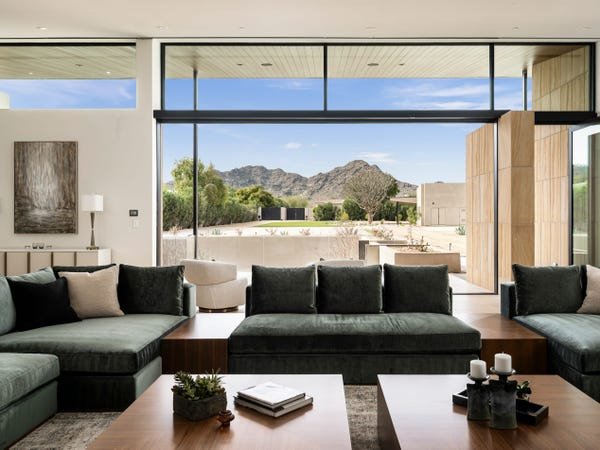
One of the house’s sitting rooms.

Phil Johnson/ProVisuals Media

Grigg predicts the home will likely attract an out-of-state buyer, perhaps looking to move to Arizona for improved quality of life or lower state taxes. He said Arizona is seeing an influx of new buyers from the nation’s biggest cities.

“$40 million gets you a lot,” Grigg said. “It’ll get you a house on the beach or a large estate in California, but now Arizona is putting itself on the map.”

Paradise Valley sits right next to the city of Scottsdale, which was found to be the country’s fastest-growing hub for millionaires in a 2025 report from Henley & Partners, a residence and citizenship firm.

Grigg added that the combination of all the property’s amenities is a big draw for buyers in the home’s price range.

“They want the best of the best and things that stand out,” Grigg said.

The property is split into a main residence and a detached guest house.


A bed in front of a fireplace.

The property features a main residence and a guest casita.

Phil Johnson/ProVisuals Media

The home is just over 23,000 square feet on an estate spanning nearly 2 ¼ acres. But if the main residence’s five guest bedrooms aren’t enough to accommodate visitors, the property also has a separate guest casita.

This includes five bedrooms, a kitchen, and 4 ½ bathrooms. Two fireplaces keep the guest home warm, and a golf putting green sits right outside.

The kitchen in the main residence has a walk-in fridge and freezer.


A kitchen with two island counters.

The kitchen has a dedicated meat locker.

Phil Johnson/ProVisuals Media

The kitchen can entertain plenty of guests with a double-oven gas range and a dedicated meat locker. Behind a door is a butler’s pantry, which includes an industrial-style walk-in fridge and freezer.

Both the main residence and guest home are controlled by smart automation systems.


Couches in front of a TV screen.

30 wireless phone chargers appear throughout the home.

Phil Johnson/ProVisuals Media

The property is fully automated, with features such as electronic shades and motorized glass doors. The house uses AVA and Crestron automation systems to control home appliances.

The home also has more than 30 wireless phone chargers throughout.

The main bathroom has spa-like features.


A bathtub and steam shower.

The home’s bathroom features a large steam shower with multiple shower heads.

Phil Johnson/ProVisuals Media

Though the home has over a dozen bathrooms, the primary bathroom stands out for its special features.

Dual shower head nozzles, body jets, and a rain shower head make up a steam shower, and there’s a freestanding tub that sits against the opposite wall.

Along another wall, pocket doors open up to reveal a courtyard with an additional tub and outdoor shower.

A 100-year-old bank vault keeps valuables safe.


A chair in front of a bank vault.

The home has a 100-year-old bank vault.

Phil Johnson/ProVisuals Media

To ensure maximum security for valuables, the home contains a 100-year-old bank vault that opens into a safe room.

A regulation basketball court means residents can play a full-court game at a moment’s notice.


A basketball court with large garage doors on the side.

The home’s basketball court has a Phoenix Suns logo at midcourt.

Phil Johnson/ProVisuals Media

The property’s basketball court features stadium-style lighting and polished hardwood floors. A Phoenix Suns logo sits at midcourt, and the gym’s walls are padded for safety.

Next to the gym is a wellness center with a red-light sauna and a cold plunge.

Or they can face off in the home’s two-lane bowling alley.


A two-lane bowling alley.

The home’s bowling alley has the look and feel of a high-tech commercial bowling alley.

Phil Johnson/ProVisuals Media

The house’s bowling alley has the look, feel, and technology of a commercial bowling alley, only it’s meant for two. It has automatic ball return and a machine that oils and cleans each lane.

The home’s shark tank sits next to the bowling alley.

An in-home movie theater seats 12.


Large chairs in front of a TV screen.

Cushioned chairs seat a dozen people in the home’s theater.

Phil Johnson/ProVisuals Media

Equipped with Dolby surround sound, the home’s theater can seat a dozen people.

A golf simulator lets anyone practice their swing without leaving the house.


A bag of golf clubs next to a golf simulator.

The golf simulator doubles as a shooting/hunting game.

Phil Johnson/ProVisuals Media

The golf simulator has a large screen that lets anyone play through a virtual golf course. The simulator also doubles as a shooting and hunting game, with a rifle and a pistol.

A wet bar supplies refreshments for guests in the surrounding rooms.


A pool table, chairs, and a wet bar.

The wet bar sits next to the movie theater, golf simulator, and bowling alley.

Phil Johnson/ProVisuals Media

Sitting right next to the movie theater, bowling alley, and golf simulator, the wet bar acts as an anchor for the surrounding amenities. Ample seating, a pool table, and access to a courtyard complete the room.

The gun room cost over $2 million, according to the home’s listing agent.


Guns lining the walls of a room in front of a shooting range.

The owner’s gun collection is worth over $1 million.

Phil Johnson/ProVisuals Media

The mansion’s gun room is perhaps one of its most attention-grabbing attractions. Aside from the owner’s gun collection, valued at over $1 million, the room is full of custom, state-of-the-art features.

There’s a three-lane shooting range and a custom $300,000 HVAC system, which produces hospital-grade air, according to Grigg. Ventilation systems are important for indoor shooting ranges because of the presence of lead and other toxic chemicals, per the Occupational Safety and Health Administration.

The home has a 20-car garage, with space for 30 more.


Cars lined up in a garage.

With the garage and other spaces, the property can fit upwards of 50 cars.

Phil Johnson/ProVisuals Media

Attached to the main house is a large garage that can fit up to 20 cars. The basketball court and other areas can be used for additional parking spaces.

A putting green sits outside for when the weather’s nice enough to hit the links.


Holes with flags on a golf putting green.

The property’s putting green neighbors the guest residence.

Phil Johnson/ProVisuals Media

Next to the guest casita, a seven-hole putting green lets golfers work on their short game.

A pool with an infinity-edge spa lets residents beat the Arizona heat.


A pool in front of palm trees.

The pool’s infinity edge creates a water-flowing effect.

Phil Johnson/ProVisuals Media

The property’s pool is surrounded by two gazebos with gas and wood-burning grills, as well as a raised viewing deck for lounging.

Despite the home’s eye-catching amenities, the property keeps a low profile in the neighborhood.


Exterior of 7545 N Mockingbird Lane at sunset.

7545 N Mockingbird Lane sits in a gated compound.

Phil Johnson/ProVisuals Media

Although the house has all the ingredients for loud, extravagant parties, the property blends in with the surrounding homes. The home isn’t visible from the street and sits in a private gated compound that can only be accessed via a long driveway.

For such a high-value property, extensive screening and proof of funds are required for potential buyers, according to Grigg.


Source link

The-5-vacation-destinations-that-will-be-more-expensive-to.jpeg

The 5 vacation destinations that will be more expensive to visit in 2026 because of tourist taxes

Tourists love Kyoto for its ancient temples, pagodas, and its cherry blossoms. But from early next year, staying in the Japanese city will become more expensive.

After March 1, visitors in Kyoto will face higher overnight taxes on accommodation across the city.

The tax is tiered according to the nightly cost of accommodation: rooms under 6,000 yen, about $38, a night will remain taxed at 200 yen, or $1.28, while the tax on rooms priced between 6,000 and 20,000 yen a night will double to 400 yen.

The steepest increases will be applied to high-end accommodations. Rooms costing 50,000 to 100,000 yen a night will see the tax jump from 1,000 to 4,000 yen, and those over 100,000 yen will rise tenfold to 10,000 yen.

Kyoto’s government estimates the revised tax will generate 12.6 billion yen a year, about $81 million.


Source link

Heres-how-the-worlds-most-expensive-color-is-made.jpeg

Here’s how the world’s most expensive color is made

Ultramarine blue, or “true blue,” was once more valuable than gold. In 1824, a synthetic version called French ultramarine made the color more accessible. But ultramarine blue made from real lapis lazuli can sell for over $60 an ounce today.

Lapis lazuli is a bright blue semiprecious stone mined primarily in Afghanistan. When Business Insider visited the world’s largest lapis lazuli mine there, its future was up in the air. So, how is the world’s most expensive color made, and why are people paying for it?


Source link