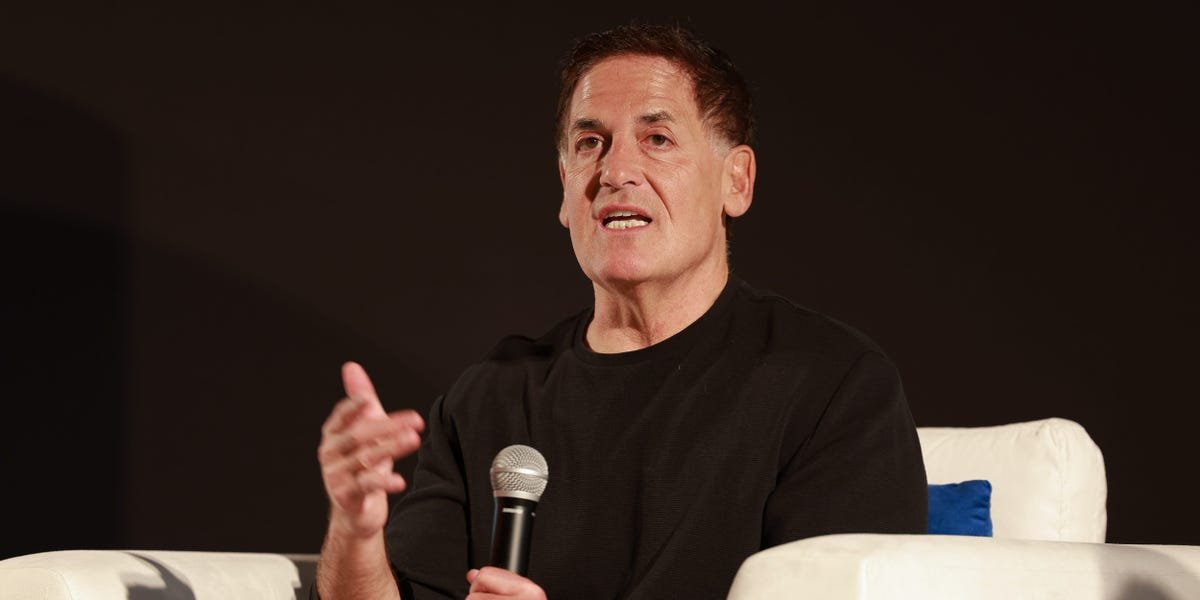
Mark Cuban said CEOs of large public companies face a tough dilemma with AI, and it’s looking like a lose-lose situation for them.
The former “Shark Tank” billionaire investor said in a Sunday X post that entrepreneurs are building AI-native companies that displace incumbents.
On the other hand, incumbents face what he called the “Innovator’s AI Dilemma”: either tear down their companies and reinvent them as native AI, or do nothing.
In either case, Cuban said investors won’t be happy. He said we’ll know when AI is affecting public companies from two kinds of shareholder lawsuits: one against companies that opt for teardowns, and the other against companies that don’t reinvent themselves. In both cases, he said stocks would fall, leading to lawsuits.
Cuban advised CEOs to ask AI models for the best paths from where their companies are to becoming AI-native versions of themselves.
“If asking your models questions doesn’t make sense to you, you are in deep shit,” he said.
The investor previously said on X that there will be two types of companies: “Those who are great at AI, and everybody else.”
“And the ‘everybody else’ is going to fail because AI is such a transformative tool,” he added.
Cuban’s comments come as some public companies have been opening up about how they are reinventing themselves as “AI native.”
The CEO of Amplitude, a publicly traded analytics company based in San Francisco, told Business Insider in January that the company is undergoing an AI transformation in several stages.
CEO Spenser Skates said Amplitude had acquired five AI startups since October 2024, appointed one of their founders to a new AI leadership position, and purchased GitHub Copilot and Cursor licenses for its staff.
Lori Schott, a mother from rural Colorado, said she stared down Meta CEO Mark Zuckerberg as he walked into court in Los Angeles on Wednesday to testify in a landmark trial regarding social media addiction.
Schott lost her 18-year-old daughter, Annalee, to suicide in 2020. She believes the content Annalee saw on social media platforms “destroyed” her mental health.
“I made eye contact with him for quite a long time,” Schott said of Zuckerberg. “I was not backing down.”
Schott is not a plaintiff in the case where Zuckerberg testified on Wednesday, but is among more than 2,000 individuals who have similar personal injury lawsuits pending regarding social media addiction and harm.
The case underway in Los Angeles centers on a 20-year-old woman, identified by the initials KGM, who says her use of social media throughout her childhood negatively affected her mental health, contributing to depression and suicidal thoughts. It is considered a bellwether trial that could indicate how other similar lawsuits related to social media harm, like Schott’s, could play out.
Lori Schott, a mother from rural Colorado, lost her 18-year-old daughter, Annalee, to suicide in 2020.
Jill Connelly/Getty Images
Meta, which owns Instagram and Facebook, was named as a defendant alongside Google-owned YouTube, TikTok, and Snapchat. TikTok and Snapchat both settled the lawsuit out of court.
Last month, Meta warned investors that its mounting legal battles over youth safety could “significantly impact” its 2026 financial results. Attorneys for more than 100,000 individual arbitration claimants have “sent mass arbitration demands relating to ‘social media addiction'” since late 2024, the company said in a 2026 10-K, which warned that potential damages in certain cases could reach into the “high tens of billions of dollars.”
In a statement, Stephanie Otway, a Meta spokesperson, said: “We strongly disagree with these allegations and are confident the evidence will show our longstanding commitment to supporting young people.” Otway highlighted changes the company has made over the past decade, including Teen Accounts, which give parents tools to manage their teens’ accounts.
Google declined to comment. TikTok did not respond to a request for comment. A Snapchat spokesperson said in a statement: “The Parties are pleased to have been able to resolve this matter in an amicable manner.”
On Wednesday, parents showed up hours before the courthouse opened in hopes of getting a seat inside. Many of them had personal stories about how they believed social media use harmed their children.
Parents gathered outside the Los Angeles Superior Court on Wednesday.
Frederic J. Brown / AFP via Getty Images
“We face a lot of stigma from people telling us we’re bad parents,” said Amy Neville, another parent who attended to show her support. She said that once the evidence comes out in the trial, she believes “the tide will turn, and the general public will be on board with us.”
“It is by design that social media is tearing their family apart,” Neville said.
On the stand, Zuckerberg said that teens represent less than 1% of Meta’s ad revenue and that most teens don’t have disposable income, so it’s not especially valuable to advertisers to reach them.
Zuckerberg said it’s in Meta’s best interest to create a platform that inspires people and makes them want to stick around for the long term.
“If people aren’t happy with a service, eventually over time they’ll stop using it and use something better,” he said.
Sarah Gardner said that regardless of the outcome of the trial, she hopes it raises awareness about how the social media companies, and specifically Zuckerberg, have been operating. Gardner is the CEO of the Heat Initiative, an advocacy group that pressures Big Tech companies to make their platforms safer for kids. She was at the courthouse with the parents who believe they have been affected.
Gardner said she’s hopeful the trial will empower more people to say, “I don’t want to be on Instagram anymore.”
An internal Nvidia email chain revealed how senior executives at the chip giant — including founder and CEO Jensen Huang — mobilized in response to customer criticism of a key product launch late last year.
The thread offers a glimpse into how the company responds to public backlash as it expands products designed for individual developers and researchers.
The thread, which Business Insider has seen, centered on the launch of DGX Spark, a desktop AI system designed for developers and researchers to build AI products and work on apps for data science, medicine, and other fields.
While much of Nvidia’s business targets data center customers, Huang underscored Spark’s significance in the thread, calling it the “ultimate developer’s platform — out of the box easy to run all NVIDIA.”
Spark drew criticism soon after its launch, with some citing software stability and performance issues, which garnered coverage in other tech outlets.
An Nvidia spokesperson declined to comment.
Anshel Sag, a Moor Insights & Strategy analyst who has tracked Nvidia launches for 15 years and was an early DGX Spark tester, said the company’s long experience releasing graphics cards in the gaming industry — where products are routinely scrutinized — has made it adept at handling public feedback, with Huang typically keeping a close eye on new releases.
In recent years, the company has become even more reactive, Sag said, due to increased internal resources and “sensitivity about the stock price and how negative sentiment can draw that down.”
Nvidia CEO Jensen Huang steps into the fray
In the fall of last year, AstraZeneca executive director Justin Johnson wrote in a LinkedIn post that while the DGX Spark met performance and speed claims, the software experience was buggy and unstable.
After an Nvidia executive shared Johnson’s post in an internal email thread, Huang entered the fray.
“Jump on x and say you will fix,” he wrote.
A founder’s edition of the DGX Spark on display at a Paris tech show last June.
Chesnot/Getty Images
Subsequently, an Nvidia engineer replied that the company had reached out to Johnson to resolve most of the issues, which were related to a version mismatch of CUDA, Nvidia’s software that allows developers to build AI apps powered by its GPUs.
Johnson responded that he appreciated the outreach and was exploring setting up DGX Spark at the pharmaceutical company, the chain said.
Nvidia staffers ramp up responses
Following Johnson’s criticism, Nvidia staffers saw other unfavorable responses online and set up a social listening campaign to flag complaints from other influential figures, as well as discussions on Nvidia forums and Reddit, the emails said.
Staffers tracked complaints and engaged directly with key critics who raised concerns about DGX Spark’s performance, heating issues, and pricing.
Another incident involved the researcher Christopher Kouzios, who wrote on LinkedIn that he’d purchased DGX Spark to conduct medical research after his daughter died from a rare brain tumor, with the goal of studying cancer risk in his sons.
Kouzios said software incompatibility had rendered the system unusable and that he’d only received an automated acknowledgment 38 hours after filing a support ticket.
After an Nvidia executive flagged the post, team members said they were fixing the bug, according to the emails. The executive later circulated an updated post in which Kouzios lauded Nvidia’s customer support.
“While the situation initially frustrated me, Nvidia’s response time was exceptional,” Kouzios told Business Insider. “In more than 33 years working with large technology companies, I have never seen an organization respond that quickly to public technical feedback.”
It’s often standard for hardware to ship without fully finished software, Sag said, adding that Nvidia tends to be more “high-touch” than other tech companies in fielding complaints — an approach that flows down from an exceptionally “hands-on” CEO.
Nvidia has previously faced some launch hiccups and early criticism for new products, such as its Blackwell rollout, which encountered manufacturing challenges.
While a CEO’s involvement is notable and Nvidia’s backchannel efforts appeared to placate critics, such an approach isn’t without risks, another analyst said.
“C-suite engagement during product controversies has become more common in tech, particularly for founder-led companies,” said Kate Holterhoff, a senior industry analyst at RedMonk. “It can signal authenticity and accountability, but it also carries reputational risk if the response is perceived as defensive or dismissive.”
Have a tip? Contact this reporter via email at gweiss@businessinsider.com or Signal at @geoffweiss.25. Use a personal email address, a nonwork WiFi network, and a nonwork device; here’s our guide to sharing information securely.