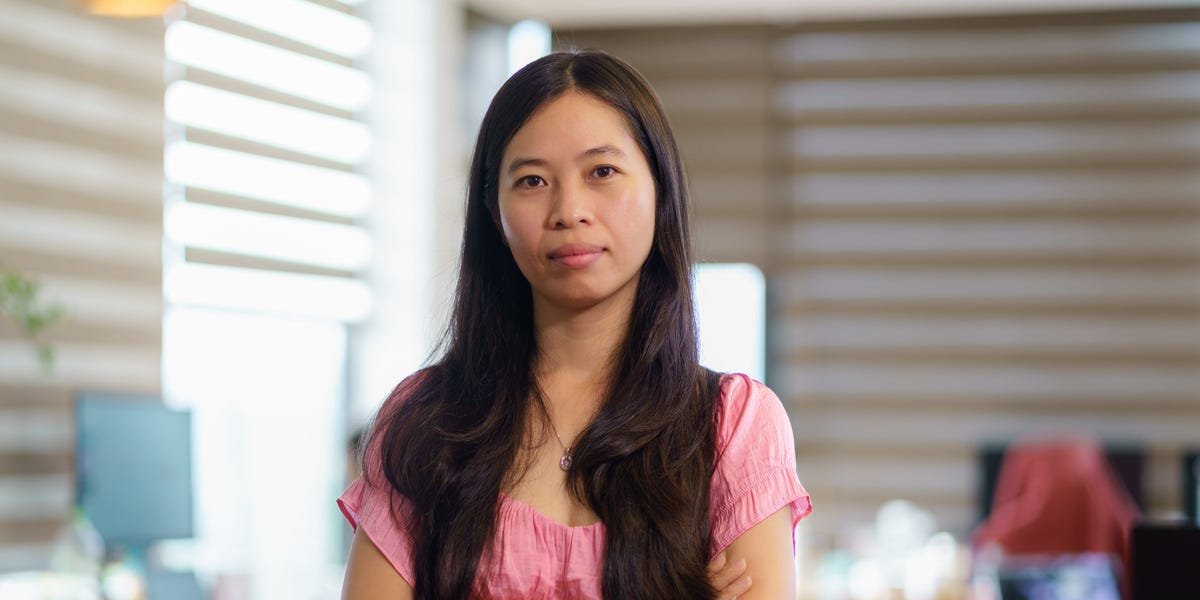
This as-told-to essay is based on a conversation with Heather Schoonover, owner of Painting With a Twist in Boise. It has been edited for length and clarity.
Three years ago, my husband Levi got a call from family. His uncle had died, and the family was preparing to sell his business, which produced trophies and medals. They just wanted to be rid of it and were going to sell it for about $40,000.
That was less than the truck we were considering purchasing. And unlike a truck, the business was something we hoped would appreciate in value. So, Levi and I loaded into a half-finished 1957 Airstream trailer and moved seven hours from our home in northern Idaho to Boise, where the business was located.
Heather Schoonover and her husband parked their Airstream inside the trophy business they bought.
Courtesy of Heather Schoonover
We parked the Airstream inside the warehouse for the trophy business and lived there for a year. Sometimes we wondered what we had done, especially since the first year, the trophy business only netted about $35,000. But the year after that, we doubled our profits, then doubled again. That’s when we started to think we had made the right decision.
We decided to open a paint and sip studio since there wasn’t one
When we moved to Boise, we were eager to make new friends. I have a background working at paint-and-sip art studios, and we thought that would be a great place to meet people. We were surprised to learn that there wasn’t a paint-and-sip in Boise.
Every time Kelly publishes a story, you’ll get an alert straight to your inbox!
Stay connected to Kelly and get more of their work as it publishes.
Gradually, we met others, and I started hosting paint-and-sip events right in the warehouse, next to our airstream. I was only charging for materials, not making any money, but people loved it. We could immediately see another business opportunity.
Having a franchise was helpful when I had a baby
We were still in the trenches of resuscitating the trophy business, so we decided to look into franchises. Ultimately, we thought that would help us have more flexibility. We wanted to own the paint-and-sip business without being tied to working there every day. Having a proven model seemed to be the option that would get us to that goal the fastest.
It was definitely the right choice. Finding a location in Boise took longer than we wanted, but our franchise company, Painting With A Twist, helped us stay focused on finding the right space and then negotiating a lease once we found it.
I found out I was pregnant the day before the grand opening. Because we had the franchise’s resources, we were able to stay open and even continue making money during my maternity leave. Having a baby and a new business in the same year would have been a million times more stressful if we were on our own.
Owning businesses gives us more control over our time
For Levi and me, success means owning our own time. Running two businesses — plus rental properties — demands a lot of time, but also gives us freedom. We can get lunch together. Before our daughter was born, Levi would bartend at paint-and-sip nights just so we could spend time together.
Having freedom in how we spend time has become even more important now that we have a baby. Our businesses have complementary schedules, so I often watch the baby while Levi works at the trophy business during the day, then I head to Painting With A Twist at night while he’s home with her.
Courtesy of Heather Schoonover
We want our daughter to know it’s OK to take risks. We went from working stable jobs and living in a nice house to running our own businesses while living in a half-finished trailer with two big dogs. Although it wasn’t glamorous, it led to opportunities and a community we love here in Boise.
We never want to look back and think “we wish we tried that.” We’d rather take the leap and try to figure it out together.
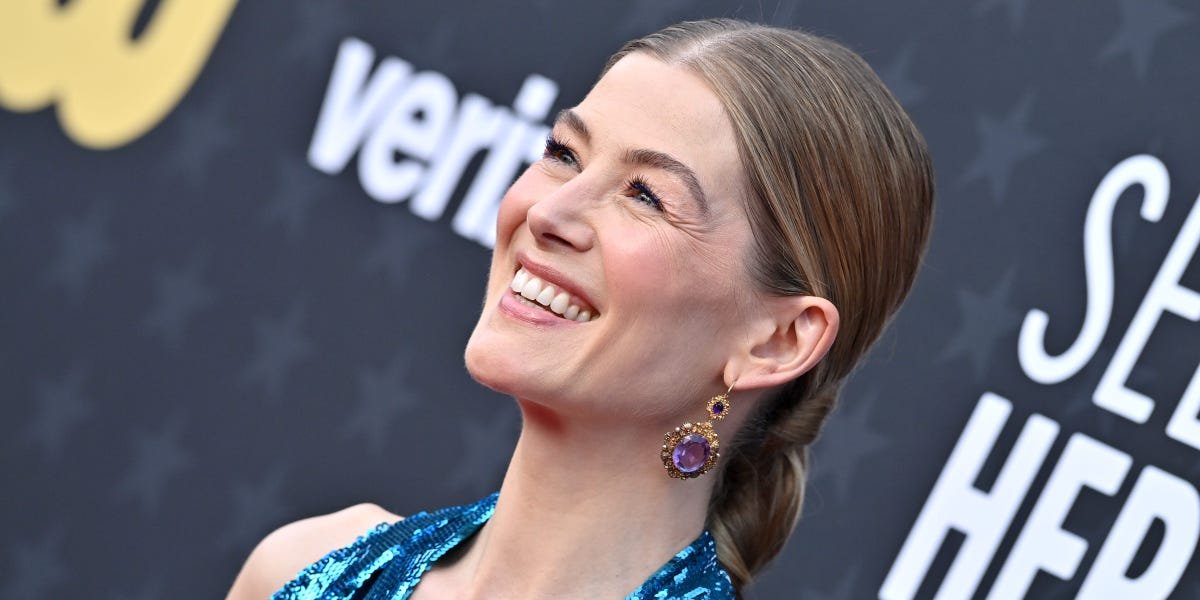
Rosamund Pike, 47, says she stepped away from the traditional expectation of marriage and built a family her own way.
On Wednesday’s episode of “How to Fail with Elizabeth Day,” the actor reflected on a broken engagement in her late 20s that reshaped her view of relationships.
Pike was engaged to filmmaker Joe Wright in the late 2000s, though the couple ultimately called off the wedding. Looking back, she said the experience made her question the conventional milestones many women feel pressured to reach.
“My failure to get married. Well, it’s a big deal for a 28-year-old, isn’t it? Your, sort of, template for womanhood — you’re doing the right thing. Got a lovely boyfriend, he’s asked you to marry him, you’re getting engaged, and there’s going to be a wedding, and you know, it’s the right age,” Pike told podcast host Elizabeth Day.
The actor also recalled her then-fiancé asking if she was “pleased” to be marrying before 30. She added that she thought it felt “right” and “romantic” at the time, until their relationship fell apart.
The breakup was “utterly devastating,” and public scrutiny made it worse, she said.
However, Pike eventually began to see the experience in a new light.
“The freedom from that afterward is that you sort of think, OK, so you haven’t achieved the thing, I suppose, the template,” Pike said. “He was a man who was eight years older than me. He was successful, he was good-looking, he was funny — he was great. And then it doesn’t happen, and you think, ‘Oh, no.'”
“But then you realize that actually you’re free in a way, because you think there are so many other templates of what life can look like for a woman,” she continued.
The breakup also helped her see that there are “so many other ways that love can look like.”
Pike has since been in a long-term relationship with businessman Robie Uniacke, and they share two sons together. Their first child, Solo, was born in 2012, and their second, Atom, in 2014.
“Here I am. I’m not married, but I have a family, and I’ve been with someone for 14, 15 years, happily not married,” Pike said.
She added that she was intentional about marking commitment in a “different way” in this relationship.
“It was more important to cement that or, sort of, mark that with starting a family than having a wedding, because also, I thought I’m the center of attention so often. I don’t need a wedding,” she said.
Pike isn’t the only celebrity to question traditional expectations around marriage and motherhood.
Charlize Theron has called single motherhood “one of the healthiest decisions” she ever made, despite the stigma around it.
“With women, it’s always like, something must be wrong with her. She can’t keep a man. And it’s never part of the discussion of like, ‘Wow, she’s really living her truth. She’s living in her happiness. This is actually a choice that she made,'” Theron said during a July episode of “Call Her Daddy.”
Michelle Obama has similarly pushed back on the idea that women must hit certain milestones by a certain age, saying turning 35 shouldn’t be viewed as a deadline for marriage or success.
“I would just say there are no ‘shoulds’. There are so many ways to live a happy, fulfilling life,” she said on a November episode of her podcast.
After we stopped traveling full-time, our 11-year-old daughter, Brooklyn, became obsessed with her bedroom.
She wanted to repaint it. Rearrange it. Add shelves, plants, posters, and end tables to organize her art supplies. She asked for candles and incense (and permission to burn them).
She pushed back when my wife and I asked her to keep her clothes picked up — not out of laziness, she explained, but because the artist in her liked how it felt to leave things wherever they landed.
At first, this “new normal” bugged me. The requests and pushback felt endless, even erratic, as if we were chasing some moving target of comfort that she would never reach.
Then one night, I walked past her room and was drawn by the scent of vanilla drifting through the crack in the door. Curled up on her bed under a throw, a small reading light on and the warm glow of candlelight around her, she sat reading a hardcover copy of “The Count of Monte Cristo.”
And it finally clicked: After years spent in airports, hotels, and temporary spaces, this was the first place within her control that she could count on staying the same.
At first, a life of travel made sense for our family
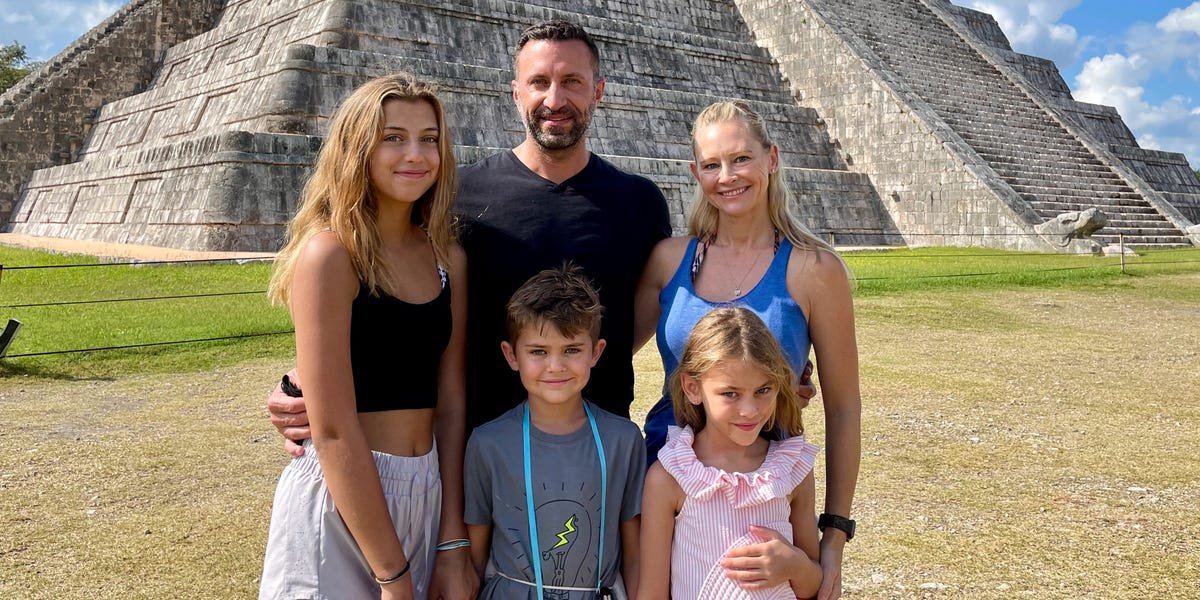
My wife and I began traveling the world with our three kids in 2020, at a time when structure had already fallen apart for most families.
School was remote. Routines were fractured. The future felt unpredictable. Travel, oddly enough, felt grounding.
If our kids were going to spend their days on screens anyway, why not replace textbooks with real places? Why not let geography, culture, and shared experience do some of the teaching?
A snapshot of our family’s travels to Abu Dhabi.
Phil Lockwood
Almost immediately, we began documenting our journey on a new YouTube channel. It was a new direction for the entire family, and the excitement was universal. Our kids even started their own channels and began producing their own episodes.
We juggled the challenges of highlighting the far-flung places we were visiting, the mistakes we were making, and the logistics of pulling off long-term travel as a family of five. Friends and family started watching.
Then strangers, too. Our audience grew into the thousands somewhat slowly, then into the hundreds of thousands surprisingly fast. Soon, we’d reached over half a million YouTube subscribers.
Sharing everything online felt natural at the time. It gave structure to our travels and, through ad revenue and brand sponsorships, helped offset the high costs. And it felt useful—like we were showing other families what was possible if they were willing to step outside the usual script.
Our family in Antarctica.
Phil Lockwood
In those early years, it felt like so many high-profile family YouTube channels were presented as success stories — adventurous, tight-knit, and inspirational. I didn’t see as much public skepticism, and some darker stories of family vloggers (like Ruby Franke’s) that would later dominate headlines hadn’t yet come to light.
So, at the time, we didn’t see ourselves as taking a risk — we saw ourselves as joining a small but growing group of households who were filming and sharing their lives publicly before the downsides were so widely discussed, documented, and understood.
For a while, it worked. Or, at least it appeared to. The kids were curious. We were together. We saw parts of the world that most families only talk about. And all five of us were enjoying building something meaningful together.
There were real benefits: closeness, adaptability, and perspective. Our kids learned how to navigate unfamiliar places and unfamiliar people. We learned to function as a family without the usual scaffolding of schedules and routines.
What we didn’t yet understand was what those benefits might be trading against.
As time went on, the cracks began to show — and coming home didn’t repair them all
Not all of our kids experienced the lifestyle the same way.
As our youngest and most adventurous, Colt thrived on the endless variety. Reagan, my oldest from a previous marriage, enjoyed the journey, but eventually chose to return to in-person school, and we adjusted our travel around her schedule with her mom. Brooklyn, though, gradually stopped enjoying it altogether.
There wasn’t a dramatic breaking point. It was a slow accumulation: long-haul flights at odd hours, constant activity, museums and cultural experiences designed for adults, not kids. Plenty of stimulation, but very little continuity.
A moment from our time in Abu Dhabi.
Phil Lockwood
What I didn’t fully appreciate was how much childhood depends on repetition — seeing the same faces, returning to the same places, building friendships that deepen rather than reset with new people every few weeks.
Other nomadic families we met reassured us that this was normal. They told us our kids would grow more worldly, more mature, even more interesting than their peers. That any awkwardness later would be a sign of depth, not loss.
And I wanted to believe that. But as Brooklyn pulled further away from the lifestyle — showing little enthusiasm for new destinations, frustration with red-eye flights, and no desire to highlight her experiences in our episodes — it became harder to ignore the possibility that what we thought was enriching had become simply exhausting for her.
The hardest part wasn’t wondering what she wanted: She was clear that she’d rather be back home, back in school, and back to occasional family vacations. The hardest part was realizing that submitting to her desires would require dismantling a life we had just spent years reorganizing everything around.
Eventually, though — and after five full years of constant travel —we made the decision to stop. We returned to the house that we’d kept in Denver. Reagan graduated and headed to college. Brooklyn enrolled in in-person high school, while Colt chose to continue online for the flexibility. Our pace slowed, and the constant motion ended.
And yes —things got easier. The kids seem more independent than ever. Life feels calmer. There’s a structure where there used to be constant negotiation.
Our family posing in India.
Phil Lockwood
Still, the relief I feel is mixed with doubt.
Brooklyn still carries some resentment about not settling down sooner. She’s now trying to build friendships in a neighborhood where other kids grew up side by side for years. She missed that stretch of middle school — the inside jokes, shared routines, and the quiet accumulation of belonging. I sometimes wonder whether the introversion I see now is simply adolescence, or whether years without steady peer relationships reshaped her in ways we can’t fully undo.
Did the benefits of those experiences outweigh the costs? Did we assume that anything lost along the way would simply return? Or are we just seeing a normal adjustment after an unusual childhood?
I don’t have clean answers. I’ve only accepted that good intentions don’t guarantee harmless outcomes — and that parenting decisions made confidently at the time can look very different in hindsight.
I don’t regret our choice — just parts of the execution
I’m glad we traveled. I’m glad our kids have seen the world. I’m also glad we stopped. I don’t regret the journey my wife and I took our children on, but I no longer assume it was unquestionably right.
If I could do it again? I’d prioritize putting down roots earlier — fewer destinations, more seasons in one place, more chances for the kids to build friendships that weren’t constantly interrupted.
And I’d question whether sharing our adventures online was necessary at all.
We visited Chiang Rai, Thailand.
Phil Lockwood
There’s a difference between traveling with kids and building a childhood around constant motion — especially when that motion is public.
We still travel, but only a few times a year, mostly around school breaks. Colt still loves going. Brooklyn hasn’t joined a trip since we settled back down; my sisters stay with her when we leave.
Recently, though, she’s started talking about ancient Greece and asking what it would take to see the ruins in person — but we’re careful not to read too much into that since interest isn’t always the same as readiness.
And if there’s one thing I’ve learned, it’s this: parenting decisions don’t come with clean verdicts. They come with trade-offs.
Sometimes the most honest stories aren’t about success or failure — they’re about realizing, long after the decision has been made, that you’re still not entirely sure where the line really was.
This as-told-to essay is based on a conversation with Scottlynn Krause, the co-owner of CS80 Vintage. It has been edited for length and clarity.
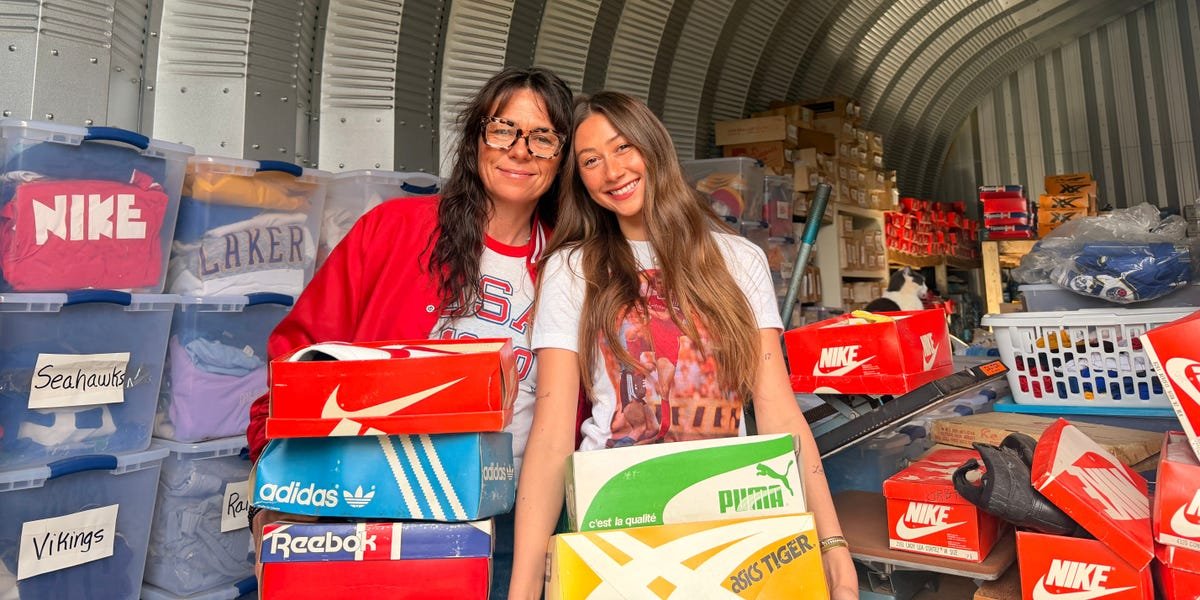
My best friend is Hannah, and her grandpa, Franz, owned a sporting goods store in the ’60s, ’70s, and ’80s. When he went out of business, he boxed up his stock, and the unused items sat in a storage unit from 1990 until 2021.
In the summer of 2021, Hannah’s mom called my mom, who is an organizer for hoarders, asking for help with the storage unit. She didn’t know what to do with the stuff, and knew my mom had experience in that realm.
We did not expect to inherit his pristine ’80s sportswear inventory
Hannah and her family said to do what we needed to do to get rid of it and take it off the property. We had 16 days to figure out what to do, because they wanted to list the house. We did not buy the inventory. It was a trade for removing it.
Originally, my mom wanted to turn everything in three months and be done with it. We were not a vintage-loving family back then, but we decided to try to sell it online. At first, it was my mom doing it all, but it was overwhelming. So I jumped in. I had (and still have) a full-time job in retail, so I feel like I see what happens with trends. Vintage had picked up, so it felt right.
The storage unit had thousands of items from well-known brands
It’s really hard to put a number on how many items were in the storage unit. It was 10,000 pairs of shoes, 25,000 hats, 2,500 pairs of baseball pants, all in 1,000 square feet, all from a single store.
The brands Franz had were Nike, Adidas, Puma, Converse, Playboy, Pony, Champion, Wilson, and more. Teams were covered in the NFL, NBA, NHL, and collegiate sports.
It was such a large inventory; we weren’t sure how to tackle it. It’s all been very word-of-mouth. We had our first sale at a flea market in early 2022. We currently sell privately on social media and on our website, which went live in December 2025.
On the website, we do 25 items per drop, and do two drops a week, on Wednesdays and Sundays. It’s first-come, first-served. Not all merchandise is on the website; it’s about a tenth of what we have. So we’re really selective with the drops because everything is so rare and special.
We store our inventory in an off-site warehouse. My mom and I go regularly to pull pieces, and it feels like a discovery every time. We never know what we are going to find. We then bring it to our studio, and I measure, photograph, and upload it to our website. My mom and I print the shipping labels, carefully pack each order, and ship everything ourselves, mostly early in the morning or late at night, squeezed in around our day jobs.
We’ve seen some really amazing items
Most of our items are one-of-a-kind, making them special. We might have one item in multiple sizes, but we don’t have four large sizes of that item, for example. Starter jackets are our most sought-after item. And our sports fans are die-hard, so people are freaking out about certain items. I didn’t grow up during this time period. It’s been so special to see the DMs we get, like “I had this shirt when I was a kid, do you have it?”
We’ve sold unique pieces, like a Run-DMC collection still in its original packaging and a rare pair of 1980s Adidas boxing shoes reminiscent of the Rocky Balboa/Freddie Mercury era. A van load of clothing from our collection was used on set for a “Stranger Things”x Target commercial.
We’ve been having a blast doing it
My mom and dad met in a sporting goods store. He’s a professional volleyball referee. My mom works as an organizer and is a photographer. I work in retail. All the pieces came together for us, giving us this gift. It was like winning the lotto.
Hannah’s family loves watching it happen. I will send her pictures of stuff all the time. They are excited to see that his stuff is moving, going places, and getting a second life.
Our goal is to continue Franz’s legacy by slowly placing these pieces with people who genuinely appreciate the memories, craftsmanship, and spirit of the 1980s. We’re exploring ways to carry that energy forward, too. We eventually want to create our own products using our deadstock blanks to keep the 80s aesthetic and story alive for the new generation.
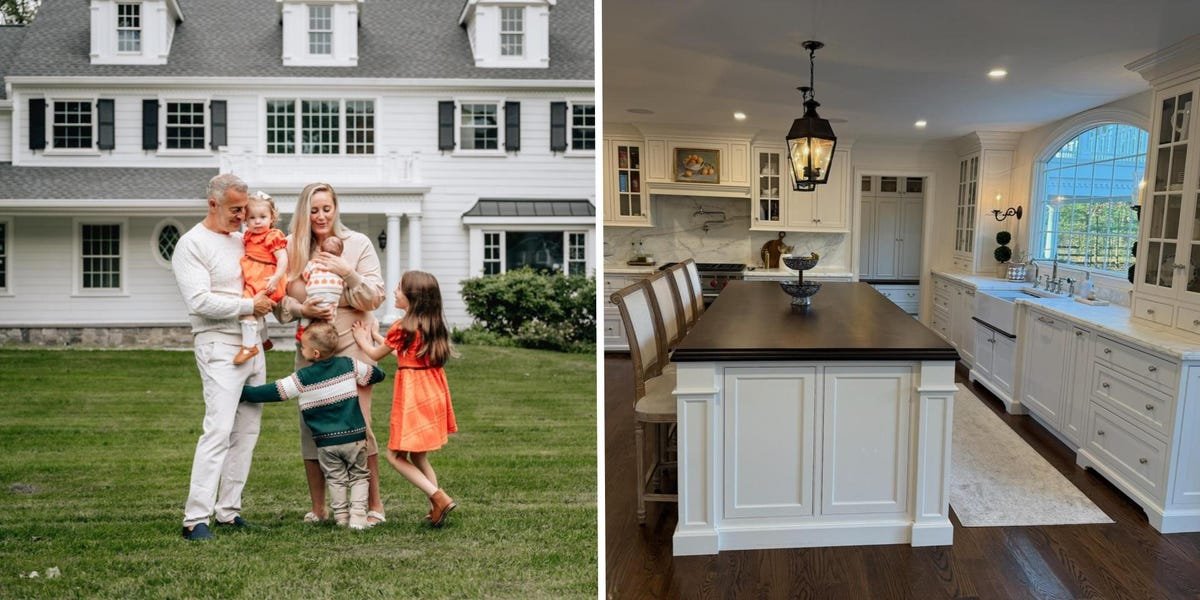
In October 2022, they saw a 2,700-square-foot house built in 1979 that spoke to Martino. It had four bedrooms, two bathrooms, and two half bathrooms, one of which was in the three-car garage. It was clearly a family home.
“The owners were there for 20-something years,” she said. “It was just dated, but it was very well cared for.”
Martino knew she would want to make substantial changes to the house, but the land it sat on made it feel like the perfect place to turn into their home.
“On our property, we have dozens of 100-foot trees,” Martino said. “All of the properties that you find for a brand-new build have nothing on them.”
She also loved the surrounding area, which offers easy access to apple orchards and horseback riding while remaining within commuting distance of her partner’s restaurants.
“It was like right price, right location, and we can do what we need to do to make it look how we wanted to in the end,” she said.
This as-told-to essay is based on an interview with Nguyen Thị Thanh Thơ, aka Hana Nguyen, 36, founder of Hana’s Coworking in Da Nang, Vietnam. It has been edited for length and clarity
I never planned to work with digital nomads. In fact, three years ago, I didn’t even know what “coworking” meant.
I was born in the countryside of central Vietnam and, in my teens, moved to Da Nang with my family for college. I first studied business administration, and later trained to become a pharmacist.
After graduating in 2016, I found a job in a local pharmacy. It was the typical job for many Vietnamese graduates: stable but low-paying; not especially challenging but also very boring.
I couldn’t get excited about it, and I didn’t see a future for myself there.
In 2023, I met a foreigner on an online forum who wanted to go hiking in the Marble Mountains, a group of cave-like temple structures in southern Da Nang. I decided to join.
At that time, I was curious about foreigners, but my English was poor, and I didn’t really know how to connect with people from other countries.
That small encounter changed everything. A few days after visiting the mountains, my new foreign friend took me to a coworking space. I had never seen anything like it before — people from all over the world working on laptops, speaking in English, and sharing ideas.
Something clicked immediately.
She began organizing events for both locals and digital nomads.
Provided by Hana Nguyen
I felt drawn to the community
I didn’t have money or experience, but I had motivation. In early 2024, I spoke to a friend who owned a hotel with an unused floor.
I offered to manage a coworking space there. I told her that I could try working there for two months for free. If it worked out, we could talk about money. If it didn’t, we could both move on.
After a few months, the project really took off, and I got some good exposure from Vietnamese TV and visiting content creators.
I worked there full-time for more than a year, doing everything myself — managing the space, cleaning, talking to customers, and organizing events. I negotiated a salary of about $250 a month, which wasn’t much, but I loved it.
Eventually, I realized I was building something valuable and with potential — but I didn’t own it. I began feeling exhausted and knew it wasn’t sustainable. Around the same time, my dad fell ill with cancer. I knew I needed to make more money to help my family, so when another friend offered me a space inside his bar — unused during the day — I said yes.
That was the first coworking space where I felt some ownership.
I didn’t have to pay rent, which worked because I had very little money — I couldn’t even afford to hire staff. But still, I managed to build the community. I organized events, beach trips, yoga, dinners — anything that helped people connect.
Since I wasn’t paying rent, I knew this arrangement could only be temporary, so I worked up the courage to ask my parents if we could convert one of the floors in our three-story family home into a coworking space. I explained that I’d need to borrow money from family members and spend a few months renovating the house.
Duc Nguyen for BI
Despite the risk, my parents agreed
It wasn’t easy. I was working nonstop and felt stressed, but the top floor, which can seat 18, filled up quickly, so I expanded the coworking space to other parts of the house. I can now fit 30 people and charge $76 a month.
I still manage everything myself. I don’t have employees. My father is a guard at the entrance, and my mother cleans the place, so it’s still very much a family business.
Many people ask me why there are so many digital nomads in Da Nang. I think it’s because the city is friendly, affordable, and super convenient. You have the beach, mountains, urban life, and an international airport close by.
Da Nang has a mix of beaches, mountains, urban life, and an international airport nearby.
Provided by Hana Nguyen
Da Nang is the kind of place where you can go for a walk along the beach in the morning, work during the day, swim in the sea in the afternoon, and eat great food in the evening — and it’s not expensive.
The biggest challenge I’ve seen among digital nomads is loneliness. Many people arrive alone, without friends, and everything feels unfamiliar — the culture, transportation, and daily life. That’s why community is so important. Everyone researches online before they come, but a real connection only happens in person. That’s exactly what I’m trying to foster with my coworking space.
At my events, around 20% of participants are Vietnamese. Many come to practice English, but they also learn about different ways of working and living. Some locals have even found freelance work with nomads in design, tech, and marketing. That makes me proud.
I’m still learning. I don’t have a big master plan. I just know I love connecting people, and I believe community can change lives — including mine.
Do you have a story to share about living abroad? Contact the editor at akarplus@businessinsider.com.