
FCC-chair-threatens-to-pull-licenses-of-broadcasters-airing-distortions.jpeg

FCC chair threatens to pull licenses of broadcasters airing ‘distortions’ about the Iran war

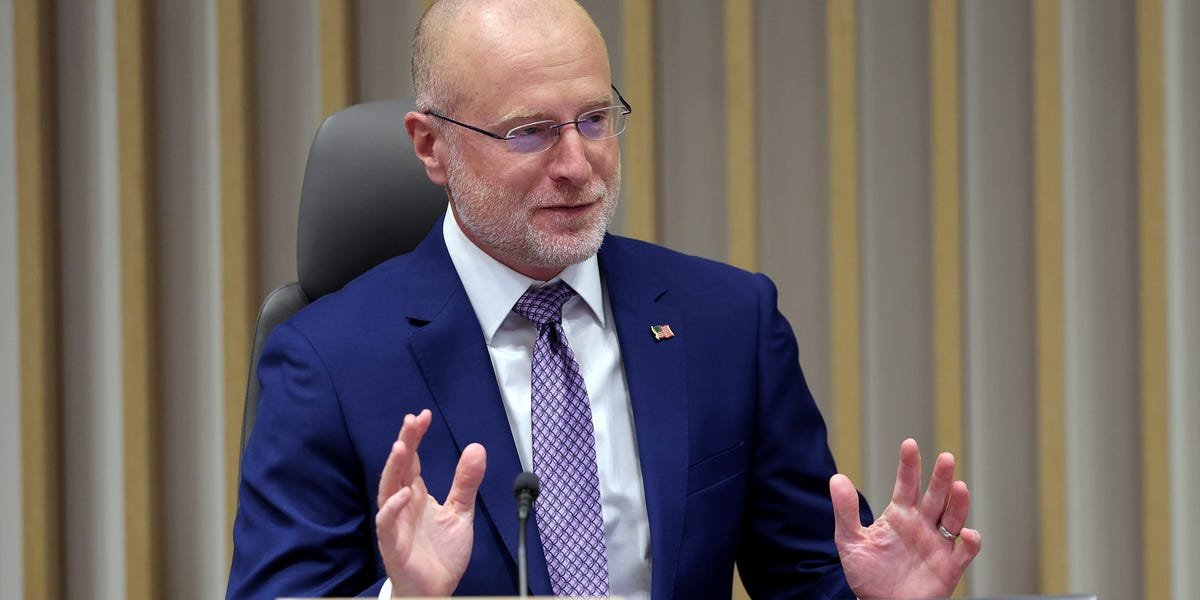
Federal Communications Commission Chair Brendan Carr warned broadcasters Saturday that they could lose their licenses if they air what he described as misleading coverage of the war involving Iran.

In a post on X, Carr said broadcasters spreading inaccurate reporting should “correct course” before coming license renewals.

“Broadcasters that are running hoaxes and news distortions — also known as the fake news — have a chance now to correct course before their license renewals come up,” Carr wrote. “The law is clear. Broadcasters must operate in the public interest, and they will lose their licenses if they do not.”

He did not specify which broadcasters may be at risk.

Carr’s comments included a screenshot of a Truth Social post from President Donald Trump accusing major newspapers of misrepresenting developments in the war, which began with US and Israeli strikes on Iranian targets and has since escalated across the region.

Trump wrote that headlines reporting that Iranian strikes had destroyed tanker aircraft at a Saudi base were “intentionally misleading,” saying the planes were not destroyed and that most were already back in service. Trump singled out The New York Times and The Wall Street Journal, writing that their coverage was “the exact opposite of the actual facts.”

The FCC regulates broadcast television and radio stations and grants them licenses to use public airwaves, which must be renewed periodically. The warning reflects a broader pattern of the FCC under Carr taking a more aggressive posture toward broadcasters’ content, and comes amid heightened tensions between broadcasters and the FCC over how political content is handled on air.

Since becoming chair during Trump’s second term, Carr has repeatedly pointed to the agency’s “public interest” standard and a rarely invoked “news distortion” policy as potential tools to scrutinize stations’ programming.

Earlier this year, CBS opted not to air a scheduled interview with Texas state Rep. James Talarico on “The Late Show with Stephen Colbert” after network lawyers warned the appearance could trigger the FCC’s “equal time” rule, which requires stations to provide comparable airtime to political candidates. The commission has recently signaled that late-night talk shows may not qualify for a long-assumed exemption to the rule and has also pursued enforcement actions related to a similar interview on ABC’s “The View.”

Critics, including former FCC officials and lawmakers, have warned that using those authorities to challenge editorial decisions risks pressuring news organizations over their coverage, while Carr has defended the approach as ensuring broadcasters meet their legal obligations.

Carr’s warning contrasts with comments he made earlier in his career. In a 2019 post on X, the then-commissioner wrote that “the FCC does not have a roving mandate to police speech in the name of the ‘public interest,'” a statement critics have resurfaced as he increasingly invokes that standard to scrutinize broadcasters’ programming.


Source link

FCC-Chair-Brendan-Carr-responds-to-Stephen-Colbert-calling-incident.jpeg

FCC Chair Brendan Carr responds to Stephen Colbert, calling incident ‘Democrat on Democrat violence’

Federal Communications Commission Chair Brendan Carr said it’s “fake news” to suggest that the government pressured CBS to pull a Democratic lawmaker’s interview from Stephen Colbert’s “The Late Show” earlier this week.

Carr addressed the latest flash point moment between broadcasters and the FCC in his Wednesday remarks during the commission’s February open meeting, saying there was “no censorship by the government here.”

Speaking to Fox News’ Laura Ingraham on Wednesday evening, Carr doubled down, describing the incident as “Democrat on Democrat violence,” rather than evidence that the commission had pressured CBS not to air the interview.

Instead, Carr said, CBS’s advice to “The Late Show” not to air an interview with James Talarico, a Democratic Texas state representative running for a hotly contested US Senate seat, was an appropriate response to prevent the commission from enforcing its equal time rule.

The equal time rule requires TV and radio broadcast stations to provide equivalent airtime opportunities to legally qualified political candidates, or risk fines or, potentially, the revocation of their broadcast license. The rule does not apply to bona fide newscasts, interviews, or on-the-spot news.

The rule has rarely been applied in recent decades. Broadcasters had generally understood a 2006 FCC ruling to mean that interviews on daytime and late-night talk shows were exempt from the rule. However, the FCC said in revised guidance sent to stations last month that “This is not the case.”

“Perhaps Colbert and other establishment Democrats want to put the thumb on the scale in this Democrat primary for one candidate over the other,” Carr told Ingraham. “I don’t know, you’ll have to ask them, but we’re going to enforce the law and hold broadcasters accountable.”

Carr told reporters during the FCC’s open meeting that the commission was pursuing “enforcement actions” against the talk show “The View” over its broadcast of an interview with Talarico.

“What we’re doing now is simply applying the law on the books in an even-handed manner, and for people that benefited from a two-tier system of justice during the Biden years, they may feel like that’s weaponization, but that doesn’t make it so,” Carr told Ingraham.

Representatives for Fox News, CBS, The Late Show, and the campaigns of Talarico and primary opponent Jasmine Crockett did not immediately respond to requests for comment from Business Insider. The FCC pointed to Carr’s remarks during the open meeting when reached for comment.

CBS previously said in a statement that it did not specifically prohibit “The Late Show” from broadcasting the interview, but that it did provide the show with legal guidance.

Colbert, who has hosted “The Late Show” since 2015, told his viewers on Monday that CBS lawyers said “in no uncertain terms” that his late-night talk show could not air the interview with Talarico. He also said he was told not to acknowledge the decision on air, which prompted his decision to post the interview on YouTube.

By the time of Carr’s appearance on The Ingraham Angle, Colbert’s interview with Talarico had received more than 3.8 million views — significantly more than other recent interviews, which average between about 75,000 and 510,000 views.

Rep. Crockett, a Democrat running against Talarico, said during a Tuesday appearance on “The Briefing with Jen Psaki” likely gave her primary rival a “boost.”

In a Wednesday social media post, Talarico’s campaign confirmed that the fervor around the incident had a positive effect, saying it had raised $2.5 million in 24 hours after the Colbert interview was scrapped.


Source link