David Ellison’s right-hand man is leaving Paramount Skydance.
Jeff Shell has stepped down from Paramount, where he’d been president since August 2025, the company said in a statement on Wednesday. As president, Shell helped oversee the company’s day-to-day operations.
The company said in a statement that it was “grateful for Mr. Shell’s many contributions and to have relied on him as a valued advisor.”
Shell’s departure comes weeks after a strange legal fight in which RJ Cipriani, a professional gambler and self-proclaimed whistleblower, sued the Paramount president for $150 million. In the suit, Cipriani alleged that he wasn’t paid for “crisis communications services” he provided and was misled about a TV show he said Shell promised to help him make.
Cipriani also accused Shell of telling him about sensitive, non-public information, including its deal to secure UFC rights in the US.
In response, Shell countersued Cipriani, alleging extortion and defamation and calling the case “a shakedown.”
Cipriani is not shy about his history of alerting the feds. He told The Hollywood Reporter in an interview: “If that’s extortion, I guess I’m an extortionist. I don’t know what to tell you.”
Paramount said in its statement that it “followed standard practice” and, with the help of a law firm, “conducted a complete and thorough review” of Cipriani’s allegations.
“The facts demonstrated that these allegations do not establish a securities law violation,” Paramount said. The company added that Shell “has elected to transition” from his role as president and Paramount’s board “to focus on this lawsuit.”
Prior to joining Paramount, Shell was chairman of RedBird Sports and Media, led by Paramount investor Gerry Cardinale.
Shell also served as CEO of NBCUniversal for more than three years. NBCU fired Shell for cause after an investigation into allegations of sexual misconduct against him, leaving the executive without more than $43 million in severance he would have received. Shell apologized for an “inappropriate relationship” with a colleague and said he was “truly sorry” to employees at NBCU and Comcast, its parent company.
Shell helped guide Ellison as he became Paramount’s CEO last August, including through the media company’s turbulent pursuit of Warner Bros. Discovery.
Ellison has remade Paramount in other ways besides buying WBD. Those include bringing in polarizing editor Bari Weiss as the top editor at CBS News and requiring many Paramount employees to work in the office full time.
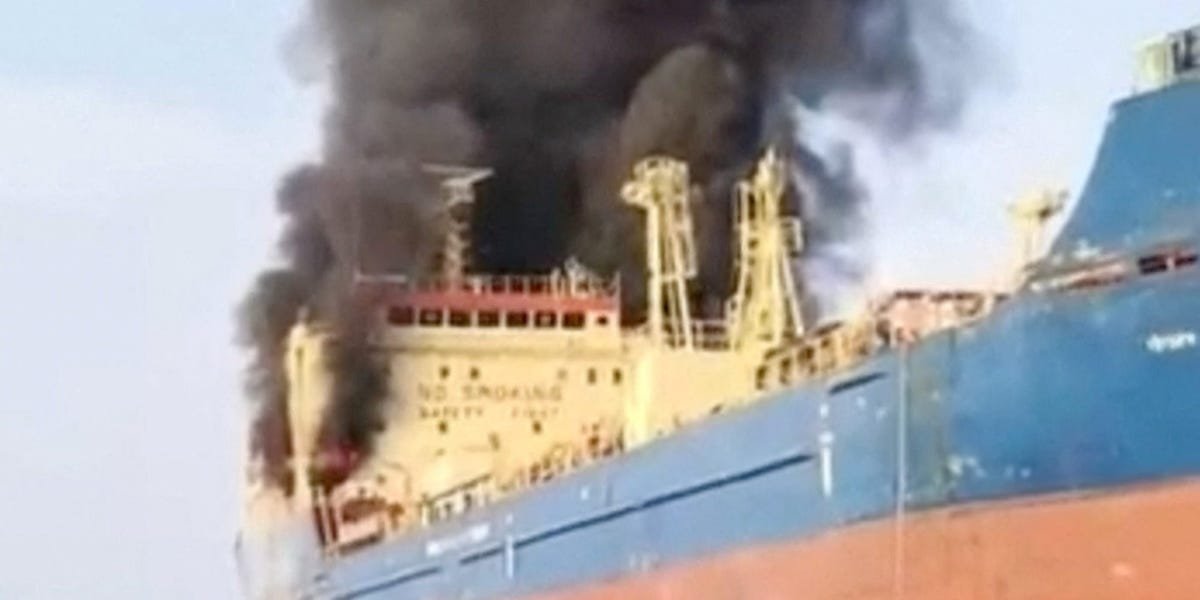
Exploding drone parts are now part of the growing fight between the US and its partners and Iran. Oman said one struck a tanker and resulted in the death of a crew member.
Oman News Agency, the state news agency of the Sultanate of Oman, said on Monday that an oil tanker flagged to the Republic of the Marshall Islands “was attacked by an unmanned surface vessel.”
It said “the attack triggered a fire and explosion within the main engine room, resulting in the fatality of one crew member of Indian nationality.”
The tanker, MKD VYOM, was around 52 nautical miles off the coast of Oman and had 21 crew members on board: 16 Indian nationals, four Bangladeshi nationals, and one Ukrainian national. They were evacuated by commercial vessel MV SAND, which flies Panama’s flag, the report said.
It said that a vessel from Oman was monitoring the condition of the tanker that was hit and that it was giving navigational warnings to ships nearby. The hit tanker was carrying an estimated 59,463 metric tons of cargo.
The use of drone boats adds to what was already a growingly precarious situation in highly strategic waters, with reports of vessels being targeted and hit by incoming munitions.
Oman did not say who the drone boat belonged to. Iranian officials have said that Iran has them in its arsenal, and Iran has also repeatedly tried to steal US drone boats. The Iranians and their proxies in the region have also previously threatened and attacked merchant vessels.
No naval force operating in the region has said it is using the technology in the conflict that boiled over this past weekend.
Drone boats are an increasingly prominent warfighting technology. They gained notoriety as Ukraine used them against Russia’s Black Sea Fleet, leveraging the low-cost assets to damage and destroy expensive Russian warships. Russia has since adopted the tech. Other actors, like the Houthi rebels, an Iranian proxy group in Yemen, have used them in attacks as well. Western militaries are using this technology too, but primarily for reconnaissance.
The waters around Oman and Iran are hugely important to global trade. They include the Strait of Hormuz, where around 20% of the world’s daily oil supply passes through.
Multiple ships came under fire in this area over the weekend and on Monday, with crews evacuated and some injured. Several major shipping companies have said that they are avoiding the area to keep crews safe.
The US and Israel launched attacks on Iran on Sunday, hitting aircraft, command and control centers, warships, missile sites, and killing Iran’s Supreme Leader. Iran retaliated by firing towards a host of nearby countries that have US bases. Fighting continues.
Israel and Hezbollah both said on early Monday local time that they had launched strikes at each other, blowing open a new front in the ongoing regional war.
In a statement published by Lebanese media, Hezbollah said that it had launched “a barrage of advanced missiles and a swarm of drones” against a missile defense site in Haifa, which is in northern Israel.
The group said the attacks were carried out “in revenge for the pure blood of the Supreme Leader of Muslims,” referring to the death of Iranian leader Ayatollah Ali Khamenei.
The Israel Defense Forces also said in a statement that it had begun striking Hezbollah targets in Lebanon “in response to projectile fire toward northern Israel.”
“Hezbollah is operating on behalf of the Iranian regime, opening fire against the Israeli civilians, and bringing ruin to Lebanon,” it said.
Every time Matthew publishes a story, you’ll get an alert straight to your inbox!
Stay connected to Matthew and get more of their work as it publishes.
The statement further said that Israeli troops were prepared for “an all-fronts scenario.”
The Israeli air force said that the Hezbollah launches “fell in open areas” within Israeli territory, and that Israeli forces had begun striking the Beirut area.
Social media videos of the Lebanese capital have so far shown damaged cars and buildings, particularly in the southern suburb of Dahieh. The full extent of the strikes there is not immediately clear.
Israeli forces have told about 50 villages in southern and eastern Lebanon to evacuate, saying that it is likely to begin conducting strikes against Hezbollah targets there.
Hezbollah has long been backed by Iran, which the US and Israel began attacking on Saturday with an onslaught of strikes from ground, air, and sea forces amassed in the region.
Tehran, Washington, and Tel Aviv said that Khamenei, a central figure for decades among militant groups in the region, had been killed within the first 24 hours.
Iran has responded by launching missiles and drones at over half a dozen of its neighbors, such as the United Arab Emirates and Bahrain, saying it is attacking military sites.
Hezbollah’s entry into the fight means that Tehran’s response is now joined by one of its regional allies. However, it remains to be seen how deeply involved the politically powerful Lebanese group will become.
Fears remain that the Houthis, a rebel group in Yemen that is closely tied to Iran’s government, may soon renew attacks in the Red Sea.
The Yemeni militia previously launched drones and missiles at commercial vessels attempting to pass through the key shipping lane, saying they were protesting Israel’s extensive bombardment campaign and occupation in Gaza.
Meanwhile, in the Strait of Hormuz, a vital waterway for the global oil market between the Persian Gulf and the Gulf of Oman, several tankers reported coming under attack on Sunday as the war raged.
Although Iran maintains significant control over the strait, it’s not yet clear who is orchestrating or launching these attacks.
The US and Israel’s fight with Iran shows just how key air defenses have become in higher-intensity modern wars, conflicts increasingly defined by long-range missile and drone attacks.
The conflict, which killed Iran’s Supreme Leader, has been heavily focused on air defenses, either knocking them out to permit air operations or leaning hard on them to shield bases from retaliatory strikes.
The US and Israel said their strikes focused on Iran’s air defenses and missile launch sites, and US and partner forces in the countries attacked in response relied on a mix of air defenses to fend off Iranian weapons.
Kuwait, home to installations like Ali Al Salem Air Base that hosts US troops, reported on Sunday that it had faced 97 ballistic missiles and 283 drones. Defeating this kind of barrage demands deep air defense arsenals.
When air defenses fall short
US Central Command on Saturday said the strikes on Iran aimed to “dismantle the Iranian regime’s security apparatus” and prioritized locations “that posed an imminent threat,” listing Iranian air defense capabilities, missile and drone launch sites, and military airfields as targets.
US Central Command shared footage of strikes on Iranian targets, including Iranian air assets.
US Central Command/X
The Israel Defense Forces said that they had “dismantled the majority of the aerial defense systems in western and central Iran” and are “paving the way towards establishing aerial superiority over the skies of Tehran.”
On Saturday, Israel used around 200 jets to drop hundreds of bombs on 500 targets on Saturday, including Iran’s air defense systems and missile launchers.
Having insufficient air defenses can leave a country severely vulnerable in a war of ranged strikes by creating a permissive environment for enemy airpower, as well as munitions, to find their targets, be they military installations or senior leadership. Over the past day, Iran has suffered serious losses to both.
Air defenses matter in a missile fight
Air defenses have been critical for the US and its allies this weekend.
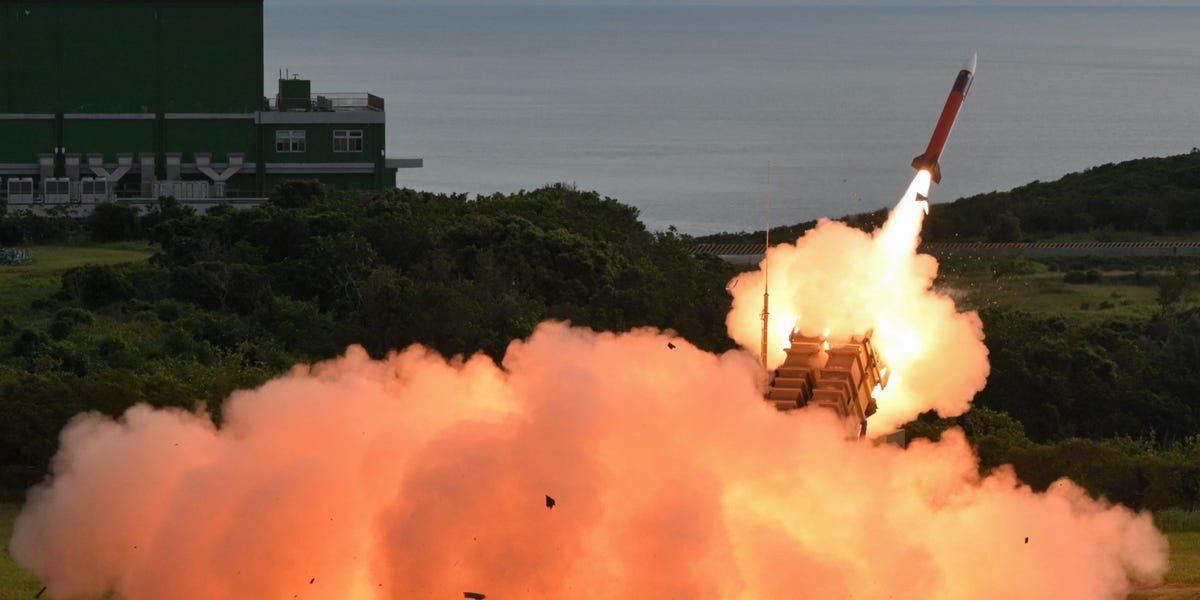
CENTCOM said it was able to defend against hundreds of Iranian missile and drone attacks, with no casualties. A US official told Business Insider that US-made MIM-104 Patriot surface-to-air missile systems and Terminal High Altitude Area Defense, or THAAD, batteries were used to protect the Middle East from Iran’s retaliatory strikes. Warship-launched interceptors and aircraft were also involved, as they’ve been in other engagements involving big Iranian missile barrages.
Nations attacked by Iran, countries like Qatar, the United Arab Emirates, and Bahrain, said they were largely able to intercept Iran’s missiles, sometimes stopping entire waves. Details are still emerging, but damage appears minimal. Casualties, likewise, have been extremely limited thus far, at least compared to what they might have been otherwise.
Some of Iran’s retaliatory strikes were successful, but countries reported intercepting entire waves of attacks with air defenses.
Stringer/REUTERS
That was only day one though. Iran has a large missile arsenal, and it has pledged to continue its attacks. Continued large barrages will put tremendous strain on air defense arsenals.
Along with other current and potential conflicts, Iran is yet more evidence that much of modern war has become ranged missile fights. If you don’t have good air defenses, you may very well lose.
This is a very different way of war compared to the fights against terrorists and insurgencies that the US and its allies waged for decades in the Middle East.
More would be needed for higher-end threats
China and Russia both field substantial missile arsenals that they are continuing to expand. The West is aware, but the war in Ukraine, where Russia bombards Ukrainian cities nightly with massive mixes of missiles and drones, has been a real wake-up call.
Ukraine has been developing its own air defenses while seeking additional options from partners. Each barrage is extremely demanding. In one engagement, Ukraine expended nearly $100 million in interceptors fighting off Russian attacks.
Much of the West has allowed air defense arsenals to atrophy, but there are significant new investments in air defense across the NATO alliance.
The NATO chief pledged a fivefold increase in air defenses, driven by the alliance’s increased spending. Established manufacturers are increasing production, and new systems are being created. President Donald Trump wants his Golden Dome missile defense system to protect against complex attacks from Russia and China.
But air defense systems and their missiles are expensive and time-consuming to make, and the industry is struggling to keep up with increasing demand, even with companies boosting output.
Mick Ryan, a retired Australian major general and strategist with a focus on future war, said that the heavier demand could cause new problems. Patriot interceptor missiles are critical to Ukrainian defenses, but are in heavy demand at present in the Middle East,” he wrote on Saturday.
Russia, he said, will want to “exploit any temporary Ukrainian capability gaps while American attention and production capacity focuses on Iran.”
The US will also need to maintain a strong air defense posture in both Europe and the Pacific as well, even as it fights Iran.
Ryan warned that concentrating US missile defense assets in the Middle East could degrade its deterrence in the Pacific: “Every carrier in the Gulf, every squadron in Europe, every missile defence battery protecting Middle Eastern countries represents capacity unavailable for containing Chinese expansion.”
Iran launched missile strikes into at least six countries in retaliation for the Saturday morning attack by the US and Israel.
Multiple countries across the Middle East reported Iranian bombardments, with the IRGC, the Islamic Revolutionary Guard Corps, saying that it had launched attacks on US bases.
Iran said it targeted at least four bases hosting US forces in the Middle East. Details about the scale and the impact of the strikes are still emerging, but multiple nations reported being able to intercept the attacks. Some have reported damage and at least one death from debris. At least one US base appears to have been hit.
Bahrain’s state news agency said that the US Navy’s 5th Fleet service center was the subject to a missile attack, without offering details or reporting any casualties. Iran also said it targeted the base. The agency also reported Bahrain’s defense forces saying that its air-defense systems successfully intercepted multiple missiles from Iran.
Qatar’s defense ministry said successfully intercepted three waves of attacks that had targeted multiple areas of the country, and that all missiles were intercepted before they reached the country’s territory, the state-run Qatar News Agency reported.
Qatar hosts Al Udeid, the biggest US base in the region. Iran said it targeted the base, without giving details over whether it was successful. The US has not confirmed an attack. Qatar condemned what it said were Iranian strikes on US bases in Qatar and neighboring countries.
Jordanian state media reported the country’sair defense systems successfully intercepting two ballistic missiles that targeted the country.
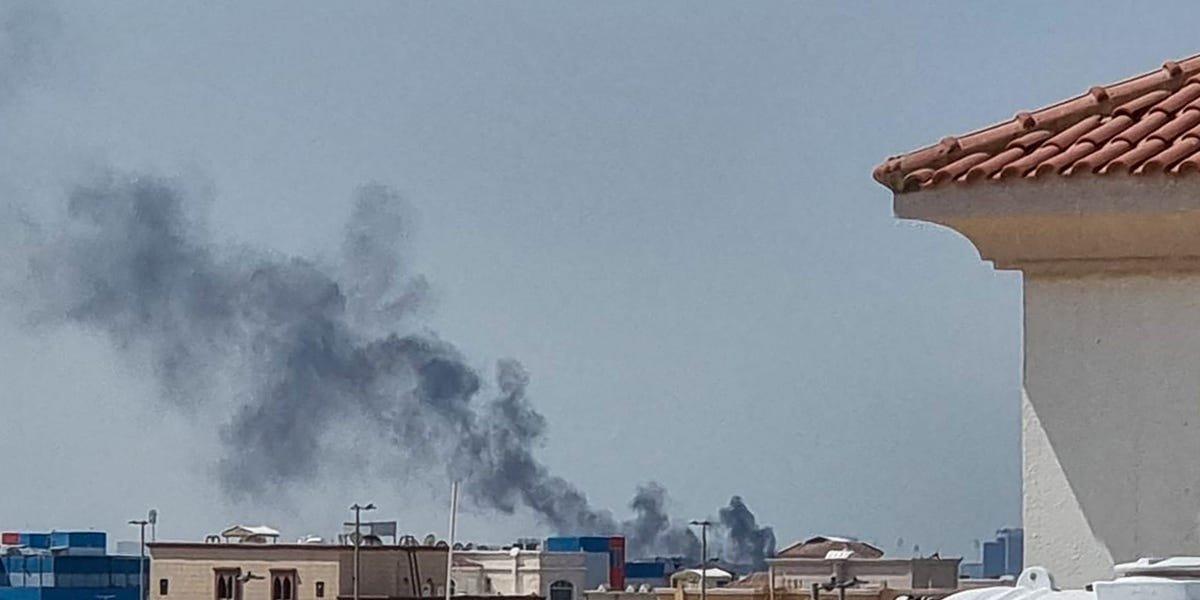
A smoke plume rises over Abu Dhabi from the site of an Iranian missile strike.
AFP via Getty Images
The country’sPublic Security Directorate said there have been 12 separate incidents created by falling debris across the country, causing some damage but with no reported civilian casualties.
The Muwaffaq Al-Salti Air Base in Jordan, which is key for the country’s air force and also has a US military presence, was targeted, Iranian state media reported. It did not give any details over whether the reported attack was successful, and the US has not confirmed any attack.
The United Arab Emirates’ defense ministry said it intercepted Iranian ballistic missiles across multiple attacks. It said one person was killed by falling debris in Abu Dhabi, the country’s capital.
It shared images of what appears to be downed Iranian missiles.
It said that missile debris also damaged some infrastructure. Explosions were also reported in Abu Dhabi and Dubai. Its Al Dhafra Air Base hosts US forces. The IRGC said that the base was targeted, but that has not been confirmed.
A plume of smoke rises over Tehran, Iran.
Mahsa / Middle East Images / AFP via Getty Images
Kuwait’s army said its air defenses intercepted missiles that were detected in the country’s airspace. The country hosts the US military at its Al Salem Air Base, another base the IRGC said was targeted but with no confirmation.
Israel reported multiple missile barrages from Iran, but has not reported any deaths or major damage to the country.
Successful attacks have been reported in Iran, and its people are trying to flee the capital city, Tehran. Iranianofficials said an Israeli attack on a girls elementary school in southern Iran killed least 51 people. Israel has released video footage of strikes in Western Iran against missile launchers and other targets.
US embassies in countries across the region have given advice to Americans to shelter-in-place.
Attacks and counter-attacks are still ongoing. US President Donald Trump said that he would destroy Iran’s missile program and navy and make sure that the country can “never” have a nuclear weapon.
“The lives of courageous American heroes may be lost, and we may have casualties. That often happens in war,” Trump said in a statement. “But we’re doing this not for now — we’re doing this for the future. And it’s a noble mission.”
Flights have been cancelled across the region with multiple countries closing their air spaces, creating major disrupution in one of the world’s busiest flight routes.
Hilary Duff, 38, says she walked away from her first marriage because she didn’t want to sacrifice her own happiness — even as a young mom.
On Wednesday’s episode of “Call Her Daddy,” the “Lizzie McGuire” star spoke about navigating a divorce in her late 20s and how motherhood shaped her approach.
Duff split from her first husband, Mike Comrie, in 2015. They share a son, Luca, who was born in 2012.
“I knew from my parents’ divorce that I was going to show my kid that you’ve got to fight for your happiness. And I knew that it was going to be better to do it when he was younger than it was going to be when he was five and aware, or eight and aware,” Duff told podcast host Alex Cooper.
Duff added that kids can sometimes blame themselves when their parents’ marriage doesn’t work out.
“I was like, if Luca cannot remember this and have two lives that exist that he can be happy in and feel secure in, I think we’re winning,” she said.
Duff said therapy was essential in helping her process the end of her marriage, and ultimately, the experience taught her to stand up for herself.
“You’ve got to fight for yourself, and it doesn’t matter that you have kids. Your kids are going to be OK. You know what I mean? You just have to show them that you also matter,” Duff said.
As a parent, it’s easy to lose yourself in your child and feel like their needs should outweigh your own, she said. But she added it was also “important” not to let that be the deciding factor in whether she stayed in an unhappy marriage.
Duff added that mom guilt can sometimes overshadow her own feelings.
“There’s this part of your brain where you’re like, ‘Yeah, I’m still in here, and I’m still me,’ and then there’s this huge shadow over it that’s like, ‘But everything for the family and everything for your kid,'” she said.
Duff added that finding balance between motherhood and her own identity is something she has to work at.
“It’s a constant conversation to choose yourself and choose something you know that you enjoy outside of family life and kids,” she said.
In 2019, Duff married Matthew Koma, and the couple has three daughters.
Duff isn’t the only celebrity who has spoken about navigating divorce with kids.
In a 2022 podcast appearance, Kim Kardashian said she tries to protect Ye, formerly known as Kanye West, in the “eyes of my kids, for my kids.”
“One day my kids will thank me for not sitting here and bashing their dad when I could. They’ll thank me and I’ll privately answer anything that they want to know. But it’s not my place anymore to jump in,” she said.
In February, Miranda Kerr said choosing forgiveness helped her co-parent peacefully with her ex, Orlando Bloom.
“When you have a child with someone else, they’re always going to be that person’s parent for the rest of their life. There are going to be situations where you’re going to need to talk if you like it or not. So why not make it harmonious?” Kerr said.