
Heres-how-US-combat-search-and-rescue-crews-save-downed-fighter-pilots.jpeg

Here’s how US combat search-and-rescue crews save downed fighter pilots in the middle of a war

When a US aircraft goes down in combat, rarely used but highly trained airborne search-and-rescue crews spring into action.

Multiple American media outlets, citing anonymous US officials, reported the loss of a US Air Force F-15E fighter jet to enemy fire over Iran and the subsequent search for the downed airmen on Friday. Later reports indicated that two search-and-rescue helicopters were hit during operations, underscoring the risks of these kinds of missions. Both helicopters managed to return to base.

Additionally, an A-10 Thunderbolt II attack aircraft crashed in Kuwait territory after taking hostile fire the same day. The A-10 pilot was safely recovered, reports said.

US Central Command has not commented publicly on these incidents, nor has it shared information in response to Business Insider’s queries concerning them. As of Friday afternoon, one member of the two-person F-15E Strike Eagle crew had been rescued by American forces, according to The Washington Post and other reports.

The status of the second F-15E crew member is unclear.


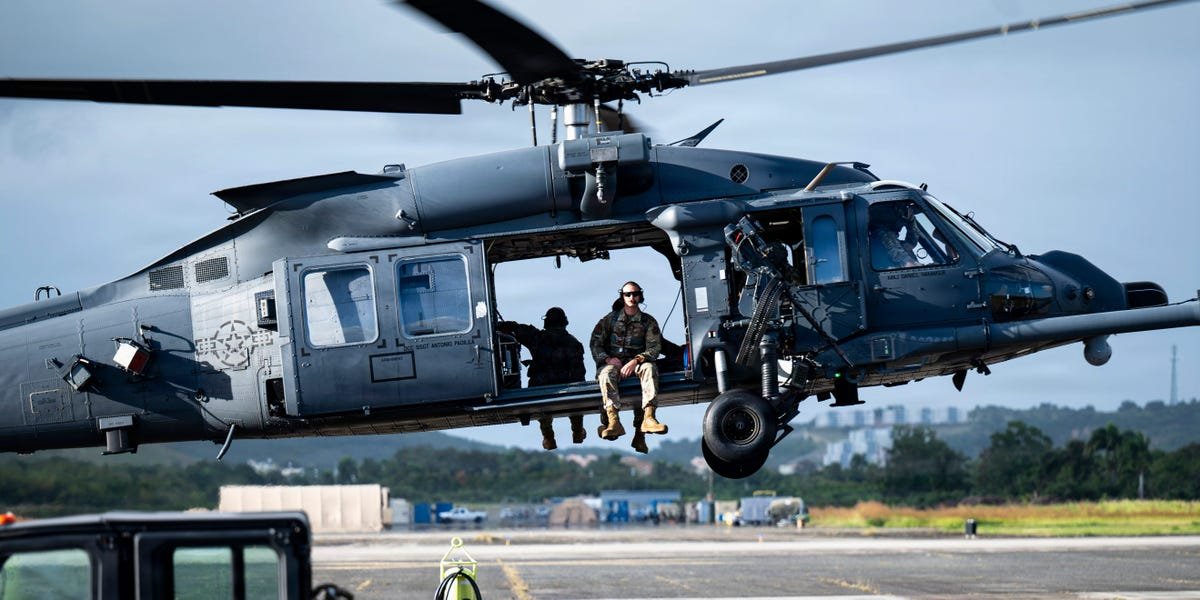
A 305th Rescue Squadron HH-60W Jolly Green II receives fuel from a HC-130J Combat King II off the coast of California during an exercise on Dec. 7, 2025.

A 305th Rescue Squadron HH-60W Jolly Green II receives fuel from a HC-130J Combat King II off the coast of California during an exercise. 


Master Sgt. Darius Sostre-Miroir/US Air Force


Business Insider spoke with a current Air Force search-and-rescue pilot about the operations they carry out.

He said that the Friday rescue mission, which videos showed being conducted in broad daylight, was extraordinarily bold. Air Force combat search-and-rescue, also known as CSAR, is the military’s force dedicated to rescuing downed aircrew.

Combat search-and-rescue missions are dangerous under the best of conditions, he said, ideally on dark nights with no moonlight.

“Darkest of dark nights, this is still pretty intense and pretty scary. Doing this in full moonlight would still be risky,” he said. More light means increased risk to the crew, more easily spotted by enemy weapons that often lack the advanced night capabilities the US military possesses.

But a rescue mission in broad daylight exposing crews to a variety of threats “is just some complete other level,” the pilot said, noting it reflected the urgency to locate American personnel. “It is sort of terrifying to go like, ‘let’s just go fly in broad daylight into the middle of a country that is at war with us,” he said.

For American troops, rescuing downed comrades is one of the most sacred duties, the pilot told Business Insider. Finding crews before the enemy does is critical and serves both the service members and broader operations, as capture can have serious strategic consequences.

Aircrews, and other service members like special operations personnel, train for the possibility that they might end up stuck behind enemy lines or be captured during their SERE training, short for ‘survive, evade, resist, escape,” which helps troops prepare for potential POW experiences.

Search-and-rescue crews have developed alongside combat aviation. The Vietnam War — when American aircraft were frequently shot down and aircrews were captured as POWs — saw the expansion and refinement of these operations, with coordinated, specialized units sent deep into enemy territory to rescue downed airmen. The helicopters used in these missions now share the name “Jolly Green” with those of the Vietnam era.

So what does the rescue mission look like today?

“The CSAR mission is extremely well resourced in the USAF,” Greg Bagwell, a former British Royal Air Force senior commander and airpower expert, wrote on social media, explaining that these operations rely on units from within Air Combat Command and Air Force Special Operations Command. “It is well practiced by all aircrew and is a key part of any mission brief.”

The mission often involves Pave Hawk helicopters (a derivative of the well-known Black Hawk made for search-and-rescue), HC-130 refuelers, and Pararescue Jumpers, commonly known as PJs, supported by special mission aviators operating guns and hoists on the helicopters.

Helicopters scouring the terrain for downed troops are slow, not well-armed, and need fuel support to keep up the search.

Another aircraft, such as A-10 Warthog ground-attack aircraft, might float nearby and serve as a mission command aircraft, a sort of quarterback that can direct rescue assets, the American CSAR pilot said. Such aircraft may also defend search-and-rescue forces.


An Air Force HH-60W Jolly Green II takes off in Ceiba, Puerto Rico, Jan. 23, 2026.

An Air Force HH-60W Jolly Green II takes off in Ceiba, Puerto Rico. 


Senior Airman Gabriel Jones/US Air Force


The crews in the search-and-rescue helicopters incur serious risk, flying low and slow in their search.

“They’re trying to get in, avoid hostile fire, and somehow locate this individual,” the pilot said. “And the goal is for the PJs to run out, grab the guy who looks American, drag him in the helicopter and go.”

When an aircraft is shot down in combat, the likelihood that the downed airmen are hiding somewhere near the enemy is high, meaning CSAR crews may face an adversarial response.

On top of the concerns about enemy fire, including everything from small arms to shoulder-launched rockets and surface-to-air missiles posing a threat, the helicopter crews also have to be prepared to operate in any kind of environment, from open terrain with high exposure to complicated urban battlespaces with hard-to-see power lines and other obstacles.

“You train a whole lot, and the hope is you never have to do it,” the CSAR pilot said of the missions. “But you certainly train to do it every single day.”


Source link

Israel-struck-Iran-with-F-35I-Adir-stealth-fighter-jets-that.jpeg

Israel struck Iran with F-35I Adir stealth fighter jets that cost $44,000 per hour to fly

Updated

  • Israeli Air Force F-35I planes struck Iranian missile systems and military leaders on Saturday.
  • The Israeli F-35 variant is known as “Adir,” meaning “Mighty One” in Hebrew.
  • The planes also struck Iran in June and aided defenses against Iranian missiles in 2023 and 2024.

Israel launched what it called “the most extensive aerial operation ever conducted by the Israeli Air Force” on Saturday, targeting Iranian missile systems and military leaders in tandem with US forces. Israel’s F-35I stealth fighter jets were on the front lines.

The Israeli variant of the US-made Lockheed Martin Lightning II Joint Strike Fighter plane is known as “Adir,” meaning “Mighty One” in Hebrew. With advanced stealth capabilities and a customized electronic warfare system, the F-35I is one of the most powerful tools in Israel’s air defense arsenal.

In addition to Israel’s newest assault on Iran, the Israeli planes also conducted preemptive strikes against Iran’s nuclear program in June, intercepted hundreds of drones, missiles, and rockets fired by Iran in a retaliatory attack in 2024, and took down a missile fired by an Iran-backed group in Yemen in 2023, according to the Israel Defense Forces.

Here’s a closer look at the “Mighty One” military aircraft.

F-35 Lightning II stealth fighter jets, produced by Lockheed Martin, are some of the most advanced military aircraft in the world.

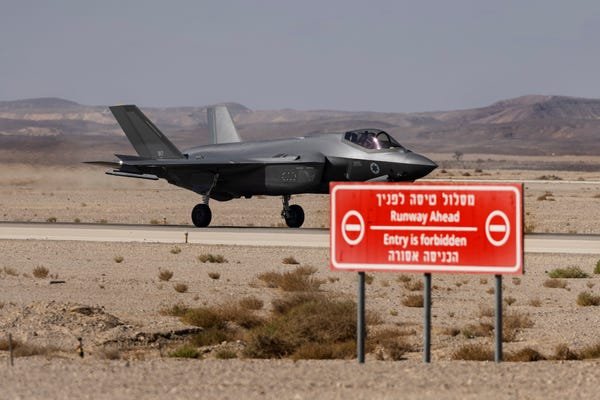
An Israeli F-35I lands at Ovda airbase near Eilat, southern Israel.

Tsafrir Abayov/AP

The F-35 stores its weapons and fuel internally, and its aligned edges and radar-absorbent coating also help the aircraft evade detection. The planes cost $44,000 per hour to fly, The National Interest reported.

They feature advanced stealth and information-processing capabilities and can reach supersonic speeds of Mach 1.6, or 548.8 meters per second.


An Israeli Air Force F-35I Adir multirole fighter aircraft

An Israeli Air Force F-35I Adir fighter aircraft flies over the Negev Desert.

YURI CORTEZ/AFP via Getty Images

Lockheed Martin CEO Marillyn A. Hewson said in 2018 that the planes “can fly in what we call ‘beast mode,‘ carrying up to 18,000 pounds of internal and external ordnance, in a mix that can include 5,000-pound-class weapons.”

In 2016, Israel became the first country other than the US to acquire F-35 fighter jets.


Israeli Prime Minister Benjamin Netanyahu stands next to a F-35 fighter jet just after it landed in Israel at Nevatim air base  in 2016

Israeli Prime Minister Benjamin Netanyahu stands next to an F-35 fighter jet just after it landed in Israel at Nevatim air base.

Amir Cohen/Reuters

Israel was the first country to select the model through the US Foreign Military Sales process and bought 50 planes, according to Lockheed Martin.

Israel has made significant modifications to the jets.


A new production line for F-35 wings is seen in Israel Aerospace Industries' (IAI) campus, near Tel Aviv

A production line for F-35 wings in Israel Aerospace Industries’ (IAI) campus near Tel Aviv.

Amir Cohen/Reuters

Israel manufactures its own wings and electronic warfare system for the F-35I. It also developed its own version of the high-tech helmet that displays the plane’s airspeed, altitude, targeting information, and other crucial stats directly on the pilot’s visor.

The Israeli Air Force named its F-35I variant “Adir,” meaning “Mighty One” in Hebrew.


Israeli Air Force technicians customize an F-35I plane with a Star of David symbol.

Israeli Air Force technicians customize an F-35I plane with a Star of David symbol.

Israeli Air Force

The Israeli Air Force also added a six-pointed Star of David to the design, a Jewish symbol that also appears on the Israeli flag.

In 2018, Israel became the first country to use the F-35I in combat, its air force chief said.


An Israeli Air Force F-35 flies during an aerial demonstration

Israeli Air Force F-35 flies during an aerial demonstration.

Amir Cohen/Reuters

“We are flying the F-35 all over the Middle East and have already attacked twice on two different fronts,” then-Israeli Air Force chief Major-General Amikam Norkin said in a speech at a gathering of foreign air force leaders, Reuters reported.

In July 2023, Israel acquired an additional 25 Adir planes in a $3 billion deal.


Israeli F-35I planes at Nevatim airbase in Israel.

Israeli F-35I planes.

Israeli Air Force

The deal was financed through the military aid Israel receives from the US, Reuters reported.

In November 2023, Israel’s F-35I Adir fighter jets took down a missile fired by an Iran-backed group in Yemen, according to the IDF.


An Israeli F-35 fighter jet

A F-35I fighter jet flies during a graduation ceremony for Israeli Air Force pilots in southern Israel.

Amir Cohen/Reuters

It was the first known intercept of a cruise missile by an F-35 plane.

The Israeli Air Force released footage of the encounter on X, writing in Hebrew that its personnel are “preoccupied at every moment with planning and managing the defense response and are prepared for any threat in any area.”

Iran appeared to target the Nevatim air base, which houses Israel’s fleet of F-35I jets, during an attack in April 2024.


An Israeli F-35 combat aircraft is seen in the skies over Israel's border with Lebanon

An Israeli F-35 combat aircraft in the skies over Israel’s border with Lebanon.

Ammar Awad/Reuters

Out of the over 350 ballistic missiles, cruise missiles, and UAVs, or unmanned aerial vehicles, launched at Israel by Iran and its proxies in Iraq, Yemen, and Lebanon, around 99% were intercepted by Israel and its allies. The IDF released photos showing minor damage near a runway at the Nevatim Airbase and to a road in Hermon caused by the few projectiles that landed.

The missiles appeared to target Israel’s Nevatim Airbase in the Negev desert, which houses its fleet of F-35I stealth fighter jets. The base remained operational throughout the attack, according to the IDF, with the Adir fighter jets aiding the defensive mission.

“Iran thought it would be able to paralyze the base and thus damage our air capabilities, but it failed,” IDF spokesperson Rear Adm. Daniel Hagari said in a statement.

In June 2025, the Israeli Air Force launched around 200 fighter jets, including F-35Is, in a preemptive strike targeting Iran’s nuclear program.


An F-35I Israeli fighter jet used in strikes against Iran.

An F-35I Israeli fighter jet used in strikes against Iran.

Israel Defense Forces

An IDF spokesperson said that Israeli fighter jets struck over 100 sites across Iran to prevent it from developing a nuclear weapon, including military targets and its largest uranium enrichment site in Natanz.

The IDF said that Iran’s nuclear program had “accelerated significantly” in recent months and called it “clear evidence that the Iranian regime is operating to obtain a nuclear weapon.” Iran maintains that its nuclear program is solely for civilian purposes.

“This is a critical operation to prevent an existential threat by an enemy who is intent on destroying us,” Lt. Gen. Eyal Zamir, the IDF’s Chief of the General Staff, said in a statement.

The IDF released photos showing planes used in the large-scale operation, including F-35I jets.

F-35Is struck Iran over the weekend in what the IDF called “the largest military flyover in Israeli Air Force history.”


US and Israeli F-35s flying together during a training exercise.

US and Israeli F-35s flew together during a training exercise. The two countries launched new strikes against Iran using land, air, and sea assets.

U.S. Air Force photo by Senior Airman Duncan C. Bevan

As part of Operation Roaring Lion, Israel’s moniker for Operation Epic Fury, around 200 Israeli fighter jets, including F-35Is, struck 500 Iranian missile launchers and aerial defense systems on Saturday. IDF spokesperson Lt. Col. Nadav Shoshani characterized the operation as “the most extensive aerial operation ever conducted by the Israeli Air Force.”

The strikes “significantly degraded” Iran’s offensive capabilities, the IDF said. The strikes also killed Iranian military leaders, including Iranian Defense Minister Aziz Nasirzadeh and Mohammad Pakpour, commander of the IRGC.

The war in Gaza prompted new scrutiny of US military aid to Israel.


An Israeli soldier sits inside a F-35 fighter jet

An Israeli soldier sits inside an F-35I fighter jet after it landed in Israel at Nevatim Airbase.

Amir Cohen/Reuters

The October 7 terrorist attacks carried out by Hamas killed around 1,200 Israelis and captured over 240.

Israel’s counteroffensive airstrikes and military actions in Gaza resulted in over 72,000 Palestinian fatalities, according to figures provided to the United Nations Office for the Coordination of Humanitarian Affairs by the Hamas-run Ministry of Health in Gaza. The IDF reports that at least 17,000 of these fatalities were Hamas militants. A ceasefire agreement was reached in October.

According to the United Nations Relief and Works Agency, over 1.9 million Gazans, around 90% of the population, have been displaced by the war.

The devastating human toll of the war in Gaza with US-funded planes like the F-35I has prompted new scrutiny of US aid to Israel, with some lawmakers in Congress raising the possibility of conditioning military and economic aid.


Source link

Headshot of Chris Panella.

Israeli combat footage shows it bombing vintage American-made fighter jets in Iran

Israel shared new footage of it bombing two of Iran’s American-made fighter jets preparing to take off as joint US-Israeli combat operations against Iran continue.

Iran’s fleet includes several vintage US aircraft, including the McDonnell Douglas F-4 Phantom II and legacy Northrop Grumman F-5s. Along with Iran’s few US-provided Tomcats, which were iconized in the “Top Gun” movies, these aircraft are part of an aging Iranian Air Force that has limited air combat capabilities against advanced Israeli and US aircraft.

The Israel Defense Forces video captured strikes on the F-5 and F-4 jets at an airport in Tabriz in western Iran on Sunday morning. The IDF said that it hit the aircraft as they were preparing to take off. The footage shows direct hits on each aircraft.

Israel and the US launched massive attacks on Iran on Saturday, dubbed Operation Epic Fury by Washington and Operation Roaring Lion by Israel. The attacks are aimed at eliminating Iranian leadership and ushering in regime change in Tehran. As of Sunday, Israel and the US say they’ve taken out dozens of Iranian officials, including Supreme Leader Ayatollah Ali Khamenei.

Iran has launched several phases of retaliatory missile and drone strikes against Israel and bases hosting US troops in the region, including Qatar and the United Arab Emirates. The US and Israel have said the operations will continue into the coming weeks.

In sharing the video on the F-4 and F-5 strikes, the IDF said the attacks “were conducted to degrade the Iranian Air Force’s activities and to further expand the degradation of their aerial defense.” The US has said operations are aimed at crippling Iran’s military.

Vintage US-made aircraft


An F-4 Phantom II aircraft painted with a camouflage color scheme.

The F-4 Phantom II was a workforce fighter bomber for the Air Force and Navy during the Vietnam War.

Vincent De Groot/185th Air Refueling Wing, Iowa Air National Guard


Iran operates a fleet of aging aircraft, including some that are US-made but have become obsolete over the years due to international sanctions and embargoes that have prevented the country from modernizing its fleet.

The F-4 Phantom II, manufactured by the McDonnell Aircraft Corporation and later McDonnell Douglas, now part of Boeing, entered service in the US in early 1960s and was a workhorse during the Vietnam War and Cold War. The two-seat, twin-engine fighter was flown by the US Air Force, Navy, and Marine Corps for decades as a principal air superiority fighter.

Through the 1970s and the end of the 20th century, the F-4 was gradually replaced by the F-15 Eagle, F-16 Fighting Falcon, and F/A-18 Hornet, as well as the F-14 Tomcat for various US armed forces.


A F-4 Phantom II is seen sitting on tarmac.

The F-4 was retired by the US in 1990s, while other countries gradually stopped flying the aircraft through the 2020s.

AFSC/Defense.gov


Prior to the 1979 Iranian Revolution, which upended ties, the US sold many of these aircraft to Iran.

Iran still fields large numbers of the aging fighters — among the most numerous of these Cold War designs still in service globally — but their operational rates have fallen sharply due to sanctions and the difficulty of sustaining upgrades and spare parts.

Iran has kept some aircraft flying due to reverse-engineering, but it’s been estimated to only have about 60 F-4s, fewer than 50 F-5s, and 20 to 30 F-14s in its inventory. Combat over the past year may have reduced those numbers even further.

Actual airworthy numbers are likely lower than reported, with some jets stripped for parts. Iran’s effective airpower remains contested and constrained by attrition and long-running maintenance hurdles.

In contrast, Israel and the US fly newer, more powerful aircraft, including the fifth-generation F-35 stealth fighter, as well as a mix of highly capable fourth-generation jets like F-16s and F-15s.

In previous conflicts, as well as the current one, Israel has said that it’s achieved air superiority over swaths of Iran with a mix of fourth- and fifth-gen fighters and by degrading Iran’s air defenses.


Source link

Armed-with-longer-range-missiles-a-top-Russian-fighter-jet-is.jpeg

Armed with longer-range missiles, a top Russian fighter jet is posing a bigger threat, analyst says

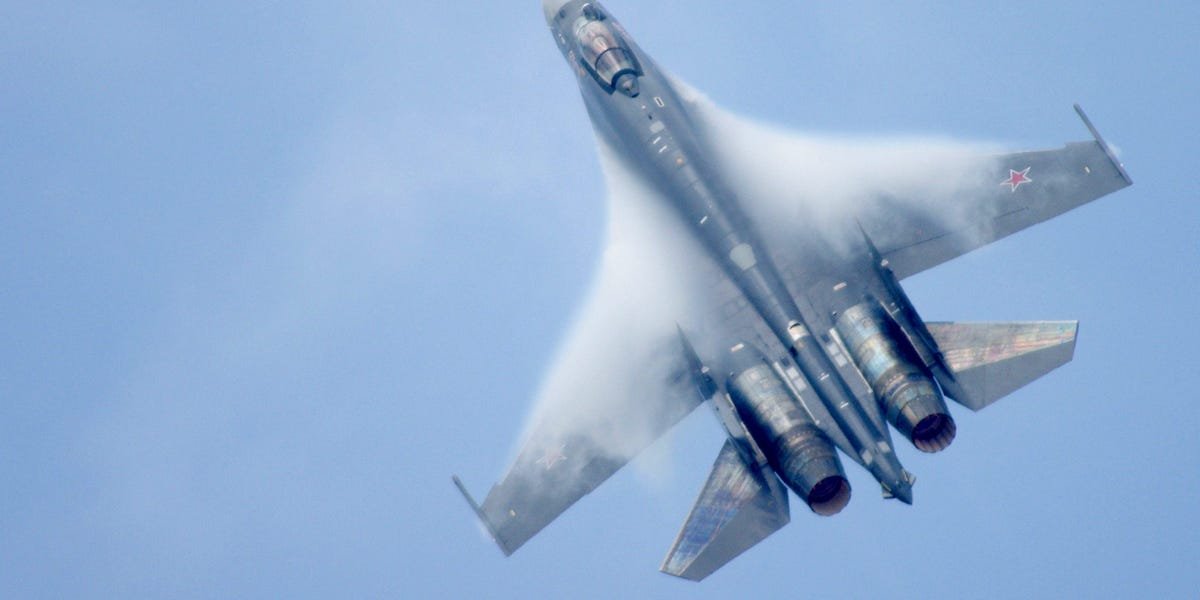
Russia’s Su-35 fighter jets are increasingly flying with longer-range air-to-air missiles that make them a potentially greater threat to NATO air operations, a leading airpower expert assessed in a recent report.

Justin Bronk, a researcher at the UK-based Royal United Services Institute, said in his assessment of Russian air power that regularly arming Su-35 and Su-30SM2 jets with R-37M missiles “has significantly contributed to increasing the threat that they can theoretically pose to NATO air operations.”

The R-37M missile, which NATO calls the RS-AA-13, is “much more capable at long range” than the R-77-1 missiles the Su-35 had previously relied on, Bronk told Business Insider in a discussion of his recent report.

R-77-1 missiles have a range of about 62 miles, while R-37M missiles are understood to have a range of around 200 miles. Real-world kills at range depend on a mix of factors, but reach still matters.

Bronk told Business Insider that the longer-range R-37M missiles had been “very much a specialist weapon” for a limited selection of Russian jets. But “now you see absolutely routine employment” of the weapon on Russia’s Su-35S.

The Su-35 fighter is “the primary air superiority aircraft for the Russians,” he added. The jet is key for Russia’s air force, with the UK Ministry of Defence in 2023 describing it as Russia’s “most advanced combat jet in widespread service.”

Bronk told Business Insider that for the NATO alliance, the regular arming of Su-35s and Su-30SM2s with the R-37M is “a problem” because it puts “more credible long-range air-to-air missiles at play from the Russian side.”

Those missiles used to be contained within a smaller part of the force, mainly Russia’s MiG-31s. Now, Bronk said, having them on more jets “is obviously a significant growth in the potential threat that they can pose to NATO aircraft in a direct conflict.”


A grey fighter jet in a light blue sky with fire visable in its two engines

The R-37M was previously concentrated on Russia’s MiG-31 jets.

Mikhail Svetlov/Getty Images


Additionally, he said, Russia’s Su-35 crews are “generally more highly selected, better trained, more capable than the crews on the MiG-31s.” Russia’s better pilots tend to fly its top jets, and those will be the pilots operating these missiles.

Having them routinely carry long-range air-to-air missiles, rather than the “really pretty limited” R77-1 that they used to carry, Bronk said, “is a significant shift.”

A missile with a longer reach

The R-37M’s combat effectiveness has been spotlighted by Russia’s full-scale invasion of Ukraine, which began in February 2022.

Late that year, a RUSI report said the R-37M, combined with Russia’s MiG-31BM interceptor aircraft, was proving to be “highly effective and difficult for Ukrainian pilots to evade due to its speed, very long range, and specialized seeker for low-altitude targets.”

At that time, it said Russia was just starting to put them on Su-35S jets.

A newer report from RUSI in November highlighted how much more the R-37M missile was being used, saying that this missile “in particular, has been used to destroy several Ukrainian aircraft at long range,” including one kill recorded at more than 109 miles.

“This is significantly beyond the engagement range of most NATO air-to-air munitions,” the report said. But it also said that the missiles’ success was “heavily determined by Ukraine’s lack of effective radar warning receivers,” something NATO has fielded far more robustly across its air forces.

The Su-35 threat

Making the Su-35 more powerful is a big move for Russia. In 2022, analysts at the RAND Corporation described the Su-35 as Russia’s “signature heavy fighter.”

Ukraine has shot down multiple Su-35s in its fight against Russia’s invasion, but Bronk said that despite reported losses, the fleet has “marginally increased since the start of the full-scale war.”

He estimated that in late 2020, Russia had about 90 Su-35s. Between eight and 10 have been lost in combat or accidents, he said, but 55 to 60 new aircraft have since been delivered — leaving Russia with roughly 135 to 140 Su-35s overall, a net increase despite the attrition.

Bronk’s analysis was based on interviews with Western air forces and ministries, data from Ukraine’s armed forces, and open-source information.

He said that the Russian air force has gained so much valuable combat experience against Ukraine that its air force is now “a significantly more capable potential threat for Western air forces than it was in 2022.”

He said that in air-to-air combat, where Russian aircraft take on Western ones, the West still has a strong advantage, but longer-range air-to-air missiles complicate the picture.

And any fight would not only be in the air. The West would face not only Russia’s air force but also its vast ground-based air defense network, which the war has also made more formidable.

Bronk told Business Insider that Su-35 crews are typically “much better at working with the ground-based air defenses,” meaning the jets can operate more effectively under the umbrella of Russian surface-to-air missile systems and are therefore “more credible as an air-to-air threat.”

He said that the improvement of those ground-based defenses throughout the war — combined with the fielding of more powerful missiles on Su-35s that are increasingly integrated with them — is one reason why Russian airpower “represents a greater threat to Western air power capabilities in Europe” than it did before the full-scale invasion.


Source link