
US-military-Stealth-bombers-fighters-and-special-capabilities-used-in.jpeg

US military: Stealth bombers, fighters, and ‘special capabilities’ used in first 24 hours of Iran mission

The US has been battling Iran for more than 24 hours, and the scale of what the American military brought into the fight is now coming into focus.

After a slow but steady drip of details, we now have a clearer, more comprehensive picture of the kind of US combat platforms involved and the targets struck on the opening day of combat, executed alongside the Israeli military.

US Central Command said forces involved in Operation Epic Fury struck over 1,000 Iranian targets with destroyer-launched Tomahawks, stealth B-2 Spirit bombers armed with 2,000-pound bombs, and US-made drones modeled after Iranian Shaheds, among other assets and munitions. It called the drones “American-made retribution” as the US struck Iran with a weapon Tehran designed.

Here’s the breakdown from US Central Command, which oversees US operations in the Middle East, on what went into the fight. It’s extensive, though some things are left off, covered by a note that says the operation also includes “special capabilities we can’t list.”


A graphic breaking down the weapons used in Operation Epic Fury from US Central Command

A graphic breaking down the weapons used in Operation Epic Fury from US Central Command

US Central Command


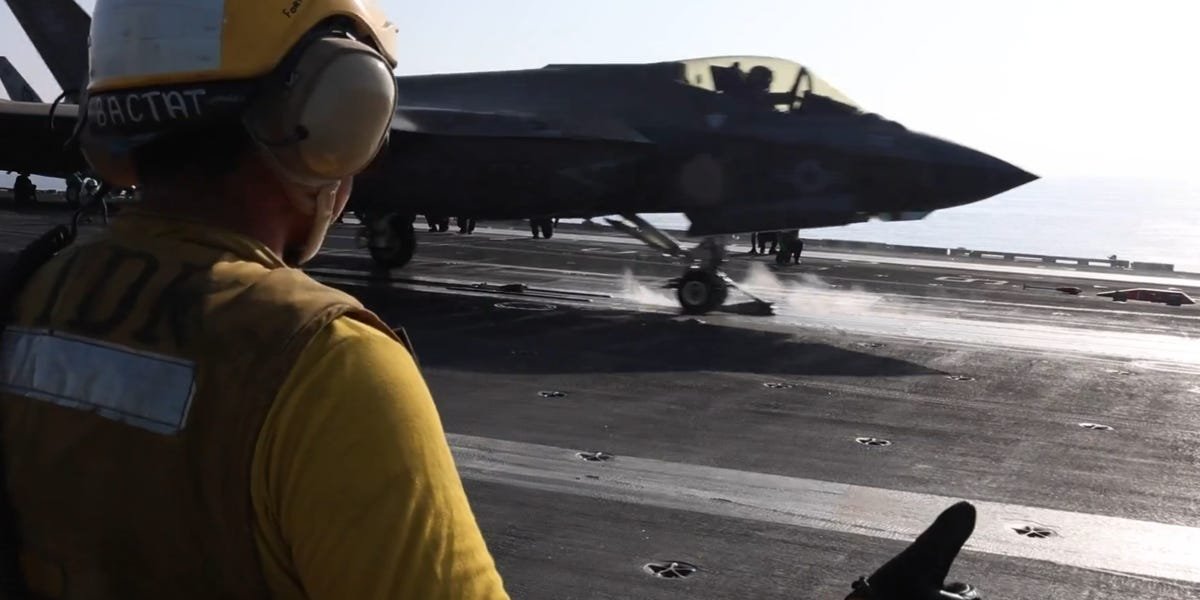
Beyond the B-2 bombers, the list of aircraft includes fifth-generation fighters like the F-35 Lightning II Joint Strike Fighter and F-22 Raptor, as well as a mix of attack aircraft and fourth-gen fighters.

There are also electronic attack planes, airborne early warning and control aircraft, surveillance platforms, and logistics aircraft, such as airlift and refueling planes, listed. The Airborne early warning aircraft can detect and track targets that can be passed off in real-time to fighter jetss like the F-22 and F/A-18.

Drones include the MQ-9 Reaper, a combat and reconnaissance system, and the new Low-Cost Unmanned Combat Attack System, or LUCAS, drones. The former is intended to return home, while the latter is purposefully expendable.

Suppression operations aimed at breaking down Iranian defenses set the conditions for air superiority and permitted damaging strikes across Iranian territory. There have been no credible reports of aircraft losses.

Other assets involved include High Mobility Artillery Rocket Systems, or HIMARS, weapons that can fire both guided rockets and missiles. They gained notoriety for their combat effectiveness in Ukraine. In addition to destroyers, American aircraft carriers are in the area, launching fighter aircraft like the F/A-18 Super Hornet and F-35C, the carrier-based variant of the stealth fighter.

While much of the weaponry on the list is offensive or intended to support offensive operations, some assets are strictly defensive. These include Patriot surface-to-air missile systems and Terminal High Altitude Area Defense, or THAAD, batteries. These have been used in air defense battles as Iran launched its missiles.

Prior to the beginning of “major combat operations” against Iran, which President Donald Trump announced early Saturday morning in a video message, the US spent weeks building up its military presence not seen in the area in decades.

The impact of operations, in which the US has suffered some personnel losses, has been felt across Iran. The US has hit command and control centers, operational centers of Iran’s Islamic Revolutionary Guard Corps, missile sites, navy warships, and critical communication sites.

The Israeli military, as part of Operation Roaring Lion, has also struck hundreds of targets across the country, which has seen much of its military and political leadership killed.


Source link

Israel-says-200-fighters-struck-Iran-in-the-largest-air.jpeg

Israel says 200 fighters struck Iran in the largest air operation in its history

Roughly 200 fighter jets participated in Israel’s widespread airstrikes against Iran on Saturday, the Israeli military said, calling the attack the largest air operation in its history.

The Israeli fighter jets dropped hundreds of bombs on 500 targets in western and central Iran, including air defense systems and missile launchers, the military said in a statement. The government earlier announced it had carried out a “preemptive” strike.

Attacks on the defensive systems — a tactic known as suppression of enemy air defenses, or SEAD — allowed Israel to expand its aerial superiority over Iranian territory, the military added.

“This is the largest military flyover in the history of the Israeli Air Force,” it said, adding that the operation was based on extensive planning and “high-quality intelligence.”

The strikes involved Israeli F-35 stealth fighters and F-15 jets. The full extent of the aircraft that participated is unclear.

Israeli warplanes attacked Iran alongside the US military. President Donald Trump described the American involvement as the start of “major combat operations” after nuclear talks between Tehran and Washington broke down.

A US official told Business Insider that American air, land, and naval forces were involved in the strikes against Iran and launched drones, rocket artillery, and cruise missiles, among other weapons.


An Israeli F-15C Buzz launches for a sortie in support of exercise Juniper Falcon, May 7, at Uvda Air Base, Israel.

Israeli F-15 fighter jets were involved in the strikes.

US Air Force photo by Tech. Sgt. Matthew Plew


US fighter aircraft also participated in the attacks, which targeted Iran’s Islamic Revolutionary Guard Corps command and control facilities, air defenses, missile and drone launch sites, and military airfields, the American military said.

Hundreds of Iranians have been killed and wounded in strikes so far, according to multiple reports.

Iran retaliated by launching waves of missiles against Israel and US bases across the Middle East, sending the region into an air defense frenzy.

US Central Command, which oversees Middle East operations, said its forces “successfully defended against hundreds of Iranian missile and drone attacks.”

Several Middle Eastern countries confirmed shooting down Iranian missiles as well, though some projectiles managed to slip past air defenses. CENTCOM said there are no reports of US casualties, nor has there been significant damage to American facilities.

Saturday’s strikes mark the second time in less than a year that the US has attacked Iran. American forces bombed the country’s nuclear facilities in June 2025 as part of Operation Midnight Hammer.

They also follow a steady buildup of US military forces in the Middle East and the Eastern Mediterranean Sea, including more than a dozen warships and hundreds of aircraft.


Source link