
Bryan-Johnson-shares-a-simple-test-you-can-do-anywhere.jpeg

Bryan Johnson shares a simple test you can do anywhere to figure out your biological age

As a multi-sport athlete, I track my fitness through swim time trials, burnout lifts, and functional threshold power evaluations that push me to my mental and physical limit.

Bryan Johnson, the 48-year-old entrepreneur obsessed with longevity, has a much simpler and less grueling test as a proxy for how your body is aging, which may or may not match your chronological age.

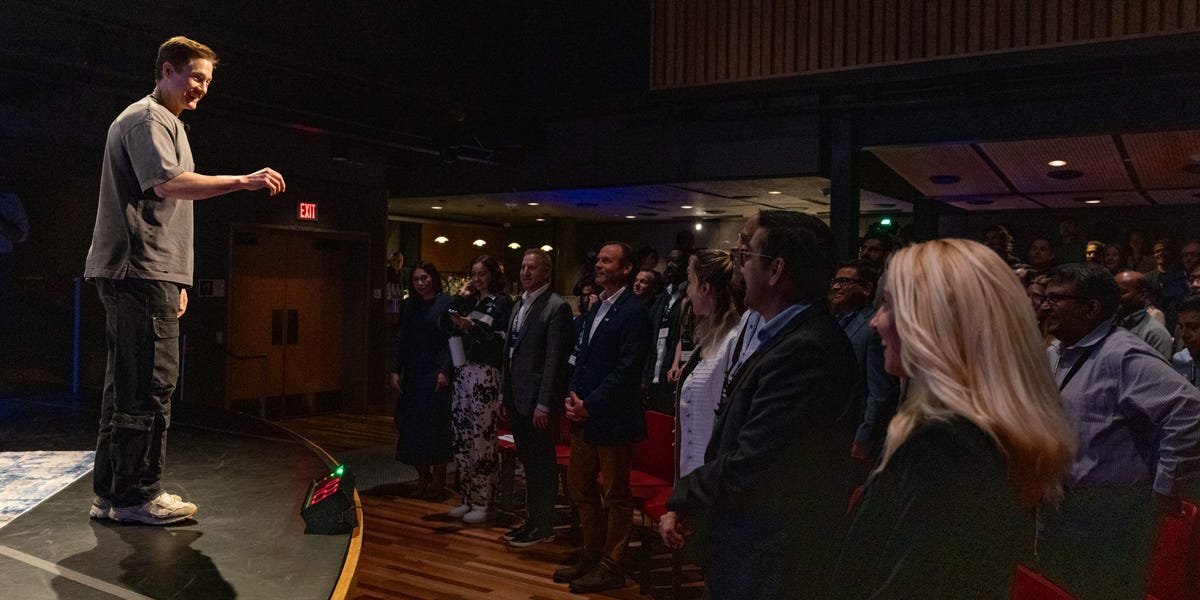
Johnson led the exercise at Business Insider’s The Long Play event in San Francisco on Tuesday. You can do it anywhere with a timer.

The test: Start your timer, close your eyes, and stand on one leg. See how long you can avoid falling.

According to Johnson, if you stand for zero to seven seconds, your body is 60-80 years old. Seven to 15 seconds is 40-60 years old, and 15 to 30 seconds is 20 to 40.

“As you age, your brain atrophies, and your ability to maintain your balance goes away. That’s why when you get older, if you fall down, it’s no good,” Johnson said.

A small Mayo Clinic study of adults over 50 published in 2024 found that among several functional tests, one-leg balance time was most affected by age.

The Mayo Clinic researchers dubbed the one-legged test “a valid measure of frailty, independence, and fall status.”

Unlike Johnson’s version on Tuesday night, the study didn’t test people under 50, nor did it offer specifics about balance time matching biological age.

The balance test isn’t a new idea, and the Cleveland Clinic cautions that “it’s not a complete balance evaluation on its own” and it’s “far from a perfect indication of longevity.”

But by Johnson’s standards, my biological age — especially on my dominant, more stable left leg — is right where I should be.



Source link

Figure-AI-CEO-says-over-170000-people-have-applied-to.jpeg

Figure AI CEO says over 170,000 people have applied to his robot company in the last 3 years. He hired fewer than 500.

A humanoid robotics startup in Silicon Valley appears to have an acceptance rate lower than any Ivy League university.

Figure AI has been flooded with résumés since its founding in 2022, according to the startup’s founder and CEO, Brett Adcock.

“Just checked, 176,000 job applications at Figure the last 3 years,” he wrote in an X post on Saturday. “We’ve hired ~425 people.”

That amounts to a hiring rate of about .24% within the three years. Adcock wrote that most of the submissions were “slop.”

The spread of the 176,000 applications over the three years is unclear. Adcock did not immediately respond to a request for comment.

Even if the number of applications were divided equally among the years Figure AI was operating — just under 59,000 applications a year — the acceptance rate would still be lower than that of the hardest university to get into. Caltech had the lowest acceptance rate of 3%, according to US News & World Report’s rankings list.

Adcock wrote in the comments of his X post that the review process has been a slog.

“We go through these one by one like a monkey — it’s incredibly time consuming,” he wrote.

According to the CEO, the “ATS” or applicant tracking system — a software employers use to sift through résumés — can’t save a lot of time if a company is being barraged with hundreds of thousands of applications.

“In the ATS it takes at least 20 seconds of button clicks per submission even if it’s garbage,” he wrote.

Adcock did not immediately respond to a request for comment.

A company like Figure AI sits right in the intersection of two trends within the job market.

Today’s job candidates aren’t applying to just a handful of roles. Business Insider’s chief correspondent Aki Ito reported that the average job opening saw 242 applications, citing data from Greenhouse, a leading ATS platform.

“Applying to a job in 2025 really is the statistical equivalent of hurling your résumé into a black hole,” Ito wrote.

On the other hand, Figure AI operates in one of the hottest spaces of the tech industry, that is, robotics and artificial intelligence.

Top tech firms like Meta and OpenAI are in the midst of an AI talent war, offering up to seven- to nine-figure pay packages just to poach superstar AI researchers.

Even tech startups are scrapping for AI talent, floating higher equity packages and other perks that may not come as easily at a big company, such as a co-founding title or more time for research.

Figure AI happens to be one of the leading names in the humanoid robotics space.

The company recently raised more than $1 billion in its Series C funding round — with backing from Parkway Venture Capital, Brookfield Asset Management, and Nvidia, among others — for a $39 billion valuation.

Adcock said on X that he may need to find another way to sift through résumés.

“Need a model to do this for us better, maybe I’ll work on one,” he wrote.


Source link