YouTuber Caleb Hammer has built a career digging into people’s poor money decisions on his show, “Financial Audit.”
He says there’s one mistake he sees most consistently.
“It’s the cars,” he said during a wide-ranging interview with Business Insider. “People are obsessed with getting whatever big truck or SUV that has the new year on it. And they say it’s the safety features, because, you know, we were making cars one year ago that were just killing everyone. So you’ve got to get the 2027 Ford F-150 Turbo edition.”
Hammer, who also sells a budgeting app, Dollarwise, and financial education courses, conceded that it’s not entirely people’s fault that they fall into the car trap.
“You need to have a car to have a job, and you need to have a job to have a car,” he said. “We have that endless loop because we have horrible public infrastructure in this country. We built everything around the car. So people are stuck in that loop.”
Every time Lucia publishes a story, you’ll get an alert straight to your inbox!
Stay connected to Lucia and get more of their work as it publishes.
Still, he said, people will also try to justify spending beyond their means on their “dream car.”
“It doesn’t make sense,” he continued.
Hammer, 31, speaks from experience. He once racked up $120,000 in debt by paying for college, a car, and some impulse buys. He taught himself about money management, which inspired him to start his show.
Now, he has a mortgage and a modest amount of debt, and has shifted his priorities. He spends on the occasional dinner out, his dogs, and hiring good people for his company.
“I still love McDonald’s,” he said. “I try not to get it, and my girlfriend doesn’t want me to because it’s bad for me. But at least I can afford it.”
Hammer said he doesn’t see the financial situation of everyday Americans improving anytime soon, especially with the rise of buy-now-pay-later services.
“With Klarna being baked into everything and Afterpay, unfortunately, I have a feeling the show’s going to be going till I’m done,” he said.
The head of the US Postal Service is warning lawmakers that the agency would run out of cash within the next year unless Congress steps in.
On Tuesday, David Steiner, the postmaster general, called the situation a “critical juncture” during a House Oversight hearing.
“In about a year from now, the Postal Service would be unable to deliver the mail if we continue the status quo,” Steiner said. “I like to say that we got thrown overboard and into the water. But, instead of tossing us a life jacket, we were thrown an anchor.”
The agency is federally mandated to deliver mail to every address — rural or urban — across the US, six days a week.
USPS hasn’t turned a profit since 2006.
Last fiscal year, the 250-year-old agency said it lost $9 billion, following a $9.5 billion loss in the fiscal year 2024. The agency’s debt limit, meanwhile, rests at $15 billion.
To help address the problems, Steiner, who took over as USPS’s top role last year, proposed increasing the agency’s borrowing authority and raising stamp prices.
USPS isn’t designed to operate like a typical profit-driven company, Amrou Awaysheh, the associate professor of operations and supply chain at Indiana University, said. It’s designed instead to deliver important packages — including prescriptions, mail-in ballots, and letters — to all residents.
“Private carriers frequently hand off the ‘last mile’ to USPS in these places because the routes aren’t profitable for them,” Awaysheh told Business Insider. “If USPS has to pull back, there is no obvious private player ready to match its universal coverage at the same prices.”
Steiner said part of the agency’s financial challenges stems from Americans sending fewer letters.
He pointed to a dramatic long-term decline in mail volume. At its peak in 2006, USPS delivered 213 billion pieces annually.
That has plunged to about 109 billion today — a drop he said represents roughly $81 billion in lost revenue at current stamp prices. Right now, he reported that 71% of USPS delivery routes are losing money.
USPS said fewer Americans are sending mail. It’s lost more than $18 billion since 2024.
: Spencer Jones/GHI/UCG/Universal Images Group via Getty Images
“No company could weather that much revenue loss,” Steiner said.
USPS is also facing the possibility of losing a significant portion of its package business with Amazon, its largest customer.
According to a person familiar with the matter, USPS could lose at least two-thirds of its Amazon shipping volume by the fall.
An Amazon spokesperson said in a statement that it “wanted to increase our volumes with the USPS,” but the agency “abruptly walked away at the eleventh hour.”
USPS didn’t immediately respond to a request for comment from Business Insider.
“Losing Amazon’s high volume, high-frequency stream will be difficult to replace in a competitive market,” Donnafay MacDonald, the retail industry research director at Info-Tech Research Group, told Business Insider. “The issue at hand is the effect this has on USPS per unit costs, as relatively lower volumes usually lead to increased per unit costs.”
Steiner said on Tuesday that his agency needs to bring in more cash — and added that it won’t get there just by making more cuts to services or jobs.
“We can do anything you want,” he said. “But someone has to pay for it.”
This as-told-to essay is based on a conversation with Sarah Canzano, the mother of Gavin Canzano. It has been edited for length and clarity.
I’m the mom of an elite teenage athlete. My husband was a downhill skier as a teenager, and he taught our boys, Gavin and Deacon, to ski when they were about two or three. I don’t ski at all.
Gavin was a shy and reserved kid, but he was a different kid on the mountain. He was so confident. We used to say that skiing was like oxygen to him. It’s where he is at his best.
It was easy to recognize his talent early
Gavin began skiing with the Bristol Mountain Freestyle team when he was around 8 years old. It’s a feeder into the US Ski Team. It was apparent quickly that he was very good in the air. In 2024, when he was 14, he was invited to Lake Placid, N.Y., to participate in the US Ski Team’s Project Gold, an aerial camp. He was all in on aerial skiing after that.
Sarah Canzano’s son started doing aerial ski when he was 8 years old.
Courtesy of Sarah Canzano
Now 15, he is part of the US Ski Team’s national development program for aerials. He trains with his national teammates at the Olympic Training Center in Lake Placid. He also travels for competitions.
It can be challenging to raise a teenage athlete and create balance
He’s a 15-year-old boy. He makes mistakes. But as long as he’s working hard, and doing the best he can at school and being a good human, we will continue to make sacrifices for him.
We have also had conversations with Gavin about the sacrifices that he would have to make on this path. That means school is going to be harder, because he’s going to miss a lot of school. He won’t be able to see his school friends that much when he’s competing and traveling. But, we’ve always told him, “We will work hard for you as long as you are working hard for yourself.”
Sarah Canzano’s family has had to adjust to her oldest’s ski training.
Courtesy of Sarah Canzano
He loves what he does, which makes it easy for us to support him. If he ever got to the point where he didn’t want to do it anymore, we would never make him. It sounds insane considering the investment we’ve made, but it’s his body, his life. We are also teaching him to advocate for himself because we won’t always be with him.
We’ve had to change our lifestyle to accommodate him
I’m a travel agent, and we like to travel as a family. Before, we’d be off to an island somewhere every break, but now I’m spending that time standing on a mountain. We’ve definitely had to change our plans several times for him, but we never put that burden on him. This is our family’s choice.
My husband and I divide and conquer a lot. A lot of times, just my husband or just me will travel with Gavin, so that Deacon can be home, in school, and with his friends, pursuing his hobbies. Pat and I are apart a lot, but we also try to take advantage of that one-on-one time with our kids, and the moments we have together with them.
Deacon is the real hero here; he is such a supportive little brother. He goes along for the ride with minimal complaints and is Gavin’s biggest fan. He’s so proud of him.
We’re taking it one step at a time, but the Olympics are the goal
We want him to have fun. He had me write “have fun” on his skis, so if he’s having a bad day or a couple of bad jumps, he can remind himself that this is fun.
Sarah Canzano’s son is training to compete in the 2034 Olympics.
Courtesy of Sarah Canzano
But it’s also serious. We might consider looking for financial sponsors soon, as we try to get him to where he needs to be. We will cross those bridges as they come. The goal is the US Ski Team for the 2034 Olympics. That sometimes feels overwhelming — it’s almost a decade away.
My job as his mom is balance. I have to let go of some control, but I also need to remember that he’s 15 and still needs a lot of guidance from us. I am confident in his abilities, and I’m now able to watch him jump without closing my eyes anymore.
Sometimes, a decision doesn’t make sense on paper, but it just feels right to your soul. That’s what my family’s big move was like.
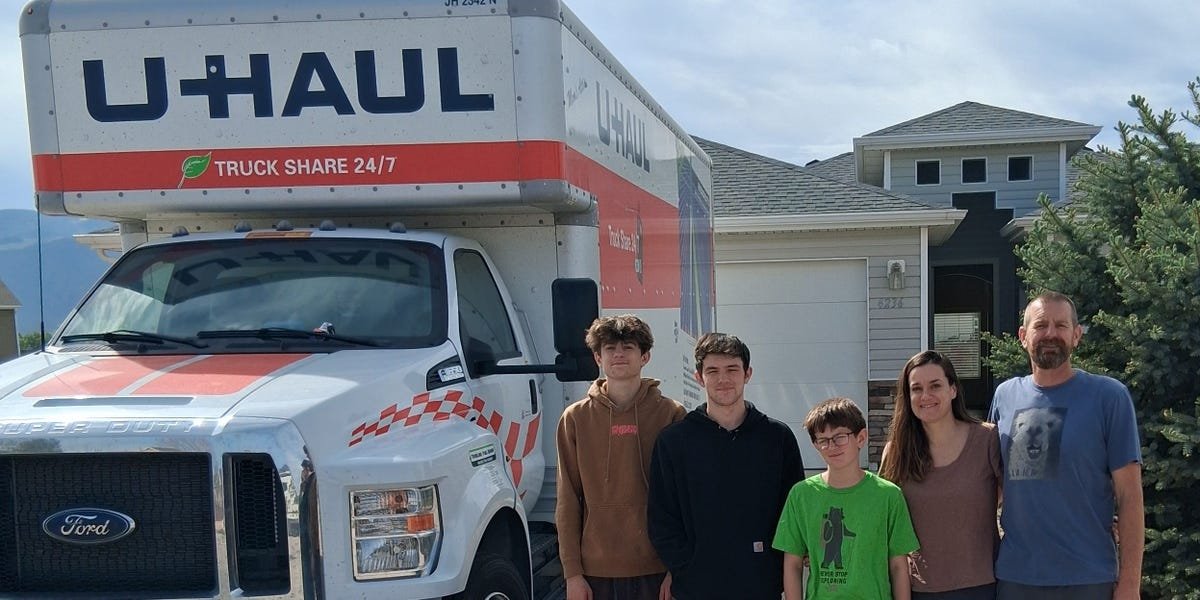
Last year, our family of five sold our affordable home in rural southern Utah to move into a more expensive rental in a Denver suburb.
We had wanted a change for a long time, and the timing finally felt right. We could’ve stayed where we were “safe” financially, but all our family members were struggling in different ways.
I couldn’t shake the feeling that nothing would really get better until we were brave enough to make a big change — so we did.
Moving from Utah to Denver was a difficult financial decision
One of the hardest parts to accept about moving was leaving our extended family and a house that we had lived in for 13 years.
Every time Katy publishes a story, you’ll get an alert straight to your inbox!
Stay connected to Katy and get more of their work as it publishes.
Even more difficult was that our house in Utah was affordable. We were privileged to buy a house when prices were reasonable, and mortgage rates were low. We would have moved a long time ago, but we felt stuck in a home we had outgrown because it was cheap.
We knew that if we sold our house, we would be paying a lot more elsewhere. But the decision still felt right for our family.
We figured Denver was worth the price increase
We chose a Denver suburb because we love the outdoors and also miss the opportunities that a city provides. We have friends in the area, so we knew we would have a community once we arrived.
The author’s kids enjoy Denver’s nature.
Courtesy of Katy Anderson
We chose an area known for its “small town feel.” As soon as we moved in, I immediately fell in love with the neighborhood. We are surrounded by an abundance of mature trees, and are within walking distance of wonderful trails for walking and biking.
I’ve been amazed at the wildlife around us, especially considering we live in a Metro area.
Just walking the trails in our neighborhood, we’ve seen rabbits, coyotes, elk, raccoons, turkeys, and many different species of birds. We feel closer to nature here than we did in rural Utah.
After living here for a few weeks, we decided to purchase e-bikes so we could ride much farther along the trails, including to coffee shops, restaurants, city gardens, and parks.
This area also provides us with access to shopping, museums, concerts, and sporting venues. After living in a secluded town for so many years, having these amenities feels like a luxury.
We’re saving money in other ways
Our rent is high in Denver, and that has been the biggest adjustment.
Before we made the move, I was also worried about the cost of living, but I have been pleasantly surprised. Our kids even get free school lunch thanks to a statewide Healthy School Meals for All program. My kids have all commented that the food is of better quality. They actually want to eat the school lunches here.
We are paying much less for gas in Colorado, as we are driving substantially less. In Utah, we lived on the outskirts of town and had to drive 15 to 20 minutes to get to work or to the nearest grocery store.
When we moved to Colorado, we also immediately ended most of our subscriptions and streaming services. We’ve cut down on our discretionary spending and are eating more family meals at home.
We also chose jobs that would help us adjust to our new housing costs
We knew we would be paying more for housing no matter where we moved, so we chose a location with ample work opportunities. My husband is a psychiatric nurse practitioner, and I have picked up a part time job in addition to my freelance writing business.
We are all making more money in Colorado than we could in Utah, where the minimum wage is still $7.25 per hour. Two of my teenage sons were amazed when they realized how much more they could earn in their new city.
Right now, we are enjoying the freedom of renting. Buying a home in this economy feels daunting, and we want to take our time exploring Colorado to see where we may want to buy if it feels right.
For now, I am grateful that my kids have a chance to experience living in a bigger city with more diversity and opportunities. Overall, I feel like we fit in here in a way that we never did in our old town, and that is priceless.
Adios to casual dating: Young Americans are seeking committed life partners to split bills with.
Quincy Yang, the co-CEO of dating app Coffee Meets Bagel, told Business Insider that money and economics are huge considerations for Gen Z when choosing a partner.
“It’s so hard to afford to buy a house, or any property,” Yang said, adding that a lot of younger people are staying at home with their parents. He said for older generations, it was more affordable to “live the American dream” of buying a home and starting a family.
“Now, you need dual incomes to afford just the median condo or house. You need to have a pretty good job; you can’t slack off too much,” he said.
Yang said the affordability crisis has affected dating. “There’s an incentive now to find a good partner who is financially stable and ambitious.”
Every time Aditi publishes a story, you’ll get an alert straight to your inbox!
Stay connected to Aditi and get more of their work as it publishes.
Shn Juay, Yang’s co-CEO, said that this is evident in Gen Zers not being as into hookups as older generations.
“When you talk about dating apps, the first thing that comes to mind will be hookups,” she said. “But the Gen Zs are really more conscious about more real things in their life, they’re not into hookups. Unlike the previous generation, what they imagine of an ideal partner is very pragmatic.”
The CEOs said that daters should choose dealbreakers judiciously while finding a partner.
“You can always go for a higher degree, or you get promoted along the way, but not at age 28 years old, where everybody’s probably still really early in their career,” Juay told Business Insider.
Dual incomes are needed to achieve the American dream
Living in the US is more expensive than ever.
Housing costs have been rising faster than incomes over the last two decades, according to a June 2024 report by the US Treasury Department.
Grocery prices are not providing any relief. US food prices rose nearly 25% from 2020 to 2024, according to data from the US Department of Agriculture.
The Trump administration’s imposition of tariffs on foreign goods this year has exacerbated this problem by forcing retailers like Walmart and Target to raise prices.
In this climate, living alone has become an unaffordable luxury for many Americans.
A Pew Research Center study released in January said more US adults are living with a partner. The study analyzed US Census Bureau data and found that the percentage of adults living without a partner decreased from 44% in 2019 to 42% in 2023.
Life costs more, so money is a priority for younger daters
So naturally, finances are a big priority for daters.
In November, the dating app, which has around 20 million users worldwide, conducted a survey of about 1,050 of its users in the US between the ages of 21 and 35. The respondents were working professionals who said they were either actively seeking a relationship or open to one.
The survey revealed that financial stability was a top priority for them, with 54% of the respondents listing it as such. Almost 60% labeled “ambition/drive” as a must-have in a potential partner, even more than having shared interests.
“While many are looking for someone to spend their life with, practical matters still reign supreme,” said Coffee Meets Bagel, which markets its app as “for serious daters.”