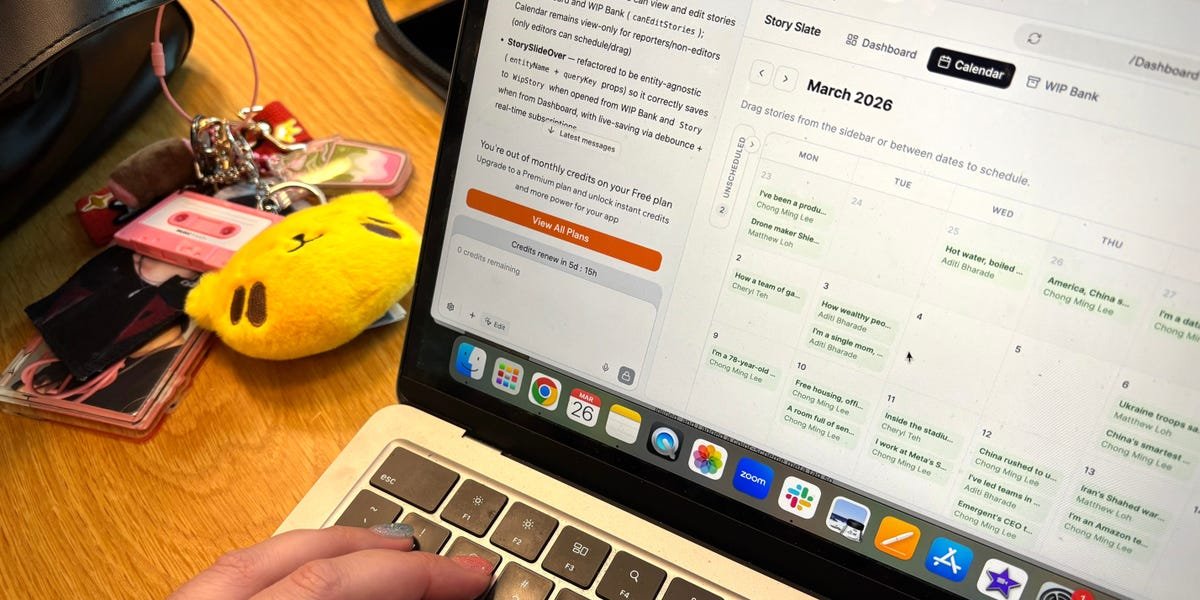
Just 15 minutes, from concept to publish. That’s how long it took for me to create a basic version of a work management tool like Asana without writing a single line of code.
The idea struck me one weekday when I asked my team: “What annoys you most about our workflow? What’s the one thing you want me to change?”
One pain point came up: They weren’t a huge fan of the Google Doc I’d been using to track our long-term reporting. So, I thought: I have 15 minutes for a coffee break. Let me see how far I get using vibe coding — the concept of using prompts to create software with AI — on Base44, an app-building platform.
While my dashboard app has far fewer features than Asana, the results impressed me. And it taught me an important lesson about the “SaaSpocalypse,” the idea that AI can create products for free that work as well as software products companies would usually sell. Those fears have battered software stocks, with Asana down about 54% this year, and Atlassian, the company behind project management app Trello, down about 59%.
An Asana spokesperson told Business Insider that a productivity dashboard is “a small piece of what companies need to run work effectively, at scale.” They added that Asana’s tools help coordinate work across “many teams and large departments” — including between humans and AI agents.
My project also gave me other reasons why AI may not mean game over for productivity software companies.
From prompt to publish in minutes
I’ve used a range of productivity tools, from Notion to Monday.com and Asana. I find all of them useful, particularly Notion’s high level of customizability and Asana’s flexibility for collaborative teamwork.
They gave me a good idea of what I wanted, so I started off with a simple prompt:
I want to vibe code a slick dashboard for a small team of reporters at Business Insider. I want it to be a slate for enterprise reporting, allowing each user to input their stories to a common dashboard. I also want functionality that lets a user drag and drop entries into a publishing calendar, with daily/weekly/monthly/yearly view toggles.
I plopped this prompt into ChatGPT and asked it to generate a detailed prompt for Base44 and Lovable. These are two of many one-stop shops on the market that let users build and launch the app directly on their platform.
ChatGPT gave me tailor-made prompts for each platform. I refined the prompts by asking for more functionality, then prompted ChatGPT to troubleshoot in advance if the instructions might create any issues on the Lovable and Base44 backends.
After five minutes of planning, I had my detailed prompts locked and loaded.
10 minutes to build
This wasn’t my first time using Base44 or Lovable. I’d used vibe-coding platforms to try to code other apps, including one for tracking collectible cards, so there wasn’t the same learning curve as a newcomer.
It was extremely easy to get started. All I did was plug my ChatGPT-generated prompt into both platforms. I walked away for five minutes as the platforms’ chatbots “thought” their way through my request, figuring out how best to execute it.
When I returned to my laptop with a warm mug of tea, I had two complete prototypes generated on both apps.
I dedicated 5 minutes to ensuring the app was secure, adding login and authorization permissions for each reporter and editor. That’s something that’s baked into off-the-shelf apps like Asana, and security has caused headaches for other apps built with AI. I also got picky about customizing the dashboard’s aesthetics, and spent a minute or so changing the font types and colors on each platform.
It was important that the app allowed me to sort projects by progress and see at a glance all the work each reporter had on their plate. I also wanted a broad calendar view to see which stories I was planning to publish in the next month. And I wanted a repository of works-in-progress.
It was important to me that the app had tabs for a dashboard, a calendar view, and a section for works in progress.
Cheryl Teh
It was also essential that the app include tabs for a dashboard, a calendar view, and a section for works in progress.
I also asked the vibe-coding apps to make sure all the dashboard data could be downloadable in one click, so my writers have fast, easy access to their complete story slate.
After some back-and-forth prompting, I got all of these features — but I did burn through all my free credits on Lovable before getting the app ready to use. But in under 15 minutes and within the free credit limit, my Base44 dashboard for drafts was ready for launch.
The hype train for vibe coding is real
I’m no coding wizard. I have distinct and embarrassing memories from college of having a minor crisis trying to build a website on Dreamweaver and struggling to build a codebase for my master’s thesis. As I see it, vibe coding has opened the door wide for nontechnical people like me to build the bones of simple applications in a short time.
My team and I vibe-coded apps on various platforms to see how the products stack.
Amanda Goh
My team and I recently vibe-coded apps on various platforms as an experiment to see how the products stack. We built several apps— including a thumbnail composite-maker, a writing companion, and an AI-powered photo critic. In most cases, we got these apps to a usable state in under 30 minutes.
Those experiences make it easy to see why AI is such a problem for software companies like Asana. In an interview with Business Insider’s Alistair Barr, Asana’s CEO, Dan Rogers, acknowledged the existential threat that companies like his face. He said this threat also presents a new opportunity for Asana: to go all in on coordinating a workforce in which humans need to work hand in hand with AI.
I’m also hesitant to write these firms off. For many users, Asana’s links to email, Slack, and apps like Canva and Zoom remain valuable. That infrastructure, plus things like cybersecurity, is typically baked into off-the-shelf software and lacking in vibe-coded projects. And, obviously, my dashboard doesn’t have the capability to track AI agents and their workflows, as Asana plans to do.
“Orchestrating humans and AI is an incredibly complex thing to do — and that complexity is underscored by the fact that many AI-native startups and foundational model providers use Asana to run their own work,” the Asana spokesperson said.
Since I made the tool in March, my team’s been using it every day, and it’s front-and-center during team pow-wows and at our 1:1s. It’s safe to say my vibe-coded app meets my basic workflow needs — and for free.
This as-told-to essay is based on a conversation with Robin Peppers Daniel, a job seeker in her early 60s who lives in South Carolina. The following has been edited for length and clarity.
Last April, I received a notification that I had 30 minutes before I would lose all of my work access — and that within an hour, I would receive some paperwork. Then my boss called me with the news: I, along with several colleagues, had been laid off.
I was working for Wells Fargo in a management role, and had some suspicion that a layoff was coming. This wasn’t my first layoff. In 2018, I was laid off from Walmart, where I worked as an instructional design manager.
A little over a year later, I started working for Wells Fargo as an external regulatory reporting consultant and was later promoted to a lead control management officer role.
My last working day at Wells Fargo was in April, but I was technically still employed and received paychecks through mid-June, followed by a few months of severance. Nearly a year after being laid off, I’m still looking for a full-time role.
Every time Jacob publishes a story, you’ll get an alert straight to your inbox!
Stay connected to Jacob and get more of their work as it publishes.
My search strategies haven’t landed me a role so far
After some reorganization about a year earlier, there was redundancy in certain areas, and I felt like my workload started to dry up. My husband and I decided to start financially preparing, which proved to be beneficial.
I’d already been casually looking for work, partially because I’d felt for a while that the role wasn’t a good fit for me. But it wasn’t until I was laid off that I updated my LinkedIn profile, and not until around June that I began actively searching for roles. I was initially focused on banking and corporate trainer roles, but I’ve become open to any position where my skills are transferable.
In terms of my job search strategies, I adopted the “open to work” banner on LinkedIn and posted that I was seeking work, which helped me connect with people who said they’d be open to referring me for roles. I’ve also tried looking for job postings on company websites rather than only on LinkedIn, where I’ve found that some postings can be outdated.
Despite these strategies, I was still struggling to land a job. There was one opportunity last year that I thought might work out. I had a referral from a former coworker who said she’d spoken about me to the hiring manager. After three interviews, I waited several weeks and eventually heard they were going in another direction.
I pick up substitute teaching shifts when I can, but I’m still unemployed
My husband and I have enough savings to be financially stable for roughly the next 18 months. In a perfect world, I would retire and get out of this work rat race, but right now, I unfortunately can’t afford to.
Last August, I applied to be a substitute teacher in my area so I could have some form of income once my unemployment benefits ran out.I used to substitute teach when my daughter was preschool age, and I enjoyed it.
However, I had to be very strategic about taking on substitute work. I live in South Carolina, but I worked in North Carolina — and was therefore subject to that state’s unemployment system. In North Carolina, you can earn a maximum of $350 a week in unemployment benefits for up to 12 weeks — $4,200 total. You can also earn up to $70 a week without impacting your unemployment check.
A full week of substitute teaching paid about $550, and depending on how many days I was needed, I had to make sure what I’d gain in income would offset what I’d lose that week in unemployment benefits.
I’m now considering teaching full-time
I’m pursuing an alternative teaching pathway in South Carolina that would eventually allow me to work as a full-time teacher after the initial testing is complete. The salary wouldn’t be what I earned in banking, but it would allow me to do something that I enjoy.
I’ve also started exploring part-time options that could hopefully provide me with income and benefits, including a small web design business my husband and I have run for years and a small skincare products business.
Read more about people who’ve found themselves at a corporate crossroads
I’ve realized this could be a really long-term unemployment spell
During much of my job search, I was fairly optimistic because I’d previously found full-time jobs through my network. Over time, I’ve realized that I could be unemployed for a while.
I think my age might be holding me back in my job search, and that some employers view me as overqualified, given my past work experience and education. As a result, I’ve been conscious of the way I present and talk about my experience level.
Nowadays, I’m only half-heartedly looking for full-time work. If a job posting has more than 100 applicants, I don’t apply. I’ve resigned myself to semi-retirement.
If I have any advice for struggling job seekers, it’s that tapping into my network and family has been the biggest help for me, even if it hasn’t led to a job yet. I’ve had some former coworkers — more acquaintances than friends — reach out to tell me about jobs. I really believe that in this market — where AI might be the one reviewing your résumé — it’s all about networking.
It’s hard to deny the appeal of a good frozen pizza, and the impressive selection at Trader Joe’s really ups the game.
There are gluten-free and vegetarian options as well as familiar classics like Margherita pizza and sophisticated tarts.
As a die-hard Trader Joe’s fan and pizza lover, I reviewed all of the chain’s frozen pies that I could find in one shopping trip. Most of these cost around $5 to $8 when I purchased them.
Keep in mind that product availability may vary, and some options may no longer be available or be limited-edition — often with the potential to return later.
The organic cheese-and-tomato pizza was far from the best option
The cheese-and-tomato pizza from Trader Joe’s was pretty basic.
Savanna Swain-Wilson
This bland, thin-crust pizza, topped with a whisper of tomato sauce and cheese, felt like it should be served at a kids’ party. It’s basic enough that even the pickiest child would eat it.
The Emmental cheese made this pizza smell and taste off to me, and the other ingredients felt a bit cheap.
The crust was a bit too thin for my liking.
Savanna Swain-Wilson
This option’s appeal is supposed to be in its value, but calling it family-size seemed like a stretch.
Even though it looked large, it was barely satisfying for two adults since the thin crust wasn’t very filling. I’m not sure if it was worth the $6 I paid.
VERDICT: Between the cracker-thin crust and disappointing sauce, this pizza left a lot to be desired. Unless you need something big enough to serve more than two people, I’d pass.
The Margherita pizza practically tasted homemade
Trader Joe’s Margherita pizza was a tasty option.
Savanna Swain-Wilson
The Trader Joe’s Margherita pizza had a great toppings-to-crust ratio and was flavorful enough on its own, though you can garnish it with fresh basil to make it seem more authentic.
The sauce had a pleasantly bright, fresh tomato flavor and was slightly thicker. The acidity balanced the cheese’s creaminess, creating a memorable, well-balanced bite.
With some more garlic, I think this would be restaurant-quality.
The ingredients mostly tasted fresh.
Savanna Swain-Wilson
The beautifully melted cheese had a slightly sweet flavor that paired nicely with the simple sauce. It didn’t taste fully fresh, but it was a step above shredded mozzarella.
The sparsely sprinkled dried basil didn’t pack the same punch as the fresh herb, but still gave this pizza enough pizzazz.
VERDICT: Though this Margherita pizza wasn’t perfect, I would spend twice as much buying the ingredients to make it from scratch, so it’s worth having on hand.
The brie-and-tomato tart was too rich to enjoy as a regular pizza, but it’s still worth serving
The brie-and-tomato tart from Trader Joe’s looked beautiful on the box.
Savanna Swain-Wilson
This is the kind of frozen dish you put out to impress people.
Brie on pizza was a new concept to me, and even though I would’ve preferred goat cheese, it still tasted good.
The creamy French cheese and crème fraîche made for a decadent, rich sauce, and the cherry tomatoes exploded with vibrant, juicy sweetness that stole the show.
The bits of dried basil across the top and in the crust tied together those sweet and rich flavors.
The brie-and-tomato tart would make for a good appetizer.
Savanna Swain-Wilson
Overall, it was quite tasty, though the specific flavors were a bit intense for a stand-alone meal. My friend and I had only two slices each. It would work better as an appetizer.
Don’t make this on a foil sheet, however. I did, and the pastry crust was limp and soggy. I fixed it by cooking it on the oven rack for a few minutes, but it would’ve been crispier if I had baked it like that from the start.
VERDICT: Though this tart’s flavors were intense, it would make a great brunch appetizer. I’d buy it again, but only for special occasions.
The burrata, arugula, and prosciutto flatbread sounded great, but didn’t impress me
I thought Trader Joe’s burrata, prosciutto, and arugula flatbread was too salty.
Savanna Swain-Wilson
Made with crème fraîche, arugula, prosciutto, and burrata, this flatbread sounded like something from a bougie cocktail bar’s menu.
I had high hopes for the layered flavors since mascarpone, Fontal, and pecorino Romano are also listed as ingredients, but the execution fell short.
The crust was a bit dense, and the toppings offered little variety since the prosciutto was soft and chewy, and the arugula was mushy like cooked spinach.
The salty flavors overpowered the burrata.
Savanna Swain-Wilson
The overly salty flavor also turned me off. This prosciutto seemed saltier than usual. I tried to split it into tiny bits that wouldn’t overwhelm the other flavors, but each serving had me reaching for water.
The crust — which tasted like a saltine cracker — and the other salty cheeses didn’t help. Instead, it buried the rich burrata flavor.
I’m typically a big fan of arugula, but this batch lost its herbal, peppery quality after being frozen and reheated. The bitter flavor was more of a distraction than anything else.
VERDICT: Despite the array of elegant ingredients, this flatbread got old after two bites, proving that some dishes shouldn’t be convenience food.
The organic 3-cheese pizza didn’t knock my socks off, but it could serve as a base for other toppings
Trader Joe’s organic three-cheese pizza tasted like a basic cheese pizza.
Savanna Swain-Wilson
This option was as basic as frozen pizza gets — mozzarella, Fontal, and a nondescript “aged cheese” on top of a simple tomato sauce and wheat crust that was decently chewy — so it was the most forgettable of the bunch.
Still, this was marginally better quality than other frozen cheese pizzas I’ve had. It smelled tasty, and the crust didn’t taste like cardboard, despite the dry ends.
The premelted cheese was a bit tacky and didn’t offer much of a satisfying pull, but the overall flavor wasn’t bad. I just wish the sauce had more seasoning.
Red-pepper flakes and hot sauce elevated the pie.
Savanna Swain-Wilson
Adding a few shakes of red-pepper flakes and hot sauce elevated the meal. This option would also make a good base for other toppings — some cooked mushrooms or red peppers would add a nice boost of flavor.
VERDICT: I probably won’t buy this three-cheese pizza again, but I’d recommend it to anyone wanting a customizable, no-frills option.
The crust on this cauliflower cheese pizza made for a convenient gluten-free meal
This pizza’s gluten-free crust is made of cauliflower.
Savanna Swain-Wilson
I appreciate that Trader Joe’s has a convenient pizza for gluten-intolerant shoppers. The chain has sold premade cauliflower crust for years, but this pie removes all the prep work.
This pizza features a simple tomato-and-cheese topping on a cauliflower crust, making it vegetarian but easy to dress up.
The base cooked in about 12 minutes, but I’d leave it in for a bit longer to let the cheese fully melt.
The crust held up well and got quite crispy.
Savanna Swain-Wilson
It didn’t look that different from regular cheese pizza. The crust browned so well that it seemed like actual bread.
Veggie-based crusts are often mushy or fall apart, but this one stayed intact until the last bite. It was a bit chewy, yet not unpleasant.
The cauliflower was detectable but didn’t overpower the other ingredients, and the addition of mozzarella in the dough made it more authentic.
Compared with other gluten-free pizzas I’ve tried, this one was more flavorful and better constructed.
VERDICT: I wouldn’t go out of my way to get this again, but the Trader Joe’s cauliflower-crust pizza is a solid gluten-free alternative.
A satisfying mix of pepperoni, Italian sausage, and roasted peppers made this Pizza Parlanno as good as takeout
Trader Joe’s Pizza Parlanno had a great mix of flavors.
Savanna Swain-Wilson
This was a fantastic frozen pizza, complete with mozzarella, Parmesan, and Romano cheese.
A crowd-pleaser for meat eaters, it was packed with a colorful melange of roasted red, yellow, and green peppers with bits of Italian sausage, onions, mozzarella, and pepperoni.
Toppings covered the entire pie, ensuring every bite was worthwhile.
All the flavors balanced each other.
Savanna Swain-Wilson
All of the components were balanced. The pepperoni’s nice kick paired well with the pepper’s subtle sweetness. The sausage was milder, but the pie already had enough flavor.
Every bite was the perfect combination of zesty, spicy, and cheesy.
VERDICT: I enjoyed every bite of this pizza and would gladly buy it again.
Trader Joe’s barbecue-chicken pizza was a solid take on the West Coast classic
This option is great to have when you’re craving barbecue-chicken pizza.
Savanna Swain-Wilson
This pizza’s barbecue sauce tasted great and wasn’t overly sweet. The sprinkled bits of red onion added an extra pop of flavor to the even distribution of cheese and meat.
It was missing the cilantro garnish that’s standard on barbecue pizza, but its flavor was still better than that of other frozen pies I’ve tried.
The Gouda brought out the smoky notes, and the chicken was surprisingly tender for being precooked.
The barbecue sauce wasn’t too sweet, and the chicken was tender.
Savanna Swain-Wilson
I intended just to eat one or two slices for this taste test, but ended up devouring four in one sitting.
The thin crust was a little dry and (understandably) had a freezer-food texture, but dousing the pizza in hot sauce or ranch would help.
VERDICT: For about $5, this was a solid, budget-friendly alternative to takeout. Just add some chopped cilantro to make it taste like the real deal.
The chain’s meat-lover’s vegan pizza had potential, but the toppings left me with mixed feelings
I wasn’t a fan of this Trader Joe’s pizza’s meatless pepperoni.
Savanna Swain-Wilson
This option features a regular wheat crust topped with vegan mozzarella, Italian-flavored soy chorizo (not to be confused with the chain’s award-winning Soyrizo), and faux Italian sausage and pepperoni.
As a former vegetarian, I appreciate seeing more plant-based options, but I don’t understand the point of this one.
Most pizzas are already vegetarian and can easily be made vegan; plus, when I followed that diet, I didn’t exactly want to be reminded of what I couldn’t eat.
I don’t understand the point of fake meat on vegan pizzas.
Savanna Swain-Wilson
Vegan cheese doesn’t melt easily, so it was tricky to tell when this pizza was finished baking. Even after 12 to 15 minutes, it didn’t quite look done.
The cheese had a slight sweetness that reminded me it was not real dairy, but it was passable when paired with the other ingredients.
I had mixed feelings about the other toppings, though. The meat alternatives at Trader Joe’s are typically reliable, but the vegan pepperoni was off-putting. Thankfully, the faux sausage was much better, and the soy chorizo added a yummy kick.
Overall, the other toppings still redeemed the disappointing pepperoni.
VERDICT: This is one of the tastier plant-based options I’ve tried. It had solid vegan ingredients, so it’s worth trying.
This French-style Maître Pierre Tarte d’Alsace tasted like something from a high-end restaurant
Trader Joe’s Maître Pierre Tarte d’Alsace is topped with caramelized onions and ham.
Savanna Swain-Wilson
This exquisite flatbread features a twisted pastry crust, caramelized onions, and matchstick-cut ham, all over a bed of crème fraîche and Gruyère.
It tasted as delightful as it sounds. The creamy base was rich and buttery, with a subtle tang that was more interesting than regular mozzarella, yet not pungent.
The toppings were plentiful.
Savanna Swain-Wilson
Trader Joe’s was generous with the toppings, so every bite was substantial. The ham was perfectly salty, and I loved how the caramelized onions added a savory sweetness to the dish.
This pizza was as tasty as some items I’ve ordered at restaurants, plus it’s only slightly smaller than the chain’s regular pizza lineup.
It was ready in eight to 10 minutes, so it’s great for a last-minute meal or appetizer. It turned out best baked directly on the rack.
VERDICT: This option was 10/10. If I see this at Trader Joe’s again, I’m buying every box.
This Tarte aux Champignons exploded with a delectable, savory flavor
Trader Joe’s Tarte aux Champignons features a creamy sauce with mushrooms.
Savanna Swain-Wilson
This had all the makings of a gourmet pizza, with a luscious sauce of Emmental and crème fraîche and finely chopped mushrooms on top of a pastry crust.
The savory and creamy nuances balanced well, and the hint of Parmesan added just enough salt to make me anticipate each bite.
I had a good feeling about this tart from the moment I saw it, and it thankfully didn’t disappoint.
Savanna Swain-Wilson
The bits of parsley flecked across the top were also a nice touch that added a pop of greenery.
Despite all of the dairy, this thin, flaky flatbread was light. I devoured half of it in a single sitting, and given the chance, I’d do it again.
VERDICT: If you want something that’s equal parts sophisticated and satisfying, look no further than this flatbread.
The garlic-and-pesto pie seriously changed the frozen-pizza game
Trader Joe’s roasted garlic and pesto pizza is my favorite.
Savanna Swain-Wilson
I’ve previously written about my love for this Trader Joe’s pizza, and I can confidently say it’s in a league of its own.
Although I only paid $5 for this, the deep-fried crust made this feel like it was hand-tossed in a nice café.
It smelled incredible and tasted even better.
Savanna Swain-Wilson
All of the ingredients tasted great, and the deep-fried, Naples-style crust gave it a standout artisan quality.
The combination of mozzarella, Parmesan, burrata, and provolone made for just the right mix of creamy, slightly sweet, and salty. Plus, the cashew pesto and aromatic bits of roasted garlic were sublime.
VERDICT: If I could buy only one frozen pizza for the rest of my life, it would be this one.
Keep reading other Trader Joe’s taste tests in this series.
This story was originally published in June 2022 and most recently updated on March 6, 2026.
Kalshi may be good for more than just making a quick buck.
A new research paper published by a trio of Federal Reserve economists suggests that the prediction market platform is a useful method for measuring macroeconomic expectations — and it may even be better than some traditional methods.
“Our results suggest that Kalshi markets provide a high-frequency, continuously updated, distributionally rich benchmark that is valuable to both researchers and policymakers,” the researchers wrote.
The researchers found that Kalshi actually beat traditional methods for two different purposes.
The first was on forecasting inflation. The researchers found that when it comes to headline consumer price index (CPI), Kalshi’s expectations represented a “statistically significant improvement” over the Bloomberg consensus, an oft-cited aggregation of financial analysis forecasts.
The second was on predicting Fed rate decisions. The researchers found that the median and mode of Kalshi’s prediction markets have a “perfect forecast record” on the day before the Fed meeting, which is a “statistically significant improvement” over Fed Funds futures.
Kalshi is also useful because it provides real-time responses to events, offering more up-to-date information than typical survey and forecasting methods, according to the researchers.
The paper was greeted as welcome news by Kalshi, which has long pitched itself as a source of useful information about future events, rather than just a betting platform. CEO Tarek Mansour touted the paper on X on Wednesday.
“The Federal Reserve just put out an incredible paper about Kalshi’s data,” Mansour wrote.
Investors have been on the hunt for reliable economic events forecasting tools recently, as the reliability of government data has repeatedly been called into question.
Now they may be able to ascertain valuable information from a platform that has achieved undeniable popularity. Goldman Sachs CEO David Solomon revealed in January that the bank is considering an expansion into prediction markets, which may compel similar institutions to do the same
The paper comes as public scrutiny of prediction markets like Kalshi and Polymarket picks up, with lawmakers raising concerns about potential insider trading and the proliferation of gambling.
A top Silicon Valley investor has an antidote for “quiet quitting.”
Bill Gurley is a general partner at venture capitalist firm Benchmarkand the author of “Runnin’ Down a Dream, How to Thrive in a Career You Actually Love.” Gurley told Neal Freyman and Toby Howell on the “Morning Brew Daily” podcast that aired on Sunday that it is “horrific” how some people are actively disengaged at work, but the heart of the matter is that people “aren’t ending up in the right place.”
“We developed this mindset where you push kids toward economic safety — doctors, lawyers, jobs where unemployment is low, and salaries are high,” said Gurley. “But we’ve pushed a lot of kids into what I call the ‘career industrial complex.'”
Gurley said that the “career industrial complex” means pushing children toward a “résumé arms race” of standardization and credential accumulation, rather than encouraging curiosity and exploration.
A simple test as to whether you would be successful in your dream job, said Gurley, is whether you would be willing to learn on your own time.
“I like to say, you know, if you have three episodes of Breaking Bad left, would you study this instead?” said Gurley. “Like, does it compete with what you do in your free time?”
Gurley added that he once did a survey where he asked 10,000 people if they would choose a different career if given the chance to go back in time, and 60% said yes.
Gurley’s comments came as workplace trends such as “job hugging” and “quiet cracking” emerged in 2025.
While workers feared layoffs and the prospects of landing new roles dimmed for many young professionals.
A Gallup poll done in 2024 found that employee engagement in the US fell to its lowest level in a decade, with only 31% of employees feeling engaged. Additionally, workers under the age of 35 are less engaged compared to other age groups.
His net worth is closely tied to Tesla’s share price, but the tech mogul’s wealth comes from several sources and often fluctuates. He crossed over the $600 billion threshold in December following an $800 billion valuation of SpaceX.
That means Musk regularly trades places with Amazon founder Jeff Bezos, Meta CEO Mark Zuckerberg, and Oracle CEO Larry Ellison for the title of world’s richest person.
How has Musk’s net worth changed over time?
Musk, who was born in South Africa, moved to Canada and dropped out of a Ph.D. at Stanford, became a millionaire before he hit 30. Musk started Zip2, a website that provided city travel guides to newspapers, with his brother Kimbal Musk, and sold it to Compaq for more than $300 million in 1999. Musk, then aged 27, is believed to have got $22 million from the deal.
He went on to cofound online bank X.com in 1999. It soon merged with Peter Thiel’s Confinity to become PayPal, and the company was bought for $1.5 billion by eBay in 2002. Despite having been ousted as CEO, Musk walked away with around $165 million.
Musk cofounded space-exploration company SpaceX in 2002. In 2004, he became an investor in and the chairman of EV company Tesla.
During the financial crisis in 2008, he saved Tesla from bankruptcy with a $40 million investment and a $40 million loan. That same year, he was named Tesla’s CEO.
Musk said 2008 was “the worst year of my life.” Alongside problems in his personal life, Tesla kept losing money and SpaceX was having trouble launching the first version of its Falcon rocket. By 2009, Musk was living off personal loans.
Tesla went public in 2010, though, and Musk’s estimated net worth steadily climbed. In 2012, he debuted on Forbes’ Billionaires List with an estimated wealth of $2 billion.
In 2016, Musk set up the tunnel-digging business, the Boring Company.
The next year, he founded the neurotechnology startup Neuralink.
Musk’s net worth began a rapid ascent at the start of the pandemic as Tesla stock prices soared. Musk started 2020 with an estimated net worth of just under $30 billion and was worth around $170 billion just a year later — a more than five-fold increase in just a year. His estimated fortune peaked at around $340 billion in November 2021.
Musk also bought Twitter for $44 billion in October 2022, serving as its CEO until he stepped down in early June 2023.
The stock is known to be volatile and has had its ups and downs since then.
The morning of Trump’s reelection on November 6, 2024, which Musk heavily campaigned for, Tesla’s stock was up about 15%, for instance.
Following an insider share sale at SpaceX, which boosted the startup to a $350 billion valuation, Musk’s wealth surged again in December 2024 by about $50 billion in one day, making Musk the first billionaire to reach the $400 billion mark.
But in the months following its election highs, Tesla’s stock dropped by over 50% following a number of factors, including a vehicle sales slump, a rising Tesla boycott movement, and Musk’s stint in the US government, which some investors felt took him away from his day-in-day-out Tesla CEO duties.
Tesla’s stock rose back up following the CEO taking a step back from his role in the Department of Government Efficiency, but it continues to have big swings. Musk had one of his single-day highest net worth losses in June 2025 following a public spat on social media with the President, in which Trump floated the idea of having his government contracts revoked, and Musk repeatedly criticized Trump’s “Big Beautiful Bill.”
The stock has since rebounded and was up over 25% in 2025 as of December.
Musk’s net worth reached unprecedented heights in December 2025, as Musk confirmed SpaceX was planning an IPO. After an insider share sale valued the private company at $800 billion, Musk’s estimated net worth surpassed $600 billion.
Musk was the first billionaire to have reached a net worth of over $500 billion, according to Forbes, making him one step closer to becoming the world’s first trillionaire.
Where does Musk’s fortune come from?
Musk’s wealth is largely dependent on Tesla shares. Though he takes no salary from Tesla, he’s awarded stock options when the company hits challenging performance metrics.
Musk’s previous $55 billion compensation plan was voided in January 2024 on the grounds that Musk had undue influence over the package and its approval due to close ties with several board members. At its annual shareholder meeting in 2024, investors voted to approve Musk’s pay package. However, the judge upheld the original ruling, and the company has since appealed the decision.
A compensation package Tesla proposed for its CEO in September 2025 could turn Musk into the first trillionaire. The unprecedented plan included a new set of 12 milestones to be completed over a 10-year period, such as boosting the company’s valuation to $8.5 trillion, selling 12 million cars, getting a million robotaxis on the road, and coming up with a succession plan.
A large part of Musk’s net worth comes from Tesla shares, while roughly over 20% comes from SpaceX stock.
The rest of his wealth comes from shares in Twitter and The Boring Company, as well as other miscellaneous liabilities.