In 2018, I moved to Ecuador for a “short time,” only to find myself captivated. I stayed for over seven years.
During my time in Ecuador, I was lucky enough to travel across the country, and though I was awed by the lush life in the Amazon rainforest, wowed by the coast, and truly amazed by the famous Galápagos Islands, the part that really captured my heart was the Andean Highlands.
One of the most impressive mountain ranges in the world passes through Ecuador. The Andes Cordillera is full of incredible sights, unique ecosystems, and unforgettable experiences. I believe there’s something here for everyone, from vibrant cities to towering volcanic peaks.
When making their itinerary for a trip to Ecuador, many people carve out most of their time for the jungles and the coast, and though these are great destinations, people are (literally) skipping over a real jewel: the Highlands.
Quito is so much more than a stopover city
It’s easy to spend several days exploring Quito.
AscentXmedia/Getty Images
Ecuador’s capital city, located in the Highlands, is home to many beautiful parks and sights, museums and galleries, and world-class restaurants and artisanal breweries.
With elaborate churches, colonial architecture, and plenty of restaurants with stellar views, it’s easy to spend a few days exploring.
I love driving to The Panecillo, a small mountain topped with a massive Virgin Mary statue, which offers gorgeous views of the historic center below.
I also recommend visiting at night to enjoy the sprawling city lights while drinking a traditional canelazo, a hot beverage made with naranjilla fruit and cinnamon.
On top of all that, Quito has a rich history. You can learn all about it at its historical center, which just so happens to be one of the first UNESCO World Heritage sites.
There are also other great towns and cities to visit in the region
Quito might be the largest city in the region, but there are tons of other places worth exploring, too.
A few of my favorites are Otavalo, Papallacta, and Baños de Agua Santa. Otavalo is only two hours north of Quito, and is known for its colorful markets and scenic landscapes. There is also plenty of great traditional food to be found here — make sure you try a locro de papa, an amazing cheese-and-potato soup.
Papallacta, just an hour from Quito or from the airport, is a smaller town, but one that’s famous for its wonderful hot springs nestled among lush mountain tops. The public hot springs have many pools for relaxing, as well as cold plunges.
Baños is around four hours south of Quito, on the border where the Andes start to turn into the Amazon. I find this town to have the perfect mix of access to nature and adventure, lovely hotels and restaurants, and nightlife.
If you love the outdoors, this region is a must-visit
The hiking here is unlike anywhere else.
Kirstynn Joseph
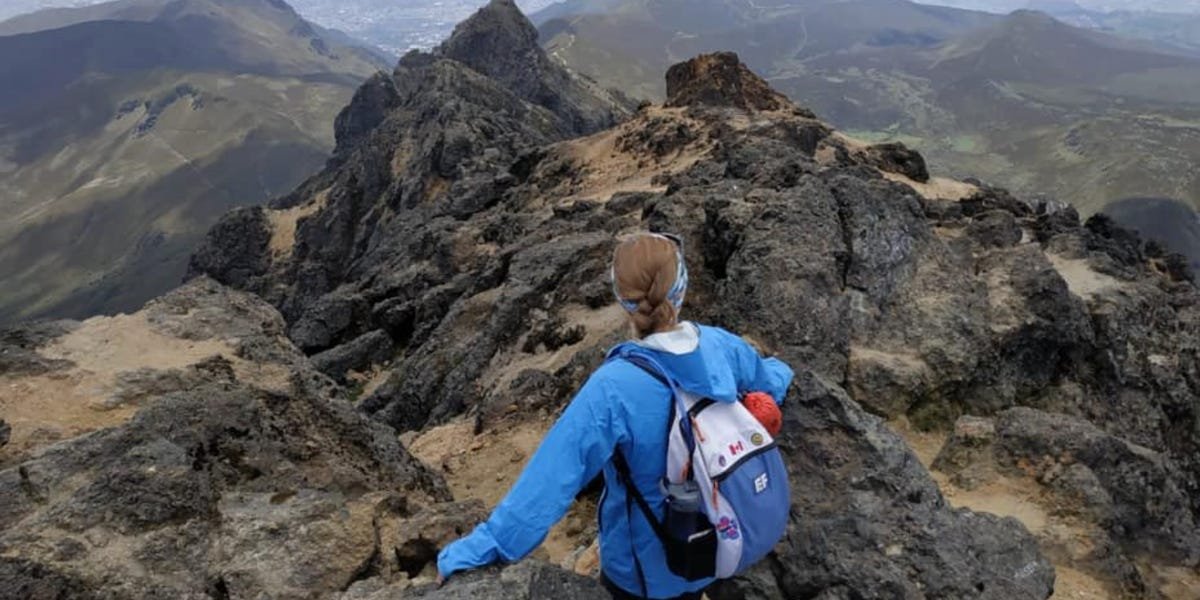
For those who, like me, enjoy spending time in nature, the scenic route here is even more special. With most hikes even starting at heights of over 9,000 feet above sea level, the mountains — many of them volcanoes — still tower over you.
Rugged rocks and gleaming glaciers dominate the peaks; you’ll spot lots of bright green cushion plants and fields of golden grasses swaying in the winds. Bright-orange chuquiragua plants, found only at these high altitudes, dot the landscape.
One of my favorite hikes is Rucu Pichincha. After riding the Telefériqo cable car to the base camp — which has an incredible view of Quito, a lovely café, and many great spots for photo ops — you can begin to hike up the trail.
Here, you will experience the biodiverse páramo ecosystem and finish at more than 15,000 feet above sea level.
Elsewhere, in different directions but all within a few hours of Quito, the Antisana, Cayambe, and Cotopaxi volcanoes are sky-high with towering peaks covered by glistening glaciers that not even the equatorial sun can melt.
The Quilotoa crater lake is a must-visit.
Kirstynn Joseph
Last but not least, Quilotoa volcano, which is in the same province as Cotopaxi and just a bit further away, holds a turquoise crater lake where you can kayak — one of my absolute favorite things I’ve done here.
I may be biased, but I believe this region is one of the most underrated places in the world. If you find yourself in South America, it is absolutely worth it to set some time aside to get to know the Andes and everything they have to offer.
Just be careful on your journey there — you, too, may also find yourself staying just a bit longer than you planned.
Buying a first home is generally considered a young person’s game. If your 20s are for stumbling through adulthood, then your 30s are for settling down with a family and a mortgage. Your 40s are for reaping the fruits of that labor: as you watch your home equity swell, maybe you think about splurging for more bedrooms and a bigger yard.
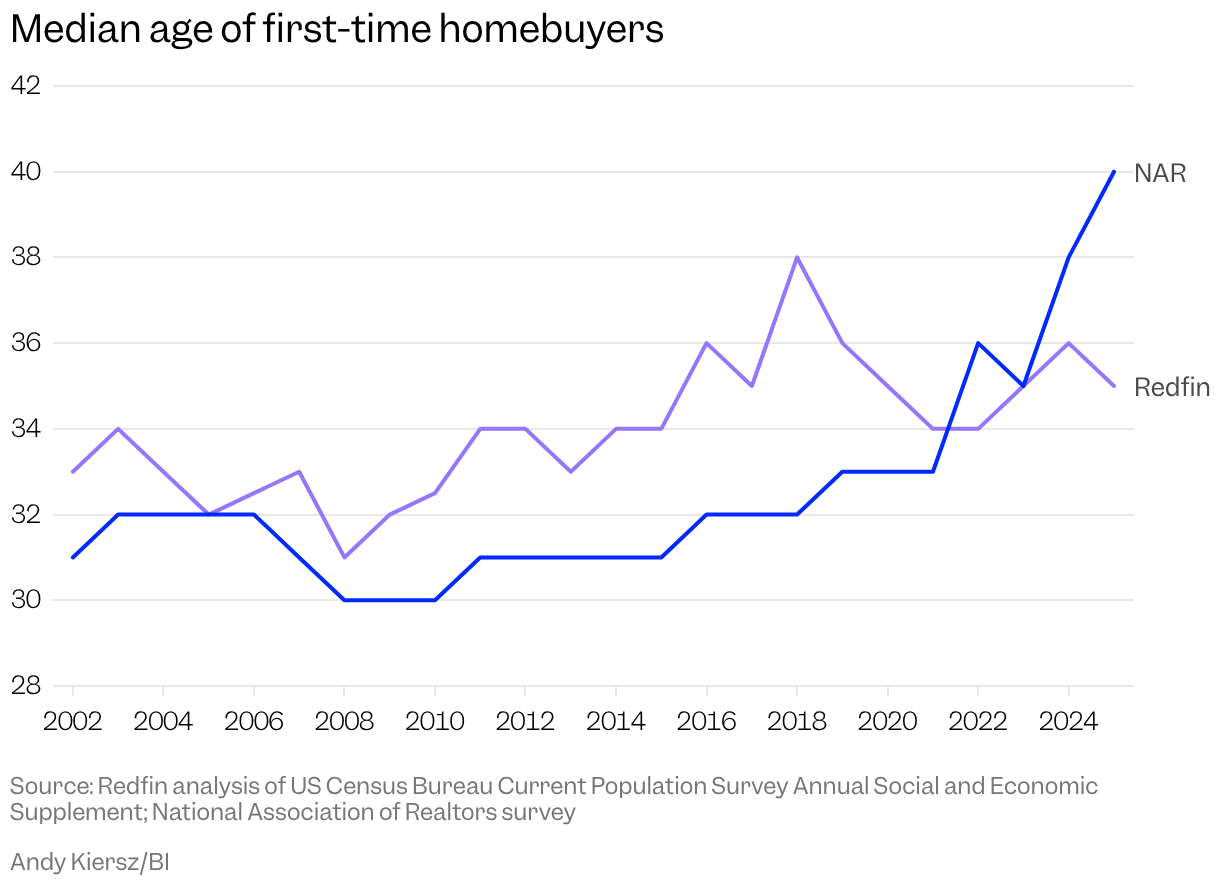
A report released last fall by the National Association of Realtors upended this basic assumption. For several decades, the typical age of first-time homebuyers bounced around the early 30s, never surpassing 33. Last year, though, the group’s annual survey found the median age of first-timers had hit a record high of 40, capping off a four-year surge that began during the pandemic-era housing shuffle. The message was loud and clear: Picking up the keys to your first place is no longer an “early adult” thing. Now it’s part of your midlife crisis.
Cue the hand-wringing. “First-home homebuyers are older than ever,” declared headlines from The New York Times and Axios. “Many would-be buyers are frozen out of the housing market,” warned another. For my own story, I dubbed this new era the “age of the geriatric homebuyer.” I spoke with a woman who placed her first winning bid on a home at 42 and couldn’t shake the feeling that she was behind. In light of the NAR’s latest data dump, however, she appeared to be merely another example of the sea change in real estate.
The splashy number seemed to confirm our worst fears about the housing market: only old, rich people are having any luck, and younger generations are struggling to break in. The optimists’ take was that elder millennials still had some breathing room. For those inclined to doomerism, though, it was more proof that a classic marker of adult success was drifting further out of reach.
“It is very consistent with this idea that housing affordability is very strained,” says Chen Zhao, a senior economist at the brokerage firm Redfin, “and therefore you have to be older to afford a house right now.”
There’s just one problem: The death of the thirtysomething homebuyer may have been greatly exaggerated. A new analysis from Redfin, shared exclusively with Business Insider, found that the median age of the first-time buyer last year was 35 — a slight decrease from the year prior. It adds to the growing pile of evidence that the new median of 40 was a mirage. While millennials, now 29 to 45, generally lag behind boomers on the homeownership front, the purchasing milestone hasn’t shifted nearly as much as the NAR report suggests.
If you want to understand the housing market’s ebbs and flows over the past couple of decades, Redfin’s analysis is a helpful starting point. Economists there found the median age of first-time buyers climbed slowly but steadily from 2008 to 2018, peaking at 38, before bouncing around the mid-30s in the following years. Zhao tells me the trend makes intuitive sense: banks tightened up lending standards after the housing bubble burst in 2008, making it tougher to get a mortgage and buy a house. Then mortgage rates began ticking downward before plummeting in 2020 and 2021, reaching a 50-year low as the Federal Reserve slashed borrowing costs to fight inflation. All those cheap home loans made it easier for younger people to break into the market, and the first-time homebuying age fell to 34 in 2021 and 2022. Then rates jumped, and the median age of first-timers followed suit, rising to 35 in 2023 and 36 the following year. Affordability improved slightly in 2025, thanks to slower home-price growth, rising wages, and marginally lower mortgage rates, which could explain last year’s decrease in the median age.
Every time James publishes a story, you’ll get an alert straight to your inbox!
Stay connected to James and get more of their work as it publishes.
While the NAR and Redfin analyses both point to first-time homebuyers generally getting older, the latter’s numbers are way less dramatic. Redfin isn’t the only one pushing back on the idea that the typical buying age skyrocketed over the past few years. A growing number of economists have chimed in to suggest the situation isn’t nearly so dire. Studies by the Federal Reserve Bank of New York and the American Enterprise Institute found that the median age of first-timers was basically unchanged at 33 between 2019 and 2024, before rising slightly last year to 34. Researchers at the Mortgage Bankers Association similarly found a modest increase from 30 to 33 over the decade leading up to 2024, followed by a dip to 32 in 2025.
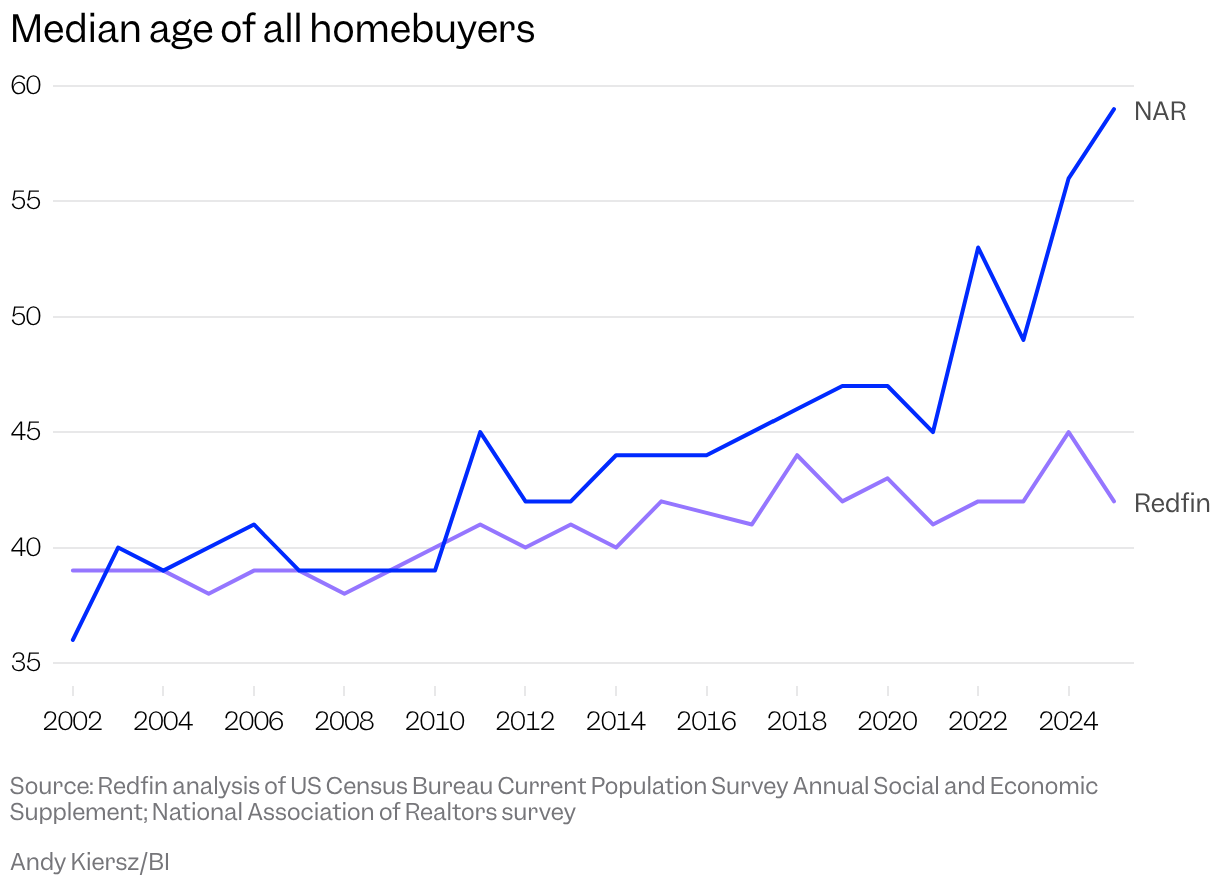
Connor O’Brien, a fellow at the DC-based think tank Institute for Progress, analyzed the Census Bureau’s American Housing Survey and American Community Survey and found that the median age for all buyers had ticked up since 2000 but hovered around 42 in 2023, while NAR reported a median age for all buyers of 49 that year and a stunning increase to 59 just two years later. That Census data only runs until 2023, but O’Brien says he doesn’t see any reason to believe that the typical buying ages would have undergone a seismic shift in two short years, given the housing market’s stasis.
So why the discrepancy? The rebuttals to NAR’s data all draw upon national data sources that researchers say are far more robust than the Realtors’ annual survey of recent homebuyers, which is conducted via mail and text message. In July of last year, the NAR sent the 120-question survey to a nationally representative sample of more than 173,000 recent homebuyers but received just 6,103 back, a response rate of 3.5% (the census’ American Community Survey, by contrast, sees a response rate of more than 80%). The New York Fed and the Mortgage Bankers Association relied on the Consumer Credit Panel and the National Mortgage Database, which sample millions of underlying documents, like mortgages and credit reports, to take the temperature of the American homebuyer.
It seemed totally implausible.Connor O’Brien, fellow at the Institute for Progress
Redfin’s analysis also uses Census data, specifically an annual supplement to its Current Population Survey, which asks households who moved in the past year why they did so. The survey doesn’t separate first-time buyers from repeat buyers, so Redfin used a proxy: it counted respondents as “first-time buyers” if they said they moved because they wanted to own rather than rent, or to start their own household, implying they’d previously been living with roommates or parents.
A Redfin analysis of census data shows the typical age of first-time homebuyers actually decreased slightly last year to 35.
Smith Collection/Gado/Getty Images
Jessica Lautz, the NAR’s deputy chief economist and vice president of research, says in an emailed statement that the organization stands by its methodology. Lautz describes the NAR’s survey as “the only national survey that asks primary residence buyers if they are a first-time buyer or repeat buyer,” and points out that analyses of mortgage and census data must rely on varying degrees of assumptions in order to parse first-timers from the rest of the pack — mortgage data, for example, doesn’t include all-cash buyers. Some of those assumptions, she says, no longer match the reality of the new housing market.
“Marriage and divorce do happen, inheritances are gifted, all-cash buyers happen, and sometimes a household may have to rent temporarily before owning again,” Lautz says in the statement. “Homeownership has become out of reach for the typical young adult in America.”
Redfin’s methodology isn’t perfect — taken on its own, I’m not sure it would unseat the NAR’s estimates. It’s important to pay attention, however, because it adds to the mountain of evidence that first-time buyers aren’t suddenly getting way older.
“Because no data source is perfect, what you really want to do is say, What is the bulk of the evidence showing me?” Zhao tells me. “When we compare our results to analyses that other people have done looking at credit bureau data or mortgage data, it seems to support the idea that the age of the first-time buyer has not increased all that much.”
This might sound like a bunch of bickering and hair-splitting, a squabble among housing nerds. But the conclusion — that people are still buying homes at roughly the same age they were a couple of decades ago — has far-reaching implications.
“People are potentially going to make policy based on their view of how the economy and housing market are developing,” O’Brien tells me. “If their views are fundamentally incorrect, that could be a big problem.”
The homeownership rate for millennials in their early 30s still lags well behind that of baby boomers at the same age.
Eileen T. Meslar/Chicago Tribune/Tribune News Service via Getty Images
The takeaway shouldn’t be that things are fine and dandy for millennial homebuyers, though.
We don’t have enough housing where people want to live, and where people find the job markets that they want to participate in.Ben Glasner, senior economist at the Economic Innovation Group
A recent analysis of census data by Ben Glasner, a senior economist at the Economic Innovation Group, found that while millennials and boomers were about as likely to own homes at 44, the ownership rate among 32-year-old millennials (41.3%) was well below the 54.7% for boomers at that age. And while Redfin and NAR pulled vastly different homebuying ages from their data, both groups advocate for more housing construction. Glasner draws a similar conclusion.
“We don’t have enough housing where people want to live, and where people find the job markets that they want to participate in,” he tells me.
The “40-year-old” finding had all the proper ingredients for virality: a nice, big number that confirmed what everyone already felt to be true about the dismal state of the world. Things are rough out there for millennial homebuyers, no doubt. But the goalposts haven’t moved as much as we thought — at least, not yet.
“I think a lot of times people feel like, Well, if I can’t achieve the homeownership step, it’s kind of like I can’t move forward with my life,” Zhao tells me. “And I think that’s why people are very hung up on this number.”
James Rodriguez is a correspondent on Business Insider’s Discourse team.
This story is available exclusively to Business Insider
subscribers. Become an Insider
and start reading now. Have an account? .
After living in Switzerland for five years, I’ve watched tourists make a lot of the same mistakes.
Don’t try to see too many places in one trip, and try visiting some smaller mountain villages.
Become at least a little familiar with the local languages and book your train tickets in advance.
Though I’m a US citizen, I’ve spent the past five years living in Switzerland.
As a semi-recent transplant, I know there’s much more to this amazing country than what visitors typically come to see. It’s one best experienced thoughtfully and authentically — not by mindlessly racing through “Top 10 ” lists.
In terms of mistakes tourists make, here are a few things I suggest you know — and avoid — before visiting Switzerland for the first time.
You’ll probably regret only visiting the Instagram-popularized spots.
Lucerne is incredible, but it’s not the only great place to visit in Switzerland. Peter Shaw/Getty Images
Zermatt, Lauterbrunnen, Interlaken, and Lucerne are popular, jaw-dropping locations, but they’re not the only spots worth visiting in Switzerland.
Instead of only seeing the few places on every tourist’s list, consider branching out to smaller, lesser-visited ones for at least a day trip. Fortunately, many are easily accessible by public transportation out of some of the area’s main hubs.
For example, close to Interlaken are the mountain villages of Frutigen, Kandersteg, and Adelboden, which offer gorgeous alpine views combined with fewer crowds and more authentic experiences.
Don’t assume the dining-out culture and prices will be what you’re used to back home.
Eating out in Switzerland can be expensive, but I’ve found the prices to be justified. Ashley Franzen
In Switzerland, dining out can seem expensive — in part because the cost of production, labor, and relevant service charges are typically already included in the price of the meal.
Personally, I find the prices easier to stomach when I remember you’re often paying for high-quality, regional fare, and restaurant staff here are typically earning a fair wage.
And although tipping servers 15% to 20% of a bill is standard practice in places like the US, it’s not the norm here. If you enjoyed the meal and the service, it’s customary to round up a few francs or leave a tip between 5% and 10%.
Make your train reservations in advance.
Not making reservations in advance could mean missing out on some special experiences. Ashley Franzen
Switzerland is a popular travel destination throughout the year, and its major attractions can fill up quickly — especially seats on our world-famous scenic routes.
If you plan on riding the Glacier Express or Bernina Express, book your train tickets as far in advance as possible.
However, don’t fret if you realize it’s too late to book a seat on a scenic route. You’ll be just fine on our “regular” trains, which tend to run faster, not book up as quickly, and still offer beautiful views.
Speaking of trains, don’t get fined for sitting in the wrong class.
Make sure you follow your ticket. Ashley Franzen
When traveling by train, it’s important to double-check your ticket class and location. (And, if you have a paper ticket, get it validated.)
Signage indicating first or second class can be found both outside and inside each car. Oftentimes, the class is also noted on the headrests of the seats themselves.
Ticketing agents on board will not hesitate to issue an on-the-spot fine for tourists seated in the wrong class. In addition to a fine of about 100 francs, you’ll also have to pay the difference in price for the ticket.
Also, pay attention to where your seats are before entering each car so you won’t have to lug an oversized suitcase through the entire train.
Switzerland is small, but I don’t advise trying to cram everything into a short trip.
While in Switzerland, take your time to experience the culture and stunning views. Ashley Franzen
Switzerland is one of the smallest countries in Europe, at about 16,000 square miles. However, I’ve seen tourists mistakenly assume they can just zip through and see everything it has to offer in just three or four days.
For example, Zurich may seem close to Geneva on a map, but they are actually about three hours apart by train. Sure, you could also opt for a one-hour flight — but my point is that trying to see so many cities in a short period won’t allow you to truly get a feel for each.
Travel is about experiencing a place, not just visiting to check it off a bucket list. If you’ve only got a week in Switzerland, I suggest you limit yourself to exploring two or three cities instead of trying to cram six or seven single-night stays in new places into your itinerary.
Become at least a little familiar with the local languages and commonly used symbols.
The Swiss take recycling seriously. Ashley Franzen
Switzerland is composed of 26 cantons, and each of these administrative regions has its own distinct culture, government, and history. They also don’t all speak the same languages.
Although you’ll find English speakers throughout the country — especially in popular tourist areas — Switzerland actually has four official languages: German, French, Italian, and Romansh.
It’s helpful to learn a few basic greetings in those major languages and ensure you use them in the appropriate region.
Also, it’s handy to become familiar with some of the commonly used symbols — especially when it comes to trash cans.
The Swiss are conscientious recyclers, so take a beat to look up the symbols printed on the bins before tossing something in them if you are confused. Your mindfulness will be appreciated