Amanda Goh

Bryan Johnson says he got sex ed wrong with his son — and he’s trying to fix it

Bryan Johnson says he didn’t teach his son enough about sex and wants to change that.

“He is 20 now, and we were talking about sex. He had these questions, and I was like, ‘I’ve never educated my son on sex,'” Johnson, the tech entrepreneur known for his pursuit of longevity, told executive editor Zak Jason at Business Insider’s The Long Play event on Tuesday.

“We, of course, have the basics covered, but his only source of education has been porn,” he said, adding that there’s an “entire generation of people who have not been educated” on how to make love.

That realization led him to try to explain intimacy more deliberately. “What I wrote was basically an instruction manual on how to have sex,” he said.

Although people have called it a “’50 Shades of Grey’ longevity version,” Johnson said it was really “like 10 lessons” he was trying to get across.

One of those lessons, he said, is the difference in arousal between men and women, which can create a mismatch if partners move at different speeds.

“Basic stuff like that, so it was like trying to educate people on, how do you create good relationships in a loving manner,” Johnson said.

He added that his son has largely taken his openness in stride: “My son is so cool.”

Johnson, who says he spends about $2 million a year on efforts to reverse his biological age, has long been public about sex as a key part of his broader approach to health and longevity. He previously said that he wears a small device on his penis to measure his nighttime erections.

At Tuesday’s event, Johnson said founders in “monk mode” may be missing the role relationships play in performance.

“Sometimes it takes a bit for them to realize that, but a good partnership is really beneficial for mental health and physical health,” he said.


Source link

My-son-bought-a-2-car-and-learned-how-to.jpeg

My son bought a $2 car and learned how to fix it himself. It gave him the independence he was craving.

My eldest felt a strong urge to own a car for most of his teenage years. He would pop into the living room and show his dad and me his latest internet find, usually a 20-year-old jalopy with questionable reliability costing several thousand dollars.

Each summer break, he would talk about buying a car with us. Each time, we wouldn’t say no. We would just urge him to consider his situation as a full-time student with an uncertain future.

We provided transportation to and from school, and while there, he walked, rode a bike, and grabbed rides from friends. Each time, he decided on his own that it might not be the smartest time to invest a couple of thousand dollars in a car of questionable repair.

He got a deal from a family friend

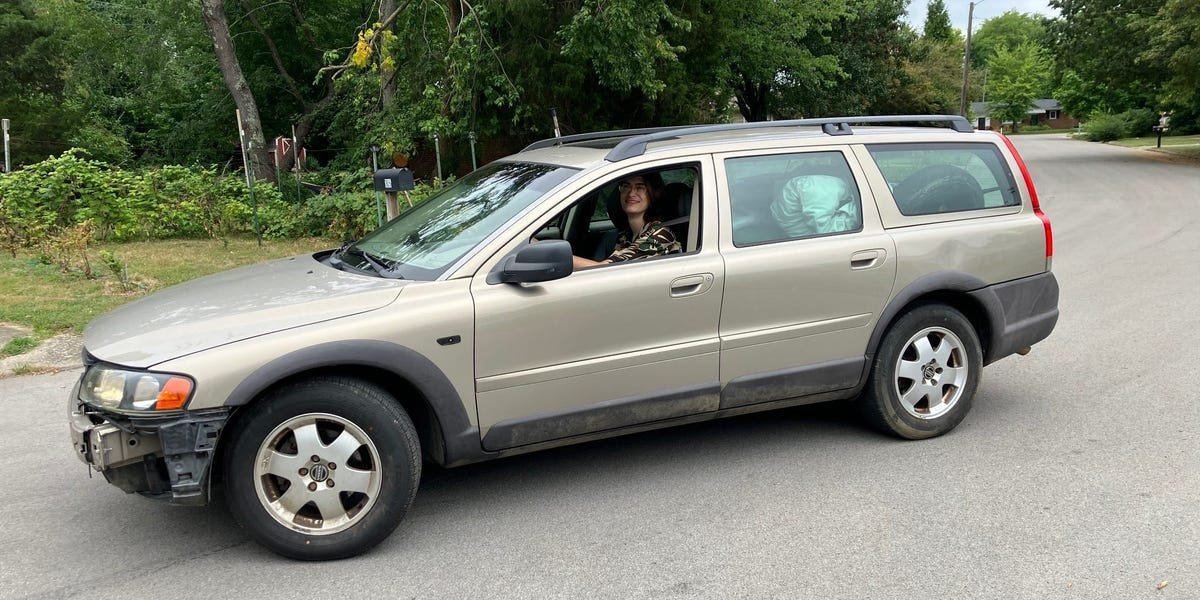
The summer before his junior year of college, however, a family friend offered him a deal he couldn’t pass up. It was a 20-year-old Volvo wagon that had a run-in with a deer. The front end was crumpled, it was undrivable, and he didn’t have the title. But the price was right — $2, twice the friend’s original purchase price of a buck.

In some ways, it was a bold move. My son didn’t have much experience in car mechanics. During that school break, he put money and time into repairs. He straightened the front radiator support with a winch so all the parts would fit again. He replaced the radiator and flushed out the intercooler. By the end, it stayed in motion long enough to limp to a storage barn for the winter.


Abandoned car

The author’s son learned how to fix the car with YouTube videos.

Courtesy of the author


The next summer, it was his main focus. He installed a new radiator fan, bought a new battery. Replaced two tires and had them aligned. Put in a new headlight and did more bodywork. He cleaned it, inside and out. And just a couple of days before returning to college, the crowning glory: a salvaged hood that perfectly matched the golden hue of his car.

He learned a lot from fixing the car

There was a fair amount of angst. Figuring out the process for issuing a new title. Hunting down the owner who last had it and arranging a meeting. Ordering the wrong or incomplete parts and having to send them back. Determining what needed to be fixed and how much it cost. Calculating how much he should spend, even after fixing it up, the car was probably only worth about $2,000.

He elected to do much of the work himself, spending hours at the “University of YouTube.” At one point, as he lamented the money he had spent so far, with the possibility that it would all be for naught, my husband asked him how much a college credit hour costs. My son looked it up. It was exactly what he had spent so far on the car. My husband said, “Haven’t you learned a lot?”


Young man posing with car

The author says her son learned so much from fixing his own car.

Courtesy of the author


That helpful reframing stuck: The night before he drove the car to college, my son commented, “Hey, I got a free car at the end of that college class.” We celebrated with him that evening, telling him how proud we were of his persistence and frugality, of his push to learn something new.

He got the independence he wanted

Seeing him drive off in that car left an indelible impression on me. Armed with his insurance’s roadside assistance, a toolbox gifted by his dad, and a bag of extra fluids in the passenger seat, he set out on the 8-hour, 57-minute drive to York College in Pennsylvania from our home in Kentucky. He couldn’t shake the small, satisfied smile on his face. I couldn’t shake my delight and my apprehension.

Being the mom that I am, I asked him to text whenever he stopped so we could track him on his journey. First stop: at the coffee shop halfway, our usual lunch break, and the new thrift store next door. Next, at a Civilian Conservation Corps museum, he saw signs along the highway. Finally, in the parking lot of his dorm. Even through text, I could sense the satisfaction and pride he felt for accomplishing that trip in his own ride.

In the ensuing months, the $2 car has safely delivered him each week to his internship and to a friend’s house for fall break. It has given him a measure of independence he didn’t have before. And it gave him something we, as parents, couldn’t, no matter how much we wanted to: a sense of self-sufficiency. That was something he had to earn.

We could only encourage him, support him, and talk him through his next steps, then see if he succeeded or failed. In the end, he knew that he could handle the road ahead by himself.


Source link

Ellen Thomas Business Insider

President Donald Trump pitched a power fix that Big Tech has a head start in

The AI data center boom has triggered a dramatic spike in electricity costs, and President Donald Trump has a plan to stop it.

To do this, Trump said at Tuesday’s State of the Union address that he issued a mandate for data centers to build their own power plants.

Trump said he’d “negotiated” a ratepayer protection pledge with major technology companies and billed it as a unique solution to Big Tech’s mounting power demand that would also protect American consumers from higher electricity bills.

“They can build their own power plants as part of their factory,” Trump said.

Many data center sites have already started building their own power plants. The vast majority of this buildout will initially run on fossil fuels, despite tech giants’ clean energy commitments.

When reached for comment on Wednesday morning, a White House spokesperson gave the following statement: “Major Tech companies will join President Trump at the White House next week to formally sign the Rate Payer Protection Pledge that he announced during his historic State of the Union address. Under this bold initiative, these massive companies will build, bring, or buy their own power supply for new AI data centers, ensuring that Americans’ electricity bills will not increase as demand grows. President Trump is committed to ensuring American AI dominance while simultaneously lowering costs for working families.”

A spokesperson for Amazon confirmed to Business Insider that it will attend the White House next week.

“The Ratepayer Protection Pledge is an important step. We appreciate the Administration’s work to ensure that data centers don’t contribute to higher electricity prices for consumers,” Microsoft vice chair and president Brad Smith wrote in an e-mailed statement.

A spokesperson for Anthropic referred Business Insider to a post on X made last night by Sarah Heck, the company’s head of external affairs.

“American families shouldn’t pick up the tab for AI. In support of the @WhiteHouse ratepayer protection pledge, Anthropic has committed to covering 100% of electricity price increases that consumers face from data centers,” Heck wrote.

Microsoft, Anthropic, and OpenAI have previously announced commitments to covering the costs of electricity consumption at their data centers, though details on those plans remain scant.

Big Tech is building its own power plants

In the last year, on-site power plants fueled mostly by natural gas have emerged as a key strategy for data center developers looking to stay ahead in the AI race. Meanwhile, US power demand has reached record highs.

Utilities in the US last year asked state regulators to approve $31 billion in rate increases, more than double the amount sought in 2024, according to research from PowerLines, a nonprofit advocate for utility customers. Many of those requests occurred in places experiencing heavy data center development, such as Virginia, Texas, Utah, and North Carolina.

Trump has framed data center developers building their own power plants as part of his broader promise to ensure that Big Tech pays for the infrastructure needed to power AI ambitions. For developers, building an on-site power plant can bypass long wait times for a grid connection.

Elon Musk’s xAI is the most prominent example of this. Musk has drawn intense scrutiny in Tennessee and Mississippi, where he has deployed unpermitted mobile generators to quickly get his data centers up and running.

Musk brought his first mobile generators to Memphis in 2024. In the US, dozens of data centers — about 30% of all planned data center capacity in the nation — plan to build their own power plants, according to a report issued this month from Cleanview, a data visualization software company that tracks clean energy and data center projects. Nearly all of that planned capacity — 90% — was added in 2025, Cleanview found.

In a review of permit documents, corporate filings, press releases, and local news stories, Cleanview identified 46 data center projects, many of them already under construction, that plan to draw power “behind the meter” by building on-site, private power plants that don’t need a grid connection or service from the local utility to run.

These include Meta’s plans to build an on-site natural gas plant for its data center in New Albany, Ohio, as well as Oracle and OpenAI’s plans to power their Project Jupiter data center site in New Mexico with two massive natural gas-fired systems.

While Big Tech companies often tout their commitments to clean energy, Cleanview’s review of behind-the-meter permit documents found that natural gas powered 75% of all equipment listed.

Tech companies have said they want to power AI with clean technology, such as small modular nuclear reactors and geothermal energy. Much of it is still years away from being deployed at scale.

Texas is becoming the top state for new data centers

Cleanview found that more than one-third of the behind-the-meter buildout is happening in Texas, which could soon overtake Virginia as the data center capital of the world.

Business Insider has reported on Oracle and OpenAI’s plan to power Stargate data centers in Texas with on-site natural gas plants, as well as Fermi America’s pitch to build the world’s largest combined data center and power plant in the state’s Panhandle region.

After Texas, the top five states with the most planned behind-the-meter capacity are New Mexico, Pennsylvania, Utah, and Wyoming. West Virginia, Tennessee, Ohio, Virginia, and North Carolina also have significant behind-the-meter projects.

Have a tip for this reporter? Contact Ellen Thomas at ethomas@insider.com or on Signal at 929-524-6964.


Source link

Kelsey Baker, Military and Defense Reporting Fellow

Thousands of military families are stuck on childcare waitlists. More spots may not be enough to fix the deeper problems.

There are an estimated 7,800 children on US military childcare waitlists. Military families and advocates say the number masks deeper shortfalls that continue to sideline working spouses and strain service members.

Lawmakers raised the issue during a recent congressional hearing, calling the persistent backlog a quality-of-life problem, even as the waitlist has notably dropped from 12,000 children in 2024.

Advocates told Business Insider that the number isn’t the whole picture and excludes families who’ve given up out of frustration or can’t use base centers that lack evening, weekend, or specialized care.

“We can’t say that we are a military that cares about our families if we pretend to provide childcare and then we’ve got a waitlist that’s got 7,800 babies waiting on it,” Massachusetts Democratic Sen. Elizabeth Warren said to service senior enlisted leaders during last week’s hearing.

None of the service leaders present disputed that figure.

Master Chief Petty Officer of the Navy John Perryman acknowledged that the Navy still has roughly 1,400 children in unmet need status, while Chief Master Sergeant of the Air Force David Wolfe said his service’s waitlist stands at around 2,700, though there are efforts underway to open new spots.

It is not clear how the remaining waitlisted children are divided between other services.

In 2022, the Air Force had 95,000 children under 5 but space for only about 23,000 in its child development centers, a 2023 service report on childcare found.

An Air Force spokesperson attributed that disparity to the number of children entering and leaving care throughout the year. “The annual number served will not correlate with daily capacity and can be significantly higher,” they said.

Not all families require on-base care. But the report added that more facility construction alone would not be a “viable solution to meet all potential demand.”

Kayla Corbitt, a military spouse and the founder of a nonprofit dedicated to helping military families find reliable childcare, told Business Insider that many families lose hope amid long waits. Staying on the waitlist, she said, requires logging on every couple of months to reconfirm before families are automatically disenrolled.

And for some families, the barriers extend beyond backlogs.


A room at the CDC at Ramstein Air Base, Germany, Jan. 14, 2026.

A room at the CDC at Ramstein Air Base, Germany.


Airman Paden Henry/US Air Force


“Anyone needing evening care, weekend care, shift work care, which is a lot of the military, they aren’t going to try to get on that waitlist,” Corbitt said, explaining that most child development centers, or CDCs, on bases don’t offer late evening or very early morning care needed for troops on 24-hour duty or for deployed service members with spouses who work unusual hours.

Additionally, children with special needs face significant obstacles in finding care, Corbitt said, as many CDCs are not equipped to provide care, and the policies sometimes vary from facility to facility, making it hard for families to know what to expect when they move.

Brigit Schneider, an Air Force spouse and mother of three children, wants to return to work as a financial planner to better support her family, but because her local childcare center won’t accept children with feeding tubes, one of her young children is shut out.

“From a special needs mom perspective, it’s an extra layer of challenge,” she told Business Insider.

Schneider pays nearly $1,000 a month for one child to receive on-base childcare, another child is receiving private care due to the severity of their disability, and a third is at home. Schneider says the third should be able to receive base care.

“A G-tube really is not a hard medical device to learn how to use,” she said.

Generally, though, military CDCs won’t accept children with gastrostomy tubes. Facilities are often unable, or unwilling, to provide higher levels of care, Corbitt said.

Air Force childcare programs are “supported by a multidisciplinary team of experts who provide consultation and support to ensure the highest quality of inclusive care,” an Air Force spokesperson told Business Insider following a query regarding the service’s childcare.

The service “offers a network of on- and off-installation care options and works closely with families to identify the appropriate setting for their child,” said the spokesperson, adding that waitlist data helps inform future allocation requirements.

Staffing shortages are another obstacle to reliable access for military personnel. Military childcare workers face unusually high attrition rates, around 50%, Warren said at last week’s congressional hearing, driven largely by meager pay.

Compounding the issue is the lack of a clear pathway that would allow qualified providers to move easily between states.

Nearly 40% of childcare workers are military spouses, said the Marine Corps’ top enlisted leader, Sergeant Major Carlos Ruiz, during the hearing. “If we can just be a little bit more smart about transferring folks and directly hiring from one CDC to another, we can reduce the attrition,” he said.

Government watchdogs have repeatedly flagged childcare accessibility as a point of concern for the US military. A 2024 Government Accountability Office report found that while the services focus heavily on recruiting new childcare workers, they do not consistently measure whether employee retention efforts are effective.

The military’s childcare shortages aren’t unique to the armed forces. Many Americans in the civilian world struggle to find reliable, reasonably priced childcare.

Often, a year of childcare amounts to an entire average salary, costing tens of thousands of dollars. The cost of childcare in the US has increased by over 150% over the last quarter-century and continues to climb, often outpacing inflation. In some areas, childcare costs can exceed rent or mortgage payments.


Source link

Will-Lewis-couldnt-fix-the-Washington-Post-Thats-on-Jeff.jpeg

Will Lewis couldn’t fix the Washington Post. That’s on Jeff Bezos.

Will Lewis, the former CEO and publisher of the Washington Post, had a terrible tenure at the paper. The two years he spent there, which ended Saturday with a two-paragraph memo, are chiefly notable for a series of cuts and layoffs, culminating in a 30% bloodletting days ago.

But let’s be clear: This one is on Jeff Bezos.

Most obviously, that’s because Bezos owns the Post, and Bezos was the one who hired Lewis to run the business for him.

Bezos was also the one signing off on Lewis’s actions at the paper, which mostly amounted to making the paper smaller while telling the staff that “people are not reading your stuff.”

And slightly less obviously, it was Bezos who dramatically worsened the Post’s business outlook. He decided not to endorse a presidential candidate in 2024, weeks before the election — a move that outraged many Post readers, who saw the non-endorsement as an attempt to cater to Donald Trump.

That led to more than 250,000 subscriber cancellations, a huge problem for a paper whose circulation peaked at 3 million in 2021.

The best case argument you could make for Lewis era at the Post, if you are inclined, would go something like this: Bezos, who bought the Post in 2013 and then invested heavily in staff, realized a few years ago that he now employed many more people than his business would support. So he brought Lewis in to do the grim work of shrinking the publication. Now that work is done, so Lewis can do something else and Bezos can find someone to help the Post grow again.

But the timing of Lewis’ departure — late afternoon on a Saturday, following days of howling from Post employees and many others about Lewis and Bezos’ stewardship of the paper — suggests this was not a long-in-the-making move.

And again, whether Lewis jumped or was pushed doesn’t matter in the end. The Washington Post is Jeff Bezos. He gets praise if things are going well — which, for several years after his purchase, seemed to be the case — and blame when it doesn’t.

Here I’ll also point out that Bezos, who has no problem being seen jet-setting around the world in a style befitting the world’s fourth-richest man, has been totally MIA during his paper’s recent turmoil.

On Saturday, when the paper announced it had promoted Post CFO Jeff D’Onofrio to acting publisher and CEO, Bezos finally attached his name to a public statement, promising that the new Post would thrive by giving readers things they wanted to read.

“The data tells us what is valuable and where to focus,” he said in a Post press release.

That might qualify for an insight 30 years ago, when newspapers were struggling to respond to the internet. Now that’s table stakes, and you would hope the guy who created Amazon has more up his sleeve.

I have a bunch of ideas,” for the Post, Bezos said in the fall of 2024. “I’m working on that right now.”

We’re still waiting.


Source link

Line chart

Inside Amazon’s ‘mind-blowing’ plan to fix groceries and beat Walmart

For years, Amazon was cast as Walmart’s great disruptor. Now, it’s borrowing from the retail giant it once sought to upend.

The company is rolling out Walmart-inspired ideas, including “Supercenter” warehouses, a new distribution layer known internally as the “1DC” network, and microfulfillment centers within Whole Foods stores, according to internal documents obtained by Business Insider.

The shift reflects a hard lesson: mastery of e-commerce does not translate into dominance in groceries, particularly perishable items that drive frequent shopping. Walmart’s dense network of stores and distribution centers, designed to move everyday goods quickly and cheaply, has proved difficult to replicate.

Nearly a decade after paying $13.7 billion for Whole Foods, Amazon still trails Walmart in everyday grocery shopping, and is now reshaping its retail infrastructure to compete head-on with Walmart’s Supercenter model.

Earlier this month, plans emerged for a roughly 225,000-square-foot Amazon megastore near Chicago. Bigger than a typical Walmart Supercenter, the new concept is designed to let customers buy “fresh groceries, household essentials, and general merchandise — all in one trip,” according to Amazon.

Michael Levin and Josh Lowitz, cofounders of Consumer Intelligence Research Partners, called the move “mind-blowing” and said “it reveals a degree of Walmart jealousy that we didn’t expect.”

Powerful store network

There’s a lot to be jealous about. With roughly 90% of the US population estimated to live within 10 miles of a Walmart store, the company’s 5,000-plus locations give it a powerful edge in selling fresh food and other perishables, along with many other everyday staples.

According to research firm Numerator, Walmart accounted for about 21% of the US grocery market, both online and in-store, as of September. Amazon and Whole Foods, meanwhile, each held roughly 1.6% of the market.

Meanwhile, Walmart is leveraging its Supercenters to deliver online orders faster, challenging Amazon at its own game.

That’s fueled a surge in Walmart shares, valuing the company close to $1 trillion. The stock is up almost 150% over 5 years, far outpacing Amazon’s roughly 53% gain (although Amazon is still worth more).

Amazon does well with non-perishable goods and everyday essentials such as toothpaste and paper towels. Overall, it offers millions of products for same-day delivery.

But when it comes to more delicate food items, such as pears, meat, and cheese, the company knows it has more work to do.

A company spokesperson said Amazon serves more than 150 million US grocery customers, offers nearly 3 million grocery and household items, and provides same-day delivery in more than 9,000 cities and towns.

Grocery is an “ever-growing” part of its fast-delivery business, the spokesperson added, while noting that in 2025, Amazon added perishable groceries to its Same-Day Delivery service, now available in 2,300 locations, allowing customers to shop without trade-offs between speed, selection, and savings.

Amazon’s Supercenter ambition

One element of this fresh Amazon effort is a new type of same-day delivery warehouse internally called an “SSD Supercenter.” SSD refers to sub-same-day deliveries, typically within four hours. Unlike traditional SSD warehouses that tend to be smaller, these facilities are designed to be larger to close the selection gap, specifically with “Walmart” in groceries, the document said.

Internal planning documents show Amazon intended to launch at least five such sites last year. Amazon wanted to test whether customers would “step-change their shopping habituation and engagement” once the Supercenter warehouses went live, one of the documents stated. Amazon planned to add products not currently sold on its site to the new warehouse and take a more hands-on approach to inventory sourcing, with in-stock targets above 95%, according to the document.

Sub-same-day grocery delivery is still a tiny part of Amazon’s business. At the end of September, it had 30 million eligible customers for this service, according to one of the internal documents obtained by Business Insider. Only 1.6 million of them, or roughly 5%, shopped through the service.

Speed, at scale

Amazon’s Supercenter warehouses are part of a broader push to expand same-day grocery delivery. Internal forecasts called for at least 34 US same-day grocery sites in 2025. Amazon already operates over 80 same-day facilities nationwide, though not all handle groceries, according to Marc Wulfraat, president of logistics consultancy MWPVL.

Amazon is also planning to take the model overseas. Under an initiative known as Project Taylor, the company plans to expand sub-same-day grocery delivery across Europe. It also plans to pilot sub-two-hour “ultrafast” deliveries in London in 2026, one of the documents showed.

A new “1DC” layer in the network

Less visible, but just as important, is a new upstream distribution layer called “1DC.”

These facilities store the most frequently purchased products and replenish fulfillment centers as demand emerges. That can shift weeks’ worth of inventory out of space-constrained fulfillment centers and into distribution sites optimized for palletized storage and rapid transfer.

One internal document described the change as a move from a “push” system, in which inventory is positioned based on forecasts, to a “pull” system that allows fulfillment centers to draw inventory from distribution centers as needed.

Amazon began rolling out the 1DC concept last year through new buildings and retrofits. By the end of 2025, the company planned to operate a dozen of these centers, capable of moving at least 20 million units a week, according to one of the documents. As of October 2025, the facilities only handled non-perishables, including shelf-stable food items, but not frozen or chilled products, the document stated.

“Untenable”

The 1DC idea emerged after Amazon introduced one-day delivery in 2018, one of the documents stated. Longer delivery windows once allowed the company to rely on a single layer of warehouses that could ship inventory from any fulfillment center to any customer. But faster delivery promises made that model “untenable,” forcing Amazon toward a structure long used by traditional retailers, the document added.

MWPVL’s Wulfraat said Walmart pioneered the distribution-center model that stores inventory for replenishing retail locations, while Amazon built its business around fulfillment centers that ship directly to consumers. Amazon also operates a cross-dock network to resupply its fulfillment centers, he said, and the 1DC sites represent a newer, more targeted layer of that system focused on high-velocity items.

Amazon’s spokesperson told Business Insider that 1DC is part of a broader initiative the company previously announced to regionalize its delivery operations and reduce shipping costs.

Whole Foods as infrastructure

Perhaps the clearest signal of Amazon’s shift is its rethinking of Whole Foods. Once positioned mainly as a premium grocer, the chain is increasingly treated as logistics infrastructure.

Amazon has begun installing micro-fulfillment centers in the back of select stores, effectively turning them into local hubs for online orders.

One upgraded Whole Foods site in suburban Philadelphia, announced last year, now fulfills Amazon orders from the back of the store. The model lets shoppers buy Whole Foods-specific items while also ordering products available only on Amazon, reducing the need to shop at other retailers.

Amazon expects this store to serve roughly 100,000 e-commerce units a week by consolidating deliveries from nearby stores, and forecasts online order adoption to grow to 10% by the end of 2026, according to one of the documents.

This approach also mirrors Walmart’s strategy of using its stores to fulfill online orders. Walmart said last year that it can offer same-day delivery to 93% of US households through its store-fulfilled network, with about 35% of those orders arriving within three hours.

The perishables problem

The success of Amazon’s new approach depends on one of the hardest problems in logistics: perishables.

Internal plans show Amazon aiming to expand its perishables distribution capacity from 2.6 billion units in 2025 to 3.3 billion units by the end of 2026. The increase would come from new distribution centers and tighter operational standards across the existing network.

The push is central to Amazon’s same-day delivery strategy and its broader grocery ambitions. Company documents stress that delivering high-quality perishables quickly and reliably is essential to scaling the business.

The goal is expansive. One document calls for making perishables available to “100% of Prime customers” as quickly as possible.

Have a tip? Contact this reporter via email at ekim@businessinsider.com or Signal, Telegram, or WhatsApp at 650-942-3061. Use a personal email address, a nonwork WiFi network, and a nonwork device; here’s our guide to sharing information securely.



Source link