
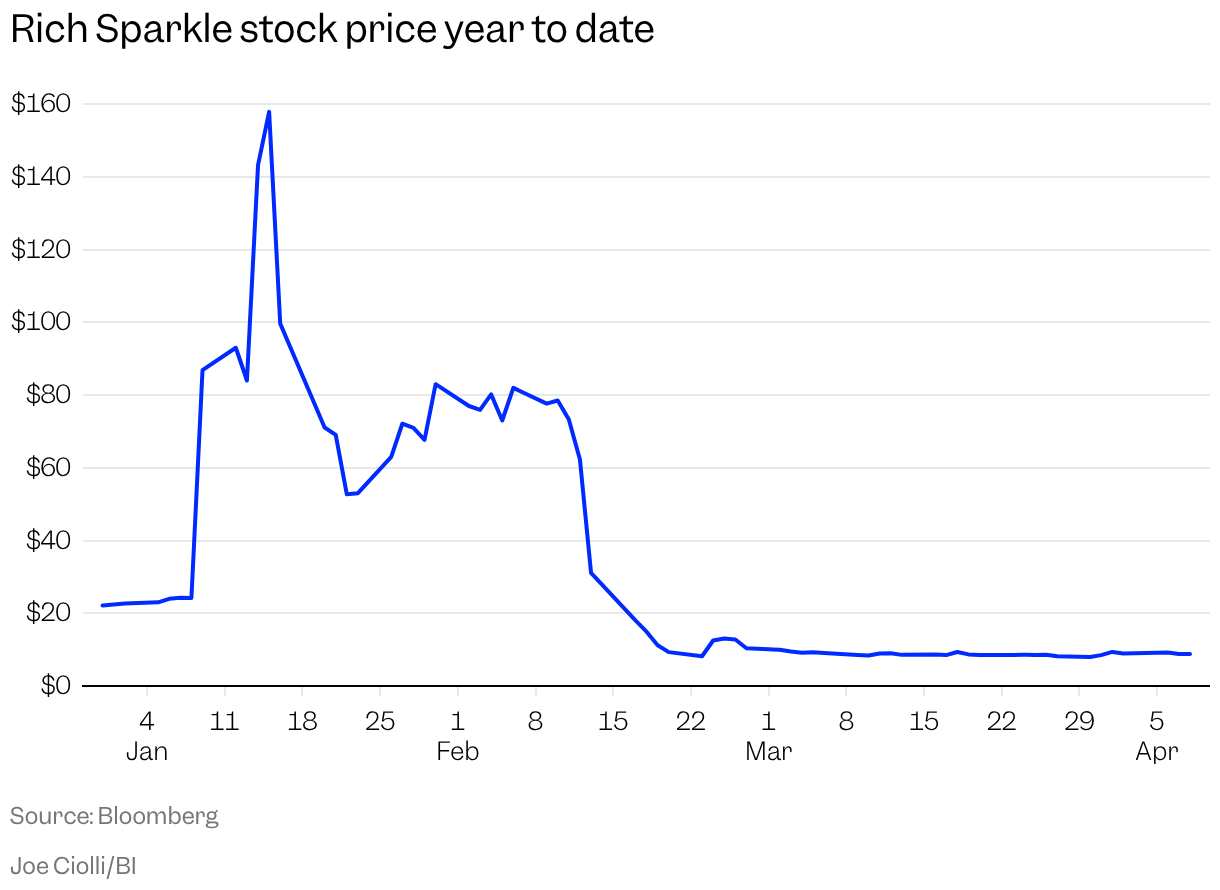
Line chart

TikTok’s top star teased a $975 million deal and then went silent. Red flags are piling up.

Khaby Lame’s mysterious $975 million deal has hit a snag: Brokerages are restricting or blocking trading in the stock behind it.

Lame, TikTok’s top influencer with over 160 million followers, announced in January that he’d struck a deal that would get him a gigantic payday and let everyday investors buy a stake in his business. To make this happen, Lame’s company would merge with the publicly traded Rich Sparkle Holdings, a financial printing firm.

Day traders pounced on the opportunity, buying stock in the company Lame would list under. Rich Sparkle’s stock surged on the announcement.

The initial excitement quickly faded. The stock has plunged more than 90% from its January high amid confusion over the deal’s future. There haven’t been any formal filings indicating that the deal was done, or that Lame’s company has received the 75 million shares it was promised.

Now, a handful of prominent investment platforms have restricted trading in Rich Sparkle’s shares.

Interactive Brokers lists the stock as non-tradable. A spokesperson for Interactive Brokers said the company “periodically reviews the securities it makes available for its clients to trade and restricts those it has determined are not appropriate to offer.”

Others, including ETrade, Merrill Lynch, Fidelity, Charles Schwab, and Vanguard, blocked online trading or put restrictions on the stock.

Some platforms, including Robinhood and Webull, are allowing trading as normal.

Rich Sparkle didn’t respond to multiple requests for comment.

Lame, who in January said he was “excited” to become a Rich Sparkle shareholder, hasn’t said anything about the deal publicly since then. He has removed Rich Sparkle’s stock ticker, ANPA, from his Instagram and TikTok bios, and his team hasn’t responded to multiple requests for comment, either directly or through intermediaries.

Rich Sparkle had a market cap of roughly $133 million as of Wednesday’s close. Some brokers limit trading in low market-cap stocks because they may not stick around for long and can create logistical headaches for a firm’s back office if they disappear, said James Angel, a finance professor and FINRA program director at Georgetown University.

“Brokers feel they are doing their customers (as well as their back offices) a favor by not letting customers buy them,” Angel said.
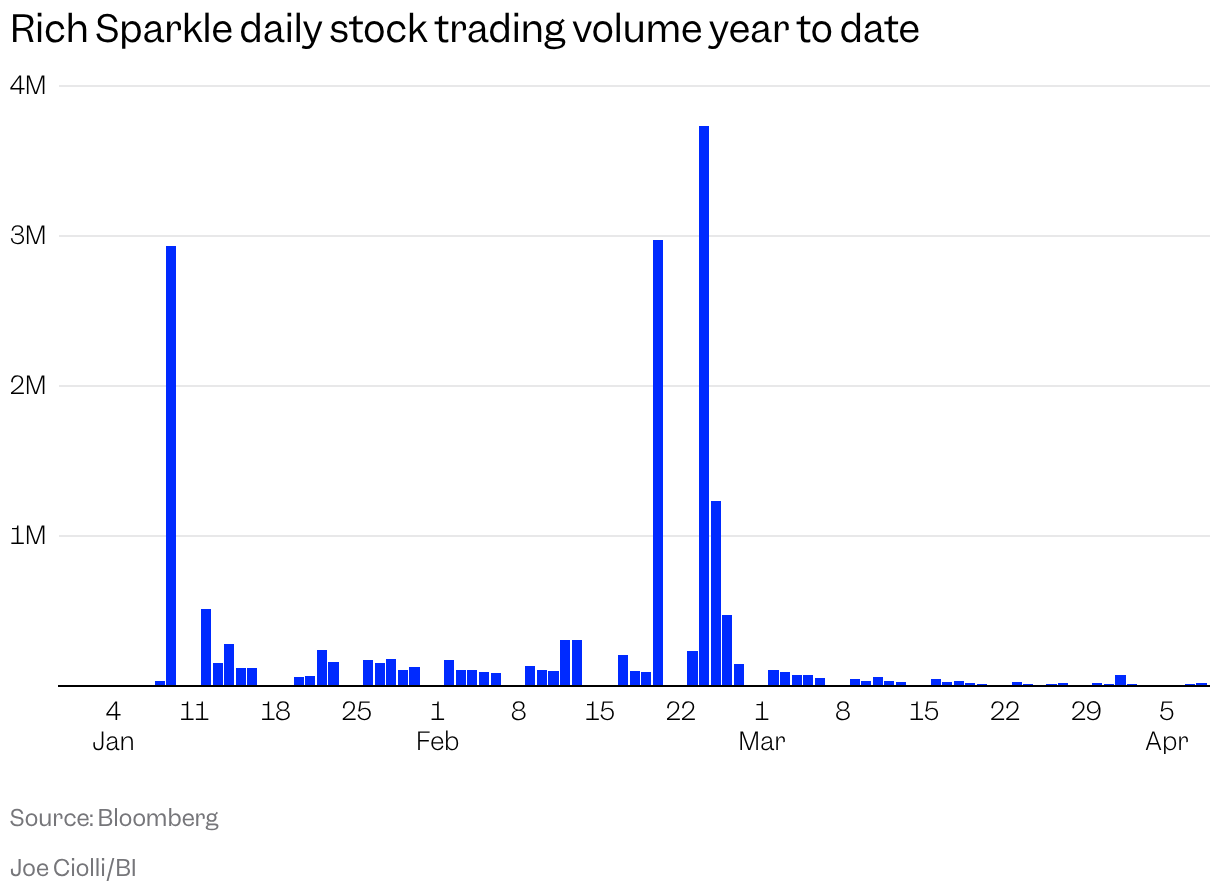
Questions multiply around the deal

Lame, a Senegalese-Italian influencer, rose to fame on TikTok through dialogue-free videos about overly complicated life hacks, like melting butter into a deodorant stick before spreading it on bread.

His $975 million deal with Rich Sparkle put him in rarefied company in the creator economy. YouTube’s top star, MrBeast, has built a company valued at about $5 billion, but few other creators have secured such a rich valuation. Unlike MrBeast’s company, Lame’s would have been publicly traded, giving retail investors an uncommon opportunity to invest directly in the fortunes of an individual creator.

The deal’s announcement sparked a wave of optimism among creator economy insiders, who saw it as proof of the industry’s value. The vibes have turned more skeptical as questions about the deal mount.

Rich Sparkle called the acquisition “completed” in a January press release; its most recent SEC filing on March 31 still described the deal as contingent on certain conditions. A January filing said the deal would be void if those conditions weren’t met or waived by February 28.

Rich Sparkle is registered in the British Virgin Islands and based in Hong Kong. Due to a quirk in how foreign-registered companies file in the US, it could take months for the deal’s status to be revealed to retail investors, Angel said.

When we called Rich Sparkle’s Hong Kong office to find out if the deal had closed, we were directed to the same corporate email address we’ve been messaging for months, with no reply.

Under the deal, Lame’s company would receive Rich Sparkle stock — not cash — in exchange for its intellectual property.

When Rich Sparkle’s shares soared after the announcement, some retail investors watched with envy.

“It started the upward climb all the way up to $180, and I was like, ‘Oh, should have held,'” said Eric Moore, a day trader who sold his Rich Sparkle shares before the deal was announced.

As the company’s share price has plummeted, so has the value of Lame’s potential stake, which Rich Sparkle initially valued at $975 million.

Some of the day traders who jumped into the short-lived Rich Sparkle upswing told us they were trying to make a quick buck on a high-flying stock — and not concerned with its long-term prospects.

Those prospects matter for where the share price will settle, which will determine Lame’s potential windfall and could impact broader perceptions of creator-fronted businesses.


LONDON, ENGLAND - NOVEMBER 12: Khaby Lame attends the Esquire Better Men dinner, in partnership with BOSS at Dante Restaurant, Claridge's on November 12, 2025 in London, England. (Photo by Max Cisotti/Dave Benett/Getty Images for Esquire UK)

Khaby Lame has done deals with big brands, including Hugo Boss. 

Max Cisotti/Dave Benett/Getty Images for Esquire UK


A bold proposal that drew industry skepticism

As part of the deal, Rich Sparkle said it planned to create an AI avatar of Lame to do brand deals and sell products on social media. Digital avatars are booming in e-commerce in China and, unlike human sellers, can sell around the clock. Some avatars have made millions in sales in a single livestream.

Still, Rich Sparkle’s estimate that Lame’s avatar could drive $4 billion in annual product sales seemed wildly optimistic, industry insiders previously told us.

The influencer data company CreatorIQ said it considers Lame to be among the most impactful creators based on the value of posts from brands, media, and other creators that mention him. By this measure, it estimates he’s earned $218.9 million from 2020 to 2025 in “EMV,” its metric for digital earned media, or unpaid mentions like press coverage.

Lame has worked with major brands including Hugo Boss, Airbnb, and Visa. He nabbed a cameo in Will Smith and Martin Lawrence-starring “Bad Boys: Ride or Die” (2024) and starred in the one-season “Khaby is Coming to America” on the free Fox streamer Tubi (2024), in which he meets and talks with celebs like David Beckham and Alicia Keys.

Lame left the US in June 2025 after ICE detained him, saying he overstayed his visa. After that, he went on a multi-city trip to China in September, where he posted about sampling the food and culture.

Nicola Paparusso, an Italian film producer and talent manager who repped Lame until November, told us he wanted Lame to pivot to mainstream acting.

“I said, ‘You can’t be an influencer forever,'” Paparusso recalled telling Lame when they were working together. He said the two parted ways over strategy direction and that he didn’t know about the Rich Sparkle deal.

In recent days, Lame has been busy posting on TikTok, filming a collaboration with Lego, and signing on to be an ambassador for the Dakar 2026 Youth Olympic Games.

He’s made no recent mentions of the Rich Sparkle deal.

Have a tip? Contact the reporters via email at lmoses@businessinsider.com or dwhateley@businessinsider.com, or on Signal at @danwhateley.94 or @luciamoses.81. Use a personal email address, a nonwork WiFi network, and a nonwork device; here’s our guide to sharing information securely.



Source link

Gold-domes-historic-statues-and-nods-to-state-flags-Photos.jpeg

Gold domes, historic statues, and nods to state flags: Photos show what the capitol looks like in every state

Updated

  • Every US state has a capitol that houses its state legislature.
  • Many state capitols are domed buildings similar to the US Capitol, but others are more unique.
  • Maryland’s State House is the oldest capitol in continuous legislative use in the US.

A state’s capitol can tell you a lot about its history and government.

Many state capitols feature references to their locations, like Kansas’ statue of a Kansa warrior atop its dome, or the New Hampshire State House, which was built with locally sourced granite.

Every capitol has a unique look and distinct origin, and you can learn more about them here.

Montgomery, Alabama

Alabama’s capitol in Montgomery.

Carol M. Highsmith/Buyenlarge/Getty Images

Alabama’s capitol is where the Confederacy began, and there’s a brass star on one of the porticos marking the spot where Jefferson Davis was sworn in as its president, according to the Alabama Historical Commission.

The building that stands today was constructed in 1851, after a fire burned down the original building in 1849, according to the Alabama Historical Commission.

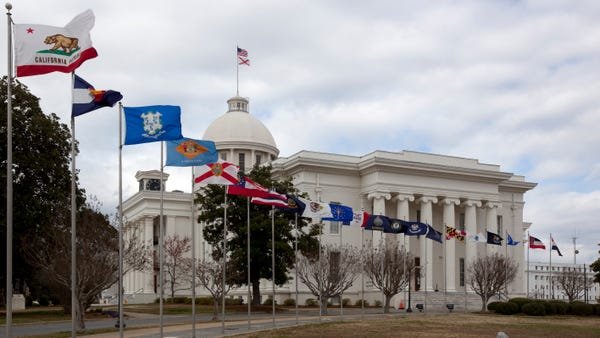
One of the more famous parts of the capitol grounds is the Avenue of Flags. It has the flag of every state plus a native rock from each state at each flag’s base. It was dedicated in 1968, according to Exploring Montgomery.

Juneau, Alaska


Alaska's capitol in Juneau.

Alaska’s capitol in Juneau.

Leamus/iStock/Getty Images Plus

The Alaska State Capitol, completed in 1931, doesn’t look much different from any other office building in Juneau, save the marble columns. According to Alaska’s official website, it is one of few state capitols to not feature a dome.

As The New York Times reported in 1981, neither the building nor the location were popular with locals — both were chosen because the residents of Alaska had to fund construction themselves — but efforts to move the capitol have failed, even though a vote passed to move the location in the ’70s.

As recently as 2022, Alaskan senators sponsored a bill to move the capital, this time to Willow, reported Alaska Public Media, but for now, Juneau remains the Last Frontier’s capital city.

Phoenix, Arizona


arizona capitol building

The Arizona Capitol Museum in Phoenix.

Visions of America/Universal Images Group/Getty Images

Arizona’s capitol was dedicated in 1901. It stopped being the home of the legislative branches of government in 1960 — and by 1978, all government officials had been moved to other buildings nearby in an area called the Capitol Complex.

The original building was then officially converted into a museum that anyone can visit.

Little Rock, Arkansas


arkansas capitol building

Arkansas’ capitol in Little Rock.

Don & Melinda Crawford/Education Images/Universal Images Group/Getty Images

Arkansas’ capitol took 16 years to complete. Construction lasted from 1899 to 1915, and the building was designed by architects George R. Mann and Cass Gilbert, according to the Encyclopedia of Arkansas.

This building replaced the State House, which is now the Old State House Museum, according to Arkansas Heritage.

Sacramento, California


california capitol building

California’s capitol in Sacramento.

David Paul Morris/Getty Images

The building was constructed between 1860 and 1874, and designed by Reuben S. Clark. It has been listed as a California Historical Landmark since 1974, according to the Historic State Capitol Commission.

Its design was based on the US Capitol in Washington, DC, among other well-known American buildings, according to the State of California Capitol Museum.

The California State Capitol is located inside the 40-acre Capitol Park, which contains trees from around the world, a World Peace Rose Garden, and the Civil War Memorial Grove.

Denver, Colorado


colorado capitol building

Colorado’s capitol in Denver.

John Moore/Getty Images

The Colorado Capitol, which was completed in 1901, was also designed to look like the US Capitol, but with a Colorado twist: The dome is covered in real gold leaf donated by gold miners to reference the Colorado Gold Rush from 1858 to 1861, according to the Colorado General Assembly.

Hartford, Connecticut


connecticut capitol building

Connecticut’s capitol in Hartford.

Rolf Schulten/ullstein bild/Getty Images

The current Connecticut State Capitol is actually the third capitol the state has had since the American Revolution. This one, designed by Richard M. Upjohn, opened in 1879, according to Connecticut’s official state website.

The golden dome is surrounded by six pairs of statues representing agriculture, commerce, education and law, force and war, science and justice, and music, according to the State Capitol Preservation & Restoration Commission.

Dover, Delaware


delaware capitol building

Delaware’s Legislative Hall in Dover.

Harvey Meston/Archive Photos/Getty Images

The Delaware Legislative Hall was dedicated in 1933 and replaced the Old State House, which is opposite the Hall on the capitol mall. It was designed in the Colonial Revival style by E. William Martin, according to Delaware’s official state website.

Washington, DC


us capitol building

The US Capitol.

Stefan Zaklin/Getty Images

The United States Capitol is located on Capitol Hill in DC. It was in construction for decades, partially destroyed in 1814, and then finally finished in 1829, according to Architect of the Capitol. The famous, gigantic dome was later added during an expansive addition in 1855, designed by Thomas U. Walter.

Atop the dome sits the “Statue of Freedom,” a 19-foot statue of a woman wearing a battle helmet, holding a sheathed sword in one hand, and a laurel wreath and shield in the other. She’s been there since 1863, according to Architect of the Capitol.

Tallahassee, Florida


florida capitol building

Florida’s capitol in Tallahassee.

Mark Wallheiser/Getty Images

The current capitol, also called the New Capitol, is located directly in front of the original — together, they form the Capitol Complex. The New Capitol was built in 1977 by architect Edward Durell Stone and the firm of Reynolds, Smith, and Hills, according to the Florida Capitol website.

The website reports the building was designed in an “international style to reflect a modern Florida,” and includes a 22-story central tower.

The Old Capitol still stands, and it was restored to its original 1902 glory in the ’80s. Currently, the building is the Florida Historic Capitol Museum.

Atlanta, Georgia


georgia state capitol

Georgia’s capitol in Atlanta.

Kevin Fleming/Corbis/VCG/Getty Images

Georgia’s capitol was finished in 1889 and designed by Willoughby J. Edbrooke and Franklin P. Burnham, according to the city of Atlanta’s website. It sits on the site of the former Atlanta City Hall/Fulton County Courthouse, which was there from 1854 to 1994.

According to the city, it’s one of 43 National Historic Landmarks in the state.

Honolulu, Hawaii


hawaii capitol building

Hawaii’s capitol in Honolulu.

Rolf Schulten/ullstein bild/Getty Images

At the dedication of the Hawaiian capitol in 1969, then-Governor John A. Burns explained the design of the building, the Honolulu Star Advertiser reported.

“In this great State Capitol there are no doors at the grand entrances which open toward the mountains and toward the sea,” he said. “There is no roof or dome to separate its vast inner court from the heavens and from the same eternal stars which guided the first voyagers to the primeval beauty of these shores.”

The building is also surrounded by a reflecting pool meant to symbolize the Pacific Ocean, which surrounds the chain of 137 recognized islands that make up Hawaii, according to the State of Hawaii.

Boise, Idaho


idaho state capitol building

Idaho’s capitol in Boise.

Education Images/Universal Images Group/Getty Images

Idaho’s capitol was designed by architects J.E. Tourtellotte and Charles Hummel, and was constructed between 1905 and 1920. According to Idaho’s Capitol Commission, it’s the only capitol in the US that is heated by geothermal water. It comes from a spring 3,000 feet underground.

Springfield, Illinois


illinois state capitol

Illinois’ capitol in Springfield.

Daniel Acker for The Washington Post/Getty Images

According to a pamphlet by the Illinois Secretary of State’s office, the current capitol (the state’s sixth) was completed in 1888, 20 years after crews broke ground. At the time of its construction, the limestone dome was illuminated by 144 gas jets. However, the carbon emitted by those jets eventually turned the dome black.

It took 100 years, but it was finally cleaned in 1986.

Indianapolis, Indiana


indiana capitol building

Indiana’s capitol in Indianapolis.

Education Images/Universal Images Group/Getty Images

According to the Indiana Department of Administration, Indiana’s capitol was completed in 1888, and is home to all executive offices, the Indiana State Senate, the Indiana House of Representatives, and the Indiana State Supreme Court, among others. It was constructed with Indiana limestone.

Des Moines, Iowa


iowa capitol building

Iowa’s capitol in Des Moines.

Carol M. Highsmith/Buyenlarge/Getty Images

The large golden dome is 23 carats, and the entire building is 275 feet tall, according to a visitor’s guide. It’s been re-gilded four times since its construction in 1886.

Overall, Iowa’s capitol has a total of five domes, making it the only capitol in the US with five.

Topeka, Kansas


kansas capitol building

State capitol in Topeka.

Joe Sohm/Visions of America/Universal Images Group/Getty Images

Kansas’ capitol dome is topped with a statue called “Ad astra” (Latin for “to the stars”), which is part of the state’s motto, “ad astra per aspera” (“to the stars through difficulties”), according to the Kansas Historical Society.

The statue itself is a bronze depiction of a warrior from the Kansa tribe (also known as the Kaw Nation or Kanza), who call Kansas home and gave the state its name.

The entire building took 37 years to construct, also according to the Kansas Historical Society, from 1866 to 1903. 

Frankfort, Kentucky


kentucky capitol building

Kentucky’s capitol in Frankfort.

Bill Pugliano/Getty Images

Kentucky’s capitol was designed by Frank Mills Andrews, according to Kentucky’s official state website. There are also statues lining the front portico that represent Kentucky, the central figure, with Progress, History, Plenty, Law, Art, and Labor as her “attendants,” according to the state website.

The current building is the fourth capitol in the state, and it was completed in 1910.

Baton Rouge, Louisiana


louisiana capitol building

Louisiana’s capitol in Baton Rouge.

David LEFRANC/Gamma-Rapho/Getty Images

The Louisiana Capitol is just one of nine capitols in the US that doesn’t feature a dome — and at 450 feet tall (or 34 floors), it’s also the tallest capitol in the country, according to Louisiana’s House of Representatives.

It was dedicated in 1932, without the person who had spearheaded the effort to build it, Senator Huey P. Long, a controversial figure in Louisiana’s history, as reported by Encyclopedia Britannica.

Augusta, Maine


maine capitol buildings

The Maine State House in Augusta.

Joe Phelan/Portland Press Herald/Getty Images

The capital of Maine was originally Portland when the state broke away from Massachusetts in 1820. But when Mainers asked for a more centrally located capital city, Augusta was chosen in 1827, according to the Maine State Legislature. The building was completed by 1832.

The State House’s dome is topped with a female figure of Wisdom, which was designed by sculptor W. Clark Noble of Gardiner, a town 6 miles from Augusta.

Annapolis, Maryland


maryland capitol building

Maryland’s state capitol in Annapolis.

Education Images/Universal Images Group/Getty Images

Maryland’s State House is the oldest capitol in continuous legislative use in the US, built in 1779, according to its official website. It’s also the only state capitol to have once served as the US capitol when the Continental Congress met there from 1783 to 1784, according to the website.

Boston, Massachusetts


massachusetts state house

The Old State House for the Commonwealth of Massachusetts in Boston.

Joe Sohm/Visions of America/Universal Images Group/Getty Images

The Massachusetts State House, built in 1789, originally had a wooden dome, but Paul Revere’s own company was responsible for covering it in copper in 1802, CBS News reported.

And the land it was built on? It used to be owned by none other than John Hancock, who was Massachusetts’ first elected governor.

Lansing, Michigan


michigan state capitol

Michigan’s capitol in Lansing.

Bettman/Getty Images

The floors of Michigan’s capitol, which was dedicated in 1879, are made of limestone and have visible fossils in them, as you can see on the capitol’s official website.

St. Paul, Minnesota


minnesota capitol building

Minnesota’s capitol in St. Paul.

Raymond Boyd/Getty Images

According to Explore Minnesota, the state’s capitol is the second-largest self-supporting marble dome in the world, only behind St. Peter’s Basilica in Rome.

Architect Cass Gilbert insisted on using Georgia marble for the dome, according to the Minnesota Historical Society. Some were critical of using out-of-state materials, so as a compromise, the contractor leased the quarry in Georgia and imported the rough marble so Minnesotans could do the work in-state.

It took nine years, but was completed in 1905.

Jackson, Mississippi


mississippi capitol building

Mississippi’s state capitol in Jackson.

RORY DOYLE/AFP/Getty Images

Designed by architect Theodore Link and constructed between 1901 and 1903, Mississippi’s state capitol was built on the site of an old state penitentiary, according to the state capitol’s official website. The building spans 171,000 square feet and features 4,750 original electric light fixtures, as well as an 8-foot statue of an eagle on the top of its dome.

Jefferson City, Missouri


GettyImages 515395544

Missouri’s capitol in Jefferson City.

Bettman/Getty Images

Missouri’s state capitol was completed in 1917, according to its official website. Ceres, the goddess of grain, sits at the top of its dome.

In addition to Missouri’s state legislature, the 500,000-square-foot building houses the Missouri State Museum with exhibits about the state’s history and natural resources.

Helena, Montana


montana state capitol

Montana’s state capitol in Helena.

Education Images/Universal Images Group/Getty Images

The main building of Montana’s state capitol was completed in 1902, and its two wings were added in 1911 and 1912, according to the Montana Historical Society. Inside, the building features works of art such as the mural “Lewis and Clark Meeting Indians at Ross’ Hole,” painted by Charles M. Russell in 1912.

Lincoln, Nebraska


nebraska capitol building

Nebraska’s state capitol in Lincoln.

Education Images/Universal Images Group/Getty Images

Nebraska’s state capitol was designed by architect Bertram Grosvenor Goodhue and completed in 1932, according to its official website. The 400-foot tower is topped with a 19-foot bronze statue called “The Sower.”

It is the only state legislature to be unicameral, meaning it only has one chamber.

Carson City, Nevada


nevada state capitol

Nevada’s state capitol in Carson City.

Joe Sohm/Visions of America/Universal Images Group/Getty Images

Nevada’s state capitol was built from 1870 to 1871 out of sandstone sourced from a quarry belonging to Abe Curry, the founder of Carson City, according to Travel Nevada. It features a silver-colored dome, a nod to Nevada’s nickname as “the silver state.”

Concord, New Hampshire


new hampshire capitol

New Hampshire’s state capitol in Concord.

Joe Sohm/Visions of America/Universal Images Group/Getty Images

The New Hampshire State House was constructed between 1816 and 1819 with locally sourced granite from Rattlesnake Hill in Concord, according to the New Hampshire Division of Historical Resources.

In 1818, a wooden sculpture of an eagle painted with gold was installed on top of the capitol dome. It was replaced with a copper replica in 1957, but the original sculpture can be viewed on display inside the capitol, according to EverGreene, the architecture firm that restored the State House’s gold-plated dome.

Trenton, New Jersey


new jersey capitol building

New Jersey’s state capitol in Trenton.

Bobby Bank/WireImage/Getty Images

After Maryland, New Jersey State House is the second-oldest capitol still in use, completed in 1792, according to the state of New Jersey’s official website. Much of the original building, designed by architect Jonathan Doane, was destroyed in a fire in 1885.

Architect Lewis Broome restored the capitol and added a cast-iron dome plated with copper and gold and featuring the Latin phrase “Fiat Justitia Ruat Coelum,” meaning  “There must be justice even though the heavens fall.”

Santa Fe, New Mexico


new mexico capitol building

New Mexico’s state capitol in Santa Fe.

Robert Alexander/Archive Photos/Getty Images

New Mexico’s capitol, known as the Roundhouse, is the only round capitol in the US, according to Santa Fe’s official tourist website. Architect Willard C. Kruger modeled the design after the Zia sun symbol, which he also incorporated into the capitol rotunda skylight. The symbol is also part of New Mexico’s state flag.

Albany, New York


new york state capitol building

New York’s state capitol in Albany.

John Greim/LightRocket/Getty Images

When New York’s state capitol in Albany was finally finished after 32 years in 1899, it was at a cost of $25 million, making it one of the most expensive government projects in the US. In 2013, The New York Times reported the figure was equivalent to more than half a billion dollars today.

Inside the granite building, visitors can find 25 murals by William deLeftwich Dodge in the Governor’s Reception Room.

Raleigh, North Carolina


The capitol building in Raleigh, North Carolina

North Carolina’s capitol in Raleigh.

LOGAN CYRUS/AFP via Getty Images

Completed in 1840, North Carolina’s 3-story capitol includes a copper dome, according to the National Park Service.

Bismarck, North Dakota


north dakota capitol building

North Dakota’s capitol in Bismarck.

KAREN BLEIER/AFP/Getty Images

North Dakota’s state capitol is the tallest building in the state at 241 feet and 8 inches tall, according to the official government website. The Art-Deco structure is nicknamed the “Skyscraper on the Prairie,” according to the Society of Architecture Historians.

Columbus, Ohio


ohio capitol building

Ohio’s capitol in Columbus.

Jumping Rocks/Universal Images Group/Getty Images

Construction of the Ohio Statehouse took over 20 years, from 1839 to 1861, according to its official website. Much of the work was done by prisoners at Ohio Penitentiary, some of whom left graffiti on the walls that was uncovered during restoration work, the website says. Built in the Greek-Revival architecture style out of Columbus limestone, the Statehouse is a designated National Historic Landmark.

Oklahoma City, Oklahoma


oklahoma capitol building

Oklahoma’s state capitol in Oklahoma City.

Jordan McAlister/Getty Images

Built in 1917, the dome on Oklahoma’s capitol was added more recently, in 2002, according to the Oklahoma Historical Society — it was left out of the original construction due to costs. The grounds of Oklahoma’s capitol also had active oil rigs until 1986. The building was added to the National Register of Historic Places in 1976.

Salem, Oregon


Oregon's state capitol building in Salem.

Oregon’s state capitol in Salem.

Education Images/Universal Images Group via Getty Images

Oregon’s Art Deco capitol is made of white Vermont marble with a gold statue of an “Oregon Pioneer” atop the dome, according to the capitol’s official website. In-person guided tours are paused due to construction.

Harrisburg, Pennsylvania


pennsylvania capitol building

Pennsylvania’s state capitol in Harrisburg.

John Greim/LightRocket/Getty Images

Pennsylvania’s capitol, designed by architect Joseph Huston, cost $13 million to build when it was completed in 1906, which would be over $403 million today, according to the Bureau of Labor Statistics.

The building’s 272-foot dome is decorated with green glazed terra cotta tile, according to the capitol’s official website.

Providence, Rhode Island


rhode island capitol building

Rhode Island’s state capitol in Providence.

Education Images/Universal Images Group/Getty Images

The Rhode Island State House, built between 1895 and 1904, features the fourth-largest freestanding marble dome in the world, according to the Rhode Island Restoration Committee‘s official website. It has been listed on the National Register of Historic Places since 1970.

Columbia, South Carolina


south carolina capitol building

South Carolina’s state capitol in Columbia.

Epics/Getty Images

The construction of the South Carolina State House began in 1854, but halted due to the Civil War. The building still features cannonball marks from when the Union army captured Columbia in 1865, according to Discover South Carolina. The State House was finally completed in 1903, and it was designated as a National Historic Landmark in 1976, according to the South Carolina Department of Archives and History.

A portrait of state senator Clementa Pinckney, who was killed in the 2015 shooting at Charleston’s Mother Emanuel AME Church, hangs in the Senate Gallery.

Pierre, South Dakota


south dakota

South Dakota’s state capitol in Pierre.

Education Images/Universal Images Group/Getty Images

South Dakota’s state capitol was constructed between 1905 and 1910, not long after South Dakota became a US state in 1889, according to the South Dakota Bureau of Administration. An annex was added in 1932. The Neoclassical building features scagliola plaster columns, war memorials, and stained-glass windows, according to Travel South Dakota.

Nashville, Tennessee


tennessee capitol building

Tennessee’s state capitol in Nashville.

Raymond Boyd/Getty Images

The Tennessee State Capitol opened in 1859. The architect, William Strickland, died during its construction in 1854 and was buried on the capitol grounds along with President James K. Polk and first lady Sarah Childress Polk, according to the Tennessee State Museum.

Austin, Texas


texas capitol building

Texas’ state capitol in Austin.

James Leynse/Corbis/Getty Images

Completed in 1888, the Texas State Capitol dome is topped with a statue of Libertas, the goddess of liberty, according to the official website for the Texas House of Representatives. It stands 14 feet taller than the US Capitol.

Salt Lake City, Utah


utah capitol building

Utah’s capitol in Salt Lake City.

Universal Images Group/Getty Images

Utah’s State Capitol was designed by architect Richard K.A. Kletting and was completed in 1916, according to its official website. The rotunda features bronze and marble statues of Native American leaders, LDS pioneers, and US presidents such as Abraham Lincoln, according to its website.

Montpelier, Vermont


vermont capitol building

Vermont’s capitol in Montpelier.

MyLoupe/Universal Images Group/Getty Images

The Vermont State House, designed in the Greek Revival architecture style, dates back to 1857, according to the National Park Service. A statue of Ceres, the goddess of agriculture, adorns the top of the dome.

Richmond, Virginia


virginia capitol building

Virginia’s capitol in Richmond.

Chip Somodevilla/Getty Images

Thomas Jefferson designed Virginia’s state capitol to look like the ancient Roman temple of Maison Carée, according to the Virginia General Assembly‘s official website. The building also features a bronze statue of Jefferson, who is depicted holding the capitol’s architectural blueprints.

Olympia, Washington


washington state capitol

Washington’s state capitol in Olympia.

Greg Vaughn /VW PICS/Universal Images Group via Getty Images

The Washington State Legislative Building features the tallest freestanding masonry dome in North America at 287 feet, according to the Washington State Department of Enterprise Services. Designed by Walter Wilder and Harry White, it was completed in 1928.

Charleston, West Virginia


west virginia capitol building

West Virginia’s capitol in Charleston.

Michael S. Williamson/The Washington Post/Getty Images

West Virginia’s capitol, designed by Cass Gilbert, took eight years and almost $10 million to construct before its completion in 1932, according to its official website. The dome stands at 293 feet tall — 5 feet higher than the US Capitol in Washington, DC.

Madison, Wisconsin


wisconsin state capitol

Wisconsin’s capitol in Madison.

Scott Olson/Getty Images

Wisconsin’s state capitol features the only granite dome in the US, according to Travel Wisconsin. On top of the dome, a gilded bronze statue by Daniel Chester French is aptly named “Wisconsin.”

Cheyenne, Wyoming


wyoming state capitol building

Wyoming’s capitol in Cheyenne.

Michael Smith/Newsmakers/Getty Images

Wyoming’s state capitol, constructed between 1886 and 1890, was built in the Renaissance Revival architecture style, according to the Wyoming Department of Administration and Information. It is one of 20 state capitols designated as a National Historic Landmark, according to the National Park Service.


Source link

The-5-red-flags-a-Michelin-star-pastry-chef-looks-for.jpeg

The 5 red flags a Michelin-star pastry chef looks for when visiting a bakery

Food can get expensive, which means it’s as important as ever to seek out good value with every purchase — even the croissant you have with your morning coffee.

Just ask Camari Mick, the executive pastry chef at The Musket Room, who’s also a partner at Raf’s.

Mick knows her way around a bakery. She grew up visiting local shops and then studied the art of pastry in fine-dining restaurants across New York City. At Raf’s, Mick turns out breads, croissants, and more for the restaurant’s daytime bakery while leading the rest of the pastry program.

Dubbed NYC’s dessert doyenne, the chef has developed her own set of red flags to look out for whenever she visits high-end bakeries.

Here’s how you can tell if you’re at a spot that’s serving high-quality products.

A great bakery should be able to nail the basics


Person using tongs to pick up an almond croissant from a bakery

Croissants should never be so uniform that they look machine-made.

Thai Liang Lim/Getty Images


The first thing Mick does when she walks into a high-end bakery is study the classics. If she sees croissants, she’ll look at the plain variety, taking note of the folds that make up the pastry’s lamination.

Some great bakeries will have croissants with layers that look perfectly aligned, others might take on a more rustic feel and seem more obviously hand-rolled. Both are welcome characteristics, Mick says.

But it’s a bad sign if the lamination is “very thick, or small, or not uniform,” she told Business Insider. And if the croissants look perfectly machine-made, something may not be right in the kitchen.

Mick also looks at the color of the croissants, which can clue you into how they may taste. If it’s too blonde on the outside, it may not have much flavor inside.

Similarly, she says, a pastry probably won’t be super flaky if it looks as if it was “sweating on itself” after being covered while hot, and you can see its layers are wrinkly.

Overall, Mick says, if it doesn’t look as if love has been put into the pastries, she “probably will only just grab a coffee.”

Beware of bread that’s wrapped

Mick says high-end bakeries should only be selling fresh bread.

Ideally, you should touch the bread to see whether it’s too hard. If that’s not an option, there are telltale signs a loaf could be subpar.

“If you were looking at any bread and it looks super voluptuous and almost fresh out of the oven, you’re good to go,” she told BI. “But if you see that the bread is already wrapped, whether it be in plastic or paper, it’s probably an indicator that it was wrapped warm and is not going to be good.”

Mick says fresh bread needs room to breathe, and wrapping it even while it’s only slightly warm will cause it to steam itself, potentially making it soggy.

If the pastries don’t look the same in most photos, it’s hard to trust they’ll be consistently good


Colorful eclairs in display case

It can’t hurt to check customer photos of pastries from a bakery.

ciobanu ana maria/Getty Images


Before she even steps into a bakery, Mick may turn to Instagram for visuals.

First, she’ll comb through the location tag for any given bakery, keeping an eye out for whatever item she was hoping to order.

She tries to see whether the baked good looks the same in all of the photos shared by diners. If it looks different every few pictures, she’s probably not going to order it because it’s unlikely to be very good, or the quality may vary depending on the batch.

And when you’re going to be spending a chunk of change at a pricier bakery, you don’t want quality to be left up to chance.

Some pastries should only be made to order

The pastry chef says her understanding of chemistry also makes her hesitant to buy certain pastries that aren’t made to order.

“You know that a crispy something filled with a moist, wet filling is going to be soggy after sitting for, like, 10 minutes,” Mick said.

For example, a bakery that fills cannoli shells and leaves them in the case until they’re purchased raises some concerns.

Cleanliness in customer-facing spaces says a lot about cleanliness in the kitchen

Look out for flies around the pastry case, Mick warns.

“If you see any type of fly problem or any kind of insect infestation in the case, be sure it’s everywhere,” she told BI.

You may even want to peek into the bakery’s bathroom before placing an order.

She added: “I’m a big believer on if their bathroom is messy, their kitchen is messy.”

This story was originally published on April 3, 2024, and most recently updated on December 29, 2025.


Source link