
Life-as-a-private-jet-flight-attendant-and-earning-over.jpeg

Life as a private jet flight attendant and earning over $100K

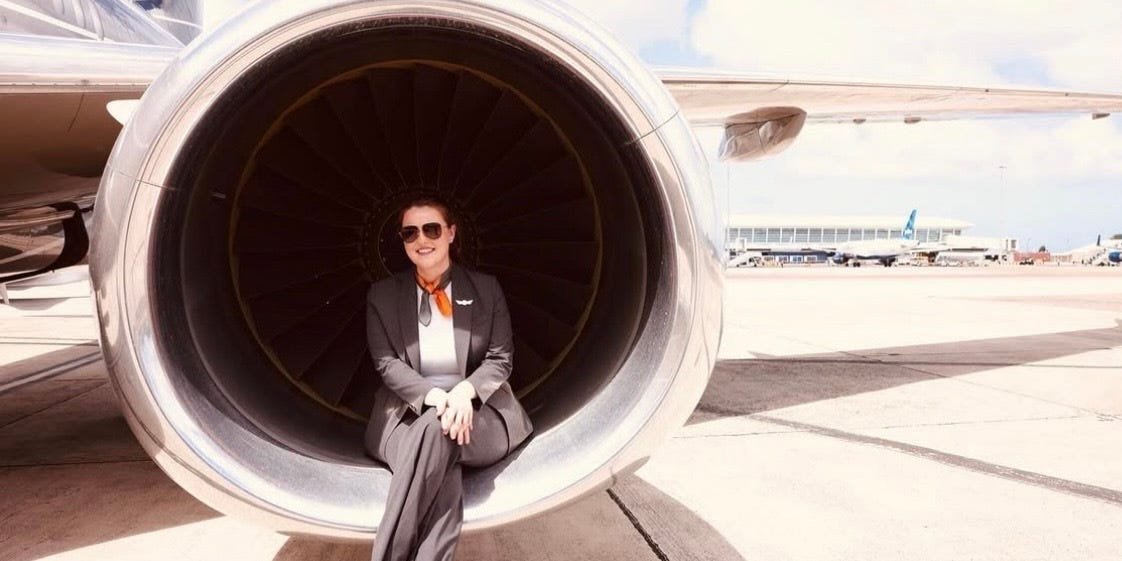
By the time 33-year-old private jet flight attendant Kelley Lokensgard greets her VIP passengers on the tarmac, she has been working for hours.

“I grocery shop the night before, then arrive two hours before the flight; I load my flower arrangements, prep my boarding appetizers, and touch up the cabin,” Lokensgard, the chief cabin attendant at Silver Air Private Jets, told Business Insider. “People don’t realize how many fingerprints they leave behind.”

That behind-the-scenes work is part of serving wealthy vacationers, business executives, and celebrities who expect flawless service and discretion.

Lokensgard, what started in 2021, said the job can be nonstop: she’s on duty for up to 21 days a month, sometimes at a moment’s notice, and is responsible for catering meals and tailoring each flight to client preferences.

This is a level of invisible labor that few people outside private aviation ever see; it’s not the glitz and glamour that social media often portrays. But Lokensgard — whose background is in music, youth education, and fine dining — said she loves the grind.


Private flight attendant Kelley Lokensgard at the golden temple in Kyoto.

Lokensgard visited the Golden Temple in Kyoto.

Courtesy of Kelley Lokensgard


“It’s a lot of schlepping and problem-solving and delicate communication with a lot of moving parts and people; you have to be a laborer to want to do this job,” she said. “I can’t imagine something that better suits my random scope of skills.”

Private flight attendants are a small but growing niche within aviation. Jobs, which are largely non-union, span from small and medium-sized private companies like Silver Air to mega operators like NetJets and VistaJet.

While many roles offer full-time benefits, as in Lokensgard’s case, others resemble gig work, which can allow for a flexible lifestyle but often comes with less predictability and fewer labor protections than at most US airlines.

The work often involves long, irregular hours, extended travel, and the demands of high-profile clients. And private flight attendants usually don’t have access to the free standby flights that commercial crew typically enjoy — meaning they only fly if a seat is available.

Still, there’s a significant payoff. Lokensgard gets to see the world through the destinations of her clients — essentially for free — while earning much more than most of her airline counterparts.

Lokensgard, who lives in Los Angeles, earns in the low six figures, though she said some veteran, freelance, and specially skilled VIP cabin attendants can make as much as $350,000 annually. Glassdoor puts the nationwide median annual salary at about $94,000.

By comparison, commercial flight attendants at American, Delta, and United typically earn a base salary between $30,000 and $80,000, depending on seniority, along with a per diem and additional pay opportunities like overtime, holidays, and international flying. Many senior crew members reach six figures after years of service.


Inside one of Silver Air's G550s.

An example of one of Silver Air’s G550s.

Silver Air Private Jets


To prepare for her role, Lokensgard completed five days of training and an online course: “There was so much to learn, it’s professionalism, luxury, service, and safety,” she said. Silver Air also sponsored culinary classes.

Her training is far shorter than the weekslong courses commercial flight attendants must complete, though that’s because the Federal Aviation Administration does not regulate corporate cabin attendant positions — its “flight attendant” rules apply to airlines and public charters, not private jets.

This means cabin training varies widely across private operators, though Lokensgard, as chief attendant, said she is incorporating more shadow flying and collaborative learning at her company.

Private aviation is not your normal 9-to-5

Lokensgard spends most of her days on the Gulfstream G550, a giant multimillion-dollar private jet with a bedroom and enough range to travel across oceans and continents. The plane has an owner but is also managed by Silver Air as a rental; Lokensgard serves whoever is on board.

She said these often long flights mean she is away from home for days at a time and must work early and late hours. A flight from the Los Angeles-area Van Nuys Airport to Tokyo, for example, would take about 11 hours and involve at least two meal services, she said.

Lokensgard must organize catering for the passengers, but is regularly asked to cook. She’ll meal-prep meats and vegetables the night before and has access to an approved skillet, oven, microwave, and chiller to work with on the plane.

“Sometimes our clients don’t want catering, and I will be told, ‘Hey, arrange steak, sushi, chicken tenders, french fries, salads, fruit platter, snacks, and desserts for the flight,'” she said. “I’ll shop at Erewhon, or I’ll ask a local steakhouse to sear a steak that I’ll finish off on the plane. Your head just explodes with ideas.”

Erewhon is the US’ most expensive grocery store and a hotspot for the LA elite.


Examples of meals the flight attendant has made.

Some meal examples include a green goddess salad sourced from an Italian farmers market and a Yucatan-style ceviche.

Courtesy of Kelley Lokensgard


Besides food service, Lokensgard said she must also perform safety checks, prepare meals for the pilots, and make the bed, among other duties. She added that there is surprisingly little time to rest, even on ultra-long-haul flights.

On the ground, Lokensgard is responsible for tasks like dishes, dry cleaning, and arranging catering for the next trip. After international flights, everyone clears customs, and Lokensgard must follow agricultural rules when disposing of food and trash.

Rest policies vary by operator. Lokensgard said her crew gets at least a day of rest after long-haul international flights; previously, Silver Air cabin attendants often finished such trips only to almost immediately hop on a commercial flight home. She receives a minimum of 10 hours of rest after shorter flights.

Lokensgard added that it sometimes makes more logistical sense for the crew to stay with the plane for a few days in its destination, giving her extra time to explore places ranging from major cities like London, New York City, and Nice to quaint ski towns in Austria.

“I make the most of it since we’re sacrificing time away from our families and communities,” she said. “We explore, see museums, and eat amazing food.” She also dedicates time to cultivating relationships with local chefs in the cities she visits for catering needs.


Lokensgard with her husband after being proposed to on the French Riviera.

Lokensgard said her husband flew to the French Riviera to propose to her during one of her layovers. She said he’s supportive of her travel-heavy career.

Courtesy of Kelley Lokensgard


Once home, Lokensgard said the first thing she does is wash her clothes and repack her suitcase, adding that she keeps a spare uniform in her car: “I have my road wardrobe and toiletries and my home ones.”

That constant readiness is essential in private aviation.

For example, on one reserve day — when she’s on standby for last-minute flights — Lokensgard was called at 6 a.m. for a flight that had to take off by 8:30 a.m. But the plane was departing from Teterboro Airport in New Jersey, at least 30 minutes from the crew’s Manhattan hotel.

“We’re ripping back the covers and packing our bags,” she said. “We’re calling to get the fuel trucks ready; I’m DoorDashing food to the airport and studying the client’s eight-page portfolio, but we were in the air by 8:26 a.m. That really built trust with the client.”


Source link

What-to-do-if-your-flight-gets-canceled-or-delayed.jpeg

What to do if your flight gets canceled or delayed by airlines

A winter storm expected to hit the Northeast is causing thousands of flight delays and cancellations.

The National Weather Service has issued a winter storm warning for areas around New York City, extending into Connecticut and New Jersey. The service expects heavy snow accumulations between six and nine inches.

About 1,400 flights in the US have been canceled, as of 2:20 p.m. ET, according to flight-tracking service FlightAware. Over 5,100 US flights have been delayed, per the service.

Affected travel hubs, including New York’s John F. Kennedy, LaGuardia, and Newark Liberty airports, have begun issuing weather warnings.

Some airlines have begun offering solutions to travelers affected by the storm. JetBlue, Delta, and Southwest have all waived fare differences for those changing flights from airports around the New York metropolitan area.

The delays and cancellations come during a high-density travel period around the winter holiday. AAA projected that 8.03 million Americans would fly domestically between December 20 and January 1.

Here is the best advice for what to do if your flight is disrupted.

1. Know your rights as an airline passenger in the US


A departure board on October 10.

Airline passengers have some customer rights in the US.

Li Rui/Xinhua via Getty Images


According to the Department of Transportation, there is no law requiring US airlines to compensate passengers for disruptions caused by uncontrollable events, such as weather. That also includes air traffic control delays.

The only rule carriers must follow is to refund customers in the event of cancellations, even for non-controllable events. And that does not mean travel credits or vouchers — it must be cash, and includes any add-ons, such as bags or seats.

But carriers do not owe meals, hotel rooms, or financial compensation for storm-related cancellations or delays — because the cause is the weather, not the airline.

Passengers are still entitled to a refund or rebooking on the same airline, but carriers are not required to provide additional accommodations or rebook on another airline.

If you choose to travel but your flight is delayed or canceled, ask the airline for the reason — ideally in writing — so you know what you’re entitled to. Airlines have different policies for disruptions they control, like crew or maintenance issues.

The DoT’s Airline Customer Service Dashboard — launched in 2022 — shows what the 10 largest US airlines promise in those cases, including rebookings, meal vouchers, and hotel accommodations.

2. Monitor your airline’s app for rebooking options


Southwest mobile app.

Most airlines allow customers to adjust their flights online.

Jaap Arriens/NurPhoto via Getty Images


When a flight delay or cancellation is announced, expect people to flock to the nearest customer service line for assistance, and for the phone lines to clog.

Wait times can be painfully long, and the best alternatives will likely go quickly. However, some airlines offer the option to rebook on their website or mobile app and waive any fees, making it sometimes easier to make changes online than in person.

If all available options are exhausted, have a plan B, such as waiting to speak with a live agent, contacting the airline through social media, or booking a hotel for the night.

Direct messaging on Facebook or Twitter can actually serve as a virtual placeholder, and you may hear back via chat before speaking to a live agent.

Here are the phone numbers for each airline:

  • Alaska: 1-800-252-7522 or text 82008
  • Allegiant: 1-702-505-8888
  • American: 1-800-433-7300
  • Avelo: 1-346-616-9500
  • Breeze: No phone number to call, but you can text the airline at 501-273-3931. If you call this number, it’ll tell you different ways to contact Breeze, like via email or Facebook Messenger.
  • Delta: 1-800-221-1212
  • Frontier: No phone number. The best way to contact Frontier is via online chat or email.
  • JetBlue: 1-800-538-2583
  • Southwest: 1-800-435-9792
  • Spirit: 1-855-728-3555
  • Sun Country: 1-651-905-2737
  • United: 1-800-864-8331

3. Ask for a hotel or meal voucher


The hyatt airport hotel in orlando airport.

The Hyatt hotel inside Orlando airport.

: Jeffrey Greenberg/Universal Images Group via Getty Images


For controllable delays or cancellations that result in a customer waiting at least three hours for a new flight or requiring an overnight stay, several airlines will offer meal or hotel vouchers. 

Carriers offering both are Alaska Airlines, Allegiant Air, American Airlines, Delta Air Lines, Hawaiian Airlines, JetBlue Airways, Southwest Airlines, Spirit Airlines, and United Airlines, per the DoT dashboard.

Frontier Airlines is the only carrier that does not offer accommodations in the event of an overnight delay or cancellation, but it will provide a meal voucher.

For US airlines not listed on the dashboard, or in cases where the disruption is uncontrollable (like because of a winter storm), or if the compensation is unclear, simply ask.

It never hurts to request a meal or hotel during flight disruptions, and you might get lucky with a goodwill gesture from the carrier.

4. Check if your credit card company offers travel insurance


American Express credit cards.

American Express and Chase have travel credit cards.

Illustration by Mario Tama/Getty Images


Several major banks offer credit cards that come with travel insurance, like Chase’s Sapphire Reserve or American Express’ Platinum Card. Both offer trip protection, meaning customers who purchased their flight with that specific card can reap the benefits.

For example, in the case of a major storm system, it’s likely many passengers will end up stranded in random cities across the US.

However, banks with travel insurance included can reimburse cardholders for unexpected expenses outside their control, including hotel, meal, and transportation costs. 

Travel insurance does not apply in all circumstances, like short delays, so be sure to check your policy before making a claim — but it also doesn’t hurt to make the claim anyway, even if the answer is no.

5. Know when to walk away


Customers standing at the taxi lines in New York JFK.

Consider renting a car or taking the train.

Wang Ying/Xinhua via Getty Images


During the holidays, it’s easy to lose sight of your purpose — seeing friends and family or simply getting away from home for a few days.

However, delays and cancellations are inevitable. Don’t spend all day sitting around waiting — give yourself a cut-off time. Once that moment passes, consider alternative means of getting to your destination, such as driving or taking a bus or train (which may also be covered by travel insurance).

If you are stuck in another city and have no other option but to stay in a hotel or wait at the airport, decide how you want to spend your time and make a plan.

Editor’s note: This article was originally published in 2023 and has been updated.


Source link