
F-15E-Strike-Eagles-deployed-during-Operation-Epic-Fury-can-fly.jpeg

F-15E Strike Eagles, deployed during Operation Epic Fury, can fly 2.5 times the speed of sound. Take a closer look.

  • The US Air Force deployed F-15E Strike Eagles during Operation Epic Fury against Iran.
  • The fighter jets are designed for air-to-air and air-to-ground combat in all weather, day or night.
  • Kuwait mistakenly shot down three F-15E Strike Eagles in a “friendly fire” incident, CENTCOM said.

F-15E Strike Eagles, fighter jets designed for air-to-air and air-to-ground combat, are usually a dominating force in the skies.

When three F-15E Strike Eagles were mistakenly shot down by Kuwait during Operation Epic Fury, it brought renewed attention to one of the Air Force’s fastest, most versatile aircraft.

Here’s a closer look at the F-15E Strike Eagle, an advanced aircraft the US is using to destroy Iran’s missile arsenal and drone bases from the skies above Iran.

The F-15E Strike Eagle has been in service in the US Air Force for nearly 40 years.

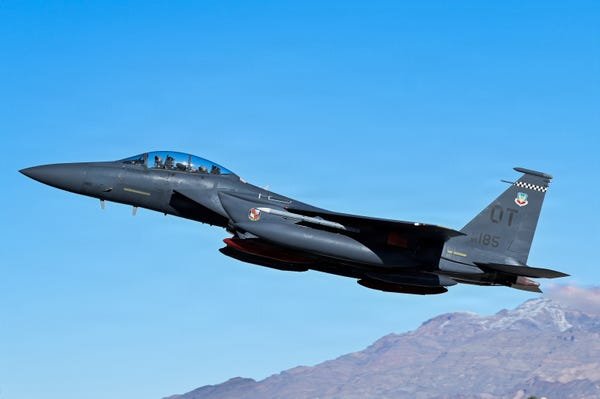
An F-15E Strike Eagle at Nellis Air Force Base in Nevada. 

U.S. Air Force photo by Airman 1st Class Jasmine Thomas

The first F-15A model flew in 1972, and the first F-15Es were produced in 1988, according to the US Air Force.

It’s the fastest crewed aircraft in the US Air Force.


An F-15E Strike Eagle flies through the sky.

An F-15E Strike Eagle during an exercise at Gando Air Base in Gran Canaria, Spain. 

U.S. Air Force photo by Staff Sgt. Elizabeth Davis

The air-to-air and air-to-ground attack aircraft can fly at 1,875 miles per hour, or 2.5 times the speed of sound.

The F-15E Strike Eagle’s high thrust-to-weight ratio enables it to accelerate during vertical climb.


An F-15E Strike Eagle.

An F-15E Strike Eagle in flight. 

U.S. Air Force photo by Staff Sgt. Tylin Rust

The high thrust-to-weight ratio also allows the F-15E Strike Eagle to execute tight turns without sacrificing speed. It has two Pratt & Whitney F100 engines, each producing over 23,000 pounds of thrust.

Another distinguishing capability is the plane’s head-up display, which projects flight and tactical information directly on the windscreen.


The head-up display on a C-17 Globemaster III.

The head-up display on a C-17 aircraft. 

U.S. Air National Guard photo by Tech. Sgt. John Linzmeier

Pilots can track and attack targets, check the status of weapons, and see other tactical and flight information without taking their eyes off the windscreen.

The fighter jet also includes a low-altitude navigation and targeting infrared for night (LANTIRN) system.


The underside of an F-15E Strike Eagle.

The underside of an F-15E Strike Eagle. 

U.S. Air Force Photo by Airman 1st Class Olivia Gibson

The LANTIRN system allows the planes to fly in any weather and attack ground targets at low altitudes. The system consists of two pods, a navigation pod and a targeting pod, mounted under the plane.

F-15E Strike Eagles can carry both nuclear and conventional weapons.


Loading an AIM-120 missile onto an F-15E Strike Eagle

US Air Force crew members load an AIM-120 missile onto an F-15E Strike Eagle aircraft at Mountain Home Air Force Base in Idaho. 

Airman 1st Class Donovin Watson/366th Fighter Wing

Its armament includes an internally mounted 20-millimeter gun with 500 rounds of ammunition, AIM-9 Sidewinder missiles, and AIM-120 AMRAAMs, an acronym for the radar-guided Advanced Medium-Range Air-to-Air Missiles.

The F-15 also regularly carries ground attack weapons like the Joint Direct Attack Munition, or JDAM, a kit that adapts an unguided munition into a “smart” bomb with fins and GPS guidance.

F-15E Strike Eagles are flown by a pilot and a weapons systems officer.


The cockpit of an F-15E Strike Eagle.

The cockpit of an F-15E Strike Eagle. 

U.S. Air Force photo by Airman 1st Class Aidan Martínez Rosiere

The weapon system officer sits directly behind the pilot, and closely manages the plane’s sensors and weapons.

Two variants of the F-15 are single-seaters: the F-15A and F-15C.

The planes can fly 2,400 miles without refueling, and can be refueled in flight.


An F-15E Strike Eagle receives in-flight refueling from a KC-135 Stratotanker.

An F-15E Strike Eagle receives in-flight refueling from a KC-135 Stratotanker during an exercise over the Atlantic Ocean. 

U.S. Air Force photo by Senior Airman Cody J. A. Mott

F-15E Strike Eagles have a fuel capacity of 35,550 pounds.

The fighter jets can be refueled in flight by KC-135 Stratotanker aircraft, which Boeing developed from its “Dash 80” prototype in the 1950s.

KC-135s were also deployed to Israel as part of Operation Epic Fury. One crashed in western Iraq on Thursday, killing six US service members. United States Central Command said the circumstances of the crash were under investigation, but it “was not due to hostile fire or friendly fire.”

Each F-15E cost $31.1 million to produce in 1998, according to US Air Force figures. That would be around $62.3 million when adjusted for inflation.


F-15E Strike Eagles at Travis Air Force Base in California.

F-15E Strike Eagles parked at Travis Air Force Base in California. 

U.S. Air Force photo by Kenneth Abbate

Newer F-15 models cost around $100 million, The Wall Street Journal reported.

The newest version of the aircraft is the F-15EX Eagle II, which features more advanced controls and upgraded engines.

On March 1, Kuwait’s air defenses mistakenly shot down three American F-15Es during Operation Epic Fury in what US Central Command described as a “friendly fire incident.”


F-15E Strike Eagles in the Middle East.

F-15E Strike Eagles at an undisclosed base in the Middle East. 

U.S. Air Force photo by Senior Airman Jared Brewer
All six crew members ejected safely. The incident is under investigation.

“Kuwait has acknowledged this incident, and we are grateful for the efforts of the Kuwaiti defense forces and their support in this ongoing operation,” CENTCOM said.


Source link

Israel-struck-Iran-with-F-35I-Adir-stealth-fighter-jets-that.jpeg

Israel struck Iran with F-35I Adir stealth fighter jets that cost $44,000 per hour to fly

Updated

  • Israeli Air Force F-35I planes struck Iranian missile systems and military leaders on Saturday.
  • The Israeli F-35 variant is known as “Adir,” meaning “Mighty One” in Hebrew.
  • The planes also struck Iran in June and aided defenses against Iranian missiles in 2023 and 2024.

Israel launched what it called “the most extensive aerial operation ever conducted by the Israeli Air Force” on Saturday, targeting Iranian missile systems and military leaders in tandem with US forces. Israel’s F-35I stealth fighter jets were on the front lines.

The Israeli variant of the US-made Lockheed Martin Lightning II Joint Strike Fighter plane is known as “Adir,” meaning “Mighty One” in Hebrew. With advanced stealth capabilities and a customized electronic warfare system, the F-35I is one of the most powerful tools in Israel’s air defense arsenal.

In addition to Israel’s newest assault on Iran, the Israeli planes also conducted preemptive strikes against Iran’s nuclear program in June, intercepted hundreds of drones, missiles, and rockets fired by Iran in a retaliatory attack in 2024, and took down a missile fired by an Iran-backed group in Yemen in 2023, according to the Israel Defense Forces.

Here’s a closer look at the “Mighty One” military aircraft.

F-35 Lightning II stealth fighter jets, produced by Lockheed Martin, are some of the most advanced military aircraft in the world.

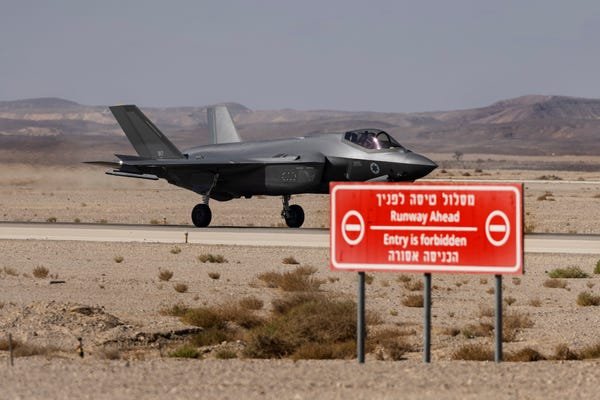
An Israeli F-35I lands at Ovda airbase near Eilat, southern Israel.

Tsafrir Abayov/AP

The F-35 stores its weapons and fuel internally, and its aligned edges and radar-absorbent coating also help the aircraft evade detection. The planes cost $44,000 per hour to fly, The National Interest reported.

They feature advanced stealth and information-processing capabilities and can reach supersonic speeds of Mach 1.6, or 548.8 meters per second.


An Israeli Air Force F-35I Adir multirole fighter aircraft

An Israeli Air Force F-35I Adir fighter aircraft flies over the Negev Desert.

YURI CORTEZ/AFP via Getty Images

Lockheed Martin CEO Marillyn A. Hewson said in 2018 that the planes “can fly in what we call ‘beast mode,‘ carrying up to 18,000 pounds of internal and external ordnance, in a mix that can include 5,000-pound-class weapons.”

In 2016, Israel became the first country other than the US to acquire F-35 fighter jets.


Israeli Prime Minister Benjamin Netanyahu stands next to a F-35 fighter jet just after it landed in Israel at Nevatim air base  in 2016

Israeli Prime Minister Benjamin Netanyahu stands next to an F-35 fighter jet just after it landed in Israel at Nevatim air base.

Amir Cohen/Reuters

Israel was the first country to select the model through the US Foreign Military Sales process and bought 50 planes, according to Lockheed Martin.

Israel has made significant modifications to the jets.


A new production line for F-35 wings is seen in Israel Aerospace Industries' (IAI) campus, near Tel Aviv

A production line for F-35 wings in Israel Aerospace Industries’ (IAI) campus near Tel Aviv.

Amir Cohen/Reuters

Israel manufactures its own wings and electronic warfare system for the F-35I. It also developed its own version of the high-tech helmet that displays the plane’s airspeed, altitude, targeting information, and other crucial stats directly on the pilot’s visor.

The Israeli Air Force named its F-35I variant “Adir,” meaning “Mighty One” in Hebrew.


Israeli Air Force technicians customize an F-35I plane with a Star of David symbol.

Israeli Air Force technicians customize an F-35I plane with a Star of David symbol.

Israeli Air Force

The Israeli Air Force also added a six-pointed Star of David to the design, a Jewish symbol that also appears on the Israeli flag.

In 2018, Israel became the first country to use the F-35I in combat, its air force chief said.


An Israeli Air Force F-35 flies during an aerial demonstration

Israeli Air Force F-35 flies during an aerial demonstration.

Amir Cohen/Reuters

“We are flying the F-35 all over the Middle East and have already attacked twice on two different fronts,” then-Israeli Air Force chief Major-General Amikam Norkin said in a speech at a gathering of foreign air force leaders, Reuters reported.

In July 2023, Israel acquired an additional 25 Adir planes in a $3 billion deal.


Israeli F-35I planes at Nevatim airbase in Israel.

Israeli F-35I planes.

Israeli Air Force

The deal was financed through the military aid Israel receives from the US, Reuters reported.

In November 2023, Israel’s F-35I Adir fighter jets took down a missile fired by an Iran-backed group in Yemen, according to the IDF.


An Israeli F-35 fighter jet

A F-35I fighter jet flies during a graduation ceremony for Israeli Air Force pilots in southern Israel.

Amir Cohen/Reuters

It was the first known intercept of a cruise missile by an F-35 plane.

The Israeli Air Force released footage of the encounter on X, writing in Hebrew that its personnel are “preoccupied at every moment with planning and managing the defense response and are prepared for any threat in any area.”

Iran appeared to target the Nevatim air base, which houses Israel’s fleet of F-35I jets, during an attack in April 2024.


An Israeli F-35 combat aircraft is seen in the skies over Israel's border with Lebanon

An Israeli F-35 combat aircraft in the skies over Israel’s border with Lebanon.

Ammar Awad/Reuters

Out of the over 350 ballistic missiles, cruise missiles, and UAVs, or unmanned aerial vehicles, launched at Israel by Iran and its proxies in Iraq, Yemen, and Lebanon, around 99% were intercepted by Israel and its allies. The IDF released photos showing minor damage near a runway at the Nevatim Airbase and to a road in Hermon caused by the few projectiles that landed.

The missiles appeared to target Israel’s Nevatim Airbase in the Negev desert, which houses its fleet of F-35I stealth fighter jets. The base remained operational throughout the attack, according to the IDF, with the Adir fighter jets aiding the defensive mission.

“Iran thought it would be able to paralyze the base and thus damage our air capabilities, but it failed,” IDF spokesperson Rear Adm. Daniel Hagari said in a statement.

In June 2025, the Israeli Air Force launched around 200 fighter jets, including F-35Is, in a preemptive strike targeting Iran’s nuclear program.


An F-35I Israeli fighter jet used in strikes against Iran.

An F-35I Israeli fighter jet used in strikes against Iran.

Israel Defense Forces

An IDF spokesperson said that Israeli fighter jets struck over 100 sites across Iran to prevent it from developing a nuclear weapon, including military targets and its largest uranium enrichment site in Natanz.

The IDF said that Iran’s nuclear program had “accelerated significantly” in recent months and called it “clear evidence that the Iranian regime is operating to obtain a nuclear weapon.” Iran maintains that its nuclear program is solely for civilian purposes.

“This is a critical operation to prevent an existential threat by an enemy who is intent on destroying us,” Lt. Gen. Eyal Zamir, the IDF’s Chief of the General Staff, said in a statement.

The IDF released photos showing planes used in the large-scale operation, including F-35I jets.

F-35Is struck Iran over the weekend in what the IDF called “the largest military flyover in Israeli Air Force history.”


US and Israeli F-35s flying together during a training exercise.

US and Israeli F-35s flew together during a training exercise. The two countries launched new strikes against Iran using land, air, and sea assets.

U.S. Air Force photo by Senior Airman Duncan C. Bevan

As part of Operation Roaring Lion, Israel’s moniker for Operation Epic Fury, around 200 Israeli fighter jets, including F-35Is, struck 500 Iranian missile launchers and aerial defense systems on Saturday. IDF spokesperson Lt. Col. Nadav Shoshani characterized the operation as “the most extensive aerial operation ever conducted by the Israeli Air Force.”

The strikes “significantly degraded” Iran’s offensive capabilities, the IDF said. The strikes also killed Iranian military leaders, including Iranian Defense Minister Aziz Nasirzadeh and Mohammad Pakpour, commander of the IRGC.

The war in Gaza prompted new scrutiny of US military aid to Israel.


An Israeli soldier sits inside a F-35 fighter jet

An Israeli soldier sits inside an F-35I fighter jet after it landed in Israel at Nevatim Airbase.

Amir Cohen/Reuters

The October 7 terrorist attacks carried out by Hamas killed around 1,200 Israelis and captured over 240.

Israel’s counteroffensive airstrikes and military actions in Gaza resulted in over 72,000 Palestinian fatalities, according to figures provided to the United Nations Office for the Coordination of Humanitarian Affairs by the Hamas-run Ministry of Health in Gaza. The IDF reports that at least 17,000 of these fatalities were Hamas militants. A ceasefire agreement was reached in October.

According to the United Nations Relief and Works Agency, over 1.9 million Gazans, around 90% of the population, have been displaced by the war.

The devastating human toll of the war in Gaza with US-funded planes like the F-35I has prompted new scrutiny of US aid to Israel, with some lawmakers in Congress raising the possibility of conditioning military and economic aid.


Source link