

Taylor Rains

United is rolling out ‘basic business class’ to make premium flying cheaper. Here’s how it will work.

United Airlines is changing how people fly in its most expensive cabins.

The airline said Friday it’s soon rolling out new “basic” fares for its Polaris business class and Premium Plus premium economy cabins that strip out some perks — like seat selection and lounge access — in exchange for lower prices.

It’s essentially basic economy for premium seats. The goal is to let customers tailor their experience based on what they actually value, while simultaneously monetizing the growing demand for premium comfort.

For example, flyers who already get lounge access via a credit card can opt out of paying for a bundled perk they would not use. They can also save if they don’t care where they sit or that their ticket is nonrefundable.

United is also targeting travelers who may have considered upgrading but were previously priced out. By dangling the carrot of more “affordable” premium fares, the airline can make money off of seats that would otherwise fly empty.

The on-board experience won’t change. All Polaris customers will still get beds, chef-curated meals, and more privacy; Premium Plus still includes better food, a large recliner, and a leg and footrest.

The unbundled fares will launch “later this year” on long-haul international, transcontinental, and select Hawaii routes. United outlined how its new “Base,” Standard,” and “Flexible” fares will work:


United Polaris fare chart.

The fares have different rules around seat selection, baggage, lounge access, changes, upgrades, and refunds. 

United Airlines


United’s Polaris lounge is more upscale than its regular Club lounges. The upgrade option to United Polaris Studio refers to the new suite-style pod it’s launching on future Boeing 787s in late April.

United is applying the same new fare structure to its Premium Plus cabin. Those revamped fares — also called Base, Standard, and Flexible — mirror the Polaris options, minus lounge access.

United Chief Commercial Officer Andrew Nocella framed the changes as offering customers “more choice,” saying the new pay-as-you-go structure will make it “easier to find a fare that includes the benefits they want most — whether that’s a great value, added perks, or maximum flexibility.”

The reworked business class is part of a broader wave of new products, like door-equipped business class and beds in economy, coming to United as it chases premium revenue.

United joins a larger basic business class trend

United is the first US airline to deploy basic premium fares, but it’s not the first globally.

Air France, KLM, Finnair, Emirates, and Qatar Airways have experimented with stripped-down business-class options for years, unbundling seat selection, lounge access, and other previously free add-ons.

Delta Air Lines has also been signaling a similar direction, teasing a “business-class-lite” product since 2024. Former company president Glen Hauenstein, who retired in February, said on a January earnings call that the fare type was a “2026 initiative.”

It’s still unclear how the new à la carte premium structure will ultimately affect pricing or the customer experience. Some industry analysts have said basic business class could gradually erode the traditional premium cabin without necessarily making flying cheaper over time.

Henry Harteveldt, a travel analyst and president of Atmosphere Research Group, previously told Business Insider that fares for the new business-class ticket are likely to be similar to current levels, while the cost of fully flexible tickets would steadily rise.

He added, however, that corporate customers who pay for business class primarily to ensure employees are rested and well-fed may welcome lower fares that strip out perks they deem unnecessary.


Source link

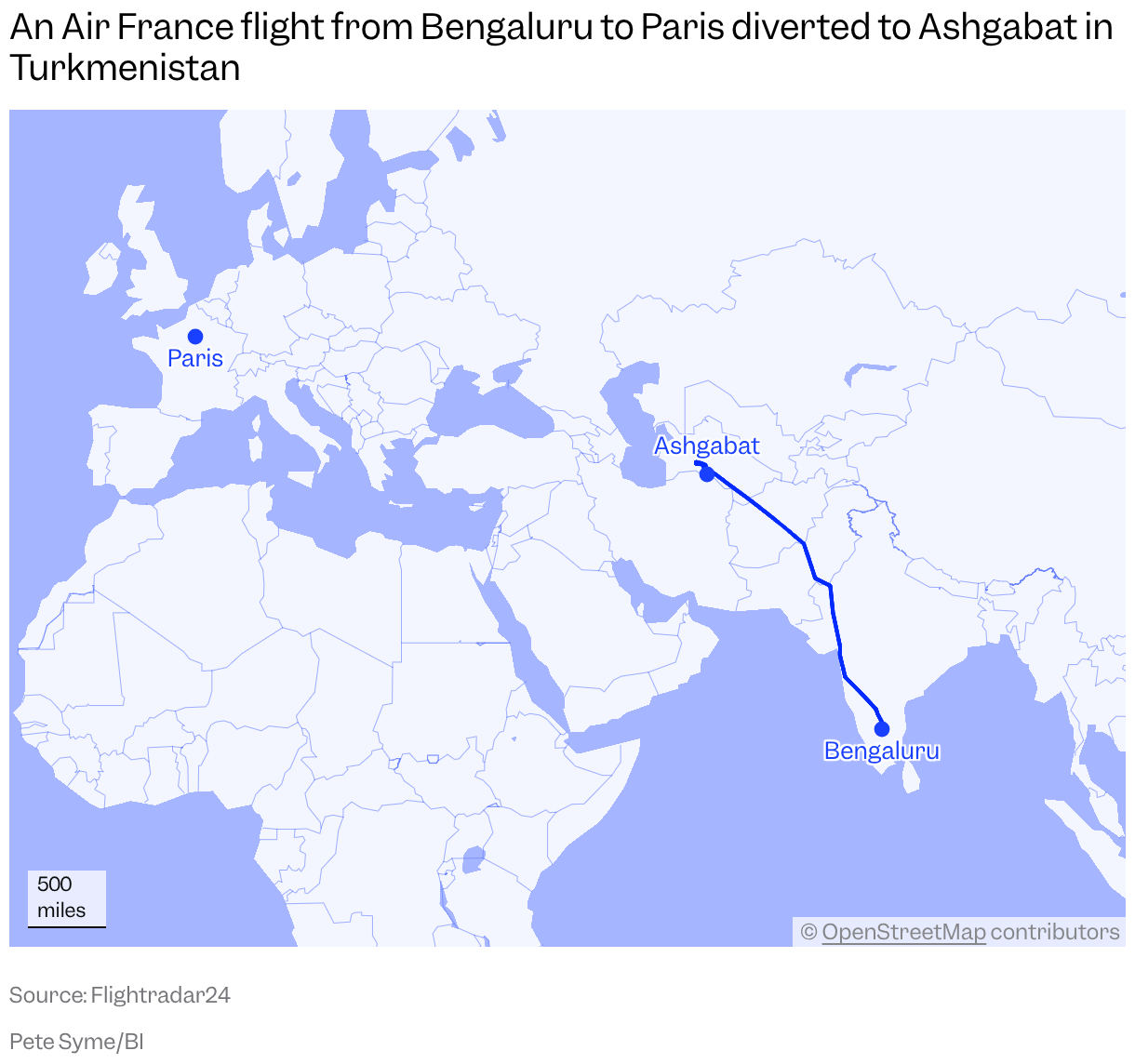
A map of the western hemisphere showing the flight path of Air France 191 which departed Bengaluru and diverted to Ashgabat.

Passengers flying to Paris spent 21 hours stranded in the remote nation of Turkmenistan

Air France passengers were delayed by nearly two days after they were diverted to Turkmenistan.

Monday’s Flight 191 was already running 21 hours late when it departed Bengaluru, India, shortly after 11 p.m., according to data from Flightradar24. It was supposed to land in Paris about 10 hours later.

However, four hours into the journey, the Boeing 777 started descending. It made a U-turn to land in Ashgabat, the capital of Turkmenistan, a sparsely populated nation in Central Asia.

Registered as F-GSPI, the jet is 26 years old. The cause of the diversion has not been confirmed, though The Independent reported that the plane suffered an engine issue.

Passengers then had to wait nearly another whole day to continue their journey to Paris. Turkmenistan is ruled by what Human Rights Watch has described as a totalitarian, hereditary government and is one of the world’s most politically secluded countries.

Air France did not respond to a request for comment sent by Business Insider.

Given that the flight departed from India, there were a number of Indian nationals on board, who were hosted by the nation’s consulate in Turkmenistan. It is unclear where the majority of the passengers on the flight stayed during their time in Ashgabat.

Ultimately, a new aircraft was dispatched to collect the passengers. Flight-tracking data shows another Air France Boeing 777 left Paris on Tuesday morning and arrived in Ashgabat after a five-hour flight.

It spent about three hours on the ground before departing Turkmenistan shortly after 1 a.m. That’s nearly 22 hours after the passengers first arrived there.

The plane then landed in the French capital at 3:23 a.m. on Wednesday. Along with the departure delay, that’s 43 hours later than passengers initially expected to get there.

Flight-tracking data appears to show that the original plane is still on the ground in Ashgabat as of Thursday morning, three days after it landed there.

This wasn’t the first time that Air France has sent a plane to rescue stranded passengers.

In May 2024, one of its Boeing 787s was flying from Paris to Seattle when a burning smell was detected in the cabin.

The pilots declared an emergency and diverted to Iqaluit, the capital of Canada’s Nunavut territory. A different flight was canceled so a Boeing 777 could take the passengers to New York.


Source link

The-memes-are-flying-about-the-Netflix-and-Paramount-bidding.jpeg

The memes are flying about the Netflix and Paramount bidding battle for Warner Bros. Discovery

The Hollywood bidding war between Paramount Skydance and Netflix has created a meme frenzy.

The two media giants are in an all-out battle for Warner Bros. Discovery after it accepted Netflix’s offer to acquire its studio and streaming businesses for an equity value of $72 billion. David Ellison’s Paramount launched a hostile $30-per-share bid for all of WBD on Monday.

Warner Bros. Discovery owns the Warner Bros. film studio, HBO, the HBO Max streaming service, and TV networks such as CNN, TNT, and TruTV. It confirmed receipt of Paramount’s unsolicited offer on Monday.

Both entities have made their cases on why they’d be the best owner for WBD. Although internet comedians don’t have a say in where the deals land, it hasn’t stopped them from weighing in with viral jokes about the dueling companies and their quest to acquire WBD.

Some social media users are poking fun at the back-and-forth with memes about how far each company is willing to go to gain WBD’s favor. One post compared the battle for the best offer to a scene from the HBO business drama “Succession,” a title Netflix would own if the deal goes through.

The Instagram meme account Litquidity used parody images that appeared to be AI-created of two business leaders speaking at the DealBook Summit to mock how each company is trying to prove its offer is better.

Some people seem to be using humor to cope with the idea of more consolidation in Hollywood. They are pushing back on both offers with memes about stopping the looming acquisition completely.

“I’m putting together a team to fight the Netflix Warner Bros merger,” one X user captioned a compilation video of various actors and famous filmmakers.

Others speculated on what the movie-watching experience could be like under Warner Bros. Discovery’s new ownership. One TikTok video showed a man sitting down to watch a movie, only for the intros to include a confusing mix of studios, backers such as Saudi Arabia’s Public Investment Fund, and even a DJ, being played before the movie began.

In the midst of all the jokes, Netflix argues that its offer would be better for consumers and creators, while Ellison says Paramount is more likely to win regulatory approval and offers Hollywood more certainty.

What all of this means in the long run is unclear so far. It could lead to job cuts in the entertainment industry as the giants consolidate their power. The trends of streaming services getting pricier and fewer movies hitting theaters could also continue, as companies release less content, Business Insider previously reported.

Either way — as with many serious big business deals — consumers and industry insiders are finding ways to laugh through it.


Source link