The-US-Air-Force-just-offered-a-fresh-look-at.jpeg

The US Air Force just offered a fresh look at its new B-21 stealth bomber

The US Air Force released new photos of its B-21 Raider stealth bomber as the service continues flight testing of the aircraft intended to be the backbone of the force’s long-range strike capabilities.

The B-21, developed by Northrop Grumman, is the Air Force’s next-generation strategic bomber and a cornerstone of the service’s nuclear modernization efforts, alongside the Sentinel intercontinental ballistic missile. The program remains on schedule and within budget, with production now accelerating ahead of planned deliveries of production models next year.

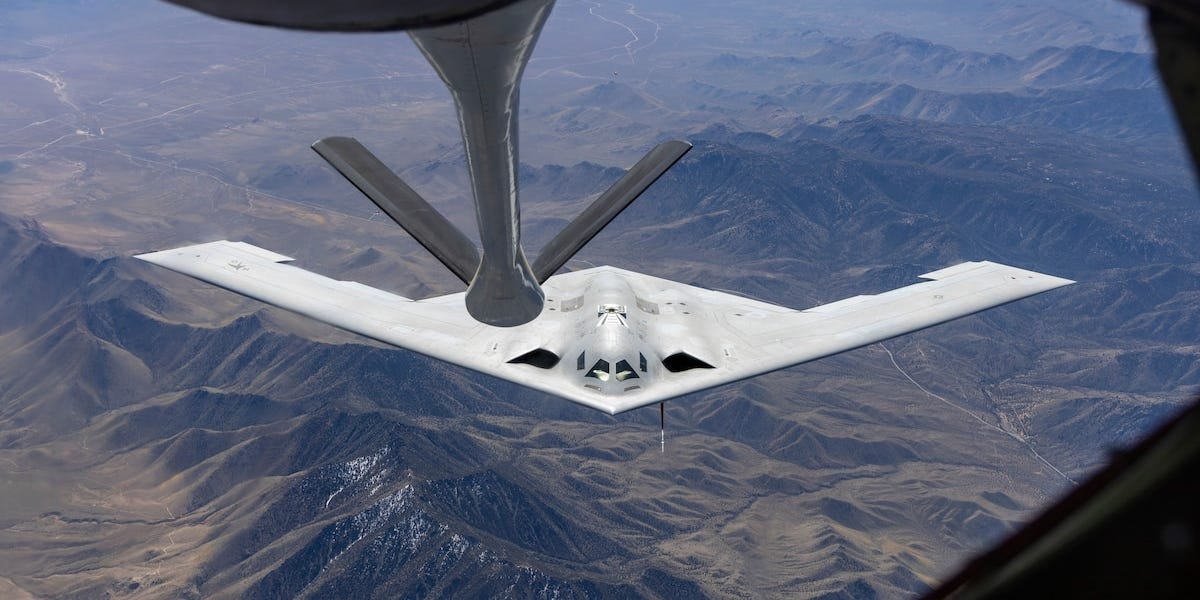
One of the new Air Force photos of the B-21 Raider released on Tuesday shows the bomber being refueled by a KC-135 Stratotanker and, as military news outlet The War Zone first noticed, offers the first full overhead view of the aircraft, including its refueling receptacle, paint markings, and exhaust.


A US Air Force B-21 Raider bomber flies over mountainous terrain.

The Air Force photos are the first overhead view of the B-21. 

US Air Force


The aerial refueling, the service said, represented “rapid maturation of the weapon system.” Aerial in-flight refueling for aircraft like the B-21, which its manufacturer calls “the most fuel-efficient bomber ever built,” is critical in a potential conflict, enabling the fleet to stay in the air longer, dramatically extending reach.

Aerial refueling tankers, for instance, have enabled US B-2 Spirit stealth bomber operations against Iran.

That said, the B-21, slated to eventually replace the Air Force’s B-1 Lancer and B-2 Spirit bombers, has been designed for fuel efficiency, consuming a fraction of the fuel of some legacy aircraft.

“This long-range strike bomber will reduce the demand on our tanker fleet and free up assets to support the joint force,” Air Force Chief of Staff Gen. Ken Wilsbach said in a service statement on the recent testing work. “This will provide a wider range of employment options and the deterrence our nation requires.”


A B-21 Raider flies behind an aerial refueling aircraft in a mountainous landscape.

The Air Force is accelerating the production timeline of the B-21. 

US Air Force


The Air Force and Pentagon have both viewed the B-21’s development and testing timeline as successes, with flight tests and early procurement remaining on schedule.

The Air Force is now accelerating the production of its new bombers and expects to procure around 100 by the mid-2030s, although there have been calls to increase procurement. Airpower experts have advocated for a much larger fleet, arguing its necessity to effectively counter China.

“The B-21 program is the leading edge of the acquisition mindset we are instilling across the force,” said Air Force Gen. Dale White, the Pentagon’s direct reporting portfolio manager for critical major weapon systems. “Every test proves the success of empowering our leaders to deliver integrated capability from the start.”

The Air Force is continuing to test the B-21 at Edwards Air Force Base in California. Other bases like Ellsworth, Whiteman, and Dyess will eventually house the B-21 for training and main operations. It’ll mark its first operational fielding next year at Ellsworth.

Both the Air Force and Northrop Grumman have said that the Raider represents a major jump in bomber capability, including next-generation stealth, software, and weaponry.

The aircraft also features an open system architecture, meaning it can be quickly and easily upgraded with new technologies without needing to build a completely new version.



Source link

Headshot of Chris Panella.

A US Air Force F-22 Raptor just showed off how it might work with a loyal wingman-type drone in a future air war

A crewed US Air Force fighter and an uncrewed jet-powered aircraft flew together recently, communicating and showing how autonomous drones might fight in a future air war alongside human pilots.

US defense firm General Atomics, a competitor in the Air Force’s Collaborative Combat Program aimed at developing and fielding loyal wingman-type drones, said on Monday that its MQ-20 Avenger, long a CCA stand-in, flew with an F-22 Raptor.

During the test at Edwards Air Force Base earlier this month, the stealth fighter’s pilot commanded the test drone to carry out tactical maneuvers, perform combat air patrols, and execute airborne threat engagement tasks.

The most recent demonstration is an advancement of a similar test in November 2025, when an F-22 pilot used a tablet to control an MQ-20, a test aircraft being used to demonstrate CCA-style teaming. The tablet allowed the pilot to communicate with the drone and send commands during flight.

The flight test earlier this month saw the Raptor pilot use government-provided autonomy software on the F-22 and a tactical data link to pass commands in real time to the drone.

“This demo featured the integration of mission elements and the ability of autonomy to utilize onboard sensors to make independent decisions and execute commands from the F-22,” David Alexander, the president of General Atomics Aeronautical Systems, Inc., said in a statement.


An F-22 flies in a blue and cloudy sky.

The Air Force views CCAs as an attritable force multiplier that will be used with manned aircraft and autonomy.

US Air National Guard photo by Staff Sgt. John Macera


General Atomics said the latest demonstration showed how CCA-type platforms could increase the combat power available to human pilots in a future war.

The Collaborative Combat Aircraft program is a priority for the Air Force as a way to bolster American airpower. These drones are meant to fly alongside advanced fighters, including the coming sixth-generation F-47 being developed by Boeing.

Air Force officials say CCAs aren’t disposable, but they’re cheaper than fighters like the F-35 Lightning II Joint Strike Fighter. They are built to be attritable so they can be risked in combat instead of a human-piloted aircraft.

Testing with the MQ-20 is helping inform the Air Force’s CCA program, which is focused on General Atomics’ YFQ-42, Anduril’s YFQ-44, and Northrop Grumman’s YFQ-48A. The air service envisions these systems as easily upgradable platforms compatible with high-end crewed aircraft.

CCA-type drones, which include designs beyond those with dedicated Air Force program designations, are designed to carry out missions on their own, from air-to-air combat to strike and intelligence roles, while also boosting the power of a formation by adding more sensors and weapons without another pilot in the cockpit.

The Air Force says that CCAs are not intended as replacements for its crewed jets but are rather partners that will change how pilots work with artificial intelligence and drones — and expand US airpower in a fight, especially against a near-peer adversary.


Source link

The-US-Navy-is-pulling-more-and-more-warships-into.jpeg

The US Navy is pulling more and more warships into its Middle East force buildup

The US military added another warship to its large Middle East buildup in recent days, and a second carrier strike group is on its way, bringing additional fighter jets and missiles toward the region.

The large-scale deployment of American forces to the Middle East has escalated significantly this month as the Trump administration pressures Iran to strike a deal that would limit its nuclear and military capabilities.

As the US Navy’s Middle East force presence has grown, its footprint in the Caribbean Sea — once the site of a substantial show of force ahead of US military action against Venezuela and its former president Nicolás Maduro — has shrunk dramatically.

There are 10 warships and an aircraft carrier positioned in the Central Command area of responsibility, the Middle East, and two more vessels situated on the outskirts of the region, according to a defense official.

Middle East

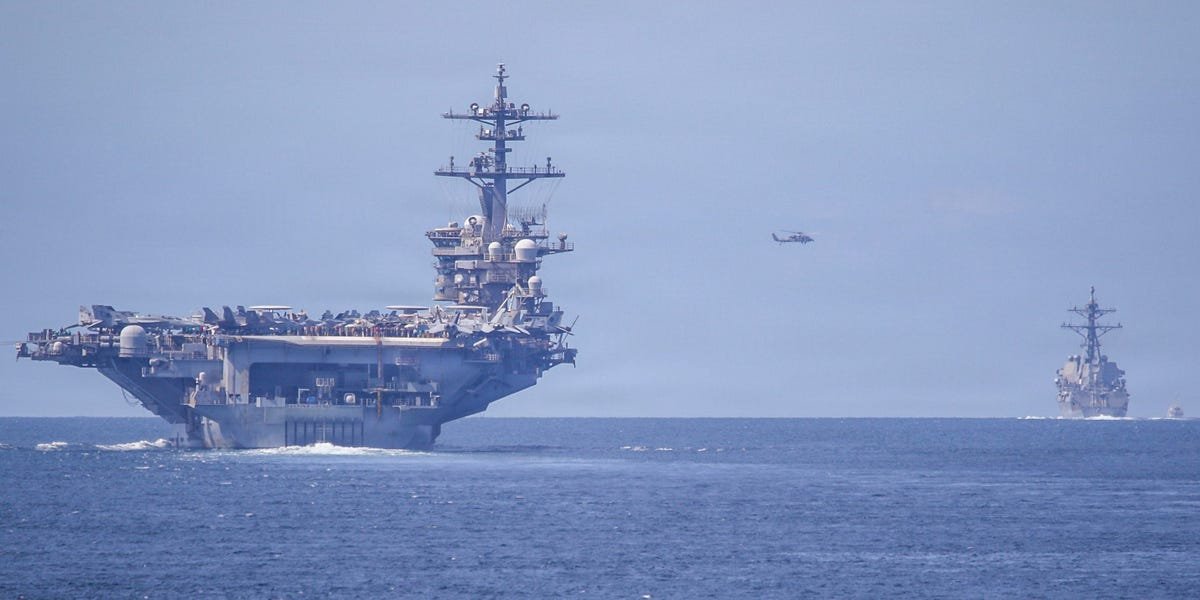
Much of the US naval force in the Middle East was operating in the Arabian Sea as of Tuesday. That includes the aircraft carrier USS Abraham Lincoln and its strike group — the guided-missile destroyers USS Spruance, USS Frank E. Petersen Jr., and USS Michael Murphy.


An F/A-18E Super Hornet, attached to Strike Fighter Squadron (VFA) 14, prepares to make an arrested landing on the flight deck of Nimitz-class aircraft carrier USS Abraham Lincoln (CVN 72) on Jan. 9, 2026.

The carrier Abraham Lincoln has dozens of embarked fighter jets.

US Navy photo by Mass Communication Specialist Seaman Samuel Evarts


The Lincoln has dozens of embarked aircraft, including fighters, electronic attack jets, and early warning planes. The destroyers escorting the carrier are equipped with Tomahawk cruise missiles. Among its air wing are F-35 stealth fighters.

Three additional destroyers — USS Mitscher, USS McFaul, and USS Pinckney — are also in the Arabian Sea. Pinckney arrived in the region in the past couple of days, the defense official said.

Another destroyer, USS Delbert D. Black, is in the Red Sea. And three littoral combat ships — USS Santa Barbara, USS Tulsa, and USS Canberra — are in the Arabian Gulf. These warships are designed for near-shore operations.

European waters

USS Roosevelt and USS Bulkeley, two destroyers capable of ballistic missile defense, are operating in the Eastern Mediterranean Sea, which is part of US Naval Forces Europe and Africa’s area of responsibility.

The defense official said the aircraft carrier USS Gerald R. Ford and its strike group — destroyers USS Mahan, USS Winston S. Churchill, and USS Bainbridge — are also operating under that command, which covers the eastern half of the Atlantic Ocean.


The world's largest aircraft carrier, Ford-class aircraft carrier USS Gerald R. Ford (CVN 78), transits the Caribbean Sea during Carrier Air Wing 8's aerial change of command ceremony, Jan. 19, 2026.

The Ford is the Navy’s largest and most advanced carrier.

US Navy photo


The Ford carrier strike group had been operating in the Caribbean for months. However, earlier this month, it was reported that the Navy’s newest and most advanced aircraft carrier was being sent to the Middle East.

As of Wednesday, the aircraft carrier was operating off the coast of Morocco near the Strait of Gibraltar, ship-tracking data shows.

Two additional destroyers — USS Thomas Hudner and USS Stockdale — that were previously in the Caribbean are now in the US Naval Forces Europe and Africa area of responsibility as well.

Caribbean

The departure of Ford and the five destroyers has diminished the Navy’s presence in the Caribbean, which falls under the Southern Command area of responsibility.

The US armed forces initially positioned a large number of warships in the waters near Venezuela last year as part of President Donald Trump’s effort to pressure Maduro. A few weeks after his capture, a dozen vessels were still present in the region.


Ticonderoga-class guided-missile cruiser USS Gettysburg prepares to steam alongside Supply-class fast combat support ship USNS Supply and San Antonio-class amphibious transport dock USS Fort Lauderdale (LPD 28), in the Caribbean Sea, January 29, 2026.

The Navy had a dozen warships deployed to the Caribbean earlier this year.

US Navy photo


Now, only five remain, the defense official said. Those include the cruiser USS Lake Erie, the destroyer USS Truxtun, the amphibious assault ship USS Iwo Jima, and the amphibious transport dock ships USS Fort Lauderdale and USS San Antonio.

Eyes on Iran

The US and Iran held indirect talks earlier in the week, and officials hinted that additional dialogue could be on the horizon.

However, US military assets — including aircraft such as fighter jets and refueling tankers — are still moving into and toward the Middle East, giving Trump plenty of options to strike Iran for a second time, which he has threatened. The US military bombed Iran’s nuclear sites last year as part of Operation Midnight Hammer.

Iran, meanwhile, conducted military exercises in the strategic Strait of Hormuz this week, and Tehran’s leadership warned the US warships deployed to the region that it is capable of sinking them in the event of a fight.


Source link

Take-a-look-inside-the-Air-Force-One-plane-that.jpeg

Take a look inside the Air Force One plane that carried 8 presidents and brought home JFK’s body from Dallas

Updated

  • SAM 26000 operated as Air Force One from 1962 to 1998, carrying eight US presidents.
  • Lyndon Johnson was sworn in on board, and the plane transported John F. Kennedy’s body from Texas.
  • SAM 26000 is housed at the National Museum of the US Air Force, where visitors can walk through it.

“If history itself had wings, it would probably be this aircraft,” Vice President Al Gore said of the SAM 26000 Air Force One plane upon its retirement in 1998.

The first Air Force jet designed and built specifically for US presidents, SAM 26000 (pronounced two six thousand) carried eight presidents between 1962 and 1998 — every leader from John F. Kennedy to Bill Clinton.

After 13,000 flying hours over 36 years of service, the plane was retired to the National Museum of the US Air Force in Dayton, Ohio, where it remains on display.

I visited the museum in August and walked through the historic aircraft. Take a look inside.

The SAM 26000 Air Force One jet, a Boeing VC-137C, was completed in 1962 for President John F. Kennedy.

SAM 26000 at the National Museum of the US Air Force.

US Air Force photo by Ken LaRock

The Boeing VC-137C was a customized and modified version of a civilian 707-320B airliner. It was powered by four Pratt & Whitney TF33 engines, each with 18,000 pounds of thrust.

First lady Jacqueline Kennedy chose the plane’s blue and white paint colors in coordination with industrial designer Raymond Loewy.


A blue and white plane on display in a museum, with

Eight US presidents flew on this Air Force One plane known as SAM 26000.

US Air Force photo by Jim Copes

The first lady also added the words “United States of America” to the aircraft to signal its importance as the president’s plane.

In a tragic period of American history, SAM 26000 transported President John F. Kennedy’s body home after his assassination in 1963.


Air Force One arrives with President John F. Kennedy's coffin.

President John F. Kennedy’s coffin was transported on Air Force One after his assassination.

Schulman-Sachs/picture alliance via Getty Images

President Lyndon Johnson was sworn in as president aboard the plane hours after Kennedy was pronounced dead.

Now an interactive museum artifact, visitors can board the plane the same way US presidents did via a staircase leading into the cabin.


Air Force One at the National Museum of the US Air Force.

Air Force One.

Talia Lakritz/Business Insider

Admission to the National Museum of the US Air Force is free.

SAM 26000 is located in the museum’s William E. Boeing Presidential Gallery, which includes other presidential planes such as the Douglas VC-54C, the first presidential aircraft, which was known as the “Sacred Cow.”

The first stop on my self-guided tour was the cockpit, which featured a four-person crew.


The flight deck of SAM 26000.

The cockpit.

Talia Lakritz/Business Insider

The crew consisted of a pilot, copilot, navigator, and flight engineer. The navigator and flight engineer roles were eventually replaced by GPS and computerized technology on later Air Force One planes.

Two phones were located behind the flight deck.


Two phones aboard Air Force One, SAM 26000.

Two phones aboard Air Force One.

Talia Lakritz/Business Insider

A plaque above the phones read, “This telephone is subject to monitoring at all times. Use of this telephone constitutes consent to monitoring.”

An equipment storage space featured a first aid kit and firearms.


A first aid kit and weapons on Air Force One SAM 26000.

A first aid kit and weapons on Air Force One.

Talia Lakritz/Business Insider

The closet also had a rack to hang suits and coats.

Next, I walked by the plane’s communication facility.


The communication facility on board SAM 26000.

The communication facility.

Talia Lakritz/Business Insider

The secure communication center allowed presidents to place calls anywhere in the world while in flight.

Meals were prepared in the galley.


The galley on board SAM 26000.

The galley.

Talia Lakritz/Business Insider

The galley included a stovetop, oven, and sink.

This seating area was used by presidential staff, members of the press, and Secret Service agents.


A seating area aboard SAM 26000.

A seating area aboard SAM 26000.

Talia Lakritz/Business Insider

The aircraft could hold up to 40 passengers.

The seating area, like many areas of the plane, is now protected by plastic barricades.

I noticed fox decals above the seats, which a museum volunteer told me was a nod to the 89th Airlift Wing, which operates Air Force One.


A fox decal on Air Force One SAM 26000.

A fox decal on Air Force One.

Talia Lakritz/Business Insider

Stationed at Joint Base Andrews in Maryland, the 89th Airlift Wing is tasked with flying the president and high-ranking government officials. The group is also referred to as “SAM FOX,” which stands for “Special Air Missions Foreign.”

The presidential stateroom was located down a long hallway.


A hallway on Air Force One.

A hallway on Air Force One.

Talia Lakritz/Business Insider

The benches in the hallway were hollow to offer additional storage.

The president’s spacious quarters featured a desk, couch, television, and private bathroom.


The president's stateroom aboard SAM 26000.

The president’s stateroom.

Talia Lakritz/Business Insider

In 1969, Nixon redesigned Air Force One and moved the presidential quarters over the wings, which was the quietest and smoothest part of the plane during flight.

The stateroom came with two phones, each with different purposes.


Two phones in the president's stateroom on Air Force One SAM 26000.

Two phones in the president’s stateroom.

Talia Lakritz/Business Insider

Presidents used the white phone to communicate with crew members and other passengers on the plane, while the beige phone could be used to call anywhere in the world.

Behind the presidential stateroom, a conference room provided more meeting space.


A conference room on SAM 26000.

A conference room.

Talia Lakritz/Business Insider

The room was furnished with throne chairs, a folding table, and another TV.

Additional conference areas provided more seating for staff, Secret Service members, and VIPs.


Seating aboard SAM 26000.

A conference room aboard SAM 26000.

Talia Lakritz/Business Insider

Presidents Nixon, Ford, and Carter sat here while flying to attend Egyptian President Anwar El-Sadat’s funeral in 1981.

An office area across the aisle featured an electric typewriter, scanner, and more phones.


A conference room with a map of the United States aboard SAM 26000.

A conference room.

Talia Lakritz/Business Insider

Presidents used the electric typewriter to write and edit speeches while on board the plane.

The wall of the office space was decorated with a map of the United States.

President Lyndon Johnson was sworn in as president in this area of Air Force One’s cabin after Kennedy’s assassination in 1963.


Lyndon Johnson takes the oath of office aboard Air Force One after the assassination of John F. Kennedy.

President Lyndon Johnson was sworn in on board Air Force One after President John F. Kennedy’s assassination.

Universal History Archive/Getty Images

Kennedy was assassinated on November 22, 1963, while visiting Dallas. He was pronounced dead at Parkland Memorial Hospital at 1 p.m., and Johnson took the oath of office at 2:38 p.m.

Jacqueline Kennedy’s pink suit was still smeared with blood when Federal Judge Sarah T. Hughes administered the oath of office on Air Force One. Johnson’s wife, Lady Bird Johnson, stood to his right.

Standing in the very spot where Johnson was sworn in after Kennedy’s assassination was awe-inspiring.


A hallway on SAM 26000.

A hallway between conference rooms on SAM 26000.

Talia Lakritz/Business Insider

Even blocked off by plastic barricades, the plane’s cabin preserves a pivotal moment in US history.

These four seats toward the back of the plane were removed to make room for Kennedy’s coffin on the flight from Dallas back to Washington, DC, in 1963.


Seats on Air Force One.

Seats on Air Force One.

Talia Lakritz/Business Insider

The Secret Service had to break the handles off the casket to make it fit through the plane door.

Air Force security personnel operated out of this area at the back of the aircraft to secure the plane while it was on the ground.


Seats for security personnel aboard SAM 26000.

Seats for security personnel.

Talia Lakritz/Business Insider

The seating area featured six seats, a phone, and a folding table.

My tour ended at the back of the plane with a view of its call sign on the tail and an American flag.


The tail of SAM 26000.

The tail of SAM 26000.

Talia Lakritz/Business Insider

According to US Flag Code, an American flag decal must always be positioned so that the stars face forward.

Air Force One remains an instantly recognizable symbol of US might, making my walkthrough tour a memorable experience.


The presidential seal on Air Force One.

The presidential seal on Air Force One.

Talia Lakritz/Business Insider

Like many modes of presidential transportation, such as the bulletproof limousine known as “The Beast” and the Marine One helicopter, Air Force One is about more than simply getting the president from point A to point B. It symbolizes the power of the United States and its elected leader wherever it goes.

The image projected by presidential planes remains of great interest to President Donald Trump, who opted to accept a luxurious Boeing 747-8 jet from the Qatari royal family instead of waiting for Boeing to deliver its long-delayed new Air Force One jets.


Source link

What-is-Delta-Force-The-elite-US-special-ops-unit.jpeg

What is Delta Force? The elite US special ops unit reported to be at the center of the raid to capture Venezuela’s Maduro

At the center of the US operation that captured Venezuelan President Nicolás Maduro and his wife was an elite and secretive special operations group, per multiple reports.

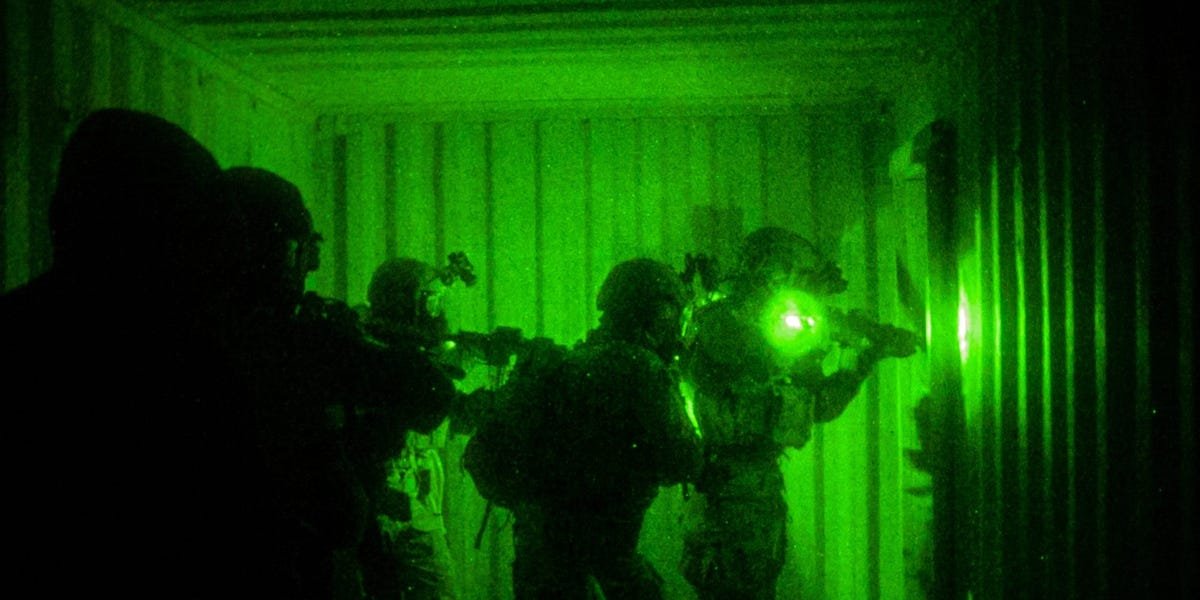
Citing officials, outlets like The New York Times and The Wall Street Journal reported that Delta Force, alongside law enforcement personnel, carried out the extraction of Maduro as part of Operation Absolute Resolve, a surprise nighttime raid of the Venezuelan leader’s compound in Caracas.

Business Insider wasn’t able to independently confirm the participation of the elite unit in the operation. The Pentagon directed BI’s queries to the White House.

In discussions of the complex operation, President Donald Trump said only that it was executed by “the most highly trained soldiers in the world,” adding that “there’s nobody that has their talent.”


Caracas at sunset

Caracas, the capital of Venezuela

Juan BARRETO / AFP via Getty Images


The president may have been speaking about all of the personnel involved. US officials said that the operation to grab Maduro included land, air, sea, space, cyber, and intelligence forces. But Trump’s language could easily apply to Delta Force, a top-tier special operations unit.

Here is what we know about this elite force.

An essential but highly secretive group

Delta Force, officially known as the 1st Special Forces Operational Detachment-Delta (SFOD-D), is tasked with capturing and eliminating high-value targets. Like other tier-one special mission units, such as SEAL Team 6, Delta Force tackles some of the US Army’s most covert and complex tasks.

The special operations unit, founded by Col. Charlie Beckwith in the 1970s for direct combat action, unconventional warfare, and counterterrorism, is headquartered at Fort Bragg in North Carolina, also home to other Army special operations forces.

Operators train for rapid infiltration and exfiltration, intense close-quarters combat, precision marksmanship, demolition, hostage rescue, and more. Unlike some other units, Delta pulls the best warfighters it can from across the US armed forces, though it mainly draws from Army special operations forces. Known as “quiet professionals,” Delta Force operators generally do not speak openly about their activities.

Much of the elite force’s work is highly classified, but some Delta missions are public knowledge.

Delta Force was involved in the US operation, Just Cause, that ultimately led to the capture of Panamanian dictator Manuel Noriega during the 1989 invasion of Panama. And the group distinguished itself during the 1993 Battle of Mogadishu, made famous by the book and film “Black Hawk Down.” Two snipers were posthumously awarded the Medal of Honor for their actions.

This century, this unit was among the US special operations forces that surged into Afghanistan immediately after the 9/11 attacks, played a role in the 2003 capture of former Iraqi President Saddam Hussein, and was involved in the death of the infamous Islamic State leader Abu Bakr al-Baghdadi in 2019.


Aircraft, explosions, and smoke were seen across Caracas, the capital of Venezuela, from about 2 a.m. The US carried out strikes and captured the nation's president, Nicolás Maduro.

Aircraft, explosions, and smoke were seen across Caracas, the capital of Venezuela, during the US operation.

Reuters


And now reporting indicates Delta Force, along with the 160th Special Operations Aviation Regiment, was instrumental in capturing Maduro.

The assault on Venezuela and raid on Maduro’s compound

The US president and other US officials shared details of the raid that captured Maduro on Saturday.

Dan Caine, chairman of the Joint Chiefs of Staff, said the apprehension team broke into a fortified compound to capture Maduro after months of planning. US intelligence agencies watched and studied his patterns of life, while other teams trained for the operation on a replica of Maduro’s home. The US used a similar tactic to ready for the 2011 raid on Osama bin Laden’s compound.

Reports indicate Delta Force was inserted into the target area by the 160th SOAR, the Night Stalkers famous for their ability to get special operators in and out of tough spots.

With fighters, bombers, electronic warfare planes, and more delivering strikes and providing air cover, Caine said the helicopters carrying the extraction team were able to reach their target with “totally the element of surprise.”

During the complex apprehension operation, American operators moved fast through the building to find Maduro and his wife, seizing them before they could get the door closed on a steel safe room.


Venezuelan President Nicolás Maduro arrives in New York.

Venezuelan President Nicolás Maduro arrives in New York.

Reuters


Trump said that Venezuela’s military was overwhelmed by US forces. Several American personnel were injured, the president said, and one of the helicopters was hit but remained flyable. No troops or equipment were lost in the operation.

The Trump administration is holding Maduro responsible for supporting narco-terrorism (drug trafficking) and other criminal activity. The recent operation is also about oil, with the administration accusing Venezuela of using oil revenue to fund malign activities. Maduro has denied the allegations.

Trump said on Saturday that the US would run Venezuela until a “safe, proper” election could occur. He also said that US oil companies would be entering the country, which has the world’s largest proven crude oil reserves.

To secure these operations, he said that he’s not ruling out putting US troops on the ground. He said the US military is ready to conduct more attacks if needed.

US Attorney General Pamela Bondi said Maduro and his wife were charged in New York with drug and weapons offenses. He is due to appear in court.


Source link

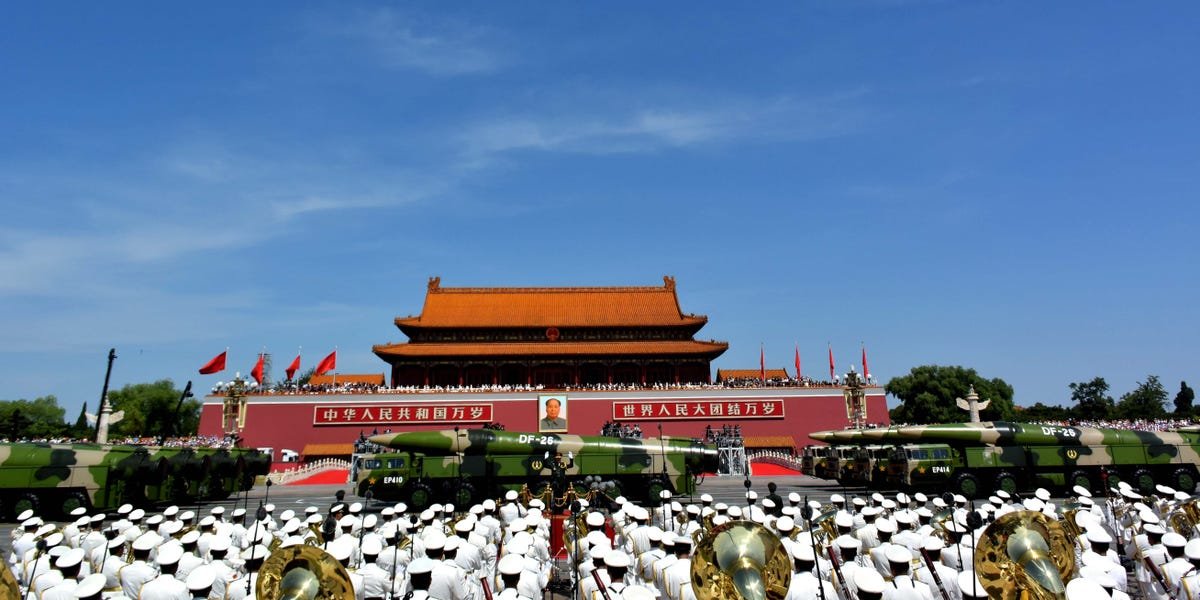
New-Pentagon-maps-show-the-reach-of-Chinas-expanding-missile.jpeg

New Pentagon maps show the reach of China’s expanding missile force

China’s missile arsenal is expanding rapidly, and new maps and data from the Pentagon show its size and reach.

China’s missile branch, known as the People’s Liberation Army Rocket Force, has seen substantial growth in recent years as Beijing builds new platforms for conventional and nuclear strike. Its capabilities threaten US, allied, and partner forces.

The latest Pentagon report on China’s military offers estimates for the number of launchers and missiles in the Chinese arsenal, including the country’s intercontinental ballistic missiles, key parts of its nuclear deterrent.

Chinese ICBMs include missiles like the DF-5 and DF-41. The Pentagon estimates China has 550 ICBM launchers and 400 missiles with estimated ranges beyond 5,500 km, the threshold for classification as an ICBM.


A chart showing the estimated ranges, missile numbers, and launcher numbers based on each system and class of China's missiles.

Estimated numbers of missiles and launchers for Chinese missiles, specifically ground-launched cruise missiles (GLCMs), short-range ballistic missiles (SRBMs), medium-range ballistic missiles (MRBMs), intermediate-range ballistic missiles (IRBMs), and ICBMs.

US Department of Defense


For China’s medium-range ballistic missiles, such as China’s DF-21s or hypersonic DF-17, the Pentagon assesses that China has 300 launchers for 1,300 missiles with ranges between 1,000 and 3,000 km. The report also documented increases in the number of launchers and missiles for some notable systems. China’s intermediate-range ballistic missiles, like the DF-26 missile, jumped from 250 launchers in last year’s report to 300 this year, and the number of IRBMs total went from 500 to 550.

These figures illustrate how heavily Beijing has invested in a powerful, diverse missile arsenal. The Pentagon highlighted in its report that the Rocket Force could play an important role in a Chinese invasion of Taiwan or other regional conflict.

According to the latest report, China’s rocket force “is prepared to conduct missile attacks against high-value targets, including Taiwan’s C2 [command and control] facilities, air bases, and radar sites” as well as deter or delay the US or its allies and partners from coming to Taiwan’s aid.

The Pentagon said that the Rocket Force has continued to rehearse strikes in recent military exercises, including 2024 drills simulating an invasion or blockade of Taiwan.


A map showing missile ranges in the Taiwan Strait.

The estimated ranges of Chinese missiles relevant to a Taiwan fight.

US Department of Defense


One map in the report shows the estimated reach of Chinese missiles that could be particularly relevant in a fight over Taiwan, weapons such as ship- and shore-launched surface-to-air missiles for knocking out hostile aircraft, as well as anti-ship cruise missiles fired from naval platforms like Chinese destroyers and land-based close- and short-range ballistic missiles.

Another Pentagon map shows the estimated reach of China’s conventional strike missiles, including the DF-17 and DF-21 MRBMs, the DF-26 IRBM, and the newly fielded DF-27 ICBM, which, like the DF-26 and some DF-21s, has an anti-ship role in addition to land attack.

Many of these systems can reach across the first island chain, which includes Japan, Taiwan, and the Philippines, while longer-range missiles extend toward the second island chain and beyond.

The DF-26 is concerning for US planners. The weapon, nicknamed the “Guam Express,” can be armed with either conventional or nuclear warheads and reach US installations on Guam. It can target US aircraft carriers and other surface ships as well.

Bombers, like China’s H-6, carrying CJ-20 cruise missiles could threaten parts of Alaska. And then the ICBMs can range significantly further. The DF-27 can, for instance, range parts of the continental United States.


A map showing estimated ranges of Chinese missiles outside of the mainland and towards other regions.

The estimated ranges of Chinese missiles with regional reach.

US Department of Defense


The Department of Defense report also looks at China’s nuclear strike options, such as land-based ICBMs and submarine-launched ballistic missiles.

China test-launched an ICBM, specifically a DF-31B missile, in September 2024, firing it from a position on Hainan Island into the Pacific. The test was the first beyond the country’s borders since the 1980s and allowed China to verify ICBM performance. The Department of Defense suspects weapons tests like these may become more regular.

This year, at a military parade in Beijing, China unveiled new, previously unseen ICBMs, shocking China watchers. Those weapons, including the new DF-61 and DF-31BJ, are not included in the Pentagon’s assessments.

China also continues to bolster its nuclear warhead count, estimated at over 600 warheads. Although 2024 saw a slower rate of production than previous years, the Pentagon still assesses that the Chinese military is on its way to 1,000 warheads by 2030, only a fraction of the US and Russian stockpiles.


A map showing the estimated ranges of China's missiles from Asia over the North Pole.

The estimated ranges of Chinese nuclear missiles.

US Department of Defense


A Pentagon map estimating the ranges of Chinese missiles available for nuclear strike indicates that three — the DF-5, DF-41, and DF-31 — all have the continental US well within range, while the submarine-launched JL-3 missile can hit most of it from waters near China. On a submarine positioned farther out, more targets could be within striking distance.

Despite these continued advancements, questions remain on the differences in quality and capabilities of Chinese weapons and training compared to the US. The Pentagon also believes China is still navigating the impacts of a vast anti-corruption campaign in the military that has particularly targeted PLARF officials.

The campaign could be detrimental if driven by political agendas, or it could deliver long-term improvements if it addresses actual problems within the force. At this point, it’s unclear how the changes will affect it.


Source link