
Photos-appear-to-show-destroyed-US-aircraft-left-in-Iran.jpeg

Photos appear to show destroyed US aircraft left in Iran after special forces rescued a stranded F-15E airman

Several photos appear to show the remains of the turboprop planes and helicopters that US special forces used while rescuing an F-15E weapons system officer stranded in Iran.

The images, which emerged on social media on Sunday evening and were spread by Iranian state media, appear consistent with multiple Western reports that US forces ditched and destroyed the aircraft near the end of the mission.

Some of the photos appear to show wrecked propellers and the nose of at least one turboprop plane.


Aircraft wreckage lies in the open desert.

Two destroyed propellers are visible in this image taken in the desert. 

SOCIAL MEDIA/via REUTERS


It’s unclear exactly when the photos were taken.


Two turboprop plane propellers lie in shambles on the desert sand.

The wreckage appears consistent with the propellers of a turboprop transport aircraft. 

SOCIAL MEDIA/Social Media via REUTERS


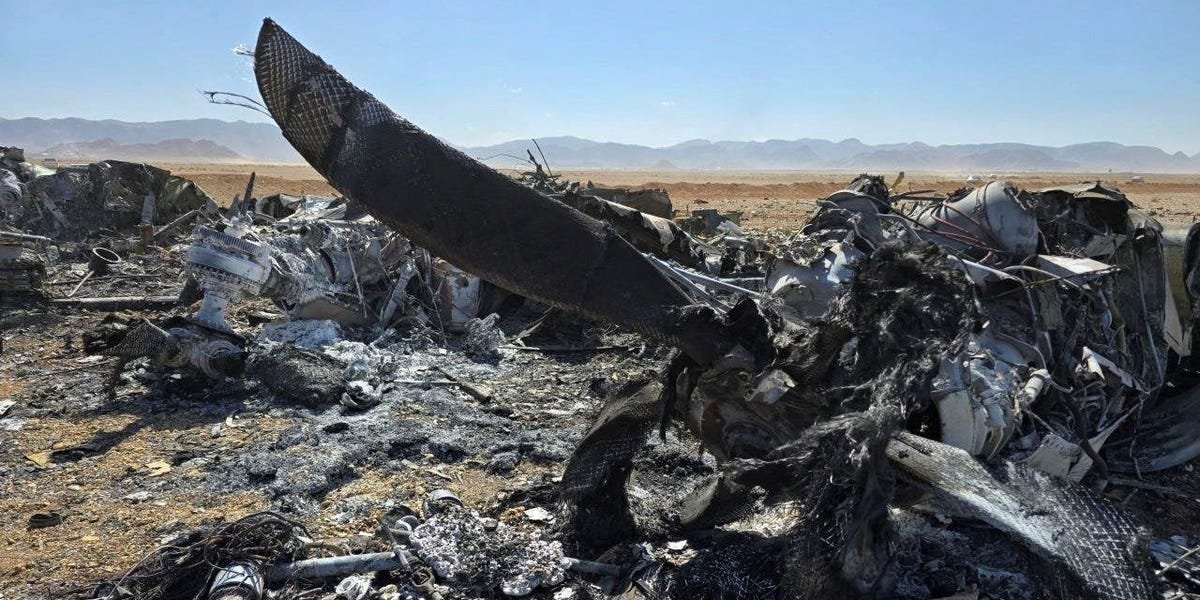
Another image appears to show a destroyed helicopter main rotor that would have been fitted with six blades.


A destroyed helicopter rotor is nestled in the desert sand.

This destroyed helicopter rotor likely had six blades. 

SOCIAL MEDIA/via REUTERS


William Goodhind, an independent open-source investigation researcher, told Reuters that the images appeared to show distinct features of a destroyed Lockheed Martin MC-130.

The medium-sized transport plane, which features four propellers, is based on the C-130 Hercules and used by US special forces, often for exfiltration and infiltration.


Aircraft wreckage sits on the desert sand.

Photos of the aircraft wreckage emerged on Sunday. 

SOCIAL MEDIA/Social Media via REUTERS


Multiple American media reports have said that during the rescue mission, US commandos retrieved the F-15E airman but were unable to take off with two MC-130s from a remote airstrip established in the nearby desert.

To keep the aircraft from falling into Iranian hands, US forces destroyed the planes, instead calling in replacement aircraft to exfiltrate the ground teams, officials told US media.


Metal debris lies in the desert.

This metal debris appears consistent with aircraft parts. 

SOCIAL MEDIA/Social Media via REUTERS


The New York Times also reported that four Boeing MH-6 Little Birds — helicopters with six-bladed rotors used by US forces to fetch the stranded officer from their hiding position — were left behind and intentionally destroyed by American warplanes.

On Sunday evening, President Donald Trump announced that the airman had been rescued, calling the operation “one of the most daring” search-and-rescue missions in US military history.

The weapons system officer was one of two US Air Force service members who ejected from an F-15E Strike Eagle shot down on Friday in Iran, about two days before his rescue.

His crewmate, the F-15E’s pilot, was retrieved separately by US forces several hours after they ejected. Several reports indicated that two search-and-rescue helicopters were hit during the operation to exfiltrate them, but returned safely to base.

The loss of the F-15E marks the first time that a US aircraft was destroyed over Iran since the Pentagon and Israel began Operation Epic Fury on February 28.

Other American warplanes have been lost during the war, however, and several others have been severely damaged. On Friday, an A-10 Warthog crashed in friendly territory after being hit, with its pilot safely ejecting.

Three other F-15s were also destroyed last month over Kuwait, in what US Central Command said was likely a friendly-fire incident involving local air defenses. The six pilots and weapons systems officers ejected and survived.

On March 12, all six crew members of a KC-135 died after the refueling aircraft crashed in Iraq. The US says that at least 13 of its troops have been killed during this year’s combat operations with Iran, with roughly 350 service members also wounded.

Human rights organizations have published differing estimates for casualties in Iran, with rough death tolls last week ranging from 1,900 to 3,500 deaths.




Source link

Matthew Loh Headshot

Video shows US forces destroying some of Iran’s old American-made warplanes

US Central Command released new footage on Wednesday of strikes against some of Iran’s old American-made surveillance and transport military aircraft.

The videos, posted on X, showed a Lockheed C-130 Hercules and a Lockheed P-3F Orion being set ablaze by airstrikes as they were grounded on runways.

It’s unclear when or where the strikes occurred.

The C-130’s frame appears to collapse upon the strike’s impact, with the fuselage separating from its wings in a fireball.

The clips also showed the apparent destruction of an Ilyushin Il-76, a Soviet-designed strategic airlift freighter.

“The Iranian regime is losing air capability day by day,” CENTCOM wrote in its post.

Iran has an aging fleet of C-130E and C-130H transport aircraft, which it acquired from the US before the 1979 Islamic Revolution. Tehran was believed to field about 28 of these turboprop planes, but it’s unclear how many remain after recent strikes on its military assets.

Iran also purchased six P-3F Orion maritime surveillance aircraft before the revolution and was, until recently, believed to still operate five of them. Its air force is also reported to have roughly five IL-76s.

Separate satellite images from Monday obtained by Business Insider also show that several of Iran’s American-made F-14 Tomcat fighter jets — made famous by the film “Top Gun” — were destroyed at an airbase in Isfahan.

The US and Israel have continued to launch strikes against Iran, saying they’ve attacked over 5,500 sites and military assets since February 28.

Many of those strikes targeted Iranian naval vessels, which the US is concerned may threaten the Strait of Hormuz, a vital waterway that services about a fifth of the world’s oil supply. Over a dozen reported attacks on the strait have reduced its traffic to a crawl, sending oil prices briefly spiking over $100.

President Donald Trump said on Wednesday that the war with Iran may end soon and there was “practically nothing left to target” in the country.

“Any time I want it to end, it will end,” he told Axios in a phone call.


Source link

Goldmans-CEO-lays-out-the-3-forces-lining-up-to.jpeg

Goldman’s CEO lays out the 3 forces lining up to make this a breakout year for dealmaking

David Solomon is officially done playing defense.

The Goldman Sachs CEO has steered the bank through several grueling years for the industry, including a multi-year drought in private equity spending and extreme trading volatility. But after a booming 2025, Solomon told investors at a UBS financial services conference on Tuesday that the firm is entering 2026 with the wind at its back.

Solomon praised policymakers in Washington for spurring acquisitive appetites. “You have a massive deregulatory trend in the United States after a very tough regulatory period in the United States, across all industries,” Solomon said.

The receptive comments about the government’s heightened support for M&A came just months after President Donald Trump lashed out at Solomon on Truth Social in August, mocking his former side gig as a DJ and encouraging him to step down from the CEO throne. Trump’s rebuke came after a Goldman Sachs economist suggested that tariff policies could cost consumers.

Despite that dustup, Solomon is now leaning into the administration’s growth-oriented agenda, arguing that the friction of the past has been replaced by a “constructive” new reality for the banking sector.

Here are the three factors Solomon named on Tuesday that have left him feeling bullish about 2026’s dealmaking forecast.

From a ‘no’ to a ‘maybe’

Solomon thinks that, coming off strong results last quarter, 2026 will represent an inflection point for the global mood toward M&A. For the past five years, he said, strategic buyers had encountered a “different regulatory regime,” adding: “Whatever the question was, the answer was no.”

“Now, whatever the question is, the answer’s maybe,” he told UBS Erika Najarian, who hosted the discussion.

That, too, he said, could drive a resurgence in the IPO market, which has been expected to return this year. And in terms of mergers and the kind of corporate dealmaking that is Goldman’s bread and butter, “this could be a top decile” year, Solomon said.

And one major driver he pointed to is cash-rich, asset-heavy private equity sponsors.

The PE gambit

A key pipeline for Goldman has been banking for the world’s top private equity sponsors, many of whom held assets longer than their own investors would like while waiting out a period of lackluster valuations and uncomfortably high interest rates.

That’s left limited partners hungry for capital returns to reinvest in future deals, the secondaries and continuation vehicles markets booming, and banks praying that 2026 is the year that their private equity clients finally indicate they’re ready for action.

Solomon said the pressure for sponsors to return capital to their investors has reached a breaking point.

“We’re reaching a point in time where that unlock” is starting to occur, Solomon said. He pointed to mounting “pressure from the LP community and the cycle life of fundraising has reached a point in time for most of these firms that they can’t get into the valuation debate as much. They’ve got to move forward.”

The downstream effects of AI investments

Solomon has been on a mission to make Goldman AI-ready and has pointed to the massive investment in the space. “The need for capital to continue on this technology cycle is going to have an impact on the overall capital-raising cycle, so I see all this stuff accelerating, and I feel pretty good about it,” he said. He cited mega-tech names that have turned to the debt market to raise liquidity for AI-related projects.

It won’t always be smooth sailing, Solomon conceded, framing Trump’s governing style as something of an open question for markets. “He also has a tendency in policy to move from policy action to policy action,” he said. “I’d still say there’s uncertainty around trade. There is uncertainty around inflation, and there’s uncertainty on geopolitics.”

But, he concluded, “I think the likely outcome in 2026 is we’re going to have a pretty constructive year for capital markets, a pretty constructive year for M&A — particularly large-cap, strategic M&A — and the result of that should be very favorable for the people in this room.”


Source link

A headshot of Insider's Pete Syme

Jet fuel shortage in Cuba forces airlines to cancel flights and send empty planes to pick up passengers

Cuba has warned airlines that it has no jet fuel, forcing some carriers to cancel flights, add refueling stops, or carry extra fuel.

Cuban aviation authorities issued a monthlong advisory on Monday that said jet fuel is unavailable at all of the country’s international airports.

The country relies heavily on Venezuela for much of its jet fuel, but supplies have been hit by US sanctions that have constrained Venezuelan oil exports. President Donald Trump has also threatened tariffs on countries that sell oil or petroleum products to Cuba.

Because of this, the country is running out of jet fuel, and therefore, airlines cannot refuel their planes on the island.

From the US, American Airlines, Delta Air Lines, and Southwest Airlines all operate direct flights to Cuba.

American and Delta said they are operating as usual. In a statement to Business Insider, Southwest said that it was requiring any aircraft flying there to also carry enough fuel to reach its next destination.

Some Canadian airlines are canceling flights entirely.

Air Canada, which had operated 32 flights a week to and from Cuba before, said it would suspend service to the country on Monday.

It will send empty planes to pick up some 3,000 customers who have already traveled to the island. These flights will be loaded with extra fuel, although the airline said refueling stops on the return leg may also be necessary.

Canadian airlines WestJet and Air Transat also said they would operate empty aircraft to help their customers. Air Transat said it would suspend flights to Cuba until at least April 30.

Several international airlines serve Cuba, and many of them are still operating flights. However, some of these will have to stop to refuel elsewhere.

Air Europa, a Spanish airline, said its flights from Havana to Madrid would stop in Santo Domingo, in the Dominican Republic, about two hours away.

“We apologise for any inconvenience this situation, which is beyond Air Europa’s control, may cause you,” it said in a travel alert.

Iberia, the Spanish flag carrier, Air France, and Turkish Airlines also fly to Cuba. They did not immediately respond to requests for comment, although it seems likely the distance would necessitate a refuelling stop.


Source link