Organizational charts show the most powerful people in a company and the structure that links them together.
Using source networks and internal documents, Business Insider’s reporters have pulled together a range of org charts from Fortune 500 companies such as OpenAI, Google, AWS, and Netflix.
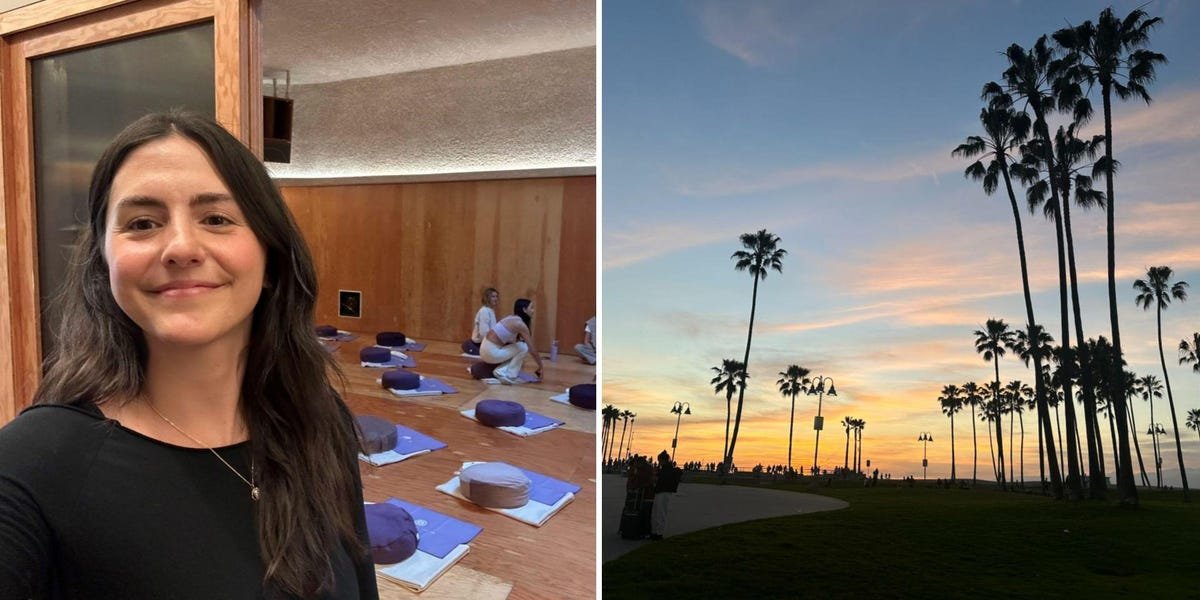
It was a scene you’d expect at a Wednesday afternoon wellness class in Los Angeles. About 40 people with matching athleisure sets, iced matcha lattes, Salomon sneakers, and at least one Fendi baguette filed into a meditation studio tucked in an alley just off the Venice boardwalk.
Toryo Ito, a Japanese Zen Buddhist monk, was already seated at the front of the room. A sculptural, oblong skylight cut into the ceiling, casting a beam of sunlight onto the floor. He sat cross-legged, wearing a black robe, with a set of small tools laid out before him: an incense holder, a spray bottle, and various blocks and mallets made with metal or wood.
Ito is the vice abbot of Ryosokuin Temple in Kyoto, which dates back over 600 years. His modern approach to Zen has made him something of an ambassador for mindfulness in the corporate world, leading meditation workshops for companies like Meta and Salesforce.
Marc Benioff, Jack Dorsey, Alex Karp, and other business and tech leaders have embraced mindfulness practice. Meditation apps have raised hundreds of millions in funding, and companies are increasingly offering programs to employees to combat burnout and improve performance.
As a business reporter living in California, the wellness capital of the US, my prior experience with meditation mostly consisted of adding it to the list of habits I’d like to start each new year, and then proceeding to complete a handful of five-minute sessions sporadically, primarily as a means to squeeze in a little sun time before a full day at my desk. Maybe a class with a real-life Zen monk would be just the motivation I needed.
What I’d actually find was that my concept of meditation was way off and that it’s a lot simpler — and more attainable — than I’d made it out to be.
Meditation does not mean thinking about nothing
The class was held at the Venice studio of Open, a mindfulness startup, and organized by Tatcha, a luxury skincare brand whose founder has her own corporate-to-mindfulness origin story. Vicky Tsai worked on Wall Street as a credit derivatives trader before quitting to start Tatcha. She met Ito in 2016 during a class at his temple in Japan. He became the company’s first-ever “global well-being mentor” in 2021.
Toryo Ito sat still and at ease while most of us fiddled with our phones.
Kelsey Vlamis
Attendees — Tatcha fans who had signed up for the class through their socials — took photos of the room and spoke quietly to one another. Some set up cameras to record themselves. One attendee took an especially aesthetic flat-lay shot of her Tatcha-branded mat and towel alongside her purple shoulder bag, which matched perfectly.
I was immediately struck by the contrast between Ito and the rest of us.
Ito sat erect but calm, doing nothing. Sometimes he looked around the room and smiled. Other times, he looked ahead or softly closed his eyes. He didn’t fidget. Meanwhile, the rest of us were on our phones, taking photos, scrolling, anything but simply sitting still.
After about 10 minutes, the room quieted, and all attention shifted to him.
He welcomed us and asked if anyone had been to Kyoto, seeming surprised when a good chunk of the room raised their hands. He said Zen emphasizes two concepts: mindfulness and expanding the boundary of the self in order to dissolve it.
Ambitious, I thought, but intriguing.
Ito said that while there’s no perfect meditative state, we should focus on paying attention. The class was broken into three rounds of meditation, each lasting 10 minutes, give or take, during which we sat in silence with our eyes closed.
For the first session, he told us to pay attention to what we heard and smelled: the chime he rang to start the session, the birds chirping on the nature soundtrack playing in the studio, the air conditioner kicking on, the sound of a spray bottle, and the earthy smell that followed. He rang another chime at the end of the session, which felt like it flew by as I tried to focus on my senses.
For the second session, he told us to focus on the sensations in our bodies and had us lift one arm, hold it in place, then the other. Lastly, he asked us to meditate on a series of questions related to self-love: What color do you associate with self-love? “Light pink,” I thought. What drink? “Sparkling water.”
It was more involved than I expected. I thought the point of meditation was not to think about anything. What Ito taught me was that it’s actually about noticing.
“Intentionally disrupt that autopilot,” Ito told me after the class, adding that he prefers dynamic meditation, like walking, where you can feel the grass beneath your feet.He said he’d spent time earlier that day walking through Venice Beach.
The Open studio was a short walk away from the Venice boardwalk.
Walter Cicchetti/Getty Images
For people with high-stress jobs, Ito said meditation can be practiced in small moments throughout the day, for 10 minutes or even just one. He recommends lighting incense and actually paying attention to the smell. When you drink coffee, notice the taste.
Doing these little practices of just noticing things you previously missed can bring the benefits of mindfulness, which he said include stress management, increased creativity, and openness to new ways of thinking.
Small moments of noticing
When the class ended, the first thing I noticed was how different the attendees seemed.
There was a newfound stillness that had previously been missing, and very few immediately reached for their phones. We sat in silence, no one rushing to get up, as several people shared how they felt with the whole class.One busy mom said she felt “at peace.”
I did not become a perfect meditator that day — although Ito would likely say there’s no such thing — but what I learned was that I actually meditate, or practice mindfulness, more than I realized.
Each time I take a walk without headphones and notice the smell of jasmine. Or when I’m camping and zone out in front of the fire, doing nothing but observing the movement, warmth, and sound of the flames.
Which also might explain why, after each of these experiences, I feel some of the benefits that ancient wisdom and modern science have associated with meditation: lower stress, better sleep, and an overall sense of calm.
Since the class, I’ve been a bit more lenient with myself about what counts as meditation, which has helped me prioritize and appreciate these small moments of noticing.
The idea of noticing the taste of your coffee as a mindfulness practice might feel a bit silly. Then again, it’s a bit silly that I’ll weigh and grind my own beans, pull espresso in my expensive machine, and drink it in front of my computer, without even noticing once I’ve finished.
Director Carl Eric Rinsch made so many failed, seven-figure option bets after Netflix wired him $11 million that his broker at Wells Fargo tried — and failed — to stop him, a New York fraud jury heard on Tuesday.
“I can afford to lose the money,” Rinsch said, according to testimony by his former Wells Fargo advisor, Ronald See.
And when the brokerage hit the brakes — limiting him to $250,000 per transaction — the show developer was undaunted.
On March 30, 2019, just three weeks after receiving the $11 million, Rinsch instructed See, of Wells Fargo Advisors, to wire his remaining $8.5 million to Citibank so he could establish a new brokerage account with Charles Schwab.
“They won’t put restrictions on me there,” Rinsch wrote See in a letter shown to jurors.
Rinsch, 48, is on trial in federal court in Manhattan, fighting charges that he had no right to use the $11 million Netflix sent him on anything other than “White Horse,” the 120-minute TV series he’d already spent $44 million of Netflix’s money on. (Rinsch ultimately never finished a single episode of the clones-versus-humans sci-fi thriller.)
Defense lawyers counter that the $11 million was actually Rinsch’s contractually-promised payment for having completed principal photography, and was his money to spend as he pleased.
Either way, testimony on Tuesday by two of Rinsch’s former financial advisors showed that he was eager to spend the cash prosecutors say the director had quickly moved into his Wells Fargo account.
The streamer wired Rinsch the $11 million on March 6, 2020, as the COVID-19 pandemic halted film production worldwide.
Over the next three weeks, he then lost some $5.8 million, almost all of it on highly risky options trades involving Gilead Sciences, which was developing COVID-19 treatment drugs. (See would earn a $22,000 fee on these losses, the defense pointed out on cross-examination.)
The director was off to the races again as soon as he switched to Charles Schwab, according to testimony.
“I could send $3 mm personal to get started,” he wrote to his new financial advisor, Adam Checchi, who also testified on Tuesday.
“I understood that to mean three million from his personal funds,” Checchi said under questioning by a federal prosecutor.
Checchi told jurors that Rinsch would soon lose almost $6 million more, mostly on failed, highly risky bets that Gilead’s stock would rise and that the S&P 500 would decline.
“I’m not a broad, diversify kind of guy,” Rinsch explained in a late March 2020 email, adding that he pursues “aggressive” option trading “fully expecting to lose it all.”
Earlier in the day, former Netflix executive Peter Friedlander, who on Monday called Rinch’s project “visionary,” completed a second day of testimony.
On overhead screens, defense attorney Benjamin Zeman showed Friedlander — and the jury — emails from August 2019, in which Rinsch begged for “immediate support” with casting in Brazil.
“Show is set to collapse,” Rinsch wrote.
The defense is blaming the implosion of White Horse on Netflix’s decision to pull support for the project in September 2020.
In the email chain projected throughout the courtroom on Tuesday, Zeman attempted to show jurors that a year earlier, Friedlander was already cold toward the show developer’s requests for help.
“His own delays in decisions have caused this,” Friedlander wrote in forwarding Rinsch’s email to Mike Posey, an original series vice president, and others, including production executive Shelley Stevens and Rahul Bansal, an original series director.
Rinsch would continue asking for support — and money — for another six months before Netflix forwarded the $11 million payment at the center of the trial. The project was ultimately written off by Netflix as a tax loss eight months later, in November 2020.
Rinsch’s trial is expected to continue through next week. He faces up to 90 years in prison if convicted of wire fraud, money laundering, and engaging in unlawful monetary transactions.