Steve Jobs was 21 when he cofounded Apple in 1976. Mark Zuckerberg was 19 when Facebook launched. Whitney Wolfe Herd was 25 when she unveiled Bumble.
Many of today’s startup founders are still young and scrappy. And in the age of AI, they’re even more empowered to barrel ahead.
Some are following the footsteps of tech titans before them and dropping out of college. Others are opting out of the undergraduate experience altogether, with a few ditching high school to pursue careers in tech.
Arlan Rakhmetzhanov, founder of AI coding startup Nozomio, told Business Insider that he dropped out of high school in Kazakhstan after getting accepted into the competitive startup accelerator program, Y Combinator (YC). At the age of 18, he raised $6.2 million for Nozomio.
Rakhmetzhanov isn’t the only teenager finding success in AI. There’s also Toby Brown, a UK teen who raised $1 million for his AI project. There’s also Zach Yadegari, the teenage cofounder of Cal AI, a nutrition app.
College-aged founders are also building companies and raising capital, such as the Yale students behind Series AI, a new social networking startup.
Alyx van der Vorm (25) and Faraz Siddiqi (23) both raised capital for their startups this year.
Kevin Farley; Muhammad Anjum
The median age for YC participants is now 24 years old, compared to 30 in 2022, YC’s Pete Koomen told The New York Times in August.
Business Insider has interviewed the founders of 12 startups who are 25 years old or younger and have raised millions in funding since 2024 about the pitch decks they used to impress investors.
Read 12 pitch decks founders who are 25 years old or younger used to raise millions:
Note: Founders were 25 or younger when Business Insider published the following articles.
Series A
Seed
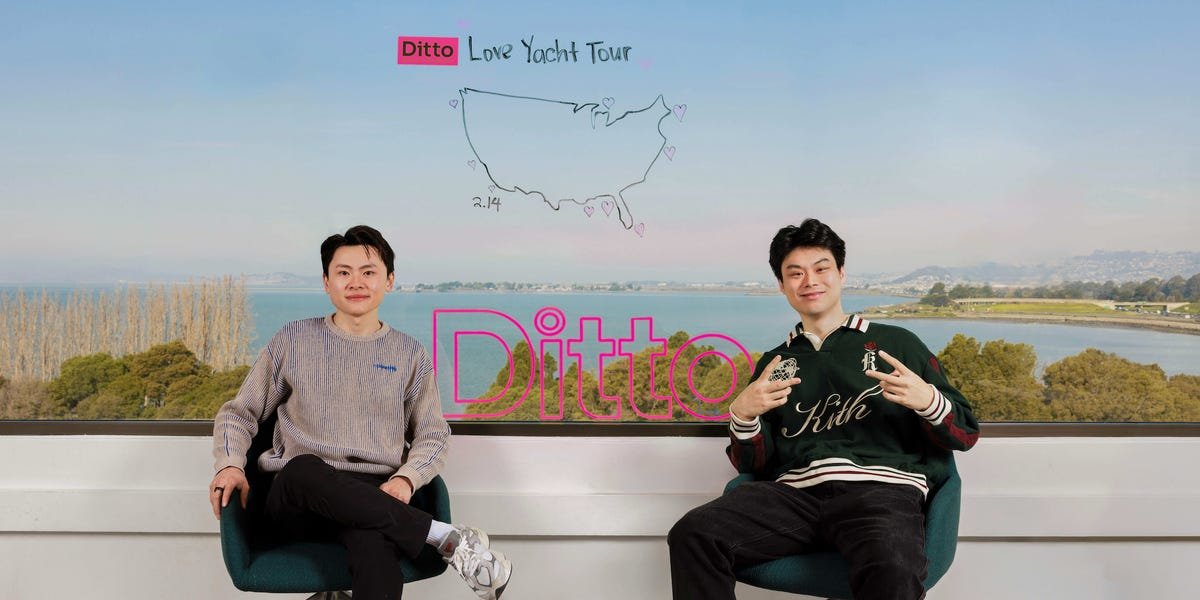
Ditto, an AI dating startup founded by UC Berkeley dropouts, raised $9.2 million when the founders were 23 and 24. Read its 12-page pitch deck.
Lyra, an AI video call startup, raised a $6 million seed out of YC when its founder was 23. Read the 8-slide pitch deck it used.
Nexad, an AI adtech startup, raised a $6 million seed after wrapping up A16z’s Speedrun accelerator. Nexad’s CEO was 25. Read the 10-page pitch deck.
Orange Slice, a YC-backed sales tech platform, raised $5.3 million when its founders were 23. Read the 7-page pitch deck.
Golpo, a generative AI video startup, raised a $4.1 millionseed out of YC when its founders — who are also brothers — were 19 and 20. Read its 7-page pitch deck.
Bluejay, an AI agent startup, raised a $4 million seed coming out of YC when its founders were 23. Read its 9-page pitch deck.
Novoflow, an agentic AI startup building tools for medical clinics, raised $3.1 million when its founders were 18 and 19. Read its pitch deck.
CodeFour, an AI police tech startup, was founded by two 19-year-old MIT dropouts and raised $2.7 million coming out of YC. Read the pitch deck.
Cerca, a dating app that connects people with mutual friends, raised a $1.6 million seed when its CEO was 23. Read the 10-slide deck.
Pre-seed
Series, an AI social networking startup, raised a $3.1 million pre-seed when its founders were 21.
This story has been updated with additional examples.
For the past three years, AI has been mostly a cost-cutting tool. A growing number of founders and investors are trying to move beyond that era.
The next chapter of AI, they argue, will be defined by new kinds of products — apps, games, companions, and services that simply couldn’t exist before large language models. They call it AI’s “Second Wave.”
“The first wave of AI made existing things cheaper. Automation. Efficiency,” said Kylan Gibbs, a former Google DeepMind product manager who runs AI startup Inworld. “The next wave makes things that couldn’t exist before. New products. New experiences. New revenue. That’s the difference between optimizing spend and creating it.”
For Gibbs, that distinction is existential. If AI merely trims costs, it reshuffles value within existing businesses. If it enables entirely new consumer products — ones people will pay for — it expands the economic pie.
“AI reaches its real economic potential when it creates value consumers want to pay for, not just value businesses want to save,” he wrote on LinkedIn. That next phase, he says, requires a new “consumer-scale AI stack”: real-time responses under 300 milliseconds, support for millions of users simultaneously, and deeply personal experiences tailored to individual preferences.
Every time Alistair publishes a story, you’ll get an alert straight to your inbox!
Stay connected to Alistair and get more of their work as it publishes.
Kylan Gibbs, CEO and cofounder of Inworld.
Inworld
In January, Gibbs launched a Silicon Valley accelerator to back up to 30 “Second Wave” AI startups — companies building new consumer experiences rather than bolting chatbots onto old workflows. Venture capital firms, including Khosla Ventures and Lightspeed Venture Partners, are involved, alongside leaders from OpenAI, Google, and Stripe. A demo day will take place in early March in San Francisco.
The philosophy echoes a recent post from Y Combinator CEO Garry Tan: “Instead of worrying about doing the same thing we’ve been doing for cheaper, why not focus on doing the thing we never even dreamed of doing?”
A handful of startups already embody that ethos.
Particle brings news for the AI era
Sara Beykpour, CEO and cofounder of Particle.
Sara Beykpour
Sara Beykpour, CEO and cofounder of Particle, says the tech industry is in a liminal moment.
“We’re in a transition between the first wave and the second wave,” she said.
The first wave delivered massive productivity gains. At Particle, an AI-native news platform, tasks that once took a month can now be built, tested, and deployed in hours.
“We actually call each other out in meetings when someone falls into the old way of thinking,” Beykpour said. “We jokingly call it ‘boomer thinking,’ even though we’re all millennials.”
That shift in mindset gives the startup more time to focus on unlocking new AI-powered formats. Particle recently launched Podcast Clips, a feature that embeds the most relevant snippets of long-form podcasts directly into news stories. Instead of hunting through a three-hour episode, users see curated clips attached to specific topics.
“It changes the information hierarchy,” Beykpour said. “Instead of having to find the podcast you want to listen to, we’re bringing the podcast to you based on the most relevant parts.”
Under the hood, the system uses AI embeddings to map relationships between transcripts and stories. A clip from a talk show about Greenland and Davos, along with comments from President Donald Trump, can be automatically linked to relevant reporting. Generative AI then layers summaries and context on top.
These AI embeddings “have gotten much better in important ways,” Beykpour told Business Insider in a recent interview.
AI can be a ‘super-motivator’ in fitness
CTO Creston Brooks (left) and CEO Alexis Sursock (right), cofounders of Luvu.
Luvu
If Particle reimagines news, Luvu reinvents personal training using generative AI.
Launched in August 2025 by CEO Alexis Sursock and CTO Creston Brooks, the AI-powered fitness app has already attracted about 250,000 users. The app features an AI “marshmallow” that acts like a personal trainer, sending highly personalized notifications and real-time feedback.
“The key is the personalization, which is powered by AI models and wouldn’t have been possible before this technology appeared in recent years,” Brooks said.
Instead of generic reminders — “It’s time for your workout” — Luvu tailors messages. If a user logged that they had a test yesterday, the app might follow up with, “Your test is over. Time to work out!”
The results are striking. Luvu’s notification click rate is four times that of typical non-personalized prompts. In an industry where only 2% to 3% of users remain active after 30 days, Brooks said, Luvu claims retention rates that are two to three times higher.
The app offers three motivational styles: supportive, neutral, or “meaner marshmallow.” Behind the scenes, Luvu also uses AI for granular, one-to-one messaging crafted by LLMs.
The company is also experimenting with reinforcement learning with verified rewards, a relatively new technique for training and improving AI models.
Users can prop their phones against a surface and record themselves exercising; the app uses computer-vision models to verify whether squats or other moves are performed correctly, offering real-time corrections like “Straighten your knees.” These verified signals feed back into the system, helping train what Brooks envisions as a future “super-motivator” model.
This isn’t just a chatbot layered on top of a fitness tracker. It’s a feedback loop between human behavior and AI, something that couldn’t easily exist before the advent of modern models.
Status helps you live your dream life online
Fai Nur, CEO and cofounder of Status.
Status
For Fai Nur, CEO and cofounder of AI-powered social simulation game Status, the Second Wave is about imagination.
“Status could not have existed before LLMs,” she said.
The app, which has surpassed 3 million downloads, lets users role-play in AI-generated social media worlds. Think The Sims, though played out as a living, breathing social feed.
Users can cast themselves as anything they can imagine, such as Hogwarts students, soccer stars, or characters from “Stranger Things.” Post an update, and AI-generated characters instantly reply. Events unfold dynamically: miss a penalty kick, and face the backlash. An AI system assigns an “aura score” to grade responses and level players up or down.
In many enterprise settings, the non-deterministic nature of LLM outputs is a liability. Generative AI models sometimes respond to the same prompt in different ways, which doesn’t lend itself to applications that require strict accuracy.
In gaming, this can be an asset because each new AI-generated response can be new, creating a richer, more varied experience.
“You haven’t been able to role-play like this until now,” Nur said.
Before LLMs, creating immersive fandom worlds required persuading other humans to participate. Now, entire social universes spin up instantly.
For Gibbs and other proponents of AI’s Second Wave, that’s the point. The technology’s future won’t be defined by incremental cost savings, but by products that feel native to AI — experiences that surprise, motivate, inform, and entertain at consumer scale.
If the first wave made businesses leaner, the second may make everyday life stranger, richer, and more interactive — and, crucially, something people will pay for.
Sign up for BI’s Tech Memo newsletter here. Reach out to me via email at abarr@businessinsider.com. Note: Axel Springer, the parent company of Business Insider, is an investor in Particle.