
I-moved-to-France-after-falling-in-love-with-it.jpeg

I moved to France after falling in love with it during summer visits. Nothing could’ve prepared me for living here full-time.

I’m originally from the Bahamas, but my love for France began while working there as an English language camp counselor every summer from 2011 to 2014.

Year after year, I fell more in love with the country — and, soon, the seed of a plan to live here began to sprout its roots. In August 2015, I finally packed my bags and made my dream of living in France a reality.

However, no amount of prior experience coming here for short spurts could’ve prepared me for moving to France and actually living there.

I underestimated how tough navigating the language barrier would be


Woman with hands in air smiling on stone path with flowers, building behid her

I wish I’d learned more French before I moved.

Nicole Bedford


Living in a foreign country can be a daunting shock to the system when you don’t speak the native language.

I knew my French being limited to phrases like “hello” and “thank you” would put me at a disadvantage — but I still wasn’t prepared for the frustration I’d feel and the judgment I’d get for being no better than a toddler trying to communicate.

Once I arrived in Rennes, where I’d chosen to move, it became clear to me English was not prevalent, and that I would need to navigate all my administrative procedures with limited French.

To navigate day-to-day transactions, such as opening a bank account, I used Google Translate to create a script. It was challenging, but I managed to get things done.

This experience taught me to never underestimate a language barrier or assume you can rely on English abroad — not even in big cities.

As a word of advice, if you plan to move to France or any country where you do not speak the native tongue, be sure to take classes in that language for six months to a year before you go.

Doing so will help you navigate day-to-day life and ensure a more seamless integration — especially when navigating the paperwork and administrative tasks that come with moving.

The slower pace of life has been nice, but it took me a bit to adjust to shops’ limited hours


Woman smiling at vineyard

It’s been nice getting to relax more often.

Nicole Bedford


Europe is known for having a slower-paced lifestyle than much of North America. However, I still couldn’t believe how relaxed my day-to-day life became after I moved — or how quickly I was able to get used to it.

My first summer living in France without having to work the whole time was the most surprising. During August, entire businesses close for summer holidays and cities feel emptier as locals go on vacation for two or three weeks at a time. It was refreshing.

I’ve grown to really appreciate how the French know how to relax and enjoy life. However, it did take me a little longer to get used to shops here having limited hours.

Businesses like pharmacies, grocery stores, clothing shops, and even private clinics often close before or just after sunset throughout France — even in many major cities.


Woman sipping from mug in front of Le Scoop

I’ve learned to check the hours on a business before I check it out.

Nicole Bedford


A lot of businesses are also closed on Sundays, as it’s meant to be a countrywide day of rest.

This was a bit jarring since I come from a country where many stores are open late for convenience — some are open 24/7, seven days a week.

However, I’ve since learned how to plan accordingly and mark which errands are time-sensitive on my to-do list.

Ultimately, though, this experience reminded me that no amount of research can prepare you for moving to a new country. There will always be surprises around the corner — but, for me, moving here has been worth it.


Source link

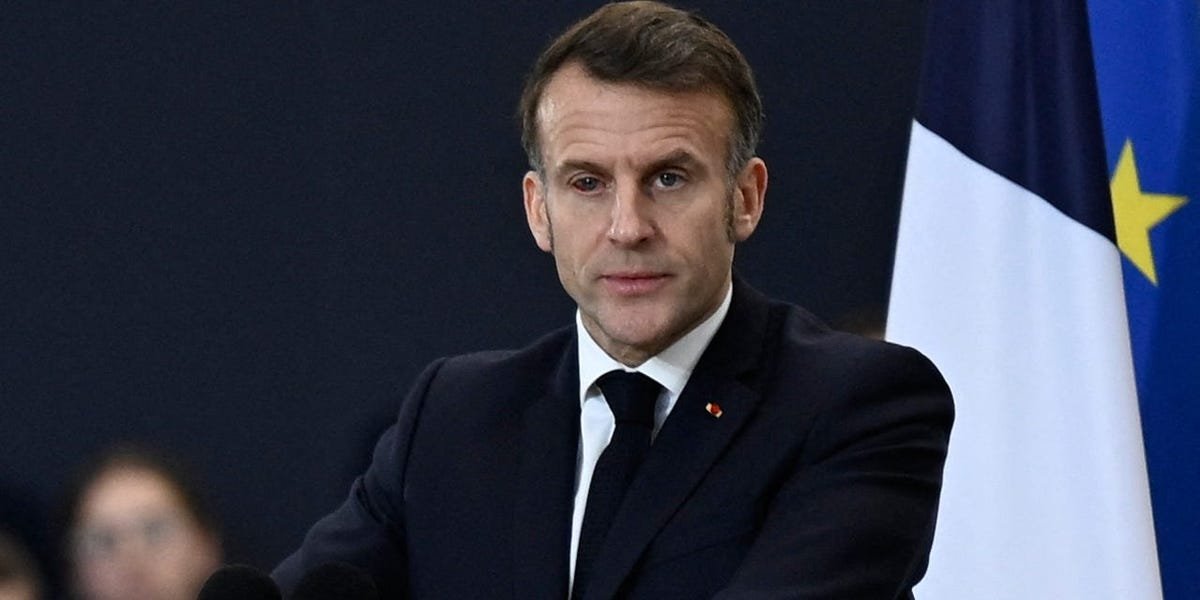
Macron-said-that-Ukraine-now-gets-two-thirds-of-its-intelligence.jpeg

Macron said that Ukraine now gets ‘two-thirds’ of its intelligence from France, not the US

French President Emmanuel Macron said on Thursday that his country has now overtaken the US as the main provider of intelligence to Ukraine.

“Where Ukraine was overwhelmingly dependent on American intelligence capacity, a year ago, two-thirds is today provided by France. Two-thirds,” Macron said in a New Year’s speech to the French military.

The French leader’s comments indicate a shift in the dynamics of Western contributions to the war and suggest that the US may have scaled back its military relationship with Ukraine.

The US briefly suspended intelligence-sharing and aid to Ukraine in March 2025, as the Trump administration was attempting to negotiate a ceasefire between Kyiv and Moscow. After roughly a week, Washington said it was lifting the suspension.

But it’s been unclear so far whether the Pentagon has continued to provide intelligence at the same level as it did during the Biden administration.

The New York Times previously reported that, in those years, US-Ukrainian intelligence-sharing ties had been so close that officials from both countries worked in the same facility to coordinate military strikes.

One of the most vital roles played by US intelligence at the time was providing targeting data and situational awareness for Ukrainian troops, especially when the latter were using American-made systems for the attacks.

Ukraine has since been trying to develop its own strike capabilities, including long-range precision missiles, that might allow it to strike Russia without Western approval.

It’s also unclear exactly how Macron quantified two-thirds of Ukrainian intelligence capabilities. His speech did not say whether he was referring to two-thirds of the intelligence provided by Ukraine’s foreign partners or to two-thirds of all the intelligence used by Ukraine’s forces.

The Élysée Palace and French defense ministry did not respond to requests for comment sent outside regular business hours. Ukraine’s defense ministry and the Pentagon have also not responded to similar requests for comment on Macron’s remarks.

The French president’s point on intelligence-sharing with Ukraine aligns with his larger push to position Paris as a regional military leader, while the Trump administration seeks to curb American involvement in Europe. President Donald Trump has also recently rattled European leaders by alluding that the US could try to take over Greenland, a Danish territory.

Macron said on Thursday that France had helped Ukraine to rebuild its forces and provided Kyiv with security guarantees in the event of a ceasefire.

Last week, European NATO members and the US issued a declaration that said willing countries would form a multinational, “European-led” force to provide “reassurances” to Ukraine and stave off a second Russian invasion or attack.

“The signal sent to our Ukrainian partners, to other Europeans, and to the world is that we are ready,” Macron said. “We are ready to sustain this effort of resistance. We are ready to deter new aggressions or to maintain peace on our soil.”


Source link

I-moved-to-France-8-years-ago-The-first-few.jpeg

I moved to France 8 years ago. The first few months were filled with challenges and surprises — especially at work.

In 2017, I quit my job as a paralegal, packed up my life in England, and bought a one-way ticket to Paris.

The new chapter was full of surprises, and though most of them were positive, I was in for some unexpected challenges in those early months — from navigating the notoriously tricky French bureaucracies (and supremely unhelpful bureaucrats operating them), to the weird and wonderful world of the Parisian soirée.

However, the strongest culture shocks came in the workplace, and even now, after eight years in France, I still find aspects of French office culture surprising.

Adjusting to French social norms was harder than expected


Woman standing in front of eiffel tower at dawn

Many traditions in France differ from what I’m accustomed to back in England.

Jodie Hughes


Getting to grips with office etiquette was my first major challenge — and the most urgent to overcome. I was starting a completely new role, in a completely new company, barely three days after arriving in France.

My title was still paralegal, but even there, my remit couldn’t have been more different. To say I had a steep learning curve ahead of me would be an almighty understatement.

I had, at least, anticipated some difficulty addressing people correctly, but that didn’t make my (frequent) blunders any less embarrassing.

In French, there are certain words for “you” and different versions of verbs depending on the level of politeness/deference needed. The rules around who you “tu” and who you “vous” feel nebulous at best — and a total minefield for a (foreign) new recruit.

Meanwhile, social norms I wasn’t expecting included greeting everyone who joins you in an elevator, and then wishing them a good day/evening when they/you leave. (People do this in medical waiting rooms here, too. I still haven’t gotten used to it.)

In England, people mostly awkwardly avoid eye contact at all costs in these situations. And if you do accidentally acknowledge someone else’s existence, at the very most, you offer them a tight (also awkward) smile.

You absolutely do not, under any circumstances, talk to them.

Mealtimes are sacred here, and I couldn’t believe the food — or bubbly — on offer in my office


Woman smiling in front of Seine river with lit up boats at night

In France, I’ve found that it’s not uncommon to pop open some bubbly at work.

Jodie Hughes


It didn’t take me long to realize just how seriously the French take enjoying the enjoyment of mealtimes.

Even my office cafeteria felt like a foodie’s dream with a rotating menu of things like duck, salmon, and paella; desserts hand-crafted by a professional pastry chef; fresh bread from the local boulangerie; and literal mounds of cheese

My lunches were so heavily subsidised by my employer that, unless I wanted a three-course meal or a glass of wine (a girl’s got to treat herself occasionally), they were almost always free.

And, yes, it’s apparently perfectly acceptable to have an alcoholic drink in the middle of the workday in France.

I also quickly learned that mealtimes, like baguettes, are sacred in this country, both for socializing and for savoring.

It’s frowned on to eat at your desk, scarfing down a sandwich while you work (I’m looking at you, England). Here, you sit down around a table, and you enjoy your food.

Accordingly, a two-hour lunch break is also customary; The French are often baffled as to what you’re supposed to do with “only” an hour.

My colleagues use their breaks to take or teach classes, exercise, or enjoy a leisurely meal in a restaurant — none of which had ever been possible with the 30 to 60 minutes I’d grown used to back home.

Remember how I said it was acceptable to have a drink with lunch?

Apparently, it’s also acceptable to have a drink before lunch, after lunch, and at essentially any time of the day, if there’s even the smallest occasion to celebrate.

I was served more champagne in my first two months in the office than I had been, cumulatively, in my entire life until that point.

One time, several bottles were opened for a colleague’s going-away breakfast at 11:30 a.m. It was tough going, but I adapted to this particular culture shock as uncomplainingly as I could …

My new vacation allowance changed my life


Woman standing next to blue water at Côte d'Azur

In France, I’ve had more paid vacation time than ever.

Jodie Hughes


Another early discovery was that work-life balance is everything in France.

The culture of competition I’d experienced in England — the peculiar bragging over who was arriving at the office earliest and leaving latest (read: burning out fastest) — was completely absent.

Leisure time feels ferociously protected here, to the extent that employees legally have the “right to disconnect” (ignore job-related calls and emails outside work hours) and the French are not shy about enforcing their rights.

Additionally, when I was informed of my vacation allowance, I was sure I must have mistranslated something: I had over five weeks of annual leave in my first year, and that’s not including the 11 public holidays.

In France, workers are generally required to take at least two consecutive weeks’ vacation. These breaks often falls between July and August, and swaths of employees disappear for an entire month.

It’s quite a contrast to the situation I’d left behind in England, where taking two weeks’ vacation in a row was considered a real extravagance. This is perhaps unsurprising, given I was never entitled to more than four weeks total annual leave.

That means everything pretty much grinds to a halt in the summer — pretty inconvenient when you’re in the middle of a project and all your colleagues are OOO until September.

But it also opened my eyes to just how life-changing that kind of balance can be, and has been one of the most incredible parts of relocating to France.

Adapting to such starkly different workplace norms from the ones I’d known in England has been a real roller-coaster ride — but there have definitely been plenty more ups than downs.

Ultimately, the experience has been as enjoyable as it has been surprising. Champagne, anyone?


Source link