I-gave-up-my-corporate-job-to-travel-full-time-and.jpeg

I gave up my corporate job to travel full-time and live in other people’s homes for free

A few years ago, I was working a traditional 9-to-5 corporate management job in the San Francisco Bay Area.

After nearly a decade in my field, I had a car, a home, emergency savings, and no debts to pay off. I’d done everything “right” and accomplished things many strive for, but I wasn’t completely satisfied.

Then, in 2022, I left my job, booked a one-way flight to Italy, and began traveling full-time. What I thought would be a short break turned into over two years of seeing new countries while living entirely off my savings.

I kept thinking, “When am I going to get tired of constantly moving around … and how can I extend this lifestyle until that time comes?”

In an effort to stretch my savings further and extend my travels, I started house-sitting.

House- and pet-sitting has helped me keep traveling and stretch my savings


Woman smiling with cat

By 2022, I wanted something different for my life. 

Alanna Parrish


I came across the idea to house-sit while looking for ways to travel more economically. In return for looking after someone’s home while they are away, I get a place to stay.

For me, this felt like an amazing trade and a way to avoid paying for hotels or rentals. Sometimes, I’m also paid for these gigs — especially if pet-sitting is involved.


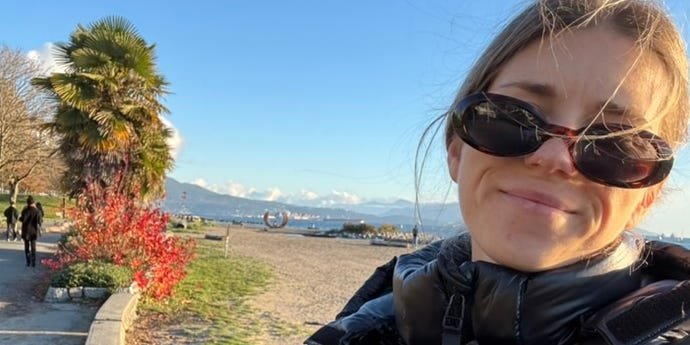
Woman smiling taking selfie while holding

I’ve watched homes and pets in many different cities. 

Alanna Parrish


Once I started, I expanded my network through travel, and I discovered a high demand for house-sitters, not only in the United States but also outside of it.

So far, I’ve watched pets and homes in more than 15 different cities, including some international ones.

I’ve woken up to ocean views in Honolulu; explored the food scene in Santa Fe, New Mexico; biked along Chicago’s Gold Coast; and discovered hidden-gem cafés throughout Greenpoint and Fort Greene, Brooklyn.

I love the freedom that comes with this lifestyle and the connections I’ve made


Woman smiling with cat on her shoulder

A lot of my house-sitting gigs involve watching pets. 

Alanna Parrish


Many people’s biggest living expense is rent or housing, but I don’t have to worry about budgeting for those. I try to line up my sits so that I don’t often need to pay for hotels or rentals, either.

This has completely changed the way I live. I love the freedom that this life brings, not only financially but also emotionally.

Since I’m staying in actual homes and often for longer periods, I’m better able to explore different cities and neighborhoods the way locals do, rather than as a tourist passing through.


Perosn holding e-reader, coffee, on sunny balcony

It’s been nice experiencing some neighborhoods as a local. 

Alanna Parrish


I get to meet homeowners from all over the world who’ve been incredibly generous and welcoming, often going above and beyond to make sure I feel at home in their space.

Building these relationships with the homeowners and their animals has been such an amazing part of this experience. I take it very seriously that people are trusting me to live in their spaces and care for every home and pet as if they were my own.

It’s not always easy to live this way, but I’m enjoying it


Woman standing in front of columns and arches

Before I started house-sitting, my life looked very different from how it looks now. 

Alanna Parrish


This lifestyle is not for everyone. I live out of a suitcase and often don’t know where I’m going next.

I am constantly planning where I will be living and how I’m going to get there. Sometimes I am booked months in advance; other times, I am figuring things out a few days before or dealing with last-minute cancellations.

The uncertainty can be stressful, but the trade-off has been worth it for me in the end.

These days, I work remotely while juggling paid sits and free ones so I can keep traveling. I don’t know when I’ll settle down and stay in one place again.

For now, this lifestyle fulfills my desire to explore, connect with others, and discover new places. And I still have a list of cities that I would love to visit — both in the United States and internationally.

Whether I see them through house-sitting or not, I don’t see myself slowing down anytime soon.


Source link

I-visited-Polymarkets-free-grocery-store-It-was-more-impressive.jpeg

I visited Polymarket’s free grocery store. It was more impressive than Kalshi’s similar stunt.

  • Polymarket launched a limited time grocery store pop-up in the West Village. I checked it out.
  • Attendees could take as many groceries as they could fit in a Polymarket tote bag.
  • Compared to Kalshi’s grocery pop-up, Polymarket’s seemed more planned out and polished.

Free groceries in New York? It feels like an impossibility — and yet, I saw it twice in two weeks.

It’s all thanks to a good old-fashioned marketing battle.

Prediction markets Polymarket and Kalshi are in a two-week grocery war, both propping up short-term free supermarket stunts in New York. Last week, Kalshi took over a Westside Market for a day. On Thursday, Polymarket debuted its own store.

I stepped inside the store two hours before it officially opened as part of a press preview. The store was pristine, unmarked by the what I assume would be the rampant foot traffic that would soon occupy it.

It looked like a miniaturized Trader Joe’s.

The experience also seemed more planned out than Kalshi’s similar marketing stunt. While Kalshi took over an existing supermarket for one day, offering $50 in free groceries, Polymarket designed its own pop-up scheduled to be open for five days (though free groceries will only be available on three of those days — more on that later).

Polymarket is also accepting community donations for local charities, and donated $1 million to Food Bank for NYC.

I came out impressed — even if it was a week behind its competitor. Here’s what I saw.

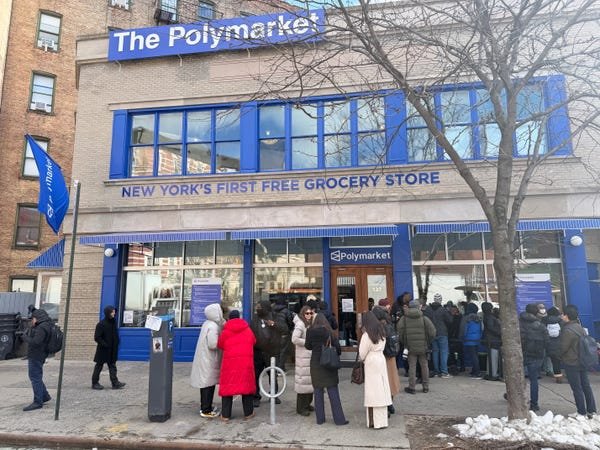
The West Village has a new pop-up.

The Polymarket flag waved in the wind of a warm(ish) winter day.

Henry Chandonnet/Business Insider

I arrived at The Polymarket (get it?) at 11:30 a.m., a half hour before the originally planned opening time of noon. (The company later pushed it back to 2 p.m., confusing some attendees.) The front of the shop was a circus of organizers, media, and everyday rubberneckers.

New York establishments love to call themselves the “first” or the “best.” Is The Polymarket really New York’s “first free grocery store”? Likely not, especially if you count the hundreds of food pantries across the city.

One attendee, Milla Jackson, arrived at 7:30 a.m.


Milla Jackson is pictured waiting in line for the Polymarket

“I looked through the window, and I saw they had some good products,” Jackson said.

Henry Chandonnet/Business Insider

I chatted with some folks in line, including Milla Jackson, a school aide from Staten Island. On hour four of her wait, she was grateful for her warm winter jacket.

Jackson heard about the pop-up in the newsletter “NYC for Free.” She spotted some olive oil inside that she was excited to pick up.

“I just found out about Polymarket,” she said. “I looked it up last night. I’m like, ‘Oh, I definitely want to show up.'”

Victoria Plaza arrived at 11 a.m.


Victoria Plaza is pictured in line for the Polymarket.

“I can’t imagine it will be sustainable for more than four days,” Plaza said.

Henry Chandonnet/Business Insider

Victoria Plaza was around Grand Central Terminal when Polymarket announced the location on social media. She expected that those ahead of her had been in the neighborhood.

The financial planning advisor came mostly out of curiosity. What would she take inside? “Whatever I can carry,” she said.

The Polymarket team was keeping everyone warm.


A staffer hands out cups of hot chocolate to those waiting in line for the Polymarket.

Polymarket staff handed out hot chocolate and coffee.

Henry Chandonnet/Business Insider

At 34° and sunny, Polymarket got lucky with a nicer opening day than Kalshi. They also handed out hot drinks (which Kalshi had) and put up heat lamps (which Kalshi did not have).

One of the day’s oddities: a painted-over sign.


A man is pictured painting over the Polymarket logo.

Why were they painting over the Polymarket logo?

Henry Chandonnet/Business Insider

A few minutes before making it inside, a man stationed his ladder on the front door and began painting over one of the Polymarket signs. No one seemed to know why.

The store’s schedule was pasted on a window.


A schedule for the Polymarket is pictured.

The Polymarket’s schedule included a Valentine’s Day celebration.

Henry Chandonnet/Business Insider

For those seeking out free groceries, Polymarket will offer them up on Thursday, Friday, and Sunday. Those days also have community donation hours.

Saturday is Valentine’s Day, when The Polymarket will have a “community celebration” with free flowers and cards. Monday is the final day for donations.

Inside, the first thing I noticed was a disclaimer.


A sign at the Polymarket demonstrating that we are being recorded is pictured.

Nestled behind a basket of Kind bars was a reminder that we were being filmed.

Henry Chandonnet/Business Insider

Inside the store, there were several framed notices that our movements would be filmed. It was a reminder: as much as The Polymarket is about free groceries, it’s also about a marketing stunt.

“Take what you need” (that can fit in a tote bag).


Free tote bags are pictured at the Polymarket.

How much can you take from The Polymarket? As much as fits in a tote bag.

Henry Chandonnet/Business Insider

No, you can’t roll up to The Polymarket with a huge trash bag and clear off all the shelves. There are unsurprisingly some limits.

At Kalshi’s pop-up, it was a cost ceiling: no more than $50 worth of goods. At the expensive Westside Market, $50 meant only a few items.

At The Polymarket, it’s a constraint of physical space. Attendees get one branded tote bag and can leave with as much as it will fit.

Offerings were limited but classic.


Boxes of pasta and jars of tomato sauce are pictured at the Polymarket.

The Polymarket had both regular and gluten-free pasta.

Henry Chandonnet/Business Insider

The Polymarket focused on pantry staples. Oil, rice, seasonings, peanut butter, beans, the list goes on. There were no fancy premade meals, like at the Kalshi pop-up.

I also noticed more branding at Polymarket’s pop-up than at Kalshi’s. Here’s a digital sign advertising Polymarket above the gluten-free pasta. The flowers were wrapped in Polymarket-branded tissue.

There was a lot of fresh produce.


Produce is pictured at the Polymarket.

Produce filled bins on the floor and fridges in the back.

Henry Chandonnet/Business Insider

Carrots, avocados, bell peppers, you name it. The Polymarket put produce front and center. They looked idyllic in their wooden crates — though I’m not sure how long that sheen will last after the public opening.

Polymarket can’t escape the hype bro reputation.


Prime energy drinks are pictured at the Polymarket.

Spotted: Logan Paul’s energy drink.

Henry Chandonnet/Business Insider

The Kalshi grocery store was swarmed with crypto influencers and online betters. While that crowd hadn’t yet arrived at The Polymarket from what I could see, there were some signs of an overly online presence. The fridges were stocked with Logan Paul’s Prime Energy, for example.

Kerrygold? In this economy?


Kerrygold butter is pictured at the Polymarket.

Polymarket shelled out for their butter choice.

Henry Chandonnet/Business Insider.

Most of the items in The Polymarket were fairly low-cost, though they all had name brands. One exception: the butter. Kerrygold is expensive! I was surprised to see a fridge full of them, ready for the taking.

One thoughtful touch: socks.


Socks are pictured at the Polymarket.

The Polymarket had cleaning products and tampons.

Henry Chandonnet/Business Insider

Socks are often the most requested items at homeless shelters. That’s especially true in the cold, cold winter. It was a nice touch to see a shelf full of them.

Why The Polymarket felt more thoughtfully designed than Kalshi’s grocery pop-up.


A sign on the Polymarket is pictured.

“This one’s on us!” a sign at The Polymarket promised.

Henry Chandonnet/Business Insider

Leaving The Polymarket, I thought it was better planned out than Kalshi’s pop-up.

Where Kalshi had unlimited options but a tight overall budget of $50, I felt The Polymarket was more tailored to what people might want from a free-grocery stunt in the winter months. I found the staff was generally friendlier, and the whole thing was a bit less confusing. The emphasis on donation also made it feel less like a shiny corporate branding exercise.

Even Mayor Zohran Mamdani, a fan of affordability but not prediction markets, seemed to begrudgingly applaud Polymarket’s move.

Who knows what will happen over the next few days, as The Polymarket opens. Maybe the shelves will run dry. Either way, Polymarket seemed to know what it was doing at the jump.

Plus, the heating lamps were a nice touch.


Source link

Influencers-convinced-me-I-needed-to-build-an-igloo-for.jpeg

Influencers convinced me I needed to build an igloo for my kids. The results made this snow day bearable, and it was free.

Years ago, we bought a geodesic climbing structure for my three kids, who were all under 5. We thought it would keep them entertained all year long without our supervision, but the reality could not be more different. The structure sat untouched through the seasons.

On Sunday, while preparing for the massive snowstorm that was headed toward Maine, Instagram fed me a reel of a couple building an igloo with the same climbing structure we have. I sent it to my husband, who came running from the room next door and said, “We have to do this!”

It turned out to be a hit with the kids, and it was surprisingly easy to pull off.

We used sheets to make it eco-friendly

The video I watched showed the first step to making the igloo is wrapping the perimeter of the climbing structure tightly with plastic wrap.


Man covering structure with a sheet

The author used bed sheets instead of serenwrap.

Courtesy of the author


We opted for a more eco-friendly option and decided to use king-size bed sheets. My husband had the idea to soak them in water first so they wouldn’t blow away in the strong wind as we were prepping the igloo. We soaked them in a tub and carried them outside quickly. The temps in Maine were in the teens, so we had to drag the sheets across the climbing dome quickly. I was actually surprised at how quickly the sheets hardened in the cold air. We just wrapped the ends of the sheet around a pole and didn’t need anything else to secure it in place.

We covered the entire structure, leaving one small triangle so the kids could crawl in and out of it, and had the rest of the dome totally covered.

I didn’t want to get my hopes up

We had tried something similar years earlier, and the sheets never hardened enough to stay on the dome. I didn’t want to get my hopes up this time around, so we left the sheets and walked over to a friends’ house to play before the snow.


Kids inside a climbing dome

The author had low expectations for the results.

Courtesy of the author


We were back home when the storm had already started, and we could see snow accumulating on the dome. I really wanted to check on it regularly because I was worried the weight of the snow would collapse the igloo’s roof. But I’m from Argentina, and I don’t do well in negative temperatures, so I let it be and decided to check it in the morning.

We woke up to tons of snow and a perfect igloo

We got absolutely dumped with snow overnight; it was the biggest snowstorm I’ve experienced since moving to Maine 6 years ago. And to my surprise, the igloo worked.


Woman inside igloo

The igloo turned out to be great for everyone.

Courtesy of the author


Immediately, my kids were excited to climb inside, even exclaiming that it was way warmer in the igloo than outside it. They called over friends and neighbors, and they all played inside the igloo while I worked and my husband snowblowed around our house.

It’s the first time that I copied something from a viral reel or TikTok video, and it really paid off. And the best part is that it costs us nothing.

Next time we get a snowstorm warning, I at least know which sheets to pull out ASAP so we can start building quickly.


Source link

Major-airlines-are-making-it-free-to-change-travel-plans.jpeg

Major airlines are making it free to change travel plans ahead of a huge winter storm

Major airlines are making it free to change your flights ahead of a dangerous winter storm.

Southwest Airlines, American Airlines, United Airlines, and JetBlue are waiving rebooking fees for flights to and from affected regions this weekend.

If your travel plans this weekend include major cities such as Dallas, Austin, Oklahoma City, Nashville, Atlanta, Charlotte, Washington, DC, Baltimore, Philadelphia, New York City, and Boston, you may want to contact your airline to avoid prolonged delays or cancellations at the airport. The National Weather Service is warning that more than 230 million Americans will be affected, from the Southwest to New England.

Even if you won’t change your plans, your flight may still get canceled. Delta Air Lines said Thursday it is canceling flights at airports in Texas, Oklahoma, Arkansas, Louisiana, and Tennessee, citing safety concerns caused by heavy snow, sleet, and freezing rain. The airline will also be bringing in cold-weather specialists.

As of Thursday evening, based on the Misery Map, which tracks real-time flight disruptions, there hasn’t been a spike in delays or cancellations.

Based on recent storms, such as the one that hit over Thanksgiving and coincided with the end of the government shutdown, mass cancellations may be inevitable. So it’s good to know your passenger rights and your options when things don’t go according to plan.

Know your rights as a passenger


A passenger checks the flight board at Boston airport.

Opt in to automatic flight updates via text or email so you don’t miss a flight delay or cancellation notification.

JOSEPH PREZIOSO/AFP via Getty Images


If your flight is canceled and you choose not to rebook, the airline is legally required to provide you with a cash refund — not a voucher or credit.

However, things are different for delays. The Trump Administration recently killed a proposal that would have required airlines to compensate passengers for long delays, so flyers largely have to rely on airline goodwill or their credit cards to get anything for the inconvenience.

Some airlines have committed to providing accommodations, transportation, and food during a controllable overnight delay or cancellation, as outlined in the Airline Customer Service Dashboard.

Controllable disruptions include issues such as maintenance or crew staffing. Frontier Airlines is the only carrier that does not offer accommodations in the event of a controllable overnight delay or cancellation, but it will provide a meal voucher.

It still doesn’t hurt to ask for a meal or hotel voucher when a non-controllable issue arises, such as the weather. The worst they can say is no.

Use your airline’s mobile app to change or cancel your flight


United mobile app.

Most airlines also offer a chat function if you prefer to text.

United Airlines


During disruptions, airlines often allow you to make changes via their mobile app or website, rather than waiting on clogged phone lines or in long customer service lines.

If this isn’t an option, try an online chat. Carriers like Delta Air Lines allow you to text a representative for help.

You can put yourself in the virtual queue and wait in line at the airport, potentially upping your chances of speaking with an agent sooner.

Here are the phone numbers for each airline:

  • Alaska: 1-800-252-7522 or text 82008
  • Allegiant: 1-702-505-8888
  • American: 1-800-433-7300
  • Avelo: 1-346-616-9500
  • Breeze: No phone number to call, but you can text the airline at 501-273-3931.
  • Delta: 1-800-221-1212
  • Frontier: No phone number. The best way to contact Frontier is via online chat or email.
  • JetBlue: 1-800-538-2583
  • Southwest: 1-800-435-9792
  • Spirit: 1-855-728-3555
  • Sun Country: 1-651-905-2737
  • United: 1-800-864-8331

Check if you have travel insurance through your credit card


Passport and Chase Sapphire Reserve credit card

Some travelers rely on their travel credit card to recoup costs during non-airline-controlled flight delays.

Evgenia Parajanian/Shutterstock


Travel credit cards, such as the Chase Sapphire Reserve and the American Express Platinum, offer built-in insurance that reimburses travelers for hotel, meal, and transportation expenses incurred due to certain flight disruptions.

The weather is typically covered. For this to work, the traveler would have needed to book their flight with that travel card.

If your credit card doesn’t offer travel insurance, it may be worthwhile to purchase a separate trip insurance policy before traveling. This type of insurance can help reimburse costs you might lose due to flight problems, such as prepaid hotel stays or cruise bookings.

However, you must purchase this insurance before any travel disruptions occur — once you know a flight might be affected, it’s likely too late.


Source link

A-Ford-worker-heckled-Trump-His-suspension-is-a-reminder.jpeg

A Ford worker heckled Trump. His suspension is a reminder that free speech can get you in trouble at work.

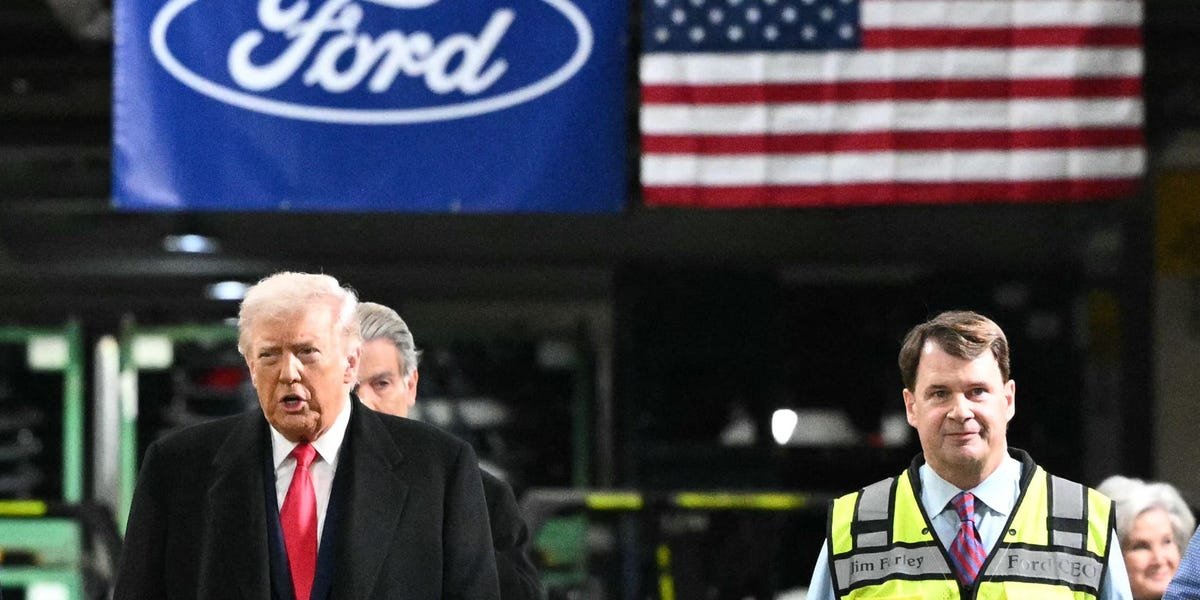
Hours after President Donald Trump toured a Ford pickup truck assembly plant, the big news story wasn’t about manufacturing jobs or the economy. It was about a Ford worker who heckled him and was later suspended.

The incident raised questions about the limits of free speech in the workplace — and when companies can discipline workers for political protest.

Business Insider spoke to five experts, including four employment lawyers and an HR executive, to find out.

Their conclusion was blunt: an employee’s words can quickly become fireable offenses.

‘An employer has the ability to discipline an employee for speech’

All four lawyers said workers retain legal free speech rights under the Constitution, but those rights rarely protect speech in their workplace.

“With very few exceptions, employees in the private sector don’t have free speech rights at work,” Mark Kluger, a co-founding partner at New Jersey-based law firm Kluger Healey, told Business Insider.

Jessica Childress, a managing attorney at Washington, DC-based The Childress Firm, said workers often confuse who the First Amendment actually applies to. The best way to think about it, she said, is to divide government action from a private company’s authority.

“The First Amendment’s right to freedom of speech only applies to government actors, not private employers, such as Ford,” she said. “A private company can — with certain exceptions — limit what their employees say.”

That distinction has played out in real-world cases before.


Juli Briskman, a former government contract worker, wearing a white shirt and riding a bike as a motorcade passes on her left. She makes an obscene gesture at the line of black cars.

Juli Briskman, a former government contract worker, was fired from her job after a photograph lensed her flipping off Trump’s motorcade.

BRENDAN SMIALOWSKI/AFP via Getty Images


In 2017, Juli Briskman, a former marketing analyst for a government contractor, was fired from her job after professional photographers caught her giving Trump’s motorcade the middle finger.

Even though her action happened outside of the office, her lawsuit against her employer was tossed.

“Employers are legally allowed to regulate behavior that disrupts the workplace,” said Jared Pope, an employment law attorney and CEO at Work Shield. “That is why most organizations apply their codes of conduct consistently, even when speech happens off the clock or references public figures.”

Still, lawyers said workers generally have more protection if they express their political belief off-the-clock.

“If you are so inclined to protest, do it off-duty, off-premises, and off-company networks,” Eric Kingsley, a partner at Kingsley Szamet Employment Lawyers, told Business Insider. “An employer has the ability to discipline an employee for speech in matters of politics when it becomes misconduct.”


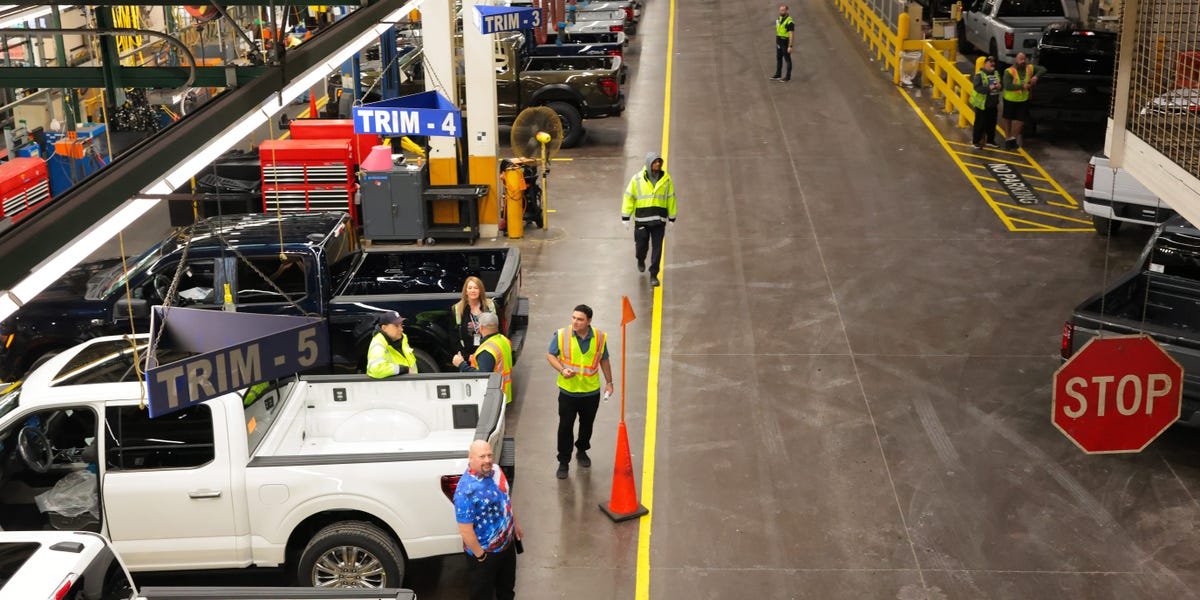
Inside an factory where several white Ford F-150 pickups are rolling down the assembly line.

Ford decided to suspend the worker initially, not fire them. The UAW said it’s looking into the situation, while Ford said it doesn’t comment on personnel matters.

JEFF KOWALSKY/AFP via Getty Images


Why Ford likely suspended — not fired — the worker initially

Each lawyer we talked to said that Ford was well within its rights to suspend the employee, T.J. Sabula.

In fact, some said the automaker may have displayed restraint by not outright firing the factory employee after the decision.

“It implies Ford is buying time,” Kingsley added. “Suspending the employee gives them a chance to investigate and make a decision that may not be as rash as laying off an employee.”

On Wednesday, the United Auto Workers, the union representing the workers in Sabula’s plant, confirmed his suspension. Sabula, who has said he doesn’t regret heckling Trump and is set to receive over $800,000 in crowdfunded support, has not responded to requests for comment from Business Insider.

Laura Dickerson, a vice president for the UAW, said the union was reviewing Ford’s actions and said workers “should never be subjected to vulgar language or behavior by anyone — including the President of the United States.”

The union also said Sabula “believes in freedom of speech, a principle we wholeheartedly embrace, and we stand with our membership in protecting their voice on the job.”

Ford declined to comment on the suspension, saying it was “a personnel matter.”

“Ford is navigating a high-profile, politically charged moment,” Lauren Winans, CEO of the HR consulting firm Next Level Benefits, said. “The union’s involvement likely influenced Ford’s decision to suspend (not fire), because unilateral termination could lead to grievances and arbitration.”

For workers wondering if they can get fired for speaking their mind at work, Kluger made it clear the answer is yes.

“Try telling your boss what you really think of them and see how long you remain employed,” he said.

Do you think Ford should fire the employee? Let us know by taking our survey:


Source link

Ford-is-so-desperate-for-mechanics-its-giving-some-of.jpeg

Ford is so desperate for mechanics it’s giving some of them free tools and Carhartt gear

America is running low on mechanics, electricians, and plumbers.

Ford thinks it can help solve the problem by getting younger workers under the hood of its new pickup trucks, enticing them with free Carhartt gear and tools.

The automaker and 137-year-old workwear brand told Business Insider they’re launching a multi-year partnership to address what both call a looming workforce crisis.

The partnership aims to train thousands of blue collar workers, a bet that the two Detroit-based brands can reinvigorate America’s manual labor pipeline.

The partnership includes three main components: opening a ToolBank USA location in Detroit that will lend 25,000 tools annually to workers and volunteers, outfitting Ford’s auto tech scholars with free Carhartt workwear, and launching a co-branded products for the public.

Ford is also donating an F-150 to ToolBank to extend the program’s mobile reach. The two companies declined to disclose the financial terms.

The partnership comes as Ford CEO Jim Farley has warned that America will face a critical shortage of skilled tradespeople within five to ten years. The company calls these workers the backbone of the “essential economy.”

For Ford, the deficit is top of mind, as the company needs thousands of auto technicians to staff its dealership service bays. Right now, the company says it has 5,000 open positions at its dealerships, including six-figure technician jobs.


Jim Farley, Ford's CEO, speaks at the company's inaugural Pro Accelerate event.

At Ford’s inaugural Pro Accelerate event, CEO Jim Farley said the US sat at a critical juncture for blue-collar employment.

Bill Pugliano/Getty Images


“The problems with the essential economy are problems for all of us,” Farley said in September at Ford’s inaugural workforce development summit, which convened industry leaders and policymakers to address the trades pipeline crisis. “We stopped investing in the trades. If Henry Ford saw what has become of us, I think he’d be kind of mad.”

In a phone interview with Business Insider, Mary Culler, the president of Ford Philanthropy, said part of Ford’s mechanic pipeline issue is a perception problem.

Ford’s current vehicle lineup includes advanced driver-assist systems like backup cameras, lane monitors, and autonomous features — making today’s auto repair roles far more technical than traditional mechanic jobs.

“People we talk to tell us, ‘I didn’t realize it wasn’t the greasy job I expected,'” Culler said. “People don’t understand that it’s a very high-tech job, it’s a very computer-intensive job.”

Ford Philanthropy has been offering $5,000 scholarships to trade- school-level technicians through TechForce Foundation, a third-party nonprofit that provides scholarships for skilled trades education. Now, participants will also receive head-to-toe Carhartt gear, including pants, shirts, and vests.

Student applicants must prove they’re studying the auto technology industries to be eligible.

“Some of this work is put in the philanthropic realm,” Culler added. “But this is a business imperative for the future of the economy and our country. We really need to close this gap on these skill trades.”

So far, the program hasn’t yet kept pace with Ford’s needs. The company has trained 1,400 technicians through TechForce since 2018 — filling less than a third of its current 5,000 open positions in seven years.

But recent jobs numbers show there is growing interest in the sector, according to LinkedIn data released last year. Half way through the year, many of the fastest-growing job titles for young workers were blue-collar, like construction workers, electricians, and mining workers.


A yellow Ford Mustang, used during NASCAR races, is displayed before a race.

Ford representatives said their workforce training programs could get perspective job-seekers onto its NASCAR teams.

Kevin Abele/Icon Sportswire via Getty Images


For mechanics, cost can be another barrier, as mechanics typically need to buy or rent their own thousand-dollar toolkits.

Culler said Ford provides wraparound support including tool kits and transportation to training facilities. The automaker is also working to expand participants’ sense of career possibilities beyond traditional dealership roles.

“We’ve taken some of the scholars to F1 and Nascar races to show them that it might not be a dealership where they end up working,” Culler said. “You could work for a race team.”

For Carhartt, the partnership serves dual purposes: recruiting workers for its Kentucky and Tennessee manufacturing facilities, and cultivating what it hopes could be lifetime customers. Someone who starts wearing Carhartt gear at age 20 as a Ford tech scholar could be a customer for the next 40 years.

Carhartt doesn’t require four-year degrees at its plants and has partnered with organizations like the National Center for Construction and Engineering Research to connect high schoolers with trades careers.


Linda Hubbard, CEO of Carhartt, speaking at Ford's Pro Accelerate summit.

Linda Hubbard, Carhartt’s CEO, is also worried about the state of the US blue-collar worker pipeline.

Bill Pugliano/Getty Images


“To me, it’s a bigger calling to amplify people who wear Carhartt,” Linda Hubbard, CEO of Carhartt, told Business Insider. “You might start out as a laborer in the trades, but you could end up owning your own business. I see a lot of these folks working their way up from the field into management into CEO positions.”

Hubbard said she wants Carhartt outfitting those workers throughout their careers, from first day at the repair shop, to their last day running their own companies. Ford, meanwhile, hopes those same workers choose its trucks as their daily drivers for decades.

The commercial partnership will extend to consumer products too.

Carhartt will launch Ford co-branded apparel, while Ford will unveil a Super Duty Carhartt edition truck. Both arrive in the back half of 2026 — the companies declined to share pricing or additional product details.

Both brands are betting their Detroit heritage and cultural cachet can make trades careers more appealing to younger workers.

“We’re raising the perception and elevating the importance of these jobs,” Culler said. “But there’s a real gap. We know there’s a real crisis.

“Carhartt is super cool, we think Ford is super cool. Hopefully we can get the younger generation to recognize this is a real opportunity.”


Source link

This-company-gives-away-free-trips-and-luxury-cars-to.jpeg

This company gives away free trips and luxury cars to its top employees every year

Companies are getting creative with rewarding standout workers, but few are giving out $170,000 luxury cars or cruises to the Bahamas.

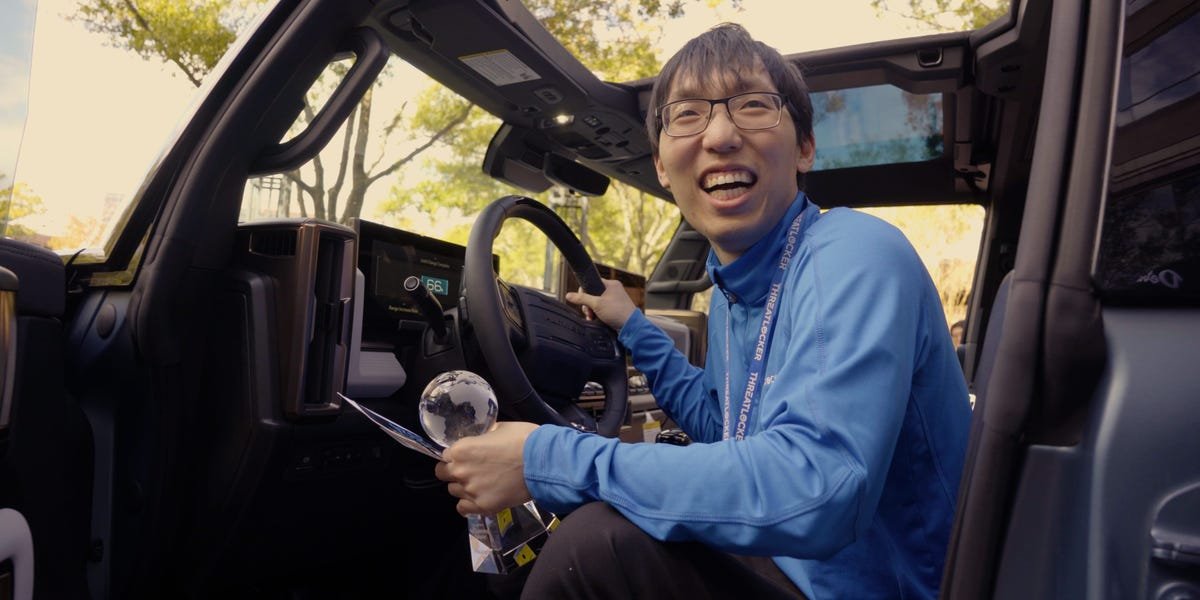
ThreatLocker, an Orlando-based cybersecurity firm with about 700 employees, gives luxury cars to its two most collaborative workers at its annual holiday party, the company told Business Insider.

The firm, which also has offices in Dublin, Dubai, and Australia, receives hundreds of votes each month for the two most helpful employees — one in the US, and one abroad. It flies in its international workers in for the holiday party.

Additionally, every manager votes for the best performer on their team that month. At the end of the year, the total votes for the top performer and the most helpful employee are combined to determine the two car recipients, the company said.

The firm usually awards an electric model, but has also handed out a $125,000 Porsche Panamera. The company hasn’t announced its car for this year yet, but told Business Insider one of the models is worth $173,000.

The tradition began in 2021 as a prize for the top performer, but CEO Danny Jenkins said it created a “dog-eat-dog” work environment. In the cybersecurity industry, teamwork is crucial to the company’s success, he said. Jenkins said the firm operates 24 hours a day with an average pick-up time of 23 seconds for any customer support issue, and colleagues need to work together to achieve that.

“Everything we do is with this matter of urgency,” Jenkins said. “So if you don’t have this teamwork where people are willing to get on a call at 2 a.m. in the morning and help each other and collaborate, then it doesn’t work.”

Jenkins said he works about 100 hours a week, and he keeps his phone on 24/7 in case issues arise.

Retaining the top

AI development has led to a boom in the cybersecurity industry, resulting in heightened demand for qualified talent. Jenkins said the company has never done layoffs and is currently hiring 40 to 50 people a month.

“I’d like to be in a situation where I don’t feel like we’re drowning because we’re constantly struggling to hire and onboard people fast enough,” said Jenkins.

That makes it all the more worthwhile to retain top talent and those who contribute to a strong culture.

He said that before the car winners are announced, between 14 and 16 runner-ups are honored in front of the company, and then offered a spot on a fully paid long-weekend getaway.

Jenkins said the trip has included a Royal Caribbean cruise to the Bahamas, as well as trips to Boston or New York. The group typically includes employees from various departments, and they all receive a spending budget of $2,500 on their trip, he said.

ThreatLocker also offers other perks to standout employees. Jenkins said that most employees work 40-hour workweeks, but sometimes teams may have to put in 18 or 19 hours straight to address an issue. Jenkins said when workers push through tight deadlines or go above and beyond, the company may reward them with court-side seats at games in the Orlando Kia Center, where the company has a permanent box.

Jenkins said the trip and car giveaway have bolstered employee success and that no car recipient has ever left the company.


Source link