

Bradley Saacks

Citadel and Millennium posted gains in a choppy February as Balyasny and Jain Global slipped

Ken Griffin’s Citadel performed across the board in February.

The firm’s five strategies that feed into its flagship Wellington fund — fundamental equity, quant, commodities, fixed income and macro, and credit and convertibles — were all up last month, a person close to the Miami-based manager told Business Insider.

The fund was up 1.9% on the month, bringing its 2026 gains to 2.9%.

The firm, which managed $66 billion at the start of February, notched gains of 1.5% in February in its tactical trading fund, which blends the firm’s fundamental stockpickers with its computer-run equity portfolios.

Michael Gelband’s ExodusPoint, which had its best year on record in 2025, was up 0.9% last month, a person close to the New York-based firm said. The manager is now up 2.6% for 2026. Millennium is now up 2% on the year after a 0.6% gain in February.

It was another banner month for Asia-based multistrategy funds. $6 billion Dymon Asia made nearly 5% in February, bringing its 2026 gains to more than 10%, while Pinpoint Asset Management is up 6.6% for the year in its flagship fund.

The stock market was down on the month, as the S&P 500 index gave back some of the gains it had notched in January. The broad sell-off in software stocks, driven by AI releases, hurt blue-chip companies like Salesforce.

There were a few multistrategy managers that ended the month down. Balyasny lost 0.4% on the month, though is still positive for the year. Walleye had its second straight down month in February, and is now down 1.4% in 2026. Jain Global lost money again in February and is down 2.2% on the year.

This month has already been volatile thanks to the strikes against Iran by the US and Israel on Saturday. Oil prices have surged, and stocks tumbled on Monday.

Firms mentioned in the story and the table below declined to comment.

This story was originally published on March 2 at 10:22 a.m. New figures have been added to the table below as they have been learned.



Source link

Thibault

China’s AI push is about spreading economic gains, not enriching tech giants, a finance CEO says

Open source — that might be the clearest signal of how China wants artificial intelligence to reshape its economy.

Hisham Alrayes, the group CEO of Bahrain-based GFH Financial Group, said China is prioritizing open models and broad deployment to spread AI’s gains across the economy, instead of funneling them to a few tech giants.

Speaking at a Davos panel on China’s “AI+ Economy” strategy on Wednesday, Alrayes said the country’s approach reflects a fundamentally different economic philosophy.

“You look at the open structure of the China AI philosophy — then you have the non-open structure,” Alrayes said. “That signals that the benefit they want to see is to trickle down into the economy, into the companies.”

Open source as economic strategy

China’s most prominent AI breakout, DeepSeek, reflects that philosophy.

It mostly uses open-source models that have drawn global attention, in contrast to many large US language models that remain closed and proprietary, reaping the benefits of tightly controlled commercial ecosystems.

Meta’s former chief AI scientist Yann LeCun, has said that a key reason behind DeepSeek’s success is its open-source model, which, he said, can outperform proprietary models in terms of efficiency and innovation by building on shared research.

Meanwhile, former Google CEO Eric Schmidt has said that China’s open-source AI models could gain an edge globally because they’re free, making them more attractive than costly proprietary US systems for governments and countries that can’t afford closed models.

Similarly, Alrayes said, China — in pursuing the open model — is aiming for affordability and scale.

“It’s not the benefit of that company, of that product, the return of that individual. It’s not an individual — it’s an economy,” Alrayes said.

That philosophy is reflected in China’s national “AI Plus” action plan, which prioritizes diffusion, said fellow panelist Gong Ke, executive director of the Chinese Institute for New Generation AI Development Strategies at Nankai University.

The policy, he said, focuses on embedding AI across manufacturing, healthcare, finance, education, and other sectors, rather than on breakthroughs such as artificial general intelligence.

He added that the plan sets explicit adoption targets, with AI agents and intelligent terminals expected to reach 70% penetration by 2027 and 90% by 2030.

AI as infrastructure, not a profit engine

Alrayes said China’s open-source tilt ultimately reflects a broader goal: making AI an economic utility rather than a profit center for a small group of companies.

“China is looking to create value throughout the economy, very clear, with very specific objectives across the economy,” he said. “Not just as a benefit to those companies. This is the difference in the philosophy.”


Source link

To-build-muscle-you-need-a-de-load-week-Heres-how.jpeg

To build muscle, you need a ‘de-load’ week. Here’s how a powerlifting doctor strategizes rest for maximum gains.

Working hard in the gym without seeing results?

A short rest may help you break that plateau, according to a doctor who set state and national records in powerlifting.

Dr. Shernan Holtan, a hematologist and busy mom of two, has been lifting weights for over a decade. She hits the gym at 5:30 a.m. for an hour of training before heading to her day job as chief of blood and marrow transplant at Roswell Park Comprehensive Cancer Center.

Her key to avoiding physical burnout and keeping up gains: Every four to six weeks, she eases up on her training to let her body recover and build back stronger.

“You give yourself a break. Come back, lower the weight drastically for a week, and really just let your body soak up all of the stress that you just put it through to let it repair and heal,” she told Business Insider.

The strategic break is commonly referred to in the fitness world as a “de-load week.” It’s an evidence-backed way to smash through plateaus, reduce the risk of injury, and boost muscle and strength gains for everyone from elite powerlifters and bodybuilders to everyday athletes.


Dr. Shernan Holtan performing weighted lunges in the gym

Building weights is about challenging your muscles, then resting and recovering.

Roswell Park Comprehensive Cancer Center


For Holtan, deloads have enabled her to maintain steady progress for years, gradually building up the strength to squat 225 pounds (or more) for reps. In that time, she’s also started running and CrossFit, in addition to hiking, biking, and going to the gym (sometimes with her teenage daughter).

“I exercise every day, but I’m not doing crazy stuff every day,” she said.

Here’s how to know if you should take a deload, and the right way to rest for better fitness.

Why resting helps you build more muscle

Unless you’re a pro athlete, less can be more when it comes to exercise.

That’s because muscle and strength gains only happen during the rest periods between gym sessions. A good gym session can break down muscle fibers, prompting them to grow back stronger, but only if you provide them with the time and resources (energy in the form of sufficient calories and protein) to recover.

Holtan said to think of it as a slow and steady effort over time, rather than going all-out at the gym (and being too sore to come back).

“It’s little micro adjustments, tiny increases in weight, a few extra reps,” she said.

Then, over the weeks and months of training, a de-load can help your body to reset and keep making progress.

A de-load can also be a full rest from exercise, and can be a good idea during a vacation or holiday, so you can fully enjoy the time off.

When to take a de-load

The right time to take a rest can vary depending on your training and goals. Trainers typically recommend taking a break every four to 12 weeks.

The length of the rest can vary too.

If you’re consistently in the gym three times a week, you may only need a day or two to deload, and can go two or three months between breaks. Competitive athletes who train five or more days a week might benefit from longer breaks every month or two.

Holtan focuses on a specific goal for four to six weeks, then rests and repeats with a slightly different goal.


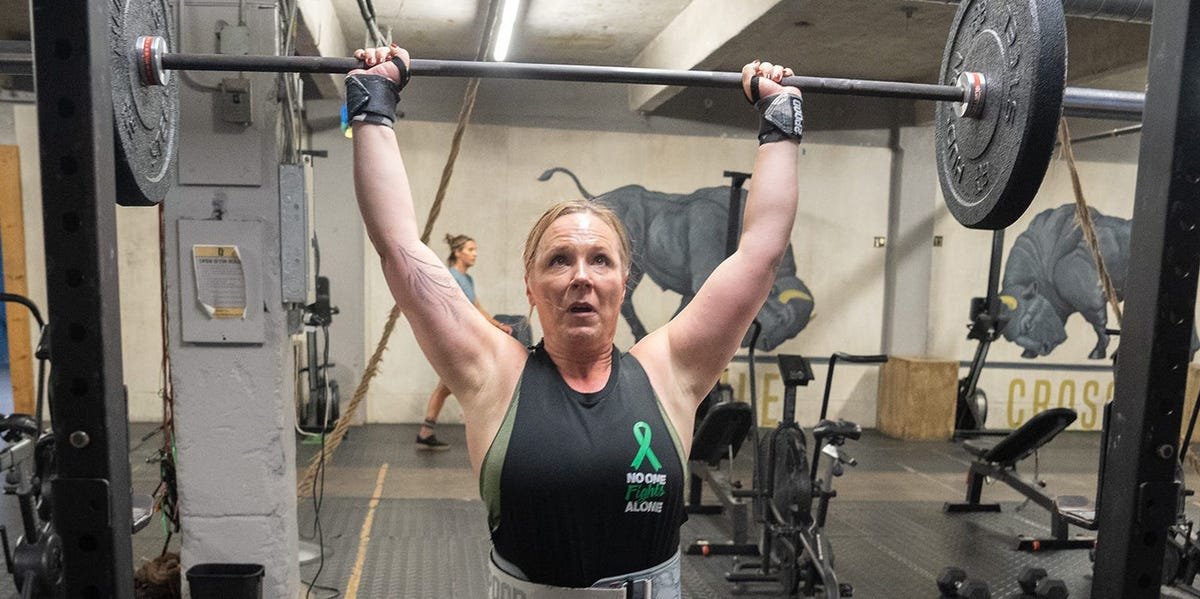
Dr Shernan Holtan lifting weights in the gym performing an overhead barbell press

Dr. Holtan said her training schedule prioritizes a specific rep range for four to six weeks, then she takes a break to recover.

Roswell Park Comprehensive Cancer Center


For instance, she might spend a month or so building up to a heavy one-rep max deadlift, bench press, and squat. After her deload week, she might focus on lifting moderate weight for more reps.

This is a type of training cycle known as periodization, which can help prevent athletes from overtraining or getting stuck in a rut.

Listening to your body can also signal that a rest might be beneficial.

If you’re just not enjoying the gym, struggle to finish a workout ,or need to foam roll the pain away, an extra rest day might be just what you need.


Source link

Ex-Google-CEO-Eric-Schmidt-says-AI-isnt-overhyped-—-the.jpeg

Ex-Google CEO Eric Schmidt says AI isn’t overhyped — the biggest gains from automating corporate work are still ahead

If AI feels overhyped now, Eric Schmidt suggests that businesses should brace themselves — the real disruption hasn’t even begun yet.

In an interview with Professor Graham Allison at the John F. Kennedy Jr. Forum at Harvard University on Monday, the former Google CEO pushed back on the idea that AI’s rapid growth is a speculative bubble, saying that the technology is actually under-hyped.

“If anything, it’s under-hyped because you are fundamentally automating businesses,” he said.

The real transformation, he said, is happening deep inside companies, where AI systems are beginning to take over the “boring” tasks that quietly consume billions in corporate spending.

The biggest gains, he suggested, will come from automating the backbone of corporate work: the repeatable, time-consuming processes buried deep inside every organization.

The former Google chief listed billing, accounting, product design, delivery, and inventory management as examples of this.

“There’s an awful lot there — it’s extraordinary,” he said, pointing to areas like medicine, climate solutions, and engineering as sectors where automation could accelerate breakthroughs.

Schmidt, who helped steer Google’s early investments in AI and later co-authored a book on AI with Henry Kissinger, implied the technology’s economic impact will be far larger than markets or executives appreciate.

Still, not everyone agrees with that perspective. Some economists are sounding alarm bells that the AI boom is overheated.

In an interview this week, renowned economist Ruchir Sharma said the AI surge displays all four traits of a classic bubble and could unravel if interest rates rise, while tech leaders such as Sam Altman and Bill Gates have cautioned that parts of the market resemble the dot-com era.

Far beyond coding

To illustrate how quickly AI capabilities are advancing, Schmidt described watching an AI system generate an entire software program.

“Holy crap. The end of me,” he said.

“I’ve been doing programming for 55 years. To see something start and end in front of your own life is really profound,” he added.

However, he said that AI’s long-term upside extends far beyond coding.

From back-office workflows to logistics and scientific discovery, Schmidt believes the automation curve is still in its early stages of scaling and that Wall Street is underestimating the magnitude of the shift.

“The reason people are spending this amount of money,” he said, “is to automate the boring parts of their business.”


Source link