

Amanda Goh

Gavin Rossdale says co-parenting with Gwen Stefani does not require doing things the same way

Gavin Rossdale, 60, says co-parenting with Gwen Stefani works even when they take different approaches.

“It’s a very, it is an interesting kind of… It’s a two-lane highway, you know, but they don’t ever seem to merge, which is fine,” Rossdale told Fox News Digital.

The musician said it involves both of them showing up for their children in their own ways.

“Probably doing the best she can, and I’m doing the best I can. And the kids are growing up, so I’m a proud proponent of the system. It’s fine,” he said.

Rossdale and Stefani share three kids together. They split in 2015, and Stefani has since married Blake Shelton. Rossdale also has an older daughter from a previous relationship.

Rossdale says the main goal is to make sure his kids grow up to be decent people, not “jerks.”

“Making them likable. I think that if you’ve got kids that are unlikable, they’ve got a tough life ahead, you know. Life is hard enough without being a jerk, without being kind of aware of other people, mindful of other people, considerate of other people, empathetic,” he said.

He added that he aims to model the kind of behavior he wants his kids to embody.

“And so all those things that I try to do my best in my life to be… Just try to show by example with my kids, consistent friends, consistent people around and a sort of a steady approach to life,” he said.

This isn’t the first time Rossdale has spoken about how he and Stefani navigate raising their kids.

In a 2023 appearance on the “Not So Hollywood” podcast, Rossdale said that he and Stefani are “really different people.”

“I don’t think there’s much similarity in the way we bring them up, but I think that gives them an incredible perspective to then choose which pieces of those two lives they’d like to inherit and move on with, and which part of themselves is it kind of comes out of the whole process,” Rossdale said.

He echoed that idea in a 2023 interview with Fatherly.

“They get two opposing views, and they can take and glean what they want and what they believe in. And, they don’t have to believe either of us,” Rossdale said.


Source link

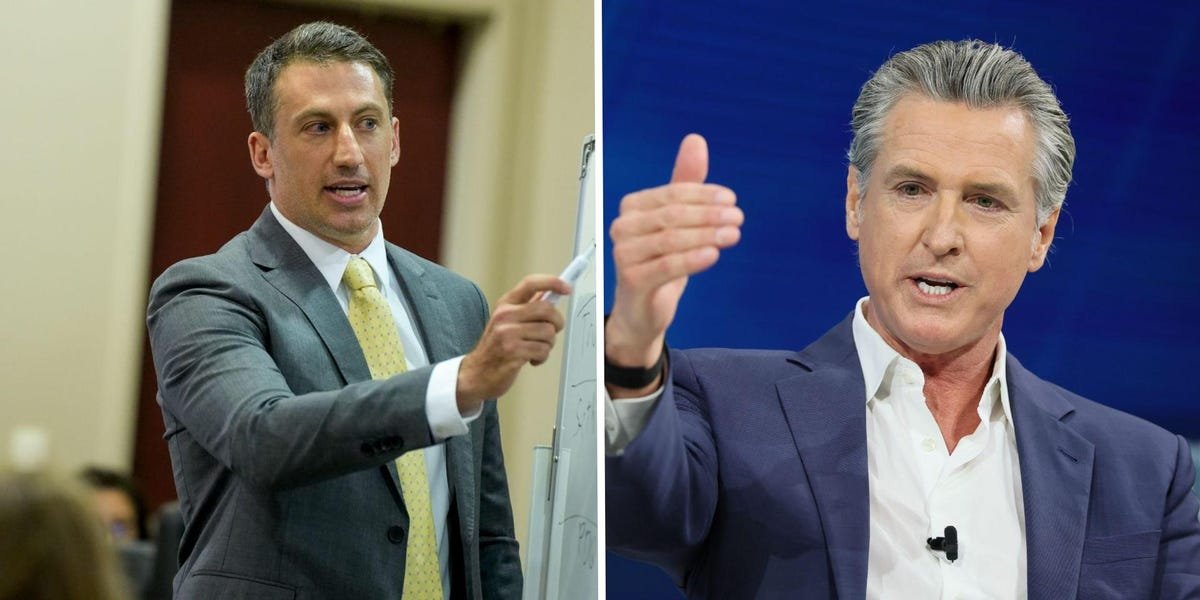
Read-the-letter-celebrity-lawyer-Alex-Spiro-wrote-to-Gavin.jpeg

Read the letter celebrity lawyer Alex Spiro wrote to Gavin Newsom, warning that his clients will ‘permanently relocate’ if California wealth tax passes

A proposed billionaire tax in California has the wealthy threatening to flee, according to a letter written by power lawyer Alex Spiro to Gov. Gavin Newsom.

In a December 11 letter that was obtained by Business Insider, Spiro lays out his opposition to the proposed tax on behalf of his clients, whom he calls “California residents who would be subject to the proposed Billionaire Tax Act.”

“It will trigger an exodus of capital and innovation from California,” Spiro wrote. “Our clients have made clear they will permanently relocate if subjected to this tax.”

The measure proposes that California residents with assets exceeding $1 billion be subject to a one-time 5% tax on the value of their assets. If the proposal receives enough signatures, it will appear on the state ballot in November 2026. If passed, it would apply retroactively to all California residents as of January 1, 2026.

While Newsom has said he is against the tax and would “fight” it, he would not have the ability to veto it if it were to pass as a ballot measure.

Several wealthy Californians, including venture capitalist Peter Thiel and Google cofounder Larry Page, have considered shrinking their presence in California, according to a New York Times report. Representatives for Page and Thiel did not respond to Business Insider when asked if they were represented by Spiro.

Over the weekend, billionaire Palmer Luckey took to X to voice his opposition to the measure.

“I made my money from my first company, paid hundreds of millions of dollars in taxes on it,” the Anduril cofounder wrote. “Now me and my cofounders have to somehow come up with billions of dollars in cash.”

While it’s not clear which clients the lawyer was referencing in his letter to Newsom, Spiro’s client roster in the past has included billionaires and A-listers. He has previously represented Kim Kardashian, Jay-Z, and Elon Musk.

Read the full letter below:

Re: Constitutional Concerns Regarding Proposed Billionaire Tax Act
Dear Governor Newsom:
I represent California residents who would be subject to the proposed Billionaire Tax Act if it qualifies for the November 2026 ballot. I write to urge you to work to prevent this initiative from moving forward. The Act has serious legal problems and would cause significant economic damage to California and the broader economy.
First, and most importantly, the Act would be unconstitutional. Although the Act purports to be a tax, it is in reality an uncompensated confiscation of property. The Act imposes a 5% levy on total accumulated wealth, including illiquid assets that generate no income. That is in substance a taking without just compensation. As the Supreme Court explained in Armstrong v. United States, the government cannot force “some people alone to bear public burdens which, in all fairness and justice, should be borne by the public as a whole.” 364 U.S. 40, 49 (1960). The Act concentrates an extraordinary burden on a small group to solve a general revenue problem— exactly what the Constitution prohibits.
Second, for the people who relocate from California in 2026 before the November election, the Act would tax them after they have become citizens of other States and without any ability to vote on the measure. The Supreme Court has held that retroactive taxation cannot be “harsh and oppressive.” United States v. Carlton, 512 U.S. 26, 30 (1994). A 5% levy on total net worth imposed on former residents who departed before the law was even enacted clearly meets that definition.
Third, the Act’s unprecedented novelty makes it especially vulnerable to a legal challenge. California has never imposed a wealth tax, much less one that reaches former residents and that is targeted at a small group of citizens. The Supreme Court closely scrutinizes unprecedented exercises of government power precisely because they lack historical precedent. See Biden v. Nebraska, 600 U.S. 477, 505 (2023). In fact, it has not hesitated to invalidate the retroactive application of new taxes, even for far less extreme measures. See Blodgett v. Holden, 275 U.S. 142 (1927). There can be no doubt that the current Supreme Court would carefully evaluate a law so out of step with the American legal tradition.
From an economic perspective, the Act creates two serious problems. First, it will trigger an exodus of capital and innovation from California. Our clients have made clear they will permanently relocate if subjected to this tax. They are not alone. See California’s wealth-tax test: Have voters finally found a policy that the state’s inherent economic strengths can’t overcome?, Wash. Post (Nov. 17, 2025) (opinion) (describing the tax as “almost tailor-made to drive most Silicon Valley tech companies to Austin, Texas”). In other words, by passing this proposal California would exchange a one-time windfall for the permanent loss of billions in annual income taxes, capital gains taxes, property taxes, and economic activity. The state’s most economically productive residents would take their businesses, jobs, and charitable giving with them. Second, the Act will force destructive asset sales. Our clients hold equity stakes in operating businesses, venture capital funds, and real estate. Paying a 5% wealth tax would require massive forced liquidations, depressing asset values and triggering market instability that would harm ordinary investors whose retirement accounts hold these same investments.
Our clients are prepared to mount a vigorous constitutional challenge if this measure advances. Litigation would be protracted and expensive, and it would generate sustained negative attention to California’s business climate. The prudent course is to prevent this constitutionally defective measure from reaching the ballot. We respectfully ask that you discourage signature gathering, oppose qualification, and if necessary, campaign against passage.
Our clients prefer to remain in California and continue contributing to the state’s economy and civic life. But they will not remain if subjected to an unconstitutional confiscation of their wealth. We hope this can be resolved through political channels rather than through years of contentious litigation.
Respectfully,
Alex Spiro


Source link