
Ukraines-drone-war-showed-the-West-it-needs-to-view.jpeg

Ukraine’s drone war showed the West it needs to view small drones less like prized gear and more like expendable ammo

Ukraine’s large-scale drone war is pushing Western militaries to treat small drones less as high-end equipment and more as expendable ammunition that isn’t meant to come back.

US Army and British Army officials, as well as a NATO veteran who volunteered to fight in Ukraine, told Business Insider that effective drone warfare requires sending large numbers forward — and accepting many will be lost as a routine cost.

Maj. Rachel Martin, the director of the US Army’s new drone lethality course, told Business Insider that the conflict shows that “if you’re going to flood the zone with drones,” especially in a combat situation where electronic warfare is heavy, “you’re going to lose a lot of drones.”

She said it’s a “transition from the army of old,” where a lost drone was “a significant emotional event” that was reported to senior leadership. In Ukraine, it’s different. “Drones go down all the time.” There, losses are typically shrugged off, rather than investigated.


A figure in camouflage gear squats with their arm up and a small drone hovering above him, with another figure in camouflage standing behind and holding a controller, under a grey sky and on grass and with two cars, light and dark grey, behind them

Drones are key to Ukraine’s fight, and the idea that many will be lost is understood across the military.

Sean Gallup/Getty Images


That shifting mindset is shaping how Western militaries train.

Lt. Col. Ben Irwin-Clark, the commanding officer of the British Army’s 1st Battalion of the Irish Guards, told Business Insider that his battalion has changed its training to allow drones to be damaged or even destroyed to reflect battlefield realities. “I absolutely think they need to be disposable because otherwise you’re not training realistically,” he said.

Not high-end equipment

Jakub Jajcay, a former special forces member from Slovakia who fought in Ukraine, told Business Insider that if NATO militaries want to start using drones for real missions, they “need to get used to the fact that they’re basically expendable material more akin to ammunition or fuel or gasoline, things like that, rather than specialized high-end pieces of equipment that need to be looked after.”

He said when he was serving in the military for his home country, “drones were very specialized pieces of equipment.”

The drones were fairly expensive, he shared, “and there was always a sort of bureaucratic process” in using them. Sometimes, only designated individuals were allowed to use the drones.


A figure in camouflage gear and with their back turned holds an arm up holding a small black drone under a blue cloudy sk,y and on shubbery

Ukraine uses small drones differently from the way that Western militaries did in previous conflicts.

Paula Bronstein/Getty Images


If something happened to a drone, “that would’ve been a big problem in training. If we had lost a drone, somebody would’ve been in big trouble for that.” The war in Ukraine shows how poorly that peacetime mindset fits large-scale combat.

Russia’s invasion of Ukraine has featured drones on an unprecedented scale. Ukraine says roughly 80% of its strikes are carried out using drones rather than other weapons. Many never reach their targets and are lost along the way, though.

Cheap drones worth several hundred dollars have destroyed weaponry worth millions. But many of them don’t have any effect. A report last year from the UK’s Royal United Services Institute said that “between 60 and 80% of Ukrainian FPVs fail to reach their target, depending on the part of the front and the skill of the operators.”

Some drones are jammed or disrupted by electronic warfare, while others are shot down or get their cables cut. Sometimes they’re knocked out by soldiers on their own side.

Many of the drones on the battlefield are single-use, designed to explode when they hit their target, but many of them are destroyed, damaged, or disabled before they even reach that point.

Jajcay said that even drones designed to be used again and again “have a lifespan of maybe a few dozen missions at most.”

He also said that drones failed “all the time,” and those losses were expected.


Four men in camouflage stand under a blue cloudy sky that has a small grey drone hovering in it with an explosive hanging from it

Allies want to learn as much as possible from Ukraine’s drone warfare.

Paula Bronstein /Getty Images


The West is changing its view

The US Army is recognizing and learning from these dynamics in Ukraine, as are other Western militaries, as they incorporate the idea that drones cannot be treated as overly precious assets into their drone warfare training and doctrine.

Maj. Wolf Amacker, who leads the Army’s Unmanned Aircraft Systems and Tactics Branch at the Aviation Center of Excellence, told Business Insider that out of the thousands of drones used daily, only around 30% of them hit their targets, while many others don’t have a significant impact on their targets.

The Army is learning that lots of drones need to be sent forward.

Irwin-Clark told Business Insider that the way the UK sees drones has also shifted. He said “every time there’s an iterative change in technology in the battlefield, everyone gets very excited about it and the ownership of that asset tends to be far too high.”


US Army soldiers during drone operator training.

The US Army is training troops for drone warfare.

US Army/Leslie Herlick


He said that often when a new and powerful technology emerges, senior leaders will try to tightly control it, arguing that because there are only a handful available, only a select few should have the authority to decide when it’s used. The assets are carefully protected, at least initially. Later on, trust is imparted to soldiers to handle technology previously in the charge of higher-ups.

That pattern, Irwin-Clark said, is “exactly what’s happening with drones.”

His battalion wrapped the first drones it received years ago in bubble wrap, “and we didn’t fly them very often,” he said. “When we did,” he continued, “we made sure we flew in the middle of a field with nothing, no obstacles around.”

Now, his battalion is deliberately crashing its latest drone delivery into targets, while looking at how to make repairs. “It really doesn’t matter if we break them,” Irwin-Clark said.

The US is coming at it the same way. Martin, who previously commanded a Gray Eagle drone company, said her course takes into account that “drones crash. I’ll say that to the day I die having owned drones as a commander: drones crash.”

Secretary of Defense Pete Hegseth said last year that the defense department needs to view small drones as consumables rather than “durable property” — more like ammunition than valuable equipment. It’s a change that Jajcay described as “a step in the right direction.”

Western armies were using various drones in warfare before Russia’s invasion, often using them as surveillance platforms or tools for launching missile strikes. Small drones weren’t used the way they’re being used in Ukraine, but the US, UK, and others are learning drone lessons from the war.

Martin said the ongoing conflict in Ukraine shows that even when you lose drones, it’s ultimately “still cheaper than employing missiles on specific targets.” That’s an equation the US Army can’t totally ignore.

“They’re cheaper, and you’re not putting human lives in danger” to carry out the mission, she shared. And the Army knows that “they’re going to crash. It’s going to happen.”


Source link

Ford-is-so-desperate-for-mechanics-its-giving-some-of.jpeg

Ford is so desperate for mechanics it’s giving some of them free tools and Carhartt gear

America is running low on mechanics, electricians, and plumbers.

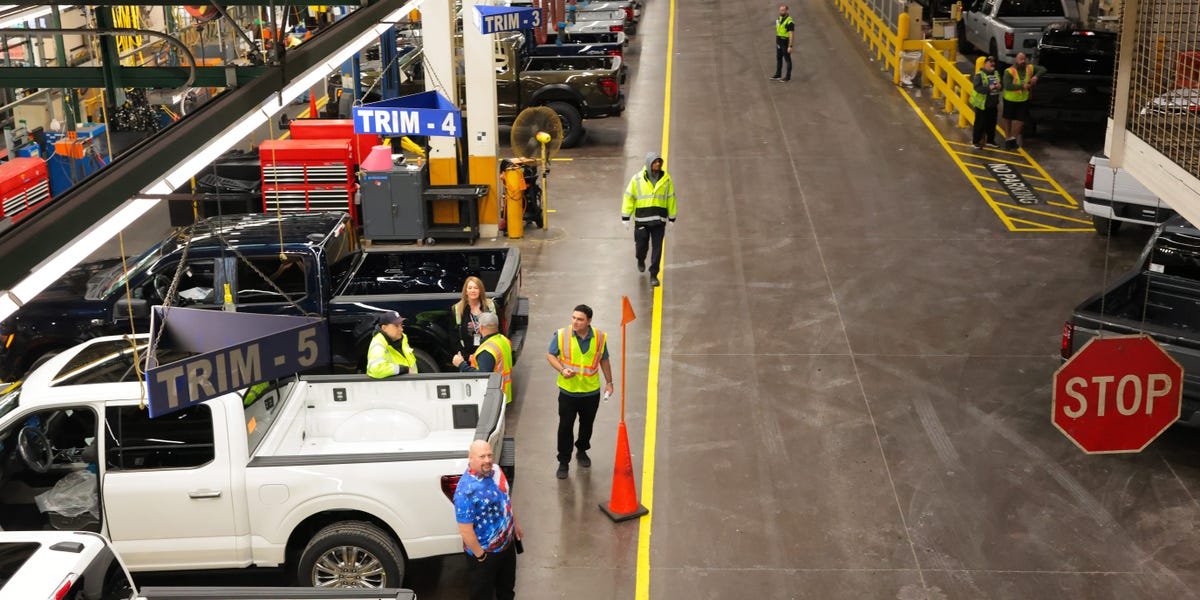
Ford thinks it can help solve the problem by getting younger workers under the hood of its new pickup trucks, enticing them with free Carhartt gear and tools.

The automaker and 137-year-old workwear brand told Business Insider they’re launching a multi-year partnership to address what both call a looming workforce crisis.

The partnership aims to train thousands of blue collar workers, a bet that the two Detroit-based brands can reinvigorate America’s manual labor pipeline.

The partnership includes three main components: opening a ToolBank USA location in Detroit that will lend 25,000 tools annually to workers and volunteers, outfitting Ford’s auto tech scholars with free Carhartt workwear, and launching a co-branded products for the public.

Ford is also donating an F-150 to ToolBank to extend the program’s mobile reach. The two companies declined to disclose the financial terms.

The partnership comes as Ford CEO Jim Farley has warned that America will face a critical shortage of skilled tradespeople within five to ten years. The company calls these workers the backbone of the “essential economy.”

For Ford, the deficit is top of mind, as the company needs thousands of auto technicians to staff its dealership service bays. Right now, the company says it has 5,000 open positions at its dealerships, including six-figure technician jobs.


Jim Farley, Ford's CEO, speaks at the company's inaugural Pro Accelerate event.

At Ford’s inaugural Pro Accelerate event, CEO Jim Farley said the US sat at a critical juncture for blue-collar employment.

Bill Pugliano/Getty Images


“The problems with the essential economy are problems for all of us,” Farley said in September at Ford’s inaugural workforce development summit, which convened industry leaders and policymakers to address the trades pipeline crisis. “We stopped investing in the trades. If Henry Ford saw what has become of us, I think he’d be kind of mad.”

In a phone interview with Business Insider, Mary Culler, the president of Ford Philanthropy, said part of Ford’s mechanic pipeline issue is a perception problem.

Ford’s current vehicle lineup includes advanced driver-assist systems like backup cameras, lane monitors, and autonomous features — making today’s auto repair roles far more technical than traditional mechanic jobs.

“People we talk to tell us, ‘I didn’t realize it wasn’t the greasy job I expected,'” Culler said. “People don’t understand that it’s a very high-tech job, it’s a very computer-intensive job.”

Ford Philanthropy has been offering $5,000 scholarships to trade- school-level technicians through TechForce Foundation, a third-party nonprofit that provides scholarships for skilled trades education. Now, participants will also receive head-to-toe Carhartt gear, including pants, shirts, and vests.

Student applicants must prove they’re studying the auto technology industries to be eligible.

“Some of this work is put in the philanthropic realm,” Culler added. “But this is a business imperative for the future of the economy and our country. We really need to close this gap on these skill trades.”

So far, the program hasn’t yet kept pace with Ford’s needs. The company has trained 1,400 technicians through TechForce since 2018 — filling less than a third of its current 5,000 open positions in seven years.

But recent jobs numbers show there is growing interest in the sector, according to LinkedIn data released last year. Half way through the year, many of the fastest-growing job titles for young workers were blue-collar, like construction workers, electricians, and mining workers.


A yellow Ford Mustang, used during NASCAR races, is displayed before a race.

Ford representatives said their workforce training programs could get perspective job-seekers onto its NASCAR teams.

Kevin Abele/Icon Sportswire via Getty Images


For mechanics, cost can be another barrier, as mechanics typically need to buy or rent their own thousand-dollar toolkits.

Culler said Ford provides wraparound support including tool kits and transportation to training facilities. The automaker is also working to expand participants’ sense of career possibilities beyond traditional dealership roles.

“We’ve taken some of the scholars to F1 and Nascar races to show them that it might not be a dealership where they end up working,” Culler said. “You could work for a race team.”

For Carhartt, the partnership serves dual purposes: recruiting workers for its Kentucky and Tennessee manufacturing facilities, and cultivating what it hopes could be lifetime customers. Someone who starts wearing Carhartt gear at age 20 as a Ford tech scholar could be a customer for the next 40 years.

Carhartt doesn’t require four-year degrees at its plants and has partnered with organizations like the National Center for Construction and Engineering Research to connect high schoolers with trades careers.


Linda Hubbard, CEO of Carhartt, speaking at Ford's Pro Accelerate summit.

Linda Hubbard, Carhartt’s CEO, is also worried about the state of the US blue-collar worker pipeline.

Bill Pugliano/Getty Images


“To me, it’s a bigger calling to amplify people who wear Carhartt,” Linda Hubbard, CEO of Carhartt, told Business Insider. “You might start out as a laborer in the trades, but you could end up owning your own business. I see a lot of these folks working their way up from the field into management into CEO positions.”

Hubbard said she wants Carhartt outfitting those workers throughout their careers, from first day at the repair shop, to their last day running their own companies. Ford, meanwhile, hopes those same workers choose its trucks as their daily drivers for decades.

The commercial partnership will extend to consumer products too.

Carhartt will launch Ford co-branded apparel, while Ford will unveil a Super Duty Carhartt edition truck. Both arrive in the back half of 2026 — the companies declined to share pricing or additional product details.

Both brands are betting their Detroit heritage and cultural cachet can make trades careers more appealing to younger workers.

“We’re raising the perception and elevating the importance of these jobs,” Culler said. “But there’s a real gap. We know there’s a real crisis.

“Carhartt is super cool, we think Ford is super cool. Hopefully we can get the younger generation to recognize this is a real opportunity.”


Source link