
Bryan Metzger

Read the memo authorizing Senate offices to use ChatGPT, Gemini, and Copilot for official use

  • Senate staff have been approved to use three major AI chatbots for official work.
  • That includes OpenAI’s ChatGPT, Google Gemini, and Microsoft Copilot.
  • Lawmakers and staffers have already been experimenting more with using AI over the last year.

Staffers in the US Senate are now allowed to use three major AI chatbots for official business.

In a memo sent to Senate offices on Monday and obtained by Business Insider, the Senate Sergeant at Arms’ Chief Information Officer approved the use of three major AI chatbots using Senate data: OpenAI’s ChatGPT, Google Gemini, and Microsoft Copilot.

The existence of the memo was first reported by The New York Times.

The memo specifically highlighted Copilot, noting that it’s integrated into the Microsoft 365 tools that Senate staff already use.

The memo said that the tool may be used for “drafting and editing documents, summarizing information, preparing talking points and briefing material, and conducting research and analysis.”

It is not clear why the Senate did not authorize Claude, the AI chatbot developed by Anthropic. A message on an internal Senate IT website, viewed by Business Insider, said that Claude was among several AI tools that are still under evaluation.

The House has already approved the use of ChatGPT, Copilot, Gemini, and Claude for official use, according to the POPVOX Foundation, a nonprofit focused on modernizing Congress.

There’s some indication that Senate staff may have already been using AI tools on the job, but unofficially.

Several senators told Business Insider in late 2025 that they were fine with their staff using AI for tasks like research and drafting talking points, though some offices were still developing their own internal guidelines.

“We certainly don’t discourage it,” Democratic Sen. Chris Murphy of Connecticut said at the time.

Read the full memo sent to Senate staffers on Monday:

SAA CIO Notice
Artificial Intelligence Platforms Approved for Senate Use
The Sergeant at Arms (SAA) office of the Chief Information Officer (CIO) has approved the use of three Generative Artificial Intelligence (AI) platforms with Senate data. Microsoft Copilot Chat is available now for use by all Senate employees at no cost. Google Workspace with Gemini Chat and OpenAI ChatGPT Enterprise also have been approved for use with the assignment of a Senate license.
The SAA will provide each Senate employee one Generative AI license at no cost for either Google Workspace with Gemini Chat or OpenAI ChatGPT Enterprise. More information about licensing for those two platforms will be provided by the CIO in the next thirty days.
ABOUT COPILOT CHAT
Copilot Chat is an AI assistant that is integrated into the Senate’s Microsoft 365 environment. It can help with routine Senate work, including drafting and editing documents, summarizing information, preparing talking points and briefing material, and conducting research and analysis. You can access the Copilot Chat web app here or download the Copilot Chat app on your mobile device. You may also see Copilot offered as a sidebar tool within Microsoft applications like Word and Excel.
Important Note: Copilot Chat does not have access to any Senate data unless that information is explicitly shared within a prompt. Copilot does not search internal drives, shared folders, email, Teams chats, or any other Senate resources on its own. Copilot Chat operates in Microsoft’s secure government cloud and meets federal and Senate cybersecurity requirements. Data shared with Copilot Chat stays within the secure Microsoft 365 Government environment and is protected by the same controls that safeguard other Senate data.
To learn more about Copilot Chat, take the Copilot Chat Training.
Use of artificial intelligence tools is governed by the Senate AI Policy and applicable office-level policies. To learn more about Senate AI initiatives, visit the Artificial Intelligence Webster Page.
If you have questions or need assistance with AI platforms or policies, call 202-224-8377 or email the Technology Experience Partners.
NOTE: You must be logged onto the Senate network to view internal links. If viewing on a mobile phone, links may need to be copied and pasted into the Senate browser. If you have questions or need assistance, please contact CIO Technology Experience Partners (TEP).



Source link

A-Google-VP-explains-why-ads-make-sense-in-AI.jpeg

A Google VP explains why ads make sense in AI search but not Gemini — yet

Marketers champing at the bit for AI chatbots to become the next major ad surface may have to suppress their appetites a little longer.

With Google’s Gemini surging in popularity, speculation has been bubbling in the ad industry that the app might be on the cusp of introducing ads to capitalize on the moment — and help offset the hefty AI infrastructure costs.

Not so, according to Google’s VP of global ads, Dan Taylor. In an interview with Business Insider this week, Taylor reaffirmed there are “no plans for ads in the Gemini app.”

Instead, the ads team is prioritizing ad placements within AI search. Google began introducing ads to AI Overviews — the natural language summaries of search results that appear at the top of its search engine results page — in 2024. Last year, it brought ads to AI Mode, its AI chatbot that appears on search pages, which enables users to conduct more in-depth research and ask follow-up questions.

“Search and Gemini are complementary tools with different roles,” Taylor said.

“While they both use AI, search is where you go for information on the web, and Gemini is your AI assistant,” he said. “Search is helping you discover new information, which can include commercial interests like new products or services. We see Gemini as helping you create, analyze, and complete that.”

From an advertising perspective, Google has over 25 years of experience with search ads. Monetizing AI assistants is a relatively new, uncharted territory with numerous questions to consider.

Here are a few:

  • Where and when should an ad show up?
  • What would these ads look like, and how should companies think about charging for them?
  • How can an AI chatbot balance commercial interests while also ensuring users feel they are getting accurate and objective answers?
  • Could the introduction of ads alienate users in a competitive landscape where apps like Gemini are fighting for supremacy against the likes of OpenAI’s ChatGPT, Microsoft’s Copilot, and Anthropic’s Claude?

A first-mover disadvantage?

Ads might feel inevitable as tech giants invest billions of dollars into their AI infrastructures. However, AI companies are aware that making the first move could be perceived as a degradation of their products and cause users to jump ship.

Google’s success in leveraging AI to create financial gains from its existing search product and advertising platform is one advantage it has over arch-rival OpenAI, which is under pressure to demonstrate a path to profitability. It potentially gives Google more leeway to wait before introducing an ad model to Gemini.

Stratechery tech analyst Ben Thompson said in a recent interview on the tech news show TBPN that OpenAI delaying ads in ChatGPT “risks the entire company.”

“They could have launched the world’s crappiest ads in 2023. By today, in 2026, they would be good,” Thompson said. “Now, they’re going to have to launch ads, they’re going to suck, and people are going to be like, ‘This sucks, I’ll just go to Gemini.'”

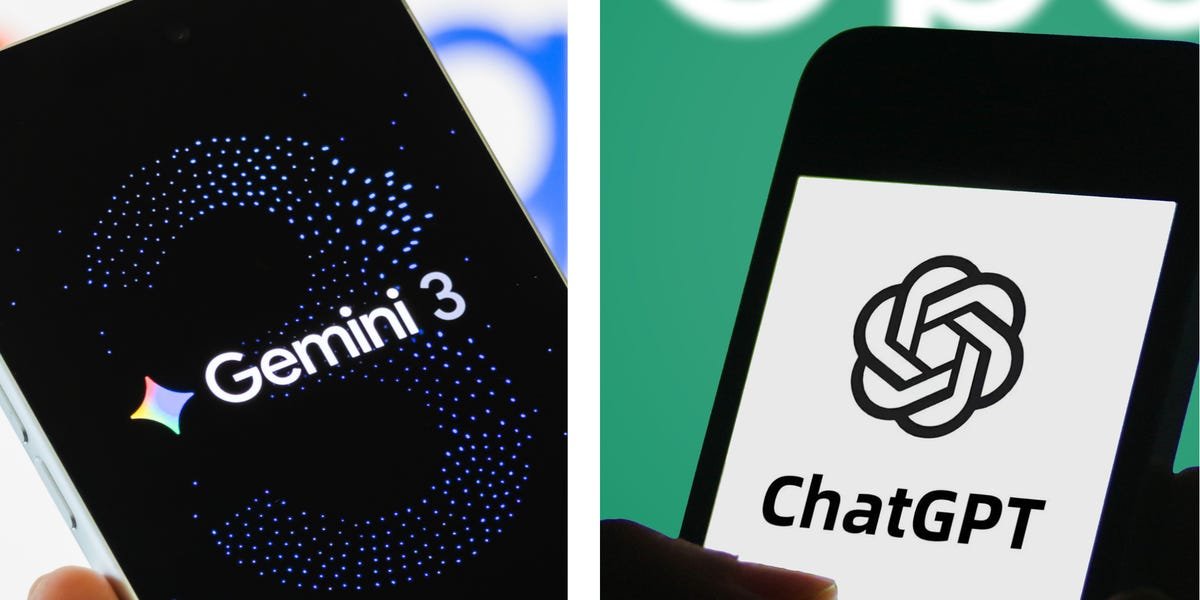
The rivalry between Google and OpenAI intensified late last year when Google released its Gemini 3 AI model, which received rave reviews. OpenAI CEO Sam Altman responded by issuing a “code red,” telling teams to redirect resources from newer projects, including a yet-to-be-released advertising program, to prioritize improving ChatGPT’s performance.

Gemini had 650 million monthly active users, Alphabet, Google’s parent company, said in its latest quarterly earnings report in October. OpenAI said in October that ChatGPT had 800 million weekly users.

What Google has learned from ads in AI search so far

Taylor said that more than 80% of Google’s advertisers are currently using some form of AI-powered search functionality. That’s largely through the adoption of tools like AI Max for Search and Performance Max, where Google’s AI algorithm automatically chooses which ad creatives a campaign should run and where to place those ads.

Advertisers can’t yet specifically choose to run ads within AI Mode or AI Overviews. Instead, the algorithm makes the decision to place them there based on targeting variables like location, demographics, keywords, and topics.

“We don’t have any plans to enable buying separately at this phase,” Taylor said.

Taylor said AI Overviews have notched up more than 2 billion monthly active users, and that people are clicking and engaging with AI Overview ads “at about the same rate” as traditional search ads.

Google’s testing of ads in AI Mode isn’t as far along and presents more challenges when trying to convert the traditional search ads playbook for the AI era. Users have longer back-and-forth conversations in AI Mode, and ads shown too early can feel “intrusive” and create “a trust problem,” Taylor said. A newbie runner seeking helpful information about how to prepare their body for a marathon later in the year might not be ready straight away for ads featuring performance running shoes, for example, he added.

This month, Google said it had begun testing a new ad format called Direct Offers, which will let advertisers present personalized discounts to shoppers who are about to make a purchase within AI Mode. Taylor said Google is only working with a specific set of advertisers on the Direct Offers pilot and didn’t have more information about when it might become broadly available.

Direct Offers was one of several announcements Google made regarding new AI-shopping experiences. New products included a forthcoming checkout function that will let shoppers complete their purchases inside AI Mode and the Gemini app.


Source link

The-gap-between-Gemini-and-ChatGPT-is-narrowing.jpeg

The gap between Gemini and ChatGPT is narrowing

Gemini is on a roll.

After a slow start, Google’s AI chatbot is rapidly gaining users, topping AI benchmark leaderboards, and forcing its biggest competitor, OpenAI’s ChatGPT, into “code red” emergencies.

Now, in another big leap, Walmart, the world’s largest retailer, is partnering with Gemini on a new shopping experience — similar to one it struck with ChatGPT in October.

When people use Gemini to ask questions or search, the assistant will now automatically recommend relevant products from Walmart and Sam’s Club, drawing on users’ past online and in-store purchases, Walmart said in a press release on Sunday.

For users who have linked their Walmart accounts, Gemini can tailor recommendations based on purchase history and enable delivery of in-store items within three hours, or as little as 30 minutes.

Walmart CEO John Furner said the partnership marks a shift in how people shop.

“The transition from traditional web or app search to agent-led commerce represents the next great evolution in retail. We aren’t just watching the shift, we are driving it,” Furner said in the press release.

In recent years, discovery-led shopping experiences on social media platforms like TikTok Shop, Instagram Shopping, and live shopping services like Whatnot have disrupted the traditional digital shopping experience.

AI is reshaping the discovery process even further.

Gemini 3 plays catch-up

While Gemini still trails ChatGPT in overall number of users by a significant margin, it’s closing the gap and even outperforming OpenAI in other key ways.

In November, after years of taking heat as the slow-moving leviathan in the AI race, Google redeemed itself with the launch of Gemini 3.

The latest version of Google’s chatbot was well received by both consumers and industry leaders. Its stock price surged in the weeks following the rollout, and Salesforce CEO Marc Benioff said he would switch from ChatGPT to Gemini, calling the latter “insane” in a viral post.

The hype forced OpenAI CEO Sam Altman to declare a “code red” at his company.

Gemini also benefits from Google’s larger ecosystem of products, like Search, Workplace, Android, and Google TV.

The protocol battle

Another promising development for Gemini, underpinning its partnership with Walmart, is the launch of a new retail protocol, which Google refers to as the Universal Commerce Protocol.

“AI agents will be a big part of how we shop in the not-so-distant future,” Google CEO Sundar Pichai said in a post on X on Sunday. “To help lay the groundwork, we partnered with Shopify, Etsy, Wayfair, Target and Walmart to create the Universal Commerce Protocol, a new open standard for agents and systems to talk to each other across every step of the shopping journey.”

Protocols have long served as the invisible scaffolding of the digital realm, and streamlining a new era of agent-to-agent communication is a critical step in unlocking an agent-powered world, founders building AI protocols previously told Business Insider.

OpenAI unveiled its own commerce protocol in September, following the launch of Instant Checkout. The new feature lets users buy items directly in ChatGPT from Etsy and over a million Shopify merchants, the company said in a blog post announcing the feature.

OpenAI also said the protocol behind it, the Agentic Commerce Protocol, is “an open standard for AI commerce that lets AI agents, people, and businesses work together to complete purchases.” It was developed alongside Stripe.

Google’s mission appears to be similar.

In response to a request for comment, a Google spokesperson referred Business Insider to a blog post Pichai wrote about its new Unified Commerce Protocol.

In it, he explains how the new protocol will change the consumer shopping experience.

He said if a shopper is looking for a suitcase, the protocol allows retailers to instantly offer a new-member price or prompt loyalty enrollment. Returning customers might see tailored discounts or product suggestions, such as packing cubes, when they check out. The transaction can then be completed in just a few taps through Google Pay — without leaving the chat, Pichai said.


Source link