Spirit-could-disappear-from-the-skies-as-fuel-costs-rise.jpeg

Spirit could disappear from the skies as fuel costs rise. See how it rose from a trucking company to a low-cost giant.

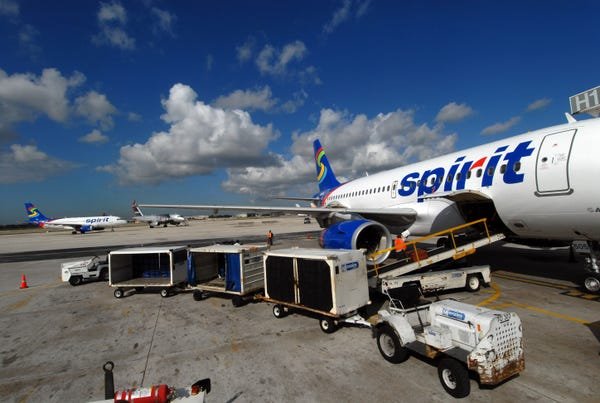
Spirit Airlines’ iconic yellow paint job could soon fade from the skies.

CNBC reported on Wednesday that the ultra-low-cost carrier, which has struggled to return to profitability post-pandemic amid changing traveler habits and rising costs, could liquidate as early as this week.

The airline had recently shown signs of progress in its Chapter 11 bankruptcy proceedings — its second since 2024 — but rising fuel costs tied to Middle East conflict are now making that recovery even harder.

A Spirit spokesperson told Business Insider that it doesn’t “comment on market rumors and speculation.”

It’s unclear what would happen if Spirit were to abruptly shutter. Beyond the immediate impact on customers, the airline’s operations would likely cease and its fleet would be grounded.

Any potential outcome would depend on whether a buyer emerges for its assets. JetBlue Airways, which attempted to acquire Spirit for $3.8 billion in 2024 before the deal was blocked by regulators, could revisit a bid.

Other carriers eyeing Spirit’s relatively young aircraft and sizeable East Coast network could also see value, though no formal interest has been announced.

If Spirit were to disappear — the nail in its coffin likely being the oil crisis and rising demand for premium travel it can’t match — it would close the book on a 62-year history.

Spirit started as Clippert Trucking Company in 1964.

Spirit’s livery in 2007. Charter One’s operation in the Bahamas means Spirit has always offered passenger service beyond the US.

Richard Sheinwald/Bloomberg via Getty Images

In 1974, the company was refounded as Ground Air Transport Inc. by Michigan-native Ned Homfeld.

Homfeld eventually founded the first passenger version of Spirit in 1980: Detroit-based Charter One Airlines. The charter tour company officially launched operations in 1983 using turboprop aircraft.

It focused on gambling trips, offering routes to Atlantic City, New Jersey, from Chicago, Detroit, Boston, and Providence, Rhode Island.

As gambling soon became popular in other states, Charter One began ferrying northerners to warmer destinations, including Florida, the Bahamas, Las Vegas, and San Juan.

Scheduled air service officially launched in 1990.


A Convair

Convair 580 turboprop (not Charter One Airlines).

Carlos Yudica/Shutterstock

A decade after its founding, Charter One launched scheduled air service from Boston, Detroit, and Providence to Atlantic City, marking the start of the company’s commercial operations.

Charter One leased two Convair 580 twin-engine turboprops for the service. It would operate the planes for only a couple of years before rebranding to Spirit Airlines.

Charter One became Spirit Airlines on May 29, 1992.


Spirit Airlines McDonnell Douglas MD-80

Spirit Airlines McDonnell Douglas MD-80.

Ivan Cholakov/Shutterstock

Spirit rebranded and added four DC-9 jets to its fleet. The company was able to secure the planes at a low price after the demise of low-cost competitor Midway Airlines brought down used-aircraft prices.

In June, the company launched its first flight from Detroit to Atlantic City, which operated twice daily. The airline’s code is NK for “Ned’s Kids.”

Spirit’s early fleet also included McDonnell Douglas MD-80 aircraft. According to Plane Spotters, 44 DC-9 and MD80 planes were delivered through the 1990s and early 2000s, with the last MD80 leaving the company in July 2010.

Spirit was small but gained early momentum with its staple cheap fares.


The snacks on Spirit

The snacks on a Spirit Airlines flight. The offerings change over the seasons.

Thomas Pallini/Business Insider

Spirit flew more than a quarter-million passengers in 1993 and generated $21 million in revenue. The company’s background as a tour operator helped it fill planes.

The carrier won over customers with cheap fares, powered by its low-cost business model in which everything beyond an unassigned seat — even water — cost extra. This secured lucrative ancillary revenue.

Legacy airlines with higher operational costs were often forced to slash fares to stay competitive when Spirit entered the market. This exacerbated the financial strains of the 1990s.

Spirit thrived as legacy airlines struggled during the 1990s recession.


Pan Am flight attendant serving drinks on the company's 747.

A Pan Am flight attendant seen serving drinks on the company’s 747.

Bettmann/Contributor/Getty Images

The 1990-1991 US recession opened the door for startups to acquire cheap planes and nonunion staff who had been employed by collapsed Pan Am, Trans World Airways, Eastern Air Lines, and Midway.

From 1993 to 1999, Spirit expanded its route network, offering flights to Philadelphia, Orlando, St. Petersburg, Myrtle Beach, Los Angeles, and New York City.

Spirit’s brand was tarnished after a failed deal with Delta Air Lines.


Spirit's catch the spirit livery.

The “Catch the Spirit” livery.

Mark Kopczak/Airliners.net

Delta’s defunct regional carrier, Comair, wanted to buy Spirit for $20 million in the mid-1990s. The deal was part of Spirit’s attempt to find a home in a bigger organization to help it expand amid growing competition.

The deal never materialized. Comair pulled out after a budget carrier, ValuJet, crashed into the Everglades in 1996, which created a stigma about the safety of low-cost airlines.

To address customer concerns, Spirit sent thousands of postcards to reassure customers about the safety of its planes.

It also launched a “Catch the Spirit” media campaign that included TV, radio, and billboard ads to sell Spirit’s perfect safety record and involved adding a new logo to its aircraft.

It took advantage of Northwest’s pilot strike.


Northwest pilot strike.

In 1998, pilots at Northwest, which merged with Delta in 2008, went on strike, leading to thousands of flight cancellations.

JEFF KOWALSKY/AFP via Getty Images

Spirit recorded a loss in 1996, mostly due to a 25% rise in fuel prices, consumer hesitation to fly low-cost carriers, and some legacy carriers matching Spirit’s fares and pushing it out of key markets.

However, Spirit’s planes began filling again in 1997. In June of that year, Spirit took over defunct carrier Sun Jet’s routes from New Jersey to Florida. It also acquired more planes to take advantage of Northwest’s 1998 pilot strike that grounded the rival for weeks.

That year, Spirit reported revenue of $121 million, had 20 aircraft in its fleet, posted the industry’s highest load factor at 76.4%, and carried 1.4 million passengers, an increase of 80% from 1997.

Spirit moved its headquarters to Florida in 1999.


Spirit Airlines headquarters in Mirimar, FL

Spirit Airlines is headquarted in Miramar, Florida.

Joe Raedle/Getty Images

The airline had been courted by several other cities, including Detroit and Atlantic City, before making its move from Eastpointe, Michigan to Miramar, Florida.

Miramar made sense because it was in the Fort Lauderdale area where Spirit’s tour company was already based, and the airline had been serving Fort Lauderdale-Hollywood International Airport since 1993.

It still has a stronghold in the city, though it has trimmed capacity in recent years to optimize its network and better manage costs.

Spirit began growing its Airbus A320 fleet in 2002.


Spirit Airlines plane in San Juan, Puerto Rico

The first livery was greyscale, the second was a blue paint scheme, and the third and most recognizable is the all-yellow “Bare Fare” livery introduced in 2014.

RICARDO ARDUENGO/Getty Images

It’s still the only aircraft family in its fleet today, and it’s relatively young at an average of eight years. The planes are no-frills with only economy seats and a few rows of premium loungers.

Spirit continued to expand throughout the 2000s. It added San Juan, Puerto Rico in 2001. Boston, Grand Cayman, and San Francisco were added in 2006.

The airline has rebranded its premium seats over the years.


Flying Spirit Airlines across the US — Spirit Airlines Flight 2021

A Spirit Airlines flight from Santa Ana, California to Newark, New Jersey.

Thomas Pallini/Insider

In 2007, the airline rebranded its “first class” as the Big Front Seat, which passengers can secure for an extra fee.

Spirit has since further revamped its most expensive seats, adding legroom, wider seating, and bundled perks to lure more premium flyers.

It’s part of a wide industry focus on premium revenue as flyers remain willing to pay up for comfort.

The last US pilot strike was by Spirit pilots in 2010.


Spirit Airlines pilot strike

Pilot strikes are rare because the Railway Labor Act makes it extremely difficult.

Joe Raedle/Shutterstock

The strike occurred amid poor wages and benefits, leading to thousands of flight disruptions.

At the time, Spirit crews were among the lowest-paid pilots in the US despite flying the same planes as their higher-paid counterparts at other airlines.

Spirit was the first airline to charge for carry-on bags.


Spirit Airlines bag size checker

Spirit Airlines bag size checker.

EQRoy/Shutterstock

The move reduced its operating costs because the resulting fewer overall bags lowered the aircraft’s fuel consumption. It also sped up the boarding process and freed up overhead bin space.

The à la carte model became its bread and butter.

In 2011, the carrier began charging for boarding passes printed at the airport ticket counter and reduced its maximum checked baggage weight from 50 to 40 pounds.

Spirit’s no-frills strategy has been controversial throughout its history.


Flying Spirit Airlines across the US — Spirit Airlines Flight 2021

A Spirit ticketing kiosk.

Thomas Pallini/Insider

In 2008, Spirit was the number one airline for customer complaints. It still managed to fly five million passengers and achieve a net profit during the recession, making it one of the few carriers to do so.

In 2011, the Department of Transportation fined the airline $50,000 for what it described as deceptive advertising, claiming it did not disclose hidden fees, like baggage.

In 2014, Spirit was the top airline pick for growth among investors, and in 2016, Spirit was the first US carrier to add the A320neo to its fleet.

By 2019, Spirit was consistently profitable and popular.


Spirit Airlines in the Caribbean

Spirit Airlines in the Caribbean

Skycolors/Shutterstock

It had become a budget leader and consistently turned a profit as people sought cheap vacations and didn’t mind a bare-bones experience.

By 2019, the airline was operating 600 daily flights to 72 destinations across the US, Mexico, Central America, and the Caribbean.

The pandemic changed everything.

Spirit was hit hard during the coronavirus pandemic.


Spirit Airlines passengers during the pandemic

Spirit took advantage of people with more limited budgets during the pandemic who still wanted to travel.

PATRICK T. FALLON/Getty Images

Spirit recorded a 2020 net loss of $428 million. Nevertheless, Spirit expanded operations with new city pairs and airports in 2021.

It ended the year with what it described as a “better than expected” operating revenue, despite the mix of poorly timed weather, system outages, and staff shortages that left thousands of customers stranded.

The customer outrage led to a warning from regulators. Still, Spirit continued to improve in 2022, reporting strong ancillary revenue in the first quarter. Things appeared to be moving back toward how they were in 2019.

Changing traveler habits derailed everything.


Spirit's barebones planes.

Spirit planes are still largely barebones, with some rows now offering more legroom and perks.

Thomas Pallini/Business Insider

Airlines have been doubling down on premium revenue as flyers remain willing to pay extra for better comfort across all cabins. This prompted Spirit to rethink its all-economy strategy.

It started bundling its fares and offering premium seating to lure more customers, but its “first class” seat still pales in comparison to the amenity-stuffed loungers on rivals like Delta and United.

In its latest update, it said it would continue to focus on high-demand routes, reduce its debt, and have just 80 aircraft by late 2026 — down from over 200 at its peak.


Source link

Nike-salary-data-reveals-what-employees-can-make-at-the.jpeg

Nike salary data reveals what employees can make at the sportswear giant

As Nike continues its quest to come back as a dominant retail force, the sportswear giant has continued to invest in tech and design jobs.

Publicly available work visa data, which companies are required to disclose to the US Department of Labor, gives an idea of how much Nike’s employees bring home and some of the roles it has invested in.

Nike had about 755 open positions worldwide listed on its jobs board as of February 13. In January, the company also said it planned to lay off 775 employees at its distribution centers, citing efforts to accelerate the use of “advanced technology and automation.”

Nike had several leadership shake-ups in 2025, including promoting at least four insiders to senior roles reporting directly to CEO Elliott Hill.

Hill, who rejoined the company in October 2024, has told investors that Nike is aligning its employees around five key action areas: culture, product, marketing, marketplace, and connecting with consumers on the ground in their communities.

That strategy plays into Nike’s efforts to focus its marquee brands — Nike, Jordan, and Converse — on key sports such as running and basketball. It’s also pushing a new collaboration, NikeSKIMS, an athleisure brand for women.

“We are in the midst of realignment at Nike,” Nike said in a July statement to Business Insider. The realignment and sport strategy aim to “create sharper distinction and dimension” for its brands, the company said.

Here’s what some key Nike roles can earn, based on work visa data for the year ending September 30.

The salary data includes information from Nike Inc. and some subsidiaries, such as its retail services arm and Air Manufacturing Innovation division. It reflects US-based roles and, given that it’s based on H-1 B visa disclosures, tends to skew more tech-focused.

Data and engineering roles: Software engineers can earn more than $300,000

Software Engineer: $124,592 to $203,581 a year

Software Engineer I: $120,000 to $144,612 a year

Software Engineer II: $152,007 to $178,231 a year

Software Engineer III: $139,845 to $180,353 a year

Senior Director, Software Engineering: $301,378 a year

Data Engineering: $104,500 to $175,000 a year

Data Analytics: $114,600 to $118,398 a year

Director, Supply Chain AI/ML Engineering: $252,535 a year

Design roles: Some designers make around $200,000

Designer II: $94,691 a year

Materials Designer: $100,000 a year

Senior Digital Product Designer: $155,810 a year

Senior 3D Designer: $106,605 a year

Director, NikeSKIMS Apparel Design: $244,466 a year

Manager roles: Managers can take home more than $270,000

Senior Manager, Software Engineering: $273,156 a year

Delivery Excellence, Uniform Operations Manager: $164,439 a year

Senior Product Manager: $153,431 to $169,744 a year

Manager, Data Engineer: $168,031 to $213,190 a year

Senior Program Manager: $147,434 a year

Supply Chain Intelligence Manager: $158,311 a year

Marketing roles: Some marketing jobs can earn as much as $425,000

Lead Professional, Sports Marketing: $128,434 to $143,251 a year

VP, Global Brand Marketing, Women’s: $425,000 a year

Have a tip? Contact Jordan Hart via email at jhart@insider.com or Signal at jordanhart.99. Use a personal email address, a nonwork WiFi network, and a nonwork device; here’s our guide to sharing information securely.


Source link

A-Facebook-veteran-took-a-big-career-risk-that-resulted.jpeg

A Facebook veteran took a big career risk that resulted in a ‘giant failure’ — but embracing a ‘J-curve’ career path paid off

At 25 years old, Molly Graham was thriving in Facebook’s HR department when a senior executive urged her to transfer out of her stable role and help build a mobile phone instead.

She took the risk — and it could have derailed her career.

But Graham, who later became a C-suite executive at some of America’s biggest companies and philanthropies, now views that risky bet as one of the most important moves she ever made.

“It just felt like falling off a cliff,” Graham, now the founder of Glue Club, said in a recent interview on Lenny Rachitsky’s podcast. “Taking risks, accepting the terrible fall and that experience of falling has been more than worth it.”

Graham described the experience as part of what she calls the “J-curve” — a career trajectory where a risky move leads to an initial drop before eventually producing outsized gains. Visually, she describes it as standing on a ledge, stepping off, sinking briefly, and then rising far higher than where you started — just like the shape of the letter J.

The concept, which she has also written about in her Lessons Substack, challenges the idea of a steady career ladder that steadily moves up and to the right.

Instead of climbing rung by rung with promotions every two to five years, Graham argues that some of the most valuable professional growth comes from jumping into roles you aren’t ready for and surviving any setbacks.

Graham’s own J-curve began when billionaire investor and “All-in” podcast host Chamath Palihapitiya, then Facebook’s vice president of growth, recruited her to help develop a smartphone, encouraging her to make the move by sketching out the J-shaped trajectory on a whiteboard.

He brought her on despite her having no experience in product development, dropping her into rooms filled with engineers and phone specialists with deep subject matter expertise. She recalled feeling like an “idiot” for much of her first six months.


Headshot of Molly Graham, the former Facebook and Google executive, and writer of the Lessons Substack

Molly Graham, the former Facebook and Google executive and writer of the Lessons Substack.

Molly Graham


At her midyear review, Palihapitiya delivered what Graham called the worst performance evaluation she had ever received. But the new experience eventually expanded her expertise.

“Slowly, I remember I had been doing all these trips to Taiwan because we were actually working on hardware and I, at some point, came back from Taiwan and I like drew on a whiteboard for him the layout of a mobile phone, trying to explain to him kind of like why something he wanted to do was not possible,” Graham said. “And I so vividly remember walking out of that meeting being like, ‘Oh like I actually know things.’ And slowly then over the following three years I became an expert in mobile.”

Palihapitiya did not respond to Business Insider’s request for comment.

“The phone itself was a giant failure — a massive, costly failure for Facebook,” Graham told Rachitsky on the podcast. “But it was not a failure for me.”

She credits the experience with teaching her that she could operate far outside her comfort zone — a lesson that later helped her take on senior leadership roles, including serving as COO of Quip, which Salesforce acquired for $750 million, and overseeing operations at the $7.4 billion Chan Zuckerberg Initiative.

The J-curve, Graham said, is especially common at fast-moving companies like Meta, Alphabet, Nvidia, and SpaceX, where leaders value employees who are willing to take big risks early and learn quickly. In those environments, proving adaptability can matter more than checking every qualification box.

Not everyone supported Graham’s decision at the time. She said Facebook COO Sheryl Sandberg, then the number two at the tech giant, advised against the move — as did her father.

“When wiser, more experienced people questioned the job offer, it definitely made me pause,” Graham told Business Insider in a follow-up email. “But my gut felt really strongly that I needed to take the risk.”

That instinct, she said, ultimately helped her discover what kind of work she didn’t want to do, and where her strengths lay. She didn’t want to sift through mock ups of hardware design and argue about a button’s placement. Instead, she sharpened her management skills and prepared to help lead large organizations.

“The much more fun careers are like jumping off cliffs,” Graham told Rachitsky. “They can take you to places that you never could have imagined.”


Source link

Prediction-giant-Kalshi-is-rolling-out-a-new-VIP-program.jpeg

Prediction giant Kalshi is rolling out a new VIP program for power users

Prediction platform Kalshi is looking to retain its power users with a new VIP program.

Kalshi has started emailing high-volume traders about a new loyalty program called “Kalshi Platinum,” which gives them access to merchandise and referral incentives, a company spokesperson confirmed to Business Insider.

Other program perks include tickets to in-person Kalshi events and dinners, plus access to a “dedicated account manager” who can assist with customer support questions from 7 a.m. to 1 a.m.

“For the past couple of months, our team has been brainstorming ideas on how to best serve our most loyal customers,” one Kalshi Platinum email read. “After speaking with both customers and partners, we are excited to announce the launch of Kalshi Platinum to a select group of Kalshi users.”

Financial exchanges Coinbase and Kraken, as well as sportsbooks FanDuel and DraftKings, have also implemented VIP programs. These types of programs have become particularly important to sportsbooks, which compete fiercely with each other for VIPs.

“Similar to other financial markets, brokerages, and large consumer brands, we’re piloting a program that offers priority support and other benefits to some of our most loyal customers,” a Kalshi spokesperson said in a statement.

Kalshi and its top rival, Polymarket, have become popular by allowing users to make money by trading contracts about the outcomes of events like elections, world events, and sports games. Unlike sportsbooks, Kalshi operates in all 50 states and is regulated by the US Commodity Futures Trading Commission. However, some state regulators have targeted prediction markets like Kalshi, arguing that parts of their businesses should be overseen by gaming authorities. Kalshi disputes that notion. The company has received cease-and-desist orders from several state agencies.

Kalshi has recently raised its profile through data integration deals with CNBC and CNN. These networks and their websites will display data from Kalshi that shows what its users think are the probabilities of different market and economic outcomes. For example, CNN could show Kalshi prediction data about which political party users think will control the Senate after the 2026 midterm elections.


Source link

Jordan Hart's face on a gray background.

5 big changes Nike CEO Elliott Hill is making to turn around the struggling sportswear giant

Nike CEO Elliott Hill inherited an uphill battle when he took over at the sports giant in October 2024.

Since then, Hill has made changes — both big and small — to the company as part of its turnaround strategy. After retiring from Nike in 2020, the former president of consumer and marketplace returned to guide the company amid declining sales, sluggish growth, and increased pressure from upstart rivals.

During the quarter preceding Hill’s start, Nike’s revenue declined 10% year over year to $11.6 billion, following flat growth in the 2024 fiscal year. Nike shares jumped about 8% on the day Hill’s appointment was announced in September.

The Nike veteran didn’t waste time launching his strategy when he took the helm, reevaluating the existing practices and adjusting them as needed.

“We lost our obsession with sport,” Hill said on a December 2024 earnings call. “Moving forward, we will lead with sport and put the athlete at the center of every decision.”

Last week, during the company’s most recent quarter, Hill told investors that the comeback “won’t be a straight line.”

Here’s what Hill has been up to in 2025.

Hill kick-started his turnaround plan

Nike’s “win now” strategy — Hill described it on last week’s earnings call as Nike’s “immediate response to our biggest challenges and opportunities” — focuses on five key areas: culture, product, marketing, marketplace, and in-person presence.

The plan leans on a sports-driven reset that has “realigned” about 8,000 employees around its core sports categories, the company said. Those categories include running, basketball, football, and training, as well as sportswear.

The idea is to put the athlete “at the center of everything that we do,” Hill said in a March earnings call.

The running category is leading the effort and reflects the direction Hill is steering the company. Nike said its running business grew by more than 20% last quarter, which ended in November, marking the second consecutive period of comparable growth.

Nike’s senior leadership team got a revamp

Hill shook up Nike’s leadership this year.

In May, he restructured its consumer, product, and brand leadership to focus on three areas: consumer and sport, marketing, and product creation. As part of that overhaul, Nike’s former president of consumer, product, and brand retired, and Hill promoted four other Nike insiders to senior roles reporting to him: president of Nike (Amy Montagne), chief innovation, design, and product officer (Phil McCartney), chief marketing officer (Nicole Graham), and chief growth initiatives officer (Tom Clarke).

Hill also hired a new communications chief this year, Michael Gonda.

And he made another round of changes in December, eliminating the roles of chief technology officer and chief commercial officer. At the same time, Nike established the role of chief operating officer, which reports to Hill. The new job’s function is to “integrate technology more seamlessly into our sport offense,” Hill said in a note to employees that Nike released publicly. Venkatesh Alagirisamy, a 20-year veteran of Nike, transitioned into the role on December 8.

As part of the shake-up, general managers in all regions now report directly to Hill.

“It’s clear how important it is to stay closely connected to what’s happening on the ground, from intern to CEO, and every role I’ve held in between, I’ve felt that way,” Hill said on last week’s earnings call.

He began mending relationships with wholesale partners

Hill said Nike’s ties with wholesalers such as Foot Locker and Dick’s Sporting Goods had frayed amid its aggressive shift toward direct-to-consumer sales.

Since Hill’s return, he said he’s been mending those relationships. For example, Nike is back on Amazon and has struck partnerships with smaller retailers, such as Urban Outfitters and Aritzia.

Nike’s wholesale revenues increased 8% year over year to $7.5 billion during its most recent quarter, which ended November 30.

Hill pulled back on promotions and raised prices

Hill said that Nike would strive to provide a more “elevated” experience for consumers, speaking in a January interview with Fortune. He said Nike had become “too promotional” on its own site.

“Being premium also means full price,” Hill told Fortune. “We’ll focus on promotions during traditional retail moments, not at the consistent levels we are today.”

He said in March that Nike Digital, which includes its website and app, ran zero promotions in North America in January and February, down from over 30 during the same months in 2024. The cutback on promotions came alongside “surgical” price increases Nike made to mitigate tariffs in 2025.

He gave the House of Innovation concept store a makeover


Nike 26.2 collection

The House of Innovation is Nike’s six-floor flagship store.

Jordan Hart/Business Insider


Nike’s 68,000-square-foot House of Innovation is the blueprint for its stores. It’s a six-story flagship store that opened in 2018, showcasing the company’s most advanced products. The first floor is dedicated to running, and the rest of the sprawling store is organized by sport, gender, and age.

Hill has frequently pointed to the revamped store in his first year as a model for Nike’s move to sports-driven retail layouts.

“It’s an immersive sport experience, and the refresh has already led to double-digit revenue increases,” Hill told investors in September.

Nike did not respond to a request for comment from Business Insider.


Source link

How-a-lesser-known-Swedish-private-equity-giant-plans-to-win.jpeg

How a lesser-known Swedish private equity giant plans to win over US retail investors

EQT is one of the largest private equity investors in the world — yet most wealthy Americans have barely heard of it. That’s the uphill battle facing Peter Aliprantis, the Swedish firm’s head of private wealth in the Americas, as EQT tries to pitch in a market dominated by Wall Street brands with plenty of CNBC airtime.

“Most people in the United States are not familiar with us, and the way we say it, we’re the best-kept secret,” Aliprantis told Business Insider.

Private Equity International ranked the firm as the second-largest private equity firm, with $312 billion of assets under management. It raised more than $113 billion in third-party private equity capital from 2020 to the end of 2024, putting it ahead of Blackstone, and just behind KKR so far this decade.

Like many of its competitors, it’s turning to private wealth as the newest source of growth. The industry’s change of fundraising focus comes as private equity firms are slow to return cash to investors, and over-allocation among institutional investors means that institutional funding is slowing.

But the same reasons that the firm isn’t as well-known in America are actually an advantage, Aliprantis said.

In a world where debt-heavy buyouts are proving more difficult and an increasingly concentrated American private market is pushing some to invest internationally, a global industrialist approach can be attractive.

EQT has returned capital at a normal pace, with $23 billion in distributions for the year ending June 2025. The firm has also been building a private wealth business for the past four years, which accounts for 10% of its current assets. The firm has a goal to reach between 15-20% during its current $100 billion fundraising cycle, according to its second-quarter report.

Aliprantis walked Business Insider through the firm’s pitch to financial advisors and private wealth distribution networks, explaining why its global reach is a significant advantage in 2025.

The key for EQT, Aliprantis said, is for the firm to offer individual investors the “exact same deals” it gives institutional investors.

EQT’s industrialist, international advantage

EQT was founded in 1994 as a spin-off from industrial holding company Investor AB, but the firm’s history stretches back to Sweden’s Wallenberg family. The Wallenbergs, called the “Rockefellers of Europe,” have created an empire of business holdings including massive stakes in Sweden’s biggest firms, like ABB, AstraZeneca, or Saab.

“The Wallenberg family has a 160-year heritage of owning and developing companies,” Aliprantis said. “We’re not financial engineers. We don’t add a lot of leverage to what we do, and we’re very, very different from what a lot of our peers on Wall Street are doing.”

Aliprantis’s comments echo a larger change in the industry, which is running out of easy money-making deals and cheap financing and now has to extract returns by actually building stronger companies.

But the firm’s biggest advantage, Aliprantis said, is its global nature.

Only 35% of its assets are based in North America, and the firm has 26 global offices where its deal teams invest in local private equity, infrastructure, and real estate deals.

“A lot of our colleagues based in New York will fly deal team partners over to different places around the world to do the deal and then get on a plan and fly home,” Aliprantis said. “Our deal teams are pretty much based in the locations where they do deals.”

This means the firm “gets the call” when local companies are looking to sell, and keeps them from larger “bake-offs” where the price might be bid-up.

This has also meant the firm can continue to provide distributions to its clients even if the market is slow in one locale.

“If you’re a US-based domicile private markets firm that has 70 to 80% of your assets in the US, guess what? If the US IPO market is slowing, you’re going to have a problem exiting,” Aliprantis said.

“Here in the US, it’s always been too much money chasing too few deals. You know what? That’s a US thing,” Aliprantis said.” If you go to Europe and you go to Asia, it’s the opposite.”

For example, Bain estimates there’s about $480 billion in dry powder for European private funds, including venture capital, compared to Pitchbook’s $914.5 billion for US-focused private equity firms, not including VC. Apollo’s Marc Rowan also recently told the Wall Street Journal that as an industry, they find themselves short ideas rather than capital.

Aliprantis said investors’ biggest reason to diversify away from the US market is its concentrated bet on AI.

“Their concern is that the Mag Seven is roughly 37% of the S&P right now, and valuations are stretched,” Aliprantis said. “Is AI really going to work? Is it not? How additive is it going to be to the bottom line? We don’t know.”

How to keep retail investors happy

Across the spectrum, Aliprantis said, the “biggest concern” is that retail investors are getting a set of less attractive deals, while institutional investors are getting a “separate set of deals.”

Aliprantis said that the firm’s six evergreen vehicles are composed of the “exact same deals” that its institutional clients invest in.

The key to doing that, and to being a responsible investor or retail capital, is “size and scale,” Aliprantis said.

Size also helps with the balance sheet necessary to launch a private wealth business. It can cost millions of dollars to hire the necessary staff to start selling to financial advisors and other wealth management channels before any revenue is returned to investors.

EQT was able to use its balance sheet, as a public company in Sweden, to build its private wealth team and now has 70 private wealth professionals globally, with 20 based in the US.

That’s not to say that smaller funds won’t succeed, but it will be much harder, Aliprantis said. With so many investors competing for retail capital, consolidation is inevitable.

“The race is on in the industry right now,” Aliprantis said.


Source link