
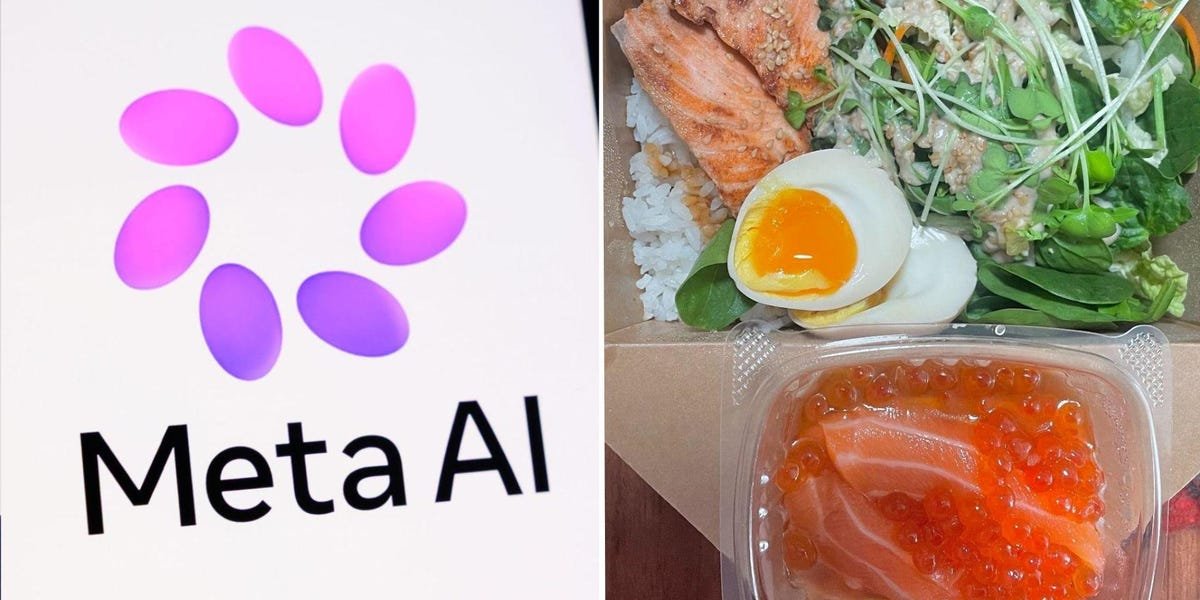
I-asked-Metas-new-Muse-Spark-AI-to-judge-my.jpeg

I asked Meta’s new Muse Spark AI to judge my lunch and give me recipes for dinner, and it mostly delivered

For some of us, cooking is hard, and coming up with nutritious meals with what’s already in the fridge is harder.

I have always struggled with meal prep, often forgoing a meal altogether when I just don’t have the mental energy to decide what to make. So, despite having a healthy dose of skepticism toward AI, I decided to let Meta’s new Muse Spark AI judge the nutritional value of my lunch and help me decide what to make for dinner based on the few items I have in my fridge.

Muse Spark was freshly launched on April 8 after Meta waged a talent war to fuel its AI ambitions. In Meta’s press release, Muse Spark was partly promoted as a personal AI tool that could help you track your health or plan a trip.

“Health is one of the top reasons people turn to AI, so we worked with a team of physicians to develop the model’s ability to provide helpful information on common health questions and concerns,” according to the press release.

With those marketed functions in mind, instead of asking the AI tool to write me a paragraph, I skipped straight to lunch.

Rating my salmon lunch


Bento box with salmon

The author’s bento box lunch with salmon. 

Katherine Li/Business Insider


I got my go-to take-out from my favorite Japanese bento place for lunch near my home. It consists of seared salmon on rice, with an egg, mixed greens, and a side of raw salmon and fish roe.

I uploaded a photo of the meal to Muse Spark and tasked it with creating a detailed breakdown of every type of food and sauce, along with the number of calories for each item. I also asked it to make a labeled image of my meal, give it a score out of 10, and explain how it factors into my nutritional needs of the day based on my biometrics.


Chart

Muse Spark made a clear chart that gave a detailed caloric breakdown of the author’s meal. 

Screenshot/Business Insider


Muse Spark was mostly accurate about what ingredients were in my meal.

It made it clear it didn’t know the weight of the ingredients or the exact type of oil it was cooked in, but it estimated that my salmon bento was around a total of 760 calories. Muse Spark also estimated, based on the photo, that the dressing and sauce I love are extremely high in calories and sodium, leaving me little room for additional sodium intake in my day.

Muse Spark also said that the meal appeared dense in micronutrients like Omega-3, based on the photo. However, the AI thought it was lacking in fiber, vitamin C, and calcium. Overall, it rated my meal a 7.5 out of 10 and reminded me that it is not a licensed nutritionist.

Where Muse Spark struggled was generating a labeled image.


Muse Spark

Muse Spark failed to clearly label the author’s meal. 

Screenshot/Business Insider


The labeled words made no sense. After one more failed attempt to ask it for a labeled image with readable text, I gave up and moved on to the next task.

The dinner challenge


Food in fridge

The author collected leftover and eclectic ingredients in my fridge for a visible photo and asked Muse Spark to suggest some dinner recipes. 

Katherine Li/Business Insider


Now that Muse Spark knew what I had for lunch, I collected leftover and eclectic ingredients in my fridge for a visible photo and asked it if it could suggest some dinner recipes for me.

I explained that I have a wide array of condiments available that aren’t shown in the photo, and I would prefer recipes that are easy to cook and clean. Here are Muse Spark’s suggestions that came with a brief step-by-step recipe:

  • Tomato-braised chicken + roasted potatoes + papaya side
  • Light spaghetti alle vongole + blueberry-oat smoothie
  • Japanese-style oyakodon + papaya-blueberry salad

According to Muse Spark, the meals are designed to make up for its analysis of my lunch, which it said lacked fiber and vitamin C, with the option to moderately increase carb intake. It also suggested that I rinse my canned tomatoes to lower their sodium level and skip any salt and soy sauce.

“Sodium is the main thing to watch — if the rest of your day is also soy-sauce heavy, you’ll likely overshoot 2300mg,” said Muse Spark.

Muse Spark was not able to tell that the package that says freeze-dried strawberries is actually covered in sweet yogurt and far too sugary for a smoothie, but its options gave me sufficient inspiration to cook and taught me clever ways to finish my leftover items, such as the papaya half.

At the end of the day, I decided on the Japanese-style oyakodon meal, and saved the other two recipes for another day.

Will I stop putting soy sauce in everything and skip my favorite condiment options in my bento? Probably not, even if I can hear Muse Spark telling me to stop in my head.




Source link

Major-US-trade-groups-pressing-Trump-to-give-tariff-refunds.jpeg

Major US trade groups pressing Trump to give tariff refunds ‘en masse’

US trade groups are pressing President Donald Trump and his administration to quickly pay tariff refunds to small businesses.

In a joint press release, the Consumer Technology Association and the US Chamber of Commerce said they had filed a brief on Wednesday in V.O.S. Selections, Inc. v. Trump, a lawsuit by small businesses seeking refunds from Trump’s sweeping tariffs.

“The brief argues that an efficient, orderly process to deliver refunds is in the best interest of all parties — the Administration, the courts, and American businesses,” the press release wrote.

“On behalf of the hundreds of thousands of businesses, especially small businesses, that are now owed refunds, the Chamber and CTA are asking the court to establish an efficient, orderly process to deliver refundsen masse,” Neil Bradley, the Chamber’s executive vice president,  said in the release.

He added that the trade organizations were concerned that other parties might try to benefit from the refund process, and “the last thing our system needs is for the trial bar to be profiting off refunds owed to small businesses.”

“While this matters for every American company, refunds are existential for the many smaller businesses and startups who shouldered the tariff burden,” Ed Brzytwa, CTA’s vice president of international affairs, said in the release.

The trade groups’ filing comes after the Supreme Court ruled, in a 6-3 decision in February, that Trump’s tariffs were illegal and that his justification for invoking the International Emergency Economic Powers Act was invalid.

And on Wednesday, Judge Richard K. Eaton of the US Court of International Trade ruled that US businesses that were subjected to tariffs are “entitled to the benefit” of the Supreme Court ruling.

Even before Eaton’s ruling, companies had started demanding refunds. Major companies like Costco, Toyota, BYD, and FedEx filed lawsuits against the administration, seeking billions of dollars in tariff duties since they were imposed last April.

Representatives for the Trump administration did not respond to a request for comment from Business Insider.


Source link

Money-managers-are-hungrier-than-ever-for-obscure-data-to.jpeg

Money managers are hungrier than ever for obscure data to give them an edge

Sophisticated money managers have long turned to intel from credit-card receipts or satellite images of retailers’ parking lots into an investing edge, but this data is increasingly becoming table stakes.

Hedge funds and other money managers spent $2.8 billion on alternative data in 2025, according to a new report from consultancy Neudata, a 17% jump from the year before. It’s more than double what asset managers spent on alternative data in 2021, which includes a wide range of non-traditional information sources.

The report projects that the total spend on alternative datasets could jump to more than $23 billion in the consultancy’s bull case in 2030 and just under $8 billion in the bear case. The driver for this growth — and how much will come over the rest of the decade — will be based on how many new entrants, both buyers and sellers, enter the market, Daryl Smith, head of research at Neudata, said.

“Plenty of funds have only stuck their toes in,” Smith said, and “several hundred” new datasets were launched last year alone.

AI is also changing how funds consume and ingest alternative data sources, the report notes.

Now that structuring and cleaning raw data has become a faster, cheaper task thanks to AI tools, asset managers are looking for direct hook-ups to alternative data vendors’ feeds. It’s also opened up alt data to a range of managers that were once unable to pull meaningful insights from the data because of technical challenges.

These new funds could be a big driver of the industry’s growth in the coming years, from the demand side, Smith said.

More companies could be selling data

Some new data vendors might not be start-ups that stumbled onto something intriguing, but instead familiar brand names. Established corporations that have seen web-scraping bots take their data to sell are now getting into the game, Smith said.

He said Neudata’s consulting team, which helps new buyers and sellers navigate the market, has gotten outreach from big-name companies recently, though he said he couldn’t reveal the names of the potential sellers. Trustpilot, the consumer review website, is one example of a firm that has begun selling its data and has presented at Neudata conferences in the past, Smith said.

Unsurprisingly, data sources tracking the growth of artificial intelligence were in high demand last year. The report points out vendors such as Aterio, which track data center construction and power usage, for example.

Still, the most popular type of dataset, of which there are thousands, is web-scraping offerings, which accounted for 15% of the total spend in 2025, roughly in line with 2024.


Source link

Donald-Trump-says-Venezuela-would-give-30-to-50-million.jpeg

Donald Trump says Venezuela would give 30 to 50 million barrels of oil to the US, to be controlled by him

  • President Donald Trump announced a plan to import over 30 million barrels of Venezuelan oil to the US market.
  • Venezuela’s interim president, Delcy Rodríguez, has not commented on Trump’s proposal.
  • Trump is considering subsidizing oil companies to expand their operation to Venezuela.

President Donald Trump said he’s wasting no time when it comes to oil in Venezuela.

In a post on Truth Social on Tuesday, Trump said that the interim president of Venezuela will “be turning over” between 30 and 50 million barrels of sanctioned oil, and that the oil would be sold at market prices, with the revenue overseen by him as president to ensure it benefits both Venezuela and the US.

“It will be taken by storage ships, and brought directly to unloading docks in the United States,” Trump wrote on Truth Social.

He added that he directed Energy Secretary Chris Wright to carry out the plan “immediately.”

It is unclear if the plan will face legal hurdles, and further details are unknown. The White House did not immediately respond to a request for comments.

The current interim leader of Venezuela is Delcy Rodríguez, who was sworn in as acting president on January 5, 2026, after the US captured and detained the country’s former President Nicolás Maduro, alongside his wife. Rodríguez is a longtime Maduro loyalist and originally served as the Vice President of Venezuela. She has so far not spoken out on whether she would cooperate with Trump’s plan.

Trump’s comments build on his previous remarks that he would “take back” Venezuela’s oil reserves and revive the country’s battered energy sector, which has faced sanctions and mismanagement.

Trump also previously said in an interview with NBC News that the US could reimburse American oil companies for expanding their operations in Venezuela, but he did not have an estimate on how much the subsidy would cost.

Even though a larger supply could lead to lower costs for American consumers, the downward pressure on prices could disincentivize large oil companies from investing in Venezuela. It could also take years to build functioning infrastructure.

Venezuela’s oil production currently accounts for less than 1% of the global oil output, despite possessing the world’s largest known oil reserves.


Source link

3-reasons-buying-Manus-could-give-Meta-a-much-needed-AI.jpeg

3 reasons buying Manus could give Meta a much-needed AI boost

AI dealmaking isn’t slowing down — and it’s Meta’s turn again.

The social media giant is buying Manus, a Singapore-based artificial intelligence startup, the companies announced on Monday.

Manus went viral in March when it previewed an AI agent that could autonomously perform tasks like screening résumés and stock analysis. Manus was created in China but relocated to Singapore in mid-2025. Meta paid more than $2 billion for Manus, the Wall Street Journal reported.

The deal is the latest in a flurry of red-hot AI investment and acquisitions this year, which includes Meta’s $14 billion investment in Scale AI in June. From providing an instant AI revenue source to giving it a leg up in AI agents, here’s why buying Manus could give Meta a much-needed boost in the AI race.

1. It’s an instant revenue generator

Manus said in December that it had processed more than 147 trillion tokens of text and said its users were in the “millions.” It also claimed to have crossed $100 million in annual recurring revenue, achieving both milestones eight months after launch.

Those numbers tell us Meta is getting a startup with a built-in audience of paying users. Meta’s business model to date has largely revolved around building free products and making money from collecting user data and targeted advertising. Manus offers a free tier for basic tasks, but charges users up to $200 a month for its pro tier.

“The purchase gives Meta a functioning business with paying customers, meaningful revenue and infrastructure already proven at scale,” said Murthy Grandhi, company profiles analyst at research firm GlobalData, in a note.

In its announcement, Meta said it plans to continue selling the Manus service separately while also integrating Manus’s technology into its existing platforms, which include Facebook, Instagram, and WhatsApp. Meta did not elaborate on which ones or how it might do so. Meta has poured billions into building up its internal AI teams and developing what is termed “superintelligence,” with so far little in terms of returns. Manus could be a way for Meta to start making money directly from AI while it continues to build out its internal efforts.

2. Manus is a big bet on agents

Meta has struggled to wow consumers and developers as much as OpenAI and Google when it comes to raw model power. However, as these models become increasingly commoditized, there is a growing need to show AI can actually be useful. One such way is AI agents, a type of software that can proactively make decisions and take actions, such as creating a marketing campaign or monitoring and fixing bugs in apps.

Buying Manus could prove a smart bet on the idea that the real value will lie in the programs that sit on top of the models. Manus primarily uses other companies’ AI models, like Anthropic’s Claude, as building blocks and layers its own software on top.

“People keep assuming a small update from OpenAI or Google will wipe out a lot of AI startups,” wrote Yuchen Jin, CEO of the AI startup Hyperbolic, in an X post about Meta’s Manus deal. “But in reality, the AI application layer should be where most of the opportunity is.”

A Meta spokesperson did not immediately respond to a question about which models Manus would support following the acquisition.

3. Meta can use its distribution advantage

One of Meta’s strengths is that its platforms are used by billions of people, which, like Google, gives it a distribution advantage. Its challenge is to find ways to keep them coming back.

Unlike Google with Gemini 3, Meta has yet to have a buzzy AI breakthrough moment with its own in-house models. Combining Manus’s “general-purpose agents” with Meta’s distribution channels gives the social media company another shot at that, particularly as CEO Mark Zuckerberg has acknowledged that Facebook has shifted from being a place for friends to view each other’s content to a “broad discovery and entertainment space.”

“Manus offers a ready-made, high-margin software layer that can be sold directly and integrated across Meta’s consumer and enterprise products,” said GlobalData’s Grandhi.


Source link

We-give-our-teenagers-more-experiences-than-gifts-for-Christmas.jpeg

We give our teenagers more experiences than gifts for Christmas. It brings us closer as a family.

When my kids were little, we embraced the magic of Santa Claus. Christmas morning meant lots of presents to unwrap, some from mom and dad, and plenty from Santa. Still, we valued giving our kids experiences, as well. When grandparents and other relatives asked for holiday gift ideas for our kids, we’d always suggest things like a membership to our local zoo or movie theater gift certificates — gifts that would provide us with time together as a family instead of sending more stuff into our house.

Our gifting style changed when my kids stopped believing in Santa. Sure, we’d give our kids a few actual presents to open on Christmas morning, but we also upped the emphasis on choosing experiences over gifts. From cruises to road trips, we started turning our focus to what we could do together to create memories over the holiday season, away from material things.

We give our kids experiences, but they still get a few things from their wish lists


The author's kids opening gifts on Christmas when they were younger.

The author’s kids have always gotten gifts, but over the years, they’ve gotten fewer presents and more experiences.

Courtesy of Terri Peters


My teenagers are now 15 and 17, and while they look forward to the items from their Christmas list that do end up under our tree, they also like finding things to experience together as a family. And it’s not always the gift of travel we bestow upon them; there’s also magic and memories to be found in the things we do together at home.

As my kids have gotten older, they’ve begun to appreciate our holiday traditions, such as assembling gingerbread houses, hopping in the car to see Christmas lights, and going to a holiday-themed theater production together just as much as they appreciate a new pair of sneakers or a video game on Christmas morning.

Travel is one of the experiences we most love giving our teens


The author with her family on a beach.

The author enjoys traveling with her family as part of their holiday gift.

Courtesy of Terri Peters


Still, travel remains a gift we love giving to our kids over the holidays. This year’s holiday trip was a trek from our home in Florida to New York City, where we stayed in a hotel within walking distance of Central Park and Times Square, saw a Broadway show every night, and ate some seriously good NYC treats all over the city.

In past years, we’ve gone on a 10-day cruise around the Caribbean and taken a 3-hour road trip to spend a few days exploring Miami. Wherever we go and however we get there, traveling helps us tuck away cherished memories of time together, and hopefully, it will teach my kids how important it is to experience the world with people you love.

We also consider holiday-season day trips part of our kids’ Christmas gifts


The author with her son and the Grinch at Univeral.

They also do day trips, including the holiday show at Universal Orlando.

Courtesy of Terri Peters


Living in Central Florida, we have lots of great day trip options, too. Often, we go on the same adventures every single year, like heading to Universal Orlando to see their Grinch-themed holiday stage show or taking a drive to do an airboat ride (a very Florida way to see nature, waterways, and yes, alligators). On these trips, we often let them bring a friend or partner along for the day, teaching them to choose time together with the people they love over spending a lot of money on gifts.

In fact, I was touched this year when my son was telling me the things he’s planning to get his girlfriend for their first Christmas together. Sure, there were some very sweet presents in the mix, but he also asked for my help in presenting her with the gift of an experience they can do together after the holidays. Seeing them pay our family traditions forward in their own ways is pretty heart-warming.

I’m so happy my family simply enjoys being together over the holidays


The author's two kids standing on a balcony.

The author’s kids enjoy spending time with each other and their parents over the holidays.

Courtesy of Terri Peters


My teens truly seem to love our family tradition of focusing on experiences more than presents during the holidays. Not only has it built us a treasure trove of memories (and family photos) throughout the years, but it’s given them a solid foundation of understanding that life isn’t about getting the next big material possession on your wish list; it’s about experiencing everything life has to offer with the people you care about most.

As a mom, I love seeing my kids open the gifts I’ve picked out for them on Christmas morning just as much as the next parent. Still, I’m OK with there being fewer presents under the tree as long as I know we truly enjoyed one another’s presence during the holiday season.


Source link