BYDs-global-push-is-accelerating-just-as-expensive-gas-jolts.jpeg

BYD’s global push is accelerating just as expensive gas jolts EV demand

BYD’s global expansion was already accelerating. Now, it’s getting a new shot in the arm: high global gas prices.

Executives at the Chinese automaker, which overtook Tesla as the world’s most popular EV seller in 2025, said on Monday it is “highly confident” it will hit or exceed its target of 1.5 million overseas vehicle sales. Insiders also told Reuters that foreign markets could eventually make up half of BYD’s car business.

It’s a sign of how quickly BYD is moving from a domestic giant to a global contender — and squeezing legacy automakers on price and technology in the process.

“A lot of automakers are really worried for good reasons,” Adam Bernard, founder of AutoPerspectives and a former GM executive, told Business Insider. “BYD is really becoming a full-line automaker. The only thing they don’t quite have is the complete global presence yet — but that’s just a matter of time.”

Simultaneously, global oil prices have been rising since the war in Iran started. Brent crude prices, the global benchmark for the oil market, have floated above $100 a barrel for the past week. They’ve risen more then 40% in the past month.

That’s led to higher prices at gas pumps worldwide, with several nations incentivizing reduced fuel consumption. Many world leaders are asking people to work remotely or use temporarily free public transit.

A wide-ranging lineup goes global


A red Yangwang U9 sports car at an auto show with its doors open.

BYD says the Yangwang U9 has a top speed of 308 mph. That would make it the world’s second-fastest car, just below the 310-mph Koenigsegg Jesko Absolut. 

GREG BAKER/AFP via Getty Images


BYD (which stands for Build Your Dreams) has an expansive lineup of vehicles. Products include everything from the low-cost Seagull hatchback and the eight-passenger Xia luxury van to the world’s second-fastest sports car, the Yangwang U9 Xtreme.

The lineup includes both plug-in hybrids and full electric vehicles.

Now, those cars are increasingly reaching dealerships in South and Central America, Europe, and Australia. They’re also about to begin sales in Canada.

BYD’s concurrent expansion into these markets is showing signs of demand outstripping supply. Dozens of X users in Australia have reported waiting up to a week to even test-drive some models.

The average price for a Toyota, Ford, or Hyundai in Australia ranges from AU$44,000 to AU$62,000, according to AussieMotor. Business Insider found offers to order a BYD Atto 1 hatchback for less than AU$25,000.

American consumers, however, remain largely off-limits. Chinese EVs face steep tariffs and regulatory barriers, including restrictions on software updates, effectively blocking large-scale entry.

China’s tech is advancing. Executives are worried.


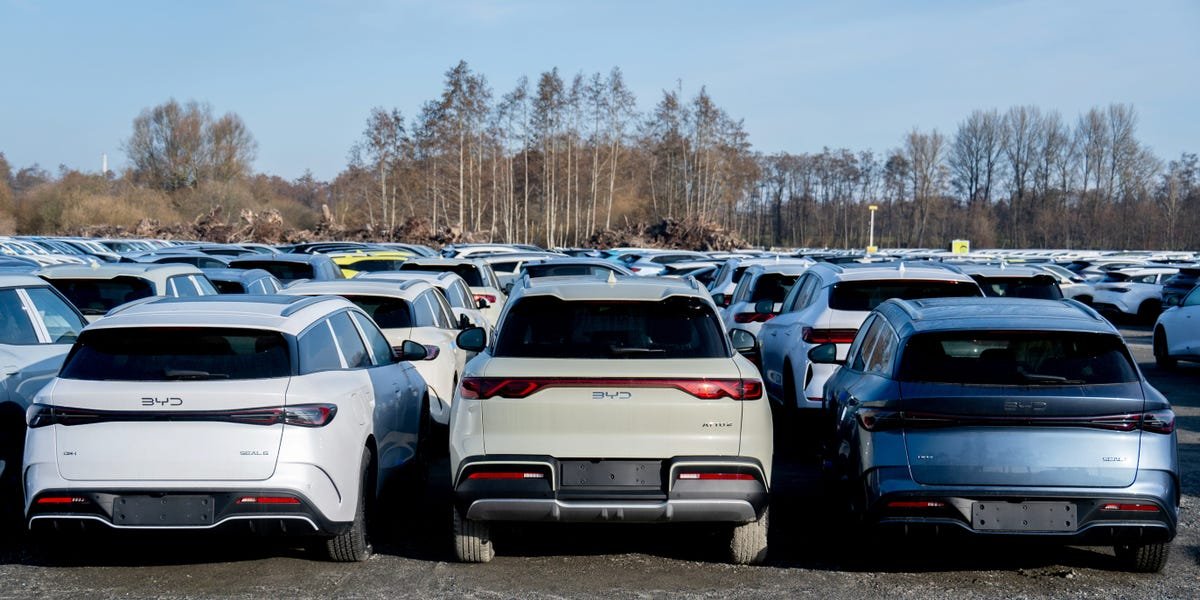
A lineup of cars in a parking lot.

China’s automotive technology is racing ahead. US auto executives have expressed concerns. 

Kevin Carter/Getty Images


Meanwhile, BYD’s technology keeps racing ahead of what legacy automakers offer. This month, the company revealed its new Blade 2.0 battery, which BYD said can charge from 10% to 70% in 5 minutes and deliver enough juice to power a car for more than 620 miles.

Those charging speeds are three times as fast as any EV on the US market.

And BYD isn’t alone. Several Chinese automakers — including Xiaomi, NIO, Li Auto, and XPeng — feature similar pricing and competitive battery technology.

Legacy automaker executives have taken note. In June, Jim Farley, Ford’s CEO, said Chinese EVs were “far superior” to US EV options. He repeated the sentiment in November, saying he was “humbled” after his engineers analyzed how Chinese competitors build their EVs.

“Unless things change, we will not survive,” Toyota’s current CEO, Koji Sato, said during a recent conference with auto parts suppliers, according to Automotive News. “Right now, we in the automotive industry are battling for our very survival.”

Not everything is rosy for the Chinese EV brand, Bernard of AutoPerspectives told Business Insider. He said the Chinese automakers still face challenges with long-term profitability, shifting government incentives (even in China), and potential backlash among US drivers.

Plus, constantly fluctuating gas prices are infrequently a stable driver for EV demand.

“It can become short attention span theater,” he said. “Gas prices move, and behavior follows — but not always for long.”

BYD didn’t immediately respond to a request for comment from Business Insider.


Source link

Global-military-spending-hit-26-trillion-in-2025-These-35.jpeg

Global military spending hit $2.6 trillion in 2025. These 35 nations have the most expensive militaries.

The world’s military budgets totaled $2.6 trillion in 2025, and the US accounted for more than a third of that.

The US has the world’s most expensive military, spending nearly $1 trillion on defense. That’s over three and a half times China’s reported defense budget, the next largest.

From spending on nuclear technology to advanced aircraft and warships, the world’s top militaries allocate hundreds of billions of dollars each year to stay ahead.

In some countries, big-ticket items such as naval assets or technologically advanced aircraft or missiles account for the bulk of military spending, while others devote large sums to maintaining large conscription troop systems.

Ultimately, military spending varies by country depending on location and interests, Gian Gentile, a retired US Army colonel and senior historian at RAND, told Business Insider. Some countries prioritize homeland defense while others value overmatch and far-reaching power projection.

“The US spends a lot on more sophisticated, extremely precise weapon systems,” he said.

A military’s budget can be measured either as a total amount or as a share of its country’s GDP, reflecting the burden on its economy. Worldwide, countries spent an average of 2.01% of their GDP on defense in 2025.

Wartime spending as a share of GDP typically rises, putting strain on the civilian economy, said Mark Cancian, a senior advisor at the Center for Strategic and International Studies. Ukraine in 2025, for example, devoted over 20% of its GDP to its military, the highest share globally.

Spending statistics help paint a picture of defense priorities, but they don’t always translate into readiness for conflict.

“Readiness is very expensive, and perishable,” Cancian said.

A country’s on-paper investment in its defense systems doesn’t always translate directly into military capability, he added. Training and maintenance are often overlooked in analyses of spending on equipment and technologies.

A particularly high cost when it comes to technologically advanced aircraft, for instance, is maintenance and sustainment.

Still, looking at military budgets can reveal how much capital each country relies on to defend itself.

Last year, the International Institute for Strategic Studies, a London-based think tank, released its Military Balance report, which included data on nearly every country’s defense budget based on each’s reported 2025 figures.

The report includes each country’s total budget (in US dollars), per-capita figures, and defense budget as a share of GDP. Some countries, such as North Korea, Libya, Syria, Cuba, and Afghanistan, did not publicly report their defense budgets.

These are the 35 countries that spend the most on their military, ranked by the size of their defense budgets.

35. Vietnam

Vietnam has the largest reserves in the world, with an estimated 5 million reservists.

NHAC NGUYEN/AFP via Getty Images

Defense budget: $8.41 billion

Defense budget per capita: $79

Percentage of GDP: 1.74%

34. Romania


Soldiers participate in military activities during the media day of the Multi-Domain Command Europe multinational exercise Dynamic Front, supported by NATO allied forces, at the military base in Cincu, Brasov county, Romania, 09 February 2026.

Romania budgets for about $527 per resident for its defense forces.

Alex Nicodim/Anadolu via Getty Images

Defense budget: $9.48 billion

Defense budget per capita: $527

Percentage of GDP: 2.24%

33. Pakistan


Pakistani soldiers

Pakistan spent a total of $10.02 on its military in 2025.

Abdul BASIT / AFP via Getty Images

Defense budget: $10.02 billion

Defense budget per capita: $39

Percentage of GDP: 2.44%

32. Qatar


A general view show armoured vehicles rolling during the military parade marking the Gulf emirate's National Day celebrations in Doha on December 18, 2012

Qatar had the second-highest military budget per capita in the world in 2025, at $3,935 per resident.

KARIM JAAFAR/AFP via Getty Images

Defense budget: $10.11 billion

Defense budget per capita: $3,935

Percentage of GDP: 4.55%

31. Mexico


The Isla Holbox (BAL-02) vessel belonging to the Mexican Navy (SEMAR), intended for humanitarian aid, is docked at Veracruz port in Veracruz, Mexico, on February 6, 2026. Mexico will ship humanitarian aid to Cuba in the coming days while continuing to negotiate with Washington on the possibility of circumventing a US oil siege, President Claudia Sheinbaum said on February 6.

Mexico allocates 0.61% of its GDP to military funding, per the IISS report.

Victoria Razo / AFP

Defense budget: $11.36 billion

Defense budget per capita: $86

Percentage of GDP: 0.61%

30. Denmark


Royal Danish Navy patrol ship

Denmark spent about $2,013 per resident on defense in 2025.

Florent VERGNES / AFP via Getty Images

Defense budget: $12.18 billion

Defense budget per capita: $2,013

Percentage of GDP: 2.65%

29. Iraq


Iraq military

Iraq budgeted for 4.78% of its GDP on military spending in 2025, IISS reported.

Zaid AL-OBEIDI / AFP

Defense budget: $12.68 billion

Defense budget per capita: $295

Percentage of GDP: 4.78%

28. Belgium


Belgian Land Force

Belgium spent nearly $14 billion on its defense funding in 2025.

JULIEN WARNAND / BELGA MAG / Belga / AFP via Getty Images

Defense budget: $13.9 billion

Defense budget per capita: $1,161

Percentage of GDP: 1.94%

27. Indonesia


Indonesian National Armed Forces troops stand in formation during preparations for deployment in Myanmar as part of the Indonesian government's relief mission to assist earthquake victims, at Halim Perdanakusuma Air Base in Jakarta on March 31, 2025

Indonesia allocates about $53 per resident on its military each year, per its 2025 budget.

BAY ISMOYO / AFP

Defense budget: $15.08 billion

Defense budget per capita: $53

Percentage of GDP: 1.04%

26. Norway


Norwegian soldiers march during a military parade on Armed Forces Day in Vilnius.

In 2025, Norway spent about $2,966 per resident on defense.

Yauhen Yerchak/SOPA Images/LightRocket via Getty Images

Defense budget: $16.44 billion

Defense budget per capita: $2,966

Percentage of GDP: 3.18%

25. Sweden


An NH90 helicopter is seen in flight after departing from a temporary base during the Nordic Response military exercise on March 07, 2024 in Kiruna, Sweden. The exercise, which primarily takes place across Scandinavia from March 3-14, features 20,000 troops from 13 allied countries. Following the recent NATO expansion, the group now includes Finland and Sweden.

Sweden’s defense budget amounts to about $1,602 per resident each year.

Leon Neal/Getty Images

Defense budget: $17.06 billion

Defense budget per capita: $1,602

Percentage of GDP: 2.58%

24. Singapore


The mobile column from the Singapore Armed Forces takes part in a parade during Singapore's 50th National day anniversary celebration at the Padang in Singapore on August 9, 2015

Singapore has the fourth-highest defense budget per capita in the world.

ROSLAN RAHMAN/AFP via Getty Images

Defense budget: $17.99 billion

Defense budget per capita: $2,958

Percentage of GDP: 3.13%

23. Taiwan


Taiwan air force

Taiwan budgets for 2.4% of its GDP on its military, or about $898 per resident, according to IISS.

I-Hwa Cheng / AFP

Defense budget: $21.2 billion

Defense budget per capita: $898

Percentage of GDP: 2.4%

22. Turkey


Turkish military on the Turkish-Iranian border

Turkey’s defense budget was over $21 billion, per the IISS report.

Anadolu/Anadolu via Getty Images

Defense budget: $21.48 billion

Defense budget per capita: $254

Percentage of GDP: 1.37%

21. United Arab Emirates


The United Arab Emirates Air Force's newly re-equipped Fursan Al-Emarat aerobatic display team flies the Hongdu L-15 advanced jet trainer from China at the Dubai Airshow on November 16, 2025 in Dubai, United Arab Emirates.

The United Arab Emirates has the seventh-highest defense budget per capita in the world.

VCG/VCG via Getty Images

Defense budget: $21.68 billion

Defense budget per capita: $2,148

Percentage of GDP: 3.81%

20. Brazil


Brazilian military parade

Brazil spends about 1.11% of its GDP on its military, according to its 2024 budget.

Anadolu/Anadolu via Getty Images

Defense budget: $24.27 billion

Defense budget per capita: $110

Percentage of GDP: 1.08%

19. Algeria


Algeria's military

Algeria spends the second-highest percentage of GDP on its military.

NurPhoto/NurPhoto via Getty Images

Defense budget: $25.21 billion

Defense budget per capita: $528

Percentage of GDP: 8.75%

18. Spain


Spanish military

Spain budgeted about 1.53% of its GDP for military spending in 2025.

picture alliance/dpa/picture alliance via Getty Images

Defense budget: $28.91 billion

Defense budget per capita: $611

Percentage of GDP: 1.53%

17. The Netherlands


Dutch military drone

The Netherlands budgeted $1,633 per resident on its military.

Remko de Waal / ANP / AFP

Defense budget: $29.12 billion

Defense budget per capita: $1,633

Percentage of GDP: 2.2%

16. Canada


Canadian Armed Forces

Canada’s military budget was over $31 billion in 2025.

Artur Widak/NurPhoto

Defense budget: $31.21 billion

Defense budget per capita: $797

Percentage of GDP: 1.37%

15. Poland


Soldiers of the Polish Armed Forces ride a battle tank

Poland spends over 3% of its GDP on its military.

Aleksander Kalka/NurPhoto

Defense budget: $33.18 billion

Defense budget per capita: $865

Percentage of GDP: 3.19%

14. Australia


Australian air forces helicopter

Australia’s defense budget equals around $1,378 per resident.

Ian Hitchcock/Getty Images

Defense budget: $37.28 billion

Defense budget per capita: $1,378

Percentage of GDP: 2.04%

13. Israel


IDF soldiers prepare tanks on August 18, 2025 near the Gaza Strip's northern borders

At $4,153 per resident, Israel had the largest military budget per capita in the world.

Elke Scholiers/Getty Images

Defense budget: $39.68 billion

Defense budget per capita: $4,153

Percentage of GDP: 6.5%

12. Italy


Members of the Italian armed force (82° Reggimento Fanteria

Italy allocates about 1.58% of its GDP on military spending, according to its 2025 budget.

Antonio Masiello/Getty Images

Defense budget: $40.09 billion

Defense budget per capita: $658

Percentage of GDP: 1.58%

11. South Korea


South Korea military

South Korea’s military budget reached nearly $44 billion in 2025, per IISS’ reporting.

Kim Jae-Hwan/SOPA Images/LightRocket via Getty Images

Defense budget: $43.84 billion

Defense budget per capita: $851

Percentage of GDP: 2.36%

10. Ukraine


Ukrainian military

Ukraine budgeted the highest percentage of its GDP for defense among countries, a common practice during wartime.

Tetiana DZHAFAROVA / AFP

Defense budget: $44.44 billion

Defense budget per capita: $1,217

Percentage of GDP: 21.19%

9. Japan


Japan military

Japan’s defense budget was nearly $59 billion in 2025.

JIJI Press / AFP

Defense budget: $58.91 billion

Defense budget per capita: $480

Percentage of GDP: 1.38%

8. France


French soldiers wait for the arrival of French President at the Istres military air force base where he is scheduled to deliver his New Year's address to the armed forces in Istres, southern France, on January 15, 2026.

France budgeted just over 2% of its GDP for defense funding in 2024.

Philippe Magoni / POOL / AFP

Defense budget: $70 billion

Defense budget per capita: $1,022

Percentage of GDP: 2.08%

7. Saudi Arabia


Saudi armed forces show their skills during a drill in Saudi Arabia's holy city of Mecca on August 13, 2018, ahead of the annual Hajj pilgrimage.

Saudi Arabia has the seventh-highest defense budget per capita at $1,951 per resident.

BANDAR ALDANDANI/AFP via Getty Images

Defense budget: $72.53 billion

Defense budget per capita: $1,951

Percentage of GDP: 5.72%

6. India


Indian Air Force's Sarang helicopter display team fly in formation during a media preview aerial display ahead of the Singapore Airshow in Singapore on February 1, 2026.

India budgeted for about $55 per resident.

Roslan RAHMAN / AFP

Defense budget: $78.31 billion

Defense budget per capita: $55

Percentage of GDP: 1.9%

5. United Kingdom


Members of the British military at RAF Leeming prepare for Exercise Hyperion Storm, a joint force validation exercise with the UK Special Operations Forces being held at RAF Leeming and the Otterburn Training Area in the north of England. Picture date: Friday January 30, 2026.

The United Kingdom’s defense budget in 2025 was over $94 billion, per the report.

Owen Humphreys – PA Images/PA Images via Getty Images

Defense budget: $94.26 billion

Defense budget per capita: $1,371

Percentage of GDP: 2.38%

4. Germany


German Defence Minister Boris Pistorius and Bavarian State Premier Markus Soeder attend the inauguration of the Innovation Center of the German Armed Forces Bundeswehr in Erding, Bavaria, southern Germany on February 2, 2026.

Germany has the highest-funded military in Europe.

Michaela Stache / AFP

Defense budget: $107.31 billion

Defense budget per capita: $1,277

Percentage of GDP: 2.14%

3. Russia


Russian tanks roll on Red Square during the Victory Day military parade, marking the 80th anniversary of the Victory in the Great Patriotic War, on May 9, 2025 in Moscow, Russia. Russia marks the 80th anniversary of the victory in World War II over Nazi Germany and its allies.

Russia spends a higher percentage of its GDP on defense spending than other nations.

VCG/VCG via Getty Images

Defense budget: $161.18 billion

Defense budget per capita: $1,150

Percentage of GDP: 6.34%

2. China


CJ-20A air-launched cruise missiles are seen during a military parade marking the 80th anniversary of victory over Japan and the end of World War II, in Beijing's Tiananmen Square on September 3, 2025.

China’s defense budget is equal to $178 per resident.

Greg Baker / AFP

Defense budget: $251.29 billion

Defense budget per capita: $178

Percentage of GDP: 1.3%

1. United States


U.S. Navy Landing Craft Air Cushion's (LCAC) unload equipment onto the beach as U.S. Marine Corps V-22 Ospreys and CH-53 Super Stallions fly overhead during the America's Marines 250 event at Camp Pendleton's Red Beach on October 18, 2025 in Oceanside, California. The U.S. Marines are marking their 250th anniversary with a live amphibious assault demonstration entitled

The US also has the fifth-highest military budget per capita.

Mario Tama/Getty Images

Defense budget: $921.02 billion

Defense budget per capita: $2,725

Percentage of GDP: 3.01%


Source link

AI logo

Atlassian lays off 10% of its global workforce and attributes the cut to the ‘AI era’


Dado Ruvic/REUTERS

  • Atlassian announced plans to cut 1,600 jobs to focus on AI and enterprise growth initiatives.
  • CEO Mike Cannon-Brookes cited AI’s impact on workforce needs as a reason for the layoffs.
  • 30% of the job cuts impact Atlassian employees based in Australia, reflecting global changes.

Another tech company is making job cuts and attributing them to AI.

Atlassian, an Australian-American proprietary software company, said on Wednesday that it is cutting about 1,600 jobs, roughly 10% of its global workforce, as the company restructures to focus on AI and enterprise growth.

In a filing with the US Securities and Exchange Commission, the Sydney-headquartered company said the layoffs are part of a broader effort to reposition the business for what CEO Mike Cannon-Brookes described as the “AI era.” About 30% of the affected roles are based in Australia.

In a message to employees, Cannon-Brookes acknowledged the growing influence of AI on the company’s workforce needs.

“It would be disingenuous to pretend AI doesn’t change the mix of skills we need or the number of roles required in certain areas. It does,” Cannon-Brookes wrote.

“I believe this is the right decision for Atlassian. But that doesn’t mean it’s easy. Far from it,” Cannon-Brookes added. “I know this has a huge impact on each of you, and it weighs heavily on me and Atlassian today.”

This is a developing story. Check back for updates.


Source link

TikToks-global-marketing-head-is-leaving.jpeg

TikTok’s global marketing head is leaving

  • Sofia Hernandez, TikTok’s global head of marketing and commercial partnerships, is leaving.
  • Hernandez oversaw TikTok’s marketing strategy for brands, advertisers, and consumers.
  • Isobel Sita-Lumsden, another TikTok exec based in the UK, will take her place.

Sofia Hernandez, TikTok’s global head of marketing and partnerships, is leaving the company, according to a memo from global business solutions lead Will Liu.

Hernandez worked at TikTok and ByteDance for nearly six years. She initially focused on marketing related to the company’s advertising business before expanding her remit to include consumer marketing. Prior to joining TikTok, Hernandez served as chief customer officer at the consumer-insights platform Suzy. Before that, she worked at a creative agency within Publicis Groupe.

Hernandez is being replaced by Isobel Sita-Lumsden, an exec in the UK who has focused on off-platform marketing partnerships and social, according to the memo.

“Sofia played a defining role in shaping our global go to market approach,” Liu wrote in his memo. “This included expanding our presence across priority markets, and strengthening how brand, product and commercial teams work together.”

Hernandez is the latest in a string of US executives to leave TikTok in the past year. About a year ago, advertising executive Blake Chandlee, who previously oversaw global business solutions, stepped down. In January, Kim Farrell, TikTok’s global head of creators, left the company amid a reorganization of the company’s content division.

Hernandez’s exit comes at a moment of transition for TikTok, which recently split off parts of its US business into a joint venture. While some employees now work for a new US division overseen by managing investors like Oracle, Silver Lake, and MGX, advertising and marketing workers remain under the oversight of ByteDance.

TikTok and ByteDance did not immediately respond to a request for comment.


Source link

Bradley Saacks

Citadel and Millennium posted gains in a choppy February as Balyasny and Jain Global slipped

Ken Griffin’s Citadel performed across the board in February.

The firm’s five strategies that feed into its flagship Wellington fund — fundamental equity, quant, commodities, fixed income and macro, and credit and convertibles — were all up last month, a person close to the Miami-based manager told Business Insider.

The fund was up 1.9% on the month, bringing its 2026 gains to 2.9%.

The firm, which managed $66 billion at the start of February, notched gains of 1.5% in February in its tactical trading fund, which blends the firm’s fundamental stockpickers with its computer-run equity portfolios.

Michael Gelband’s ExodusPoint, which had its best year on record in 2025, was up 0.9% last month, a person close to the New York-based firm said. The manager is now up 2.6% for 2026. Millennium is now up 2% on the year after a 0.6% gain in February.

It was another banner month for Asia-based multistrategy funds. $6 billion Dymon Asia made nearly 5% in February, bringing its 2026 gains to more than 10%, while Pinpoint Asset Management is up 6.6% for the year in its flagship fund.

The stock market was down on the month, as the S&P 500 index gave back some of the gains it had notched in January. The broad sell-off in software stocks, driven by AI releases, hurt blue-chip companies like Salesforce.

There were a few multistrategy managers that ended the month down. Balyasny lost 0.4% on the month, though is still positive for the year. Walleye had its second straight down month in February, and is now down 1.4% in 2026. Jain Global lost money again in February and is down 2.2% on the year.

This month has already been volatile thanks to the strikes against Iran by the US and Israel on Saturday. Oil prices have surged, and stocks tumbled on Monday.

Firms mentioned in the story and the table below declined to comment.

This story was originally published on March 2 at 10:22 a.m. New figures have been added to the table below as they have been learned.


Source link

Jordan Hart's face on a gray background.

Apple bumps up the prices of its new MacBook Air and MacBook Pro as global memory shortage continues

Amid the global memory shortage, Apple didn’t raise prices for its latest iPhone and iPad. That’s not the case for its new MacBooks.

After Monday’s reveal of the iPhone 17e and iPad Air, it’s the Mac lineup’s turn for a revamp. The tech giant announced on Tuesday a new MacBook Air, MacBook Pro, and Studio Display.

Apple introduced the M5 Pro and M5 Max chips that will power two versions of the MacBook Pro, and the MacBook Air will run on an M5 chip.

The MacBooks got a price bump along with the new chips, which offer faster performance, as well as higher storage capacity.

The MacBook Air starts at $1,099 for the 13-inch and $1,299 for the 15-inch version — a $100 price increase for each model.

The M5 Pro MacBook Pro starts at $2,199 for the 14-inch option, up from $1,999. The 16-inch will go from $2,499 to $2,699. For the M5 Max MacBook Pro, the starting price is $3,599, up from $3,199.

While Apple didn’t specify a reason for the price hikes, they arrive as the consumer electronics industry grapples with a global memory shortage as the artificial intelligence race shakes up the supply chain and market for memory chips, which are used in computers and other devices.

In its January earnings call, Apple said it expected the price of memory to continue to increase. However, CEO Tim Cook declined to speculate on whether or not it would lead to increased prices for Apple’s products.

Best Buy CEO Corie Barry addressed the memory shortage earlier on Tuesday during the retailer’s earnings call.

“As you are aware, the significantly increased demand for memory components is driving cost inflation and supply uncertainty, particularly in computing. We are partnering with our vendors to mitigate impacts on the business,” she said. “We are focused on five major themes. One, we are bringing in as much inventory as we can. We are also providing our vendors with a longer forecast horizon to better plan allocations across commercial and consumer segments and collaborate more effectively with memory partners.”

The key features that Apple highlighted in the new MacBook Air are the Liquid Retina display, up to 18 hours of battery life, and a 12 megapixel camera. It comes in four colors: sky blue, midnight, starlight, and silver. For the higher entry price, customers will also get double the amount of starting storage at 512 gigabytes.

Apple said the new MacBook Pro with the M5 Pro chip delivers faster AI image generation, LLM prompt processing, and gaming performance, with the M5 Max building on that speed even more. Apple touts the new chips as game-changers for the MacBook Pro’s AI capabilities. The M5 Pro MacBook Pro starts at one terabyte of storage, up from the previous 512 gigabytes, while the M5 Max model doubled its starting storage to two terabytes.

The Studio Display, which starts at $1,599, and the $3,299 Studio Display XDR boast 5K Retina displays designed for video editing, 3D rendering, and more workflows.

The new computers are available for pre-order starting Wednesday.


Source link

How-a-162-year-old-Turkish-delight-shop-became-a-global-dessert.jpeg

How a 162-year-old Turkish delight shop became a global dessert empire

Hafiz Mustafa has been perfecting Turkish delight since 1864. Now with three factories and 24 locations, including in London and Dubai, the company is preparing for even greater expansion, with potential branches in the US.

But instead of franchising or mass-producing its sweets, Hafiz Mustafa insists on making everything fresh in-house to maintain authenticity. We visited Istanbul to see how this 162-year-old confectioner is protecting tradition while competing in the modern global dessert market.


Source link

Microsoft-backed-Wayve-raises-15-billion-to-take-its-robotaxis-global.jpeg

Microsoft-backed Wayve raises $1.5 billion to take its robotaxis global and take on rival Waymo in London

Wayve is revving up its global robotaxi ambitions with fresh funding as it prepares to take on Waymo in London.

The UK-based autonomous vehicle software startup announced early Tuesday in the UK that it had raised $1.5 billion from a host of Big Tech giants and major automakers.

The funding round, which values the startup at $8.6 billion, includes $1.2 billion from investors including Microsoft, Nvidia, and Uber, as well as Mercedes-Benz, Nissan, and Stellantis.

It also includes additional capital from Uber, which is tied to deployments of Wayve-powered robotaxis across the globe. The two companies have a deal to launch self-driving vehicles on Uber’s app in over 10 markets worldwide, starting with London this year.

“We’ve been learning to drive on British roads for the last eight years, and so this is our home turf,” Alex Kendall, CEO of Wayve, told Business Insider in an interview.

The CEO said the latest funding round is key to pursuing the company’s ambition to license its software to major automakers and robotaxi fleet platforms like Uber.

Unlike Tesla or Waymo, Wayve is solely focused on developing software for other companies looking to deploy self-driving cars. It is not building its own fleet of robotaxis.

Kendall said owning a fleet is expensive, and Tesla’s approach to building its own car can be a constraint since it limits the company to one vehicle platform.

“Everyone wants autonomy, but not everyone wants to buy a Tesla,” he said.

Kendall added that Wayve’s AI driver is designed to be generalizable — the same way a human can quickly learn to drive different cars and in new cities.

That allows Wayve’s technology to quickly adapt to new driving environments and learn new road rules, from switching to the opposite side of the road to right turns at a red light, without relying on high-definition mapping and sensors, the approach taken by rivals like Waymo. It also allows the AI driver to be adapted by different automakers, which may have different sensor configurations on their cars, such as lidar or cameras.

“Because that’s what we’ve built, it enables us to take this business model that enables high-margin software revenues,” Kendall said.

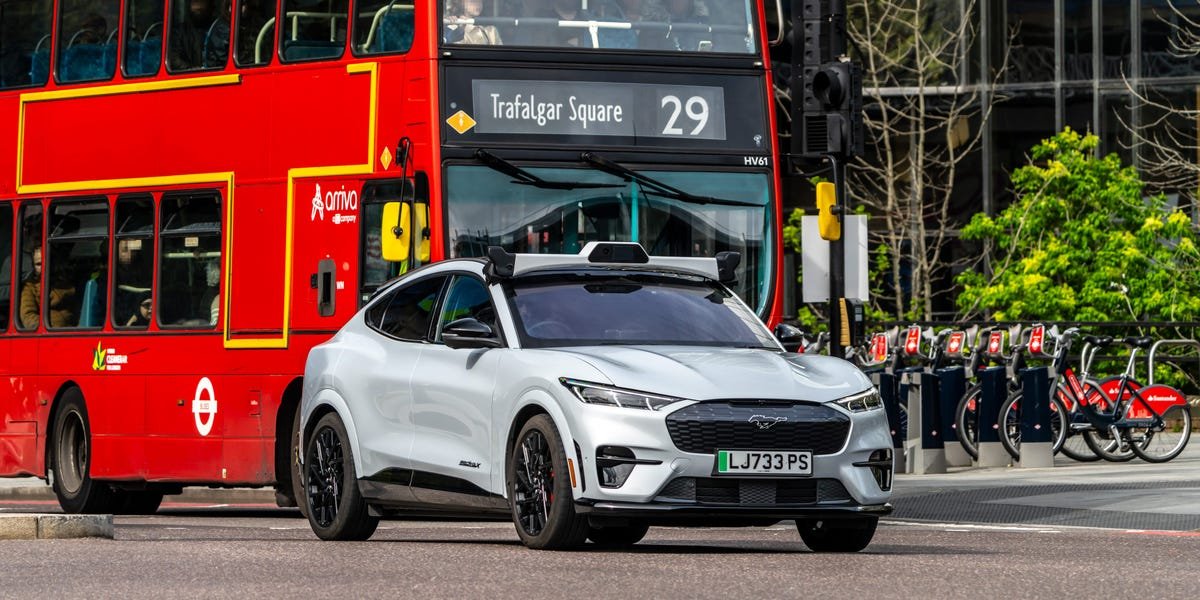
Wayve says that over the past year, its fleet of Ford Mach-Es outfitted with its AI driver has driven in more than 500 cities across Europe, North America, and Japan without being trained on city-specific data.

The company is also planning to license its technology to carmakers as an advanced driver-assistance system like Tesla’s Full Self-Driving, which handles most driving tasks with human supervision. Wayve has a deal with Nissan that will see its AI tech power the Japanese carmaker’s ProPilot driver assistance system from 2027.

The UK-based startup has been testing its tech in London since 2017, and its public debut comes as the city’s robotaxi scene gets increasingly crowded.

Waymo is aiming to begin operating its autonomous vehicles in London, its first international location, this year, while Wayve vehicles will be joined on the Uber app by robotaxis from Chinese tech giant Baidu, which is also partnering with Lyft.


Source link

Divya-Nettimis-Avala-Global-loses-more-staff-despite-a-strong.jpeg

Divya Nettimi’s Avala Global loses more staff despite a strong 2025

Avala Global, launched by former Viking Global star trader Divya Nettimi, had strong performance numbers in 2025.

However, the firm has continued to lose staff.

Three investment analysts left in the second half of 2025, and Nettimi’s fund is set to lose two more senior executives in 2026, including the firm’s COO.

Avala Global, the $2 billion manager launched by Nettimi in late 2022, gained 22.1% in 2025, according to the firm’s year-end letter to clients, which was viewed by Business Insider. Several people close to the firm told Business Insider that the manager achieved these returns despite losing analysts Jordan Straff, Nadine Lin, and Michael Wang.

Straff was a longtime investor at Roberto Mignone’s Bridger Capital before joining Avala in early 2024, while Lin and Wang both joined from Steve Cohen’s Point72.

The manager will also lose its COO, David Angstreich, and top fundraiser, Rebecca Chia. Both are set to depart in the coming months, three people close to the firm tell Business Insider.

Angstreich and Lin did not respond to requests for comment, while Chia and Straff declined to comment. Business Insider could not reach Wang in time for publication. Avala declined to comment.

Angstreich has been with Avala since its launch, while Chia joined in mid-2025 after stints at Atalaya Capital and Third Point.

The letter highlighted the team’s “depth and experience” but made no mention of the departures or expected exits. The firm hired onetime Viking Global general counsel Andrew Genser as its in-house lawyer last year and added at least four new analysts in 2025, LinkedIn shows, including two end-of-year hires from private equity firm Clayton Dubilier & Rice.

“We believe we have laid a strong foundation for the next phase of our growth,” the letter reads.

Last June, Business Insider reported that a majority of Avala’s day-one team had left the firm, including the entire four-person investing team that reported to Nettimi. Three people who had previously worked at the firm told Business Insider they left because of a tense workplace environment that came from the top of the firm. While she declined to address the specifics around different employees’ exits, Nettimi told Business Insider last year that she was confident in her team and the process for finding and vetting new talent.

Nettimi, a former Forbes 30 under 30 honoree who spent years investing at Viking Global, has managed to make money despite the churn. The firm has made more than 20% in each of the three full years it has been trading, besting the S&P 500 and Nettimi’s former manager over the same period.

The firm’s most recent letter to investors stated that long-term holdings in stocks such as data-storage company Seagate Technology, German power company Siemens Energy, and Finnish sporting goods conglomerate Amer Sports were key in driving performance last year.


Source link