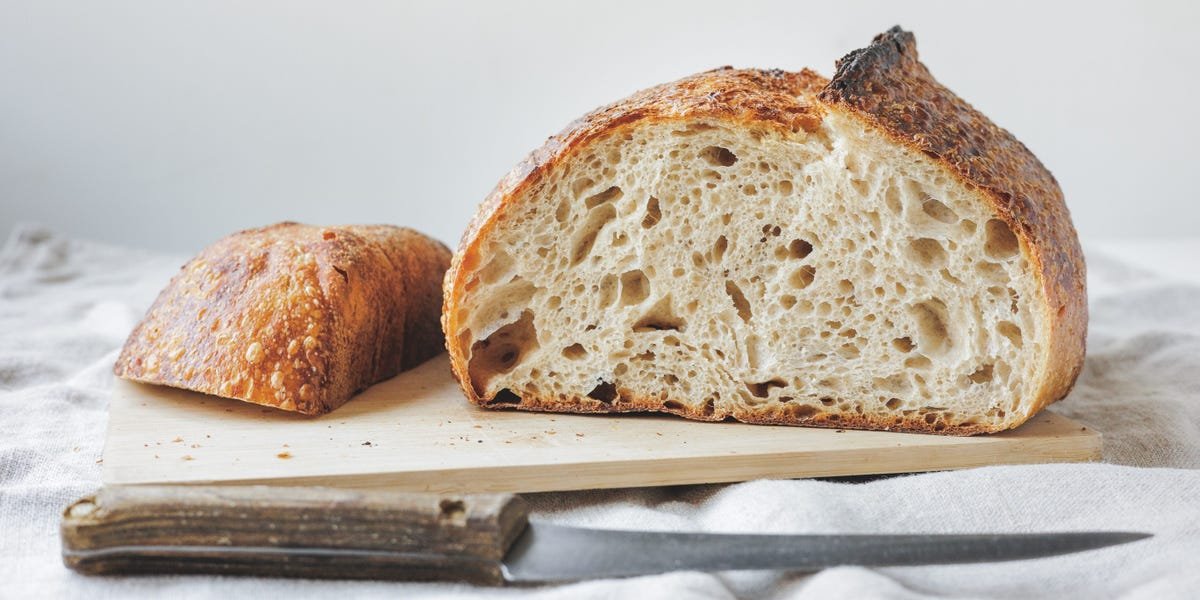
I-make-my-own-sourdough-bread-to-save-money-on.jpeg

I make my own sourdough bread to save money on groceries. Here are 5 things I wish I’d known before starting.

Seven years ago, I started making my own sourdough bread.

In addition to being a relaxing hobby that’s taught me the importance of patience, making bread also keeps me from spending ridiculous amounts of money on loaves from the grocery store.

However, baking sourdough is pretty different from other types of bread. This is partially because sourdough requires a starter — a fermented mixture of flour and water that creates its own yeast and bacteria.

The process of creating a starter, and eventually bread, isn’t foolproof and can take beginners a little while to grasp.

Here are five things I wish I’d known before making sourdough bread for the first time.

A sourdough starter needs to be fed like a pet


A jar of sourdough starter next to a loaf of the baked bread.

A sourdough starter should be fed often.

leonori/Getty Images


To keep a sourdough starter active, it has to be fed regularly using flour and water. However, I didn’t realize this until I inherited my first one.

How often it’s fed depends on where it’s stored. For example, if I leave the starter on the counter, I feed it once every 12 to 24 hours.

When I keep it in the refrigerator, however, I can feed it less, typically about once a week. This schedule also varies depending on how often I bake.

The starter can be preserved in a few different ways

When I first started making sourdough, I didn’t know I could store my starter for a while without feeding it.

Turns out, it can be left in the freezer for up to a year. Another more reliable, long-term storage option is to dehydrate the sourdough starter.

This would’ve been good to know when I let mine go bad because I went on a work trip and couldn’t find a friend to feed it for me.

A starter can be brought back to life

Luckily, even if the starter looks grim, it’s still possible to bring it back to life.

To do this, I feed mine filtered water and flour and wait a few days to see if bubbles start to form. It may take a while to get the cultures moving again, especially if the starter has been freeze-dried or dehydrated.

When it bubbles up and doubles in size, I know I have a pillowy, healthy starter to resume baking with.

Discard doesn’t actually need to be discarded


Freshly baked muffins on a baking rack.

Sourdough discard can be used to make muffins.

AshtonLNelson/Shutterstock


I didn’t realize until far into the process that sourdough discard can be used for other recipes. I figured the term indicated the runoff’s value.

However, it can either be composted or used in other recipes like flatbreads, pastries, rolls, waffles, muffins, and more.

When making sourdough, patience is key

Throughout the process, it’s important to remember that fermentation takes time. Living cultures need the ideal environment to engage, grow, and develop a strong and active formula.

My sourdough hobby definitely hasn’t satisfied any need for instant gratification. But it has tested my patience, indulged my mad-scientist alter ego, and encouraged a certain level of imagination in the kitchen.

This story was originally published on March 13, 2025, and most recently updated on March 9, 2026.


Source link

My-husband-and-I-work-from-home-and-try-to.jpeg

My husband and I work from home and try to follow a nutritious diet. Here are 10 of our favorite groceries to buy at Aldi.

  • As empty nesters who work from home, my husband and I love shopping at Aldi.
  • The Elevation energy bars and Summit Popz prebiotic sodas are good substitutes for pricier brands.
  • I love snacking on the Simply Nature coconut clusters and Southern Grove trail mix.

As empty nesters who both work from home, my husband and I try our best to choose nutritious food options while keeping our grocery costs low.

Luckily, shopping at Aldi helps us achieve both of these goals. Here are some of our favorite products to buy.

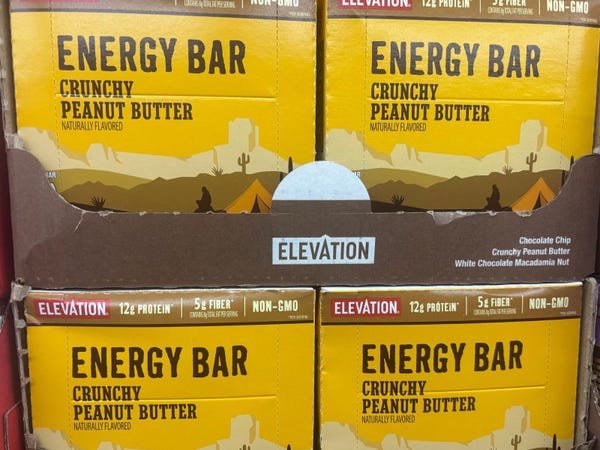
My husband enjoys the peanut butter Elevation energy bars.

Elevation energy bars are a great afternoon pick-me-up.

Amy Barnes

My husband recently stopped buying Clif Bars and replaced them with the more budget-friendly Elevation energy bars from Aldi.

These come out to just about $1 per bar, and he says the taste and texture are great.

He likes to enjoy them as a snack or an afternoon pick-me-up.

I love snacking on the Simply Nature coconut clusters.


Bags of Simply Nature coconut clusters on display at Aldi.

The Simply Nature coconut clusters are made with pumpkin, sunflower, and hemp seeds.

Amy Barnes

The Simply Nature coconut clusters satisfy my sweet tooth, with only 160 calories per serving.

These crunchy clusters are made with a mix of pumpkin, sunflower, and hemp seeds.

Southern Grove trail mix is great for when I’m hiking.


Boxes of Southern Grove trail mix on display at Aldi.

This Southern Grove trail mix is made with cranberries, sunflower kernels, almonds, edamame, chocolate, and peanuts.

Amy Barnes

Whenever I head to Aldi, I like to grab snack-size portions of trail mix. I especially love the Southern Grove version because it doesn’t include raisins.

Packed with cranberries, sunflower kernels, almonds, edamame, chocolate, and peanuts, this mix is easy to snack on at home or when we’re hiking with our dog.

I prefer Aldi’s egg bites to the Starbucks version.


Boxes of Whole & Simple omelet breakfast bites on display at Aldi.

The Whole & Simple egg bites are easy to heat up in the morning.

Amy Barnes

I’m always hunting for delicious protein options to start my day, and I often find myself craving the egg bites from Starbucks. However, my wallet doesn’t love them as much as I do.

So, I’ve switched to Aldi’s Whole & Simple version, made with bell peppers, uncured ham, and cheddar. I think they taste similar to the Starbucks version and they’re easy to heat up at home.

We love the Happy Farms spreadable cheese wedges.


Containers of Happy Farms spreadable cheeses on display at Aldi.

There are lots of different varieties of Happy Farms spreadable cheese.

Amy Barnes

Since we both work from home, my husband and I are always looking for quick lunch options. We like the Happy Farms spreadable cheese wedges, which cost less than $3 each, and taste great on their own or in wraps.

Simply Nature popcorn is great for movie night.


Bags of Simply Nature popcorn on display at Aldi.

Each cup of Simply Nature sea-salt popcorn contains 35 calories.

Amy Barnes

At only 35 calories per cup, I like to have Simply Nature popcorn with my lunch or as a movie-watching snack when the kids come back home. It’s also a good source of fiber and is gluten-free.

Aldi’s steamed vegetable medleys make dinner easy.


Bags of steamed vegetables on display at Aldi.

I love the Season’s Choice Asian-seasoned vegetable medley.

Amy Barnes

Whenever I take a trip to Aldi, I look for the Season’s Choice steamed vegetable medleys. These bags of brightly-colored veggies are reasonably priced and easy to make.

I like to season my veggies with Burman’s stir-fry sauces.


Bottles of Burman's sweet and sour stir-fry sauce on display at Aldi.

Burman’s stir-fry sauces are a great way to add flavor to steamed vegetables.

Amy Barnes

Instead of ordering take-out, I like to season my steamed vegetables with Burman’s orange or sweet and sour sauces. I just add some chicken to create an easy stir-fry meal.

Aldi sells a great substitute for brand-name probiotic sodas.


Cans of Summit Popz prebiotic soda on display at Aldi.

I love the Summit Popz prebiotic sodas.

Amy Barnes

Staying hydrated while working from home is a necessity, and I love sipping on the Summit Popz prebiotic sodas. I think they’re a great alternative to the more expensive Poppi sodas.

Click to keep reading Aldi diaries like this one.


Source link

Screen Shot 2020 09 04 at 6.22.07 PM

DoorDash’s CEO says he’s got an edge on Amazon in groceries

DoorDash CEO Tony Xu says that his company’s grocery offering has a key advantage over Amazon: choice.

Amazon is doubling down on grocery delivery, especially perishables like produce and ice cream. The retail and tech giant said last month that it’s expanding same- and next-day grocery delivery to more parts of the US this year, adding to the thousands of towns and cities it already serves — news that sent shares of Instacart and DoorDash tumbling at the time.

DoorDash, though, has something that shoppers want and that Amazon isn’t replicating, Xu said on the company’s fourth-quarter earnings call on Wednesday.

Unlike Amazon, which owns Whole Foods and several of its own food brands, DoorDash works with existing grocery chains. The delivery service has struck deals in recent years. Last year, it expanded its partnership with Kroger and signed new deals with regional chains, including Schnucks in the Midwest.

Few customers complete all their grocery shopping at a single chain, Xu said. Many stop at multiple stores each week, especially to find specific fresh groceries, such as produce, meat, and seafood.

“Consumers prefer choice,” Xu said on the call, adding that he expects there to “continue to be very strong interest in the DoorDash product” as a result.

DoorDash is also expanding its services for retailers, such as fulfillment through its DashMarts, convenience store-sized retail spaces designed for picking and delivering orders.

Xu said DoorDash is “doing that for every single grocer so that they have the capability to compete against companies like Amazon.”

DoorDash shares rose as much as 14% in after-market trading on Wednesday, despite disappointing fourth-quarter earnings and guidance for 2026. The company’s stock took its biggest one-day hit in November after it unveiled plans to spend hundreds of millions of dollars on tech improvements.

While DoorDash has become known for restaurant deliveries, its gig workers are increasingly making grocery deliveries — many of which make more financial sense for DoorDash.

Xu said DoorDash has attracted more big grocery orders from customers, not just small fill-in trips. That matters in the grocery industry, where grocers tend to make more money when customers buy a wider range of goods.

“People use us for both the quick runs as well as the stock-up use cases,” he said.

Ravi Inukonda, DoorDash’s CFO, said on the call that DoorDash’s retail and grocery business expects to “be unit-economic positive” in the second half of 2026.

Have a tip? Contact this reporter at abitter@businessinsider.com or via encrypted messaging app Signal at 808-854-4501. Use a personal email address, a nonwork WiFi network, and a nonwork device; here’s our guide to sharing information securely.



Source link

Line chart

Inside Amazon’s ‘mind-blowing’ plan to fix groceries and beat Walmart

For years, Amazon was cast as Walmart’s great disruptor. Now, it’s borrowing from the retail giant it once sought to upend.

The company is rolling out Walmart-inspired ideas, including “Supercenter” warehouses, a new distribution layer known internally as the “1DC” network, and microfulfillment centers within Whole Foods stores, according to internal documents obtained by Business Insider.

The shift reflects a hard lesson: mastery of e-commerce does not translate into dominance in groceries, particularly perishable items that drive frequent shopping. Walmart’s dense network of stores and distribution centers, designed to move everyday goods quickly and cheaply, has proved difficult to replicate.

Nearly a decade after paying $13.7 billion for Whole Foods, Amazon still trails Walmart in everyday grocery shopping, and is now reshaping its retail infrastructure to compete head-on with Walmart’s Supercenter model.

Earlier this month, plans emerged for a roughly 225,000-square-foot Amazon megastore near Chicago. Bigger than a typical Walmart Supercenter, the new concept is designed to let customers buy “fresh groceries, household essentials, and general merchandise — all in one trip,” according to Amazon.

Michael Levin and Josh Lowitz, cofounders of Consumer Intelligence Research Partners, called the move “mind-blowing” and said “it reveals a degree of Walmart jealousy that we didn’t expect.”

Powerful store network

There’s a lot to be jealous about. With roughly 90% of the US population estimated to live within 10 miles of a Walmart store, the company’s 5,000-plus locations give it a powerful edge in selling fresh food and other perishables, along with many other everyday staples.

According to research firm Numerator, Walmart accounted for about 21% of the US grocery market, both online and in-store, as of September. Amazon and Whole Foods, meanwhile, each held roughly 1.6% of the market.

Meanwhile, Walmart is leveraging its Supercenters to deliver online orders faster, challenging Amazon at its own game.

That’s fueled a surge in Walmart shares, valuing the company close to $1 trillion. The stock is up almost 150% over 5 years, far outpacing Amazon’s roughly 53% gain (although Amazon is still worth more).

Amazon does well with non-perishable goods and everyday essentials such as toothpaste and paper towels. Overall, it offers millions of products for same-day delivery.

But when it comes to more delicate food items, such as pears, meat, and cheese, the company knows it has more work to do.

A company spokesperson said Amazon serves more than 150 million US grocery customers, offers nearly 3 million grocery and household items, and provides same-day delivery in more than 9,000 cities and towns.

Grocery is an “ever-growing” part of its fast-delivery business, the spokesperson added, while noting that in 2025, Amazon added perishable groceries to its Same-Day Delivery service, now available in 2,300 locations, allowing customers to shop without trade-offs between speed, selection, and savings.

Amazon’s Supercenter ambition

One element of this fresh Amazon effort is a new type of same-day delivery warehouse internally called an “SSD Supercenter.” SSD refers to sub-same-day deliveries, typically within four hours. Unlike traditional SSD warehouses that tend to be smaller, these facilities are designed to be larger to close the selection gap, specifically with “Walmart” in groceries, the document said.

Internal planning documents show Amazon intended to launch at least five such sites last year. Amazon wanted to test whether customers would “step-change their shopping habituation and engagement” once the Supercenter warehouses went live, one of the documents stated. Amazon planned to add products not currently sold on its site to the new warehouse and take a more hands-on approach to inventory sourcing, with in-stock targets above 95%, according to the document.

Sub-same-day grocery delivery is still a tiny part of Amazon’s business. At the end of September, it had 30 million eligible customers for this service, according to one of the internal documents obtained by Business Insider. Only 1.6 million of them, or roughly 5%, shopped through the service.

Speed, at scale

Amazon’s Supercenter warehouses are part of a broader push to expand same-day grocery delivery. Internal forecasts called for at least 34 US same-day grocery sites in 2025. Amazon already operates over 80 same-day facilities nationwide, though not all handle groceries, according to Marc Wulfraat, president of logistics consultancy MWPVL.

Amazon is also planning to take the model overseas. Under an initiative known as Project Taylor, the company plans to expand sub-same-day grocery delivery across Europe. It also plans to pilot sub-two-hour “ultrafast” deliveries in London in 2026, one of the documents showed.

A new “1DC” layer in the network

Less visible, but just as important, is a new upstream distribution layer called “1DC.”

These facilities store the most frequently purchased products and replenish fulfillment centers as demand emerges. That can shift weeks’ worth of inventory out of space-constrained fulfillment centers and into distribution sites optimized for palletized storage and rapid transfer.

One internal document described the change as a move from a “push” system, in which inventory is positioned based on forecasts, to a “pull” system that allows fulfillment centers to draw inventory from distribution centers as needed.

Amazon began rolling out the 1DC concept last year through new buildings and retrofits. By the end of 2025, the company planned to operate a dozen of these centers, capable of moving at least 20 million units a week, according to one of the documents. As of October 2025, the facilities only handled non-perishables, including shelf-stable food items, but not frozen or chilled products, the document stated.

“Untenable”

The 1DC idea emerged after Amazon introduced one-day delivery in 2018, one of the documents stated. Longer delivery windows once allowed the company to rely on a single layer of warehouses that could ship inventory from any fulfillment center to any customer. But faster delivery promises made that model “untenable,” forcing Amazon toward a structure long used by traditional retailers, the document added.

MWPVL’s Wulfraat said Walmart pioneered the distribution-center model that stores inventory for replenishing retail locations, while Amazon built its business around fulfillment centers that ship directly to consumers. Amazon also operates a cross-dock network to resupply its fulfillment centers, he said, and the 1DC sites represent a newer, more targeted layer of that system focused on high-velocity items.

Amazon’s spokesperson told Business Insider that 1DC is part of a broader initiative the company previously announced to regionalize its delivery operations and reduce shipping costs.

Whole Foods as infrastructure

Perhaps the clearest signal of Amazon’s shift is its rethinking of Whole Foods. Once positioned mainly as a premium grocer, the chain is increasingly treated as logistics infrastructure.

Amazon has begun installing micro-fulfillment centers in the back of select stores, effectively turning them into local hubs for online orders.

One upgraded Whole Foods site in suburban Philadelphia, announced last year, now fulfills Amazon orders from the back of the store. The model lets shoppers buy Whole Foods-specific items while also ordering products available only on Amazon, reducing the need to shop at other retailers.

Amazon expects this store to serve roughly 100,000 e-commerce units a week by consolidating deliveries from nearby stores, and forecasts online order adoption to grow to 10% by the end of 2026, according to one of the documents.

This approach also mirrors Walmart’s strategy of using its stores to fulfill online orders. Walmart said last year that it can offer same-day delivery to 93% of US households through its store-fulfilled network, with about 35% of those orders arriving within three hours.

The perishables problem

The success of Amazon’s new approach depends on one of the hardest problems in logistics: perishables.

Internal plans show Amazon aiming to expand its perishables distribution capacity from 2.6 billion units in 2025 to 3.3 billion units by the end of 2026. The increase would come from new distribution centers and tighter operational standards across the existing network.

The push is central to Amazon’s same-day delivery strategy and its broader grocery ambitions. Company documents stress that delivering high-quality perishables quickly and reliably is essential to scaling the business.

The goal is expansive. One document calls for making perishables available to “100% of Prime customers” as quickly as possible.

Have a tip? Contact this reporter via email at ekim@businessinsider.com or Signal, Telegram, or WhatsApp at 650-942-3061. Use a personal email address, a nonwork WiFi network, and a nonwork device; here’s our guide to sharing information securely.


Source link