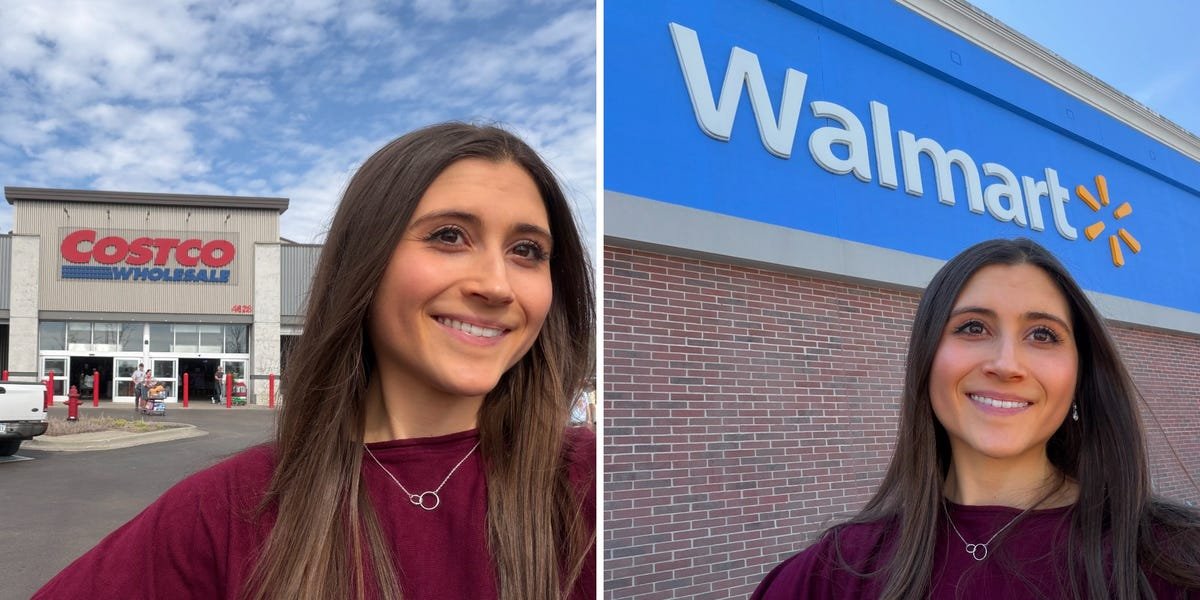
Based on my math and this particular haul, Costco generally offers lower prices.
However, the only way to reap the benefits is to purchase bulk-sized quantities, which isn’t for everyone. The real value depends on how much you can reasonably consume.
Produce is the perfect example. It’s hard to eat six heads of romaine or 10 pounds of potatoes before they go bad, even for veggie lovers.
Although these items are cheaper at Costco, large packages make it easier to waste food (and therefore money). The same goes for Costco’s mega-sized spices, chips, egg cartons, and beyond.
Plus, Costco has a $65 annual membership fee, so you’d have to spend enough to make it worth it — though breaking even is an achievable goal for most shoppers, especially families, since Costco carries more than groceries. Members also get discounts on things like travel, rental cars, tires, and gas.
This story is available exclusively to Business Insider
subscribers. Become an Insider
and start reading now. Have an account? .
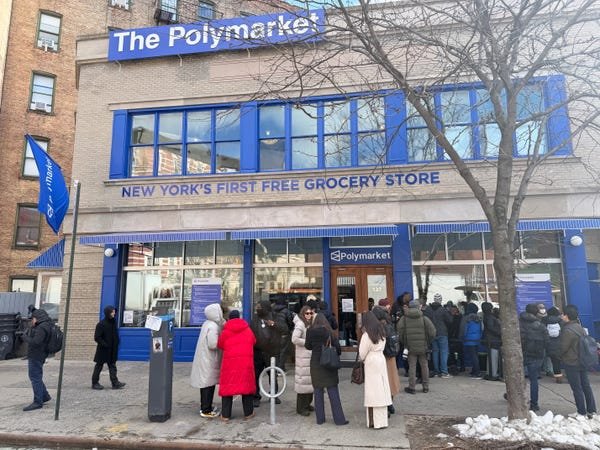
Polymarket launched a limited time grocery store pop-up in the West Village. I checked it out.
Attendees could take as many groceries as they could fit in a Polymarket tote bag.
Compared to Kalshi’s grocery pop-up, Polymarket’s seemed more planned out and polished.
Free groceries in New York? It feels like an impossibility — and yet, I saw it twice in two weeks.
It’s all thanks to a good old-fashioned marketing battle.
Prediction markets Polymarket and Kalshi are in a two-week grocery war, both propping up short-term free supermarket stunts in New York. Last week, Kalshi took over a Westside Market for a day. On Thursday, Polymarket debuted its own store.
I stepped inside the store two hours before it officially opened as part of a press preview. The store was pristine, unmarked by the what I assume would be the rampant foot traffic that would soon occupy it.
It looked like a miniaturized Trader Joe’s.
The experience also seemed more planned out than Kalshi’s similar marketing stunt. While Kalshi took over an existing supermarket for one day, offering $50 in free groceries, Polymarket designed its own pop-up scheduled to be open for five days (though free groceries will only be available on three of those days — more on that later).
Polymarket is also accepting community donations for local charities, and donated $1 million to Food Bank for NYC.
I came out impressed — even if it was a week behind its competitor. Here’s what I saw.
The West Village has a new pop-up.
The Polymarket flag waved in the wind of a warm(ish) winter day. Henry Chandonnet/Business Insider
I arrived at The Polymarket (get it?) at 11:30 a.m., a half hour before the originally planned opening time of noon. (The company later pushed it back to 2 p.m., confusing some attendees.) The front of the shop was a circus of organizers, media, and everyday rubberneckers.
New York establishments love to call themselves the “first” or the “best.” Is The Polymarket really New York’s “first free grocery store”? Likely not, especially if you count the hundreds of food pantries across the city.
One attendee, Milla Jackson, arrived at 7:30 a.m.
“I looked through the window, and I saw they had some good products,” Jackson said. Henry Chandonnet/Business Insider
I chatted with some folks in line, including Milla Jackson, a school aide from Staten Island. On hour four of her wait, she was grateful for her warm winter jacket.
Jackson heard about the pop-up in the newsletter “NYC for Free.” She spotted some olive oil inside that she was excited to pick up.
“I just found out about Polymarket,” she said. “I looked it up last night. I’m like, ‘Oh, I definitely want to show up.'”
Victoria Plaza arrived at 11 a.m.
“I can’t imagine it will be sustainable for more than four days,” Plaza said. Henry Chandonnet/Business Insider
Victoria Plaza was around Grand Central Terminal when Polymarket announced the location on social media. She expected that those ahead of her had been in the neighborhood.
The financial planning advisor came mostly out of curiosity. What would she take inside? “Whatever I can carry,” she said.
The Polymarket team was keeping everyone warm.
Polymarket staff handed out hot chocolate and coffee. Henry Chandonnet/Business Insider
At 34° and sunny, Polymarket got lucky with a nicer opening day than Kalshi. They also handed out hot drinks (which Kalshi had) and put up heat lamps (which Kalshi did not have).
One of the day’s oddities: a painted-over sign.
Why were they painting over the Polymarket logo? Henry Chandonnet/Business Insider
A few minutes before making it inside, a man stationed his ladder on the front door and began painting over one of the Polymarket signs. No one seemed to know why.
The store’s schedule was pasted on a window.
The Polymarket’s schedule included a Valentine’s Day celebration. Henry Chandonnet/Business Insider
For those seeking out free groceries, Polymarket will offer them up on Thursday, Friday, and Sunday. Those days also have community donation hours.
Saturday is Valentine’s Day, when The Polymarket will have a “community celebration” with free flowers and cards. Monday is the final day for donations.
Inside, the first thing I noticed was a disclaimer.
Nestled behind a basket of Kind bars was a reminder that we were being filmed. Henry Chandonnet/Business Insider
Inside the store, there were several framed notices that our movements would be filmed. It was a reminder: as much as The Polymarket is about free groceries, it’s also about a marketing stunt.
“Take what you need” (that can fit in a tote bag).
How much can you take from The Polymarket? As much as fits in a tote bag. Henry Chandonnet/Business Insider
No, you can’t roll up to The Polymarket with a huge trash bag and clear off all the shelves. There are unsurprisingly some limits.
At Kalshi’s pop-up, it was a cost ceiling: no more than $50 worth of goods. At the expensive Westside Market, $50 meant only a few items.
At The Polymarket, it’s a constraint of physical space. Attendees get one branded tote bag and can leave with as much as it will fit.
Offerings were limited but classic.
The Polymarket had both regular and gluten-free pasta. Henry Chandonnet/Business Insider
The Polymarket focused on pantry staples. Oil, rice, seasonings, peanut butter, beans, the list goes on. There were no fancy premade meals, like at the Kalshi pop-up.
I also noticed more branding at Polymarket’s pop-up than at Kalshi’s. Here’s a digital sign advertising Polymarket above the gluten-free pasta. The flowers were wrapped in Polymarket-branded tissue.
There was a lot of fresh produce.
Produce filled bins on the floor and fridges in the back. Henry Chandonnet/Business Insider
Carrots, avocados, bell peppers, you name it. The Polymarket put produce front and center. They looked idyllic in their wooden crates — though I’m not sure how long that sheen will last after the public opening.
Polymarket can’t escape the hype bro reputation.
Spotted: Logan Paul’s energy drink. Henry Chandonnet/Business Insider
The Kalshi grocery store was swarmed with crypto influencers and online betters. While that crowd hadn’t yet arrived at The Polymarket from what I could see, there were some signs of an overly online presence. The fridges were stocked with Logan Paul’s Prime Energy, for example.
Kerrygold? In this economy?
Polymarket shelled out for their butter choice. Henry Chandonnet/Business Insider.
Most of the items in The Polymarket were fairly low-cost, though they all had name brands. One exception: the butter. Kerrygold is expensive! I was surprised to see a fridge full of them, ready for the taking.
One thoughtful touch: socks.
The Polymarket had cleaning products and tampons. Henry Chandonnet/Business Insider
Socks are often the most requested items at homeless shelters. That’s especially true in the cold, cold winter. It was a nice touch to see a shelf full of them.
Why The Polymarket felt more thoughtfully designed than Kalshi’s grocery pop-up.
“This one’s on us!” a sign at The Polymarket promised. Henry Chandonnet/Business Insider
Leaving The Polymarket, I thought it was better planned out than Kalshi’s pop-up.
Where Kalshi had unlimited options but a tight overall budget of $50, I felt The Polymarket was more tailored to what people might want from a free-grocery stunt in the winter months. I found the staff was generally friendlier, and the whole thing was a bit less confusing. The emphasis on donation also made it feel less like a shiny corporate branding exercise.
Even Mayor Zohran Mamdani, a fan of affordability but not prediction markets, seemed to begrudgingly applaud Polymarket’s move.
Who knows what will happen over the next few days, as The Polymarket opens. Maybe the shelves will run dry. Either way, Polymarket seemed to know what it was doing at the jump.
I was initially resistant to the self-checkout kiosks at my local grocery store when they were introduced a few years ago.
It didn’t take long, however, for me to start choosing those kiosks when the regular check-out lines were long. By that time, New Jersey had banned plastic bags, so I reverted to the “I can do it faster myself” way of thinking, armed with cute bags made from recycled materials.
The way it had become so easy to breeze past the friendly faces of cashiers standing at the end caps of their respective, often empty, check-out lanes waiting to welcome customers might not seem unusual. For me, though, it’s started to feel like a sign of something bigger.
There’s a loneliness epidemic
Not only did I not have to interact with anyone in the case I’d rolled out to the store looking less than my best, but I was also saving time, I reasoned. A recovering dishwasher loading control freak, I’m also pretty specific about the way I think groceries should be bagged — heaviest to lightest, eggs, bread, and chips on top.
The author decided to change from self-checkout lines to human cashiers for a more personal connection.
Courtesy of the author
Meanwhile, the US is facing a loneliness epidemic, and our culture, especially post-pandemic, is to blame. I’m guilty of leaning into leaving my house and socializing less over the past several years, despite considering myself a social person.
According to a recent report from the American Psychological Association, many teens are turning to AI chatbots for friendship and emotional support. My college-age daughters confirmed this to be true, which should be concerning to everyone. As someone with a lifelong obsession with human behaviors, I also find it thought-provoking. It raises the question, what can we as a society do about it?
I went back to regular cashiers
I decided that the first step for me personally was to prioritize more human interaction at the grocery store. There was a part of me that missed simply saying “Hello” and asking how the person, who was specifically there to help fellow humans, was doing. If my daughters are with me, they often find something to compliment, “I like your nails,” or “Your tattoo is so cool, what does it mean?”
These days, it seems to catch some by surprise, and then to see smiles or share an unexpected laugh with a stranger — there’s something mutually fulfilling in that. In the smallest moments, we remember how others make us feel. That’s humanity, and community.
When we first moved to our little town in South Jersey, just outside Philadelphia, I knew the produce guy by name. Al had also worked on our house, and his granddaughter and our daughters went to the same elementary school. For many years, I looked forward to exchanging a few pleasantries with him and didn’t care, or correct him, when he called me Stephanie instead of Jennifer.
It’s been so nice to interact with other people
We’re officially at a point where too many people are longing for connection and to be seen, to have someone be interested in even the smallest thing about them. I make at least a couple of trips to the grocery store each week (because I’m too indecisive to plan meals in advance) and have been choosing to go to the human cashier over self-checkout whenever possible.
It’s been a breath of fresh air to overhear the chatter between cashiers and customers. I stopped in for a few things recently in anticipation of some bad weather, which people from the northeast will tell you means “milk, bread, and eggs.” The cashier, an older woman, called me “honey” but not in the passive-aggressive way Taylor Swift sings about on her latest “The Life of a Showgirl” album. She told me to be careful driving home as a coworker walked by and handed her a bag of homemade ginger snap cookies. Her face lit up.
In conversation with another cashier, a young woman, I learned she hates the cold. The high temperature that day was 25 degrees. We chatted about how she could move south, but then she’d fear tornadoes, and Florida was out of the question because of snakes. We laughed.
Walking away, I thought about how I’ve been missing the minutiae that are only present when we choose to see and acknowledge each other in person.
One grocery chain is expanding using a business model that’s somewhere between Aldi and T.J. Maxx.
Supermarket chain Grocery Outlet promises low prices, and it has a novel approach: Like Aldi’s locations, Grocery Outlet stores tend to be smaller than traditional grocery stores and emphasize low prices.
But like T.J. Maxx, Grocery Outlet often sells products that other retailers or food manufacturers can’t move themselves.
During the height of the pandemic in 2020, for instance, Grocery Outlet bought 30,000 cases of 1-gallon containers of salsa that were meant for restaurants, former CEO Robert Sheedy said on an earnings call at the time.
“Grocery Outlet buyers are experts at purchasing that product opportunistically,” the chief marketing officer, Layla Kasha, said in a statement to Business Insider in September.
That means finding products “outside of the normal retail channel as a result of packaging changes, product overruns, and other varied inventory circumstances,” she said. “Our suppliers offer us great prices on that surplus inventory, and we pass those savings along to our customers.”
This approach allows Grocery Outlet to sell products for 40% to 70% less than comparable items at traditional retailers, according to the company’s latest annual report.
Grocery Outlet had 563 stores as of its third quarter, which ended on September 27. The chain said in November that it planned to end 2025 with 37 new store openings for the year.
The San Francisco-based company already has a significant presence in the Western US, but it’s expanding in Eastern states, including Delaware, Maryland, and Pennsylvania.
I wanted to experience shopping at Grocery Outlet for myself, so I visited one of the chain’s relatively new stores in September. Here’s what I found.
Do you have a story idea to share about Grocery Outlet or another retailer? Contact this reporter at abitter@businessinsider.com.
I visited one of Grocery Outlet’s newer stores in Maryland.
This grocery outlet wasn’t too busy on a Wednesday afternoon. Alex Bitter/BI
Located in a shopping mall in Beltsville, Maryland, this store opened in July 2024.
Grocery Outlet’s emphasis on deals was clear from the moment I walked in.
This sign highlighted a major clearance on spring and summer items. Alex Bitter/BI
This sign outside the main entrance highlighted some of Grocery Outlet’s deals, including salted caramel cookies, cheese balls, and ribeye steaks.
Grocery Outlet also sells fresh produce and meat.
I saw this sign as I walked into the Grocery Outlet location. Alex Bitter/BI
Though Grocery Outlet says it’s “opportunistic” with its buying, the chain’s stores stock many of the same types of products thatyou’ll find at traditional grocery stores, such as produce. This sign reminded me of that as I walked in.
This Grocery Outlet store was similar in size to an Aldi or other small-format supermarket.
The front of Grocery Outlet included baked goods, plants, and other items. Alex Bitter/BI
Grocery Outlet stores generally take up between 15,000 and 20,00 square feet, according to the company’s latest annual filing. Aldi stores, by comparison, are generally about 22,000 square feet.
Both grocery chainsare much smaller than the format used by traditional supermarkets, which can take up twice as much space at about 40,000 square feet.
Grocery Outlet sells more than food.
The tropical potted plants were $15.99 each. Alex Bitter/BI
As I walked through the front of the store, I found ceramic pots, gardening tools, and this selection of potted plants.
I found name-brand groceries …
There were three flavors of La Croix seltzer. Alex Bitter/BI
Grocery Outlet often touts that many of its products are name brands. That was true with these boxes of canned La Croix seltzer.
… as well as items I’d never heard of before.
Bottles of Good Sport were $0.99 each at Grocery Outlet. Alex Bitter/BI
I’ve written about and followed many food and beverage brands over the years, but I wasn’t familiar with Good Sport, a dairy-based sports drink.
Grocery Outlet also has its own brands.
These bags of tortilla chips were being sold under the SimplyGo brand. Alex Bitter/BI
Grocery Outlet makes some of its own products under the SimplyGo name, such as these tortilla chips.
The chain tries to stock store-branded goods and those from name brands “as evenly as possible,” Kasha told Business Insider.
Most of Grocery Outlet’s private-label items are “everyday grocery basics” such as butter, eggs, and paper towels, she said. “We source those traditionally to ensure our shoppers can find them each time they come to the store,” she said.
Many of the name-brand goods, meanwhile, are meant to create a “treasure hunt shopping experience,” Kasha said. Think about “a holiday-themed cereal, or a fun soda flavor that you’ve never heard of,” she said.
I saw products from some popular restaurant chains in the freezer aisle.
I bought a box of these Hooters-branded crab cakes. Alex Bitter/BI
These Hooters-branded crab cakes piqued my interest, given my reporting on the chain’s bankruptcy earlier this year.
I bought a box and tried them at home. They were unremarkable.
Some parts of Grocery Outlet looked like any other grocery store.
Lemons, limes, and other fruit sit in the produce section of Grocery Outlet. Alex Bitter/BI
In the back of the store, I found the produce section, which had many of the basic types of fruit and vegetables that other stores have, from eggplants to lemons.
The quality of the produce seemed decent.
Grapes in a cooler at Grocery Outlet. Alex Bitter/BI
I bought some red, seedless grapes and was happy with the quality.
Price tags that highlighted savings were everywhere.
Every price tag at Grocery Outlet included a price for the item “elsewhere.” Alex Bitter/BI
These grapes were $1.99 a pound at Grocery Outlet. The tag said that they’d cost $3.99 a pound “elsewhere,” which seems plausible to me, though I had no clue which other stores they were talking about.
There was a robust selection of Latin American groceries.
I bought some dried chiles at Grocery Outlet. Alex Bitter/BI
Besides jars of salsa and tortillas, there was a range of spices often used in Mexican cooking. I picked up some dried chiles for my next homemade salsa rosa.
As I ventured deeper into the store, I saw more unusual products.
These Old Bay-flavored sausages intrigued me. Alex Bitter/BI
I’d never seen sausages flavored with Old Bay, which I wanted to try but opted not to because I had a long drive home.
I saw products I didn’t know existed from popular brands like DiGiorno.
I bought one of these breakfast croissants. Alex Bitter/BI
This frozen personal DiGiorno “breakfast croissant” was $2.49, so I picked one up.
Many of the products I bought were fine, though not wonderful.
The breakfast croissant, after the prescribed 20 minutes in the oven. Alex Bitter/BI
The breakfast croissant was good, though I probably won’t be rushing back for more.
Other products were surprisingly niche.
There was one last bottle of noni juice on the shelf at Grocery Outlet. Alex Bitter/BI
I almost bought the last bottle of juice squeezed from noni, a fruit native to Southeast Asia and common in parts of the Pacific such as Hawaii.
Curious, I did a quick Google search and found that this same bottle was selling for more than $40 online, as the price tag said.
I started to get a sense of Grocery Outlet’s strategy the more I saw.
Oreo Truffles Mix sat next to a cookie mix from a Chrissy Teigen brand in the baking aisle. Alex Bitter/BI
Many of the products that Grocery Outlet sold at the location I visitedwere a little outside what you’d expect in a normal grocery store.
Oreo truffle mix? A breakfast croissant with cheese and ham? It felt like I had asked the beta version of an AI model to generate pictures of normal groceries.
Many of the prices were much lower than those in other stores in the area.
These cans of diced tomatoes were in the center of the store. Alex Bitter/BI
These cans of diced tomatoes were from a brand I’ve never heard of — California Healthy Harvest. At $0.50 each, I bought two, since I hadn’t seen canned tomatoes so cheap elsewhere in the DC area where I live.
For the really value-focused shoppers, there was this “last chance” shelf in the back of the store.
There was a limited selection of products in the “last chance” section at Grocery Outlet. Alex Bitter/BI
Given Grocery Outlet’s model, I was curious to see what kinds of groceries ended up in the clearance section.
The answer: huge tins of soda crackers for $1.17 each and 6-pound cans of salsa verde for $2.57 each.
As I headed for the checkout, I saw more merchandise that wasn’t food.
This Reese’s-branded blanket was $7.99. Alex Bitter/BI
There was a selection of candy-themed blankets, such as this orange Reese’s throw.
I also found an homage to the founder of Grocery Outlet.
A depiction of Grocery Outlet’s founder, Jim Read, was painted in one corner of the store. Alex Bitter/BI
Jim Read started what would become Grocery Outlet in 1946 by selling surplus military supplies, according to the company.
Like any supermarket, there was candy near the register, tempting me as I waited.
Marshmallow Peeps were on steep discount nearly five months after Easter. Alex Bitter/BI
These packs of Peeps came individually wrapped to make them easier to hide in Easter eggs.
It’s a great idea, but given that I was shopping at Grocery Outlet in September, I could see why they were so heavily discounted.
Shopping at Grocery Outlet was one of the most novel experiences I’ve had at a store.
I took one last look back at the Grocery Outlet as I walked out. Alex Bitter/BI
The product selection was eclectic, and that’s no accident. Grocery Outlet’s “treasure hunt” strategy encourages customers to stop by regularly to see what’s new.
That could make it a hard place to shop if you tend to buy the same groceries every week or have dietary requirements.
On the other hand, many shoppers are looking to save money after years of inflation.
There are also signs that buying food from big, recognizable brands is no longer as important for shoppers as it once was, as evidenced by Aldi’s success with its store brands and Kraft Heinz’s decision to split into two companies.
Grocery Outlet reported comparable sales of just over 1% in the third quarter, the most recent reporting period. CEO Jason Potter said on an earnings call in November that he was “dissatisfied with” that result but hoped that sales would pick up in 2026.
I’ll probably be back, especially if Grocery Outlet opens more stores in my area.
This grocery outlet was about 40 minutes from Washington, DC, proper. Alex Bitter/BI
Grocery Outlet continues to open new stores, including another location in Pennsylvania in August.
If the chain continues to expand — especially on the East Coast — I bet I’ll be back at some point.
Sometimes you have to take matters into your own hands.
The government shutdown ended a while ago, but there’s been at least one lingering effect: a lack of inflation data.
The last CPI report was for September and released way back on October 24. November’s inflation report — sorry October, we’ll catch you next year — was scheduled to drop December 10, but got bumped to December 18.
But who wants to wait another two-plus weeks?
Business Insider took matters into its own hands, surveying readers about how prices have changed. We heard from roughly 200 of you, and BI’s Madison Hoff has the results, along with some personal anecdotes from readers about what they are seeing.
Unfortunately, one area readers feel prices keep climbing is something they can’t skip: Food. Whether it’s groceries (90%) or dining out (87%), the vast majority said those prices have gone up.
The data shows the affordability issue that many Americans say they’re facing.
Despite a stock market that continues to rise, people are finding themselves stretching their budgets. And unlike luxury items that one can hold off on purchasing, groceries are a day-to-day expense that Americans continue to feel the pain of.
“It’s so frustrating that people like us who are financially responsible, who are doing everything right, are still just feeling like we’re stretched every step of the way,” one reader told Madison.
That puts the Fed in an interesting position when it comes to rate cuts.
Central bankers will convene next week for their final meeting of the year. As always, Jerome Powell and co. aim to strike a balance between keeping inflation in check and maintaining a robust job market.
While our survey is far from scientific, the main takeaway is clear: most people feel prices keep going up. If you’re looking to address those concerns, cutting interest rates risks pushing inflation (and prices) even higher.
On the other hand, the job market remains largely frozen. And the best way to kickstart things on that front would be to continue easing up the policy.
So what will the Fed do? Wall Street seems bullish on another cut, with 87.6% of interest-rate traders betting on one next week, according to CME FedWatch.