Natalie Musumeci's face on a gray background

Lawsuit against Elon Musk’s xAI alleges Grok created sexualized deepfakes of 3 minors

A new lawsuit against Elon Musk’s xAI alleges that its flagship chatbot, Grok, was used to create sexualized deepfake images of three minors — content the complaint says amounts to child sexual abuse material.

The proposed class action, filed Monday in a California federal court, accuses the AI startup of profiting from the “sexual predation of real people, including children.”

“Nearly all the companies creating, marketing, and selling AI recognized the dangers of such a tool and chose to enact industry-standard guardrails that would prevent the use of their products by one extremely dangerous group: child sex predators. XAI did not,” the lawsuit says.

Representatives for Musk and xAI did not immediately respond to a request for comment by Business Insider.

Musk previously said in a January post on X that he was “not aware of any naked underage images generated by Grok. Literally zero.”

Grok generates images based on user prompts, he wrote.

“When asked to generate images, it will refuse to produce anything illegal, as the operating principle for Grok is to obey the laws of any given country or state,” Musk said. “There may be times when adversarial hacking of Grok prompts does something unexpected. If that happens, we fix the bug immediately.”

The lawsuit against xAI says that the Tennessee plaintiffs are “three of the minor victims of xAI’s knowing production, possession, and distribution of AI-generated child sexual abuse material” depicting them.

The plaintiffs, identified in the court papers only as Jane Doe 1, Jane Doe 2, and Jane Doe 3, allege that xAI’s AI tools were used to make nude images and videos of them. Jane Doe 1, a recent adult, was a minor at the time of the alleged incidents, while the two other plaintiffs are still minors, according to the lawsuit.

In December 2025, Jane Doe 1 received a message from an anonymous Instagram account warning her that “pics” of her had been generated by someone she knew and spread across the group-chat platform Discord.

“Through a series of messages, the anonymous user went on to explain that the perpetrator had uploaded a folder of image and video files depicting her and other minor females to Discord,” the lawsuit says.

The anonymous user eventually sent Jane Doe 1 several sexualized AI-generated images and videos of her and other minor girls, according to the lawsuit.

“At least five of these files, one video and four images, depicted her actual face and body in settings with which she was familiar, but morphed into sexually explicit poses,” the lawsuit says. “The images showed her entire body, including her genitals, without any clothes. The video depicted her undressing until she was entirely nude.”

Jane Doe 1 alerted the other minors in the images and their families, and a criminal investigation was opened in Tennessee, according to the lawsuit. It added that local police arrested a suspect in connection with the case in December 2025.

Last month, Jane Doe 2 learned through the investigation that at least two of her images had also been used to produce sexually explicit AI-generated content using xAI’s tools, the lawsuit says.

Local law enforcement told the girl and her mother that one image taken of the girl on the beach in a blue bikini had been “morphed to depict her without any clothes,” the lawsuit says.

Authorities also informed Jane Doe 3 that the AI-generated images recovered from the suspect’s phone included one that had been “morphed to depict her fully nude,” according to the lawsuit.

Vanessa Baehr-Jones, an attorney for the plaintiffs, told Business Insider that her clients have endured a “nightmare.”

“Their CSAM images and videos depicting them when they were minors are now forever out there on the internet in these dark net worlds of child sex predators,” Baehr-Jones said. “The harm from that is acute.”

The attorney said she hopes the lawsuit brings “accountability” for xAI and that “most importantly, this should never happen to any other victim.”

The lawsuit seeks unspecified damages and accuses xAI of production with the intent to distribute child pornography, distribution of child pornography, and possession of child pornography, among other claims.

“In our legal system, money is the way we make corporations pay for the harms that they have caused,” Annika Martin, another lawyer for the plaintiffs, said. “Because corporations are profit-seeking entities, hitting them in the wallet is the only way to influence their decision-making.”

Earlier this year, xAI’s Grok sparked massive backlash after the AI image generator was used to make nonconsensual sexualized images of real people.

In response, X, the social media site that Musk sold to xAI in March, said Grok would no longer be able to generate AI images of real people in sexualized or revealing clothing.

Ashley St. Clair, who gave birth to one of Elon Musk’s sons in 2024, sued xAI in January, alleging that Grok generated sexually explicit deepfakes of her at users’ request.

French authorities are also investigating Grok over sexualized deepfakes.


Source link

Headshot of Ben Shimkus

All the ways Elon Musk’s companies are already intertwined, from a Tesla ‘collab’ with SpaceX to Grok in vehicles

Elon Musk has for years blurred the lines between the companies he leads.

The intermingling of Elon Inc. businesses — a number which shrank from six entities to five when xAI acquired X last year, and from five to four when SpaceX acquired xAI on Monday — is something of signature for the CEO.

Over the past three years, his companies have stepped up their internal dealings, investing billions in one another, agreeing to buy up each other’s products, and exchanging software and materials.

The result is a tightly knit corporate ecosystem centered on Musk, where work — and even employees — can flow between the various entities in the name of vertical integration.

Here are some of the recent sharing agreements, purchases, and investments between Musk’s companies.

Musk’s employees often work between companies


Elon Musk took over Twitter about a year ago.

Shortly after acquiring Twitter, Elon Musk brought Tesla engineers into the offices to work on its code base.

Photo by -/Twitter account of Elon Musk/AFP via Getty Images


Musk has repeatedly drawn on employees from one company to support others in his portfolio.

In 2022, about a month after Musk bought Twitter — now known as X — he sent roughly 50 Tesla employees to the social-media company’s headquarters to help overhaul its code-review systems, according to court filings.

Musk later argued in court that the Tesla employees had “volunteered” to do the work and that their temporary reassignment should not concern Tesla’s board.

Executives share overlapping functions on several of Musk’s companies, too, according to insider org charts obtained by Business Insider.

For example, Charlie Kuehmann, the vice president of materials and engineering at Tesla, also holds the same title at SpaceX.

SpaceX contributes to Roadster, Tesla provides SpaceX with energy-storage systems


A Falcon Heavy rocket from SpaceX takes off from a launch pad in Florida during a clear day.

SpaceX is lending rocket-boosting tech to Tesla’s upcoming hyper-powered sports car, Musk said.

Joe Raedle/Getty Images


SpaceX is a major customer of Tesla’s energy business, purchasing batteries for robotics power and Megapack energy-storage systems.

It also reportedly invested $2 billion into xAI as a part of a previous funding round.

Musk has also said that Tesla’s long-awaited next-generation Roadster will be a “Tesla/SpaceX collab” and feature SpaceX-built cold-gas thrusters. The hyper-powered sports car’s launch event is penciled in for April 1.

“It’s gonna be really cool, and it’s gonna have some rocket technology in it,” Musk also said during a 2024 sit-down with Don Lemon.

SpaceX and Boring Company buy Tesla cars


Boring Company Tesla entering tunnel

A Tesla entering the Hawthorne Tunnel, made by Elon Musk’s Boring Co.

Robyn Beck/Pool via REUTERS


Aside from full-blown investments or acquisitions, the most publicly visible example of Musk’s companies coordinating might be Tesla’s vehicle sales to his tunnel-building start-up.

The Boring Company, which operates tunnels in Las Vegas and Texas, uses fleets of Tesla vehicles to transport passengers through its underground systems. The tunnel builder has also constructed tunnels around Tesla’s Gigafactory in Austin, Texas.

It isn’t alone. SpaceX also purchased an unspecified number of Musk’s Cybertrucks.

Tesla and xAI’s ‘framework agreement’ follows Grok integration into cars, Optimus demo bots.


A person in light blue jeans sits in the front passenger seat inside a self-driving Tesla.

Tesla wants to build out its AI software, including its self-driving ambitions. CEO Elon Musk said a $2 billion investment in his software company would help.

Jay Janner/The Austin American-Statesman via Getty Images


Tesla’s earnings on Wednesday disclosed that it had agree to invest $2 billion in xAI, Musk’s artificial intelligence startup, with a related “framework agreement” to explore additional collaboration opportunities.

Tesla has already integrated xAI’s Grok into its vehicles, allowing drivers to chat with the AI and use it to add and edit navigation destinations.

Videos have shown early versions of Tesla’s in-development Optimus robot using xAI’s Grok AI chatbot for its voice.

xAI has also reportedly told investors that it’s working on AI that could power Tesla’s forthcoming Optimus humanoid robots.

Tesla executives said the $2 billion investment supports the automaker’s push into self-driving technology. For example, the earnings deck explained that xAI-developed software will analyze vehicle interiors and assist with route planning, including adding high-occupancy-vehicle lanes when the car is full.

For xAI, the investment adds capital to the cash-hungry buildout of data centers and their energy needs.

The deal marked one of the clearest examples of capital flowing from Musk’s public company into a privately held firm he controls.

It’s all par for the course for ‘Elon Inc.’

The growing web of internal deals has fueled discussion among investors and analysts about whether Musk’s companies are evolving into something closer to a single, vertically integrated enterprise.

And it’s not clear if it’ll stop at SpaceX combining with xAI.

There’s also been recent reports that Tesla could combine with SpaceX.

“In Tesla’s case, an important factor to consider is that investors are buying into Elon Musk’s vision for the future as much as they are buying into an automaker or clean energy company,” Lou Whiteman, a contributing analyst at The Motley Fool, told Business Insider.

“Since this group of companies, public and private, combine to represent Elon Musk’s full vision of the future, I’d bet that many investors are happy to see Tesla involved in all aspects of ‘Elon Inc.'”


Source link

Ashley-St-Clair-sues-Elon-Musks-xAI-over-alleged-explicit.jpeg

Ashley St. Clair sues Elon Musk’s xAI over alleged explicit Grok deepfake images

Ashley St. Clair, who gave birth to one of Elon Musk’s sons in 2024, sued Musk’s xAI in a New York court on Thursday, alleging that its chatbot Grok generated sexually explicit deepfake images of her at users’ request.

In the complaint, St. Clair, a writer, influencer, and political strategist, claims X users prompted Grok to manipulate images of her, including photos from when she was 14, into graphic sexual content. She alleges some images remained online for more than a week and that her premium X account was later terminated after she complained.

She is also requesting a temporary restraining order to compel xAI to immediately cease from “the intentional disclosure of nonconsensual intimate images.”

xAI did not immediately respond to a request for comment.

“Grok first promised Ms. St. Clair that it would refrain from manufacturing more images unclothing her,” the complaint read. “Instead, Defendant retaliated against her, demonetizing her X account and generating multitudes more images of her,” the suit alleged.

St. Clair is also involved in a separate suit with Musk over the custody of their son, in which she sought sole custody.

xAI responded the same day with a separate lawsuit, arguing that St. Clair agreed to its terms of service, which requires any litigation to be heard in Texas. St. Clair is represented by attorney Carrie Goldberg, who specializes in cases involving abuse and has represented clients against Harvey Weinstein.

“xAI is not a reasonably safe product,” Goldberg said in a statement to Business Insider. “This harm flowed directly from deliberate design choices that enabled Grok to be used as a tool of harassment and humiliation. Companies should not be able to escape responsibility when the products they build predictably cause this kind of harm.”

The lawsuit followed international backlash against the Grok chatbot for its ability to undress images of real people and create sexualized images without their consent at users’ request.

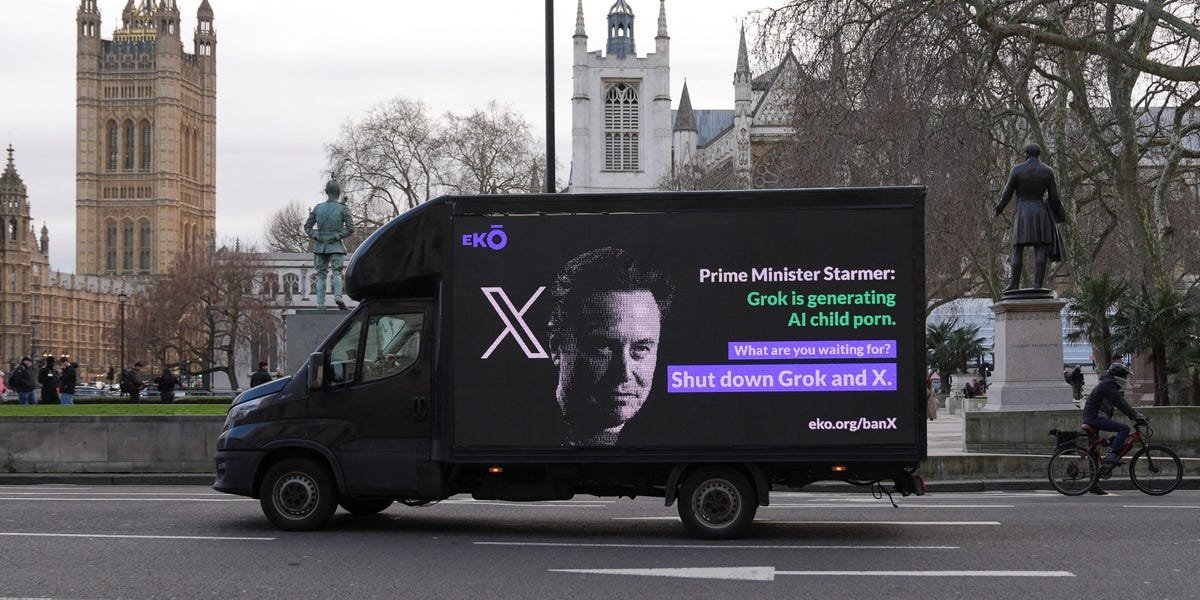
Indonesia and Malaysia blocked access to Grok, while UK Prime Minister Keir Starmer called explicit images generated by Grok “disgusting” and “shameful” in a meeting with the House of Commons.

On Wednesday, California Attorney General Rob Bonta also announced that his office is investigating the “non-consensual, sexually explicit material that xAI has produced and posted online” of “women and children in nude and sexually explicit situations.”

X said on the same day in a blog post that users would no longer be allowed to create AI photos of real people in sexualized or revealing clothing on the platform, adding that the restriction “applies to all users, including paid subscribers.”

As of Thursday morning, Business Insider reporter Henry Chandonnet found that it is still “surprisingly easy” to prompt Grok to create nude images of him by going to the app itself instead of using the Grok chatbot on X.


Source link

Shuby headshot

Grok stops users from making sexualized AI images after global backlash

Grok will no longer be allowed to create AI photos of real people in sexualized or revealing clothing, after widespread global backlash.

“We have implemented technological measures to prevent the Grok account from allowing the editing of images of real people in revealing clothing such as bikinis,” X’s safety account said in a blog post on the platform on Wednesday. “This restriction applies to all users, including paid subscribers.”

The change was announced hours after California’s top prosecutor, Rob Bonta, said he launched an investigation into sexualized AI deepfakes, including those of children, generated by Grok. Bonta said that there had been a flood of reports in the last few weeks that Grok users were taking pictures of women and minors they found online and using the AI model to undress them in images.

Indonesia and Malaysia suspended Grok because of the images, the first countries in the world to ban the AI tool. Lawmakers in the UK publicly considered a suspension.

In Wednesday’s blog post, the social media company reiterated that image creation and the ability to edit images via Grok on the X platform will now only be available to paid users as an additional safety measure.

The company restricted non-paying users last week after complaints from officials globally, but it was slammed for being insufficient.

A spokesperson for British Prime Minister Keir Starmer said it “simply turns an AI feature that allows the creation of unlawful images into a premium service.”

Elon Musk, who owns xAI, the maker of Grok, said that the UK government wanted “any excuse for censorship” in response to a post questioning why AI tools like Gemini and ChatGPT were not being looked into.

On Wednesday, a few hours before X’s official account posted about the ban on creating sexualized images, Musk asked users to try to get around the AI model’s image restrictions.

Bonta’s office and Starmer’s office did not immediately respond to requests for comment from Business Insider.


Source link