
At-a-BI-roundtable-event-HR-execs-shared-a-growing.jpeg

At a BI roundtable event, HR execs shared a growing concern around AI costs rising without clear ROI

As companies find more tasks AI can tackle, it’s costing some employees their jobs. This increased use of AI is also costing something else: money.

“Tokens, seats, we have all these enterprise tools we haven’t basically budgeted for, and it’s expensive,” said Katya Laviolette, Chief People Officer at 1Password.

Business Insider invited Laviolette, along with 13 other executives, to participate in a roundtable discussion titled “Futureproofing Your Workforce in the Age of Ai,” presented by Indeed.

Others at the table agreed that as more employees experiment with AI tools, the costs of using those tools is skyrocketing. That presents a challenge for companies. Experimentation is needed to unlock new paths to productivity. But at some point leaders must prove the new workflows are paying off financially.

“At one point, the investors are going to say, “Are you gonna produce some profit?” Laviolette pointed out. “Because it’s one thing to grow your top line, but your OPEX is really, really important.”

The solution to this problem does not automatically lead to layoffs, according to BMO Financial Group’s CHRO, Technology & Operations, Jay Ferguson.

“You can take cost out, or you can give augmentation and multipliers to every person you have,” Ferguson said. “So hypothetically, if we looked around this table and we said, ‘Okay, well, I can take 30% out of my business,’ you could do that. Short-term thinking in my view, because I still think that if I can increase everyone’s productivity by 30%, we win on both the revenue side and the cost side.”

Here are other insights executives raised during the almost two-hour conversation.

While it makes sense to have all employees use AI, senior leaders must identify the tools’ true ROI


Man in glasses holding a microphone and seated at a long table speaks to a group.

“We found you need the senior levels of the organization to find the right problem for AI to solve,” said Kyle Trahair, Managing Director & Partner, BCG. 

Lenny Poplianski


Kyle Trahair, Managing Director & Partner, BCG: What we’ve seen is there is a lot of benefit in AI-upskilling at the lower ranks of an organization. You tend to get improvements in employee experience. You get less toil, more joy because some of the more monotonous aspects of the job go away.

But what we typically hear at the CFO level is, ‘Yes, I’m hearing all those hours saved. I’m not seeing any change in the results.’

We found you need the senior levels of the organization to find the right problem for AI to solve that is sufficiently ambitious, that it’ll make a meaningful P&L impact. But they can’t do that without the AI literacy needed to understand what the art of the possible is.

It’s not just entry-level jobs that may be threatened by AI


Woman in glasses holding microphone and sitting at a long table speaks to a group.

“It isn’t just re-engineering the way we’ve always done things, it’s totally reinventing the way we do things,” said Angella Alexander, Chief Human Resources Officer, ATS Corporation. 

Lenny Poplianski


Angella Alexander, Chief Human Resources Officer, ATS Corporation: At some point the level of experience that our middle management has will quickly become irrelevant experience. The way they’re accustomed to doing things and the way they’re accustomed to thinking about things will not flex sufficiently. And so we’re thinking that it’s probably that middle layer that’s going to start to vanish because you’re going to need these new talents coming in who have this ability to do all these amazing things and move quickly, but it requires you to think about process totally differently.

So it isn’t just re-engineering the way we’ve always done things, it’s totally reinventing the way we do things.

Many employees need a push to start using AI


Woman in white blazer holding a microphone and sitting at a table speaks to a group.

“Our CTO said, ‘I’m going to clear everybody’s calendar one afternoon and everyone’s gonna do a Claude installation party,'” said Olivia Chiu, Head of Talent Management, Wealthsimple, 

Lenny Poplianski


Olivia Chiu, Head of Talent Management, Wealthsimple: Our CTO said, ‘I’m going to clear everybody’s calendar one afternoon and everyone’s gonna do a Claude installation party.’

And so they did that and the objective was, ‘We’re going to teach you how to use Claude and your job is to actually solve a real client problem that you have seen in your day-to-day.’

And so that in itself — when everybody’s doing it at the same time, that connectivity and what they saw they were able to do in an afternoon that would’ve (taken) them a week — is change management.

Tiny teams are a growing trend


Dark-haired woman holding a microphone and sitting at a long table speaks to a group.

“(People) are building companies with much less workforce,” said Sanjana Basu, Partner, Radical Ventures. 

Lenny Poplianski


Sanjana Basu, Partner, Radical Ventures: Today, we don’t have bloated 30-people teams that are pitching to us for funding. We have one person, we have 16 year-olds, 20 year-olds, 23 year-olds pitching to us all day, every day. And they are building companies with much less workforce.

I think that’s another massive change we’re going to see in the ecosystem, which is you will see people with much more high-agency autonomy who will either build their own companies, leveraging all of these AI tools in a much leaner fashion, and those same people will probably be hired into the larger companies because they can really move the needle.



Source link

The-fallout-over-OpenAIs-Pentagon-deal-is-growing.jpeg

The fallout over OpenAI’s Pentagon deal is growing

Many other OpenAI staffers have also publicly criticized the company’s Pentagon deal.

“i personally don’t think this deal was worth it,” Aidan McLaughlin, a research scientist at OpenAI, wrote on X.

Another employee told CNN that many of them “really respect” Anthropic for refusing the Pentagon’s deal.

Clive Chan, a technical staffer, wrote in an X post that he believed OpenAI’s contract barred the use of its models for mass weapons or mass domestic surveillance. Chan wrote that he’s advocating for the company to share more information.

“If we later learn this is not the case, then I will advocate internally to terminate the contract,” Chan wrote.

Even before the deal, nearly 900 former and current OpenAI and Google staffers signed a joint petition supporting Anthropic, one of their primary competitors, and opposing the use of their companies’ technology for weapons that can kill without human oversight and mass surveillance.

“The Pentagon is negotiating with Google and OpenAI to try to get them to agree to what Anthropic has refused,” the petition said.


Source link

Chong Ming Lee, Junior News Reporter at Business Insider's Singapore bureau.

Drunken boxing and backflips: China put on a robot kung fu display that shows how fast its robotics industry is growing

China didn’t just celebrate Lunar New Year this week. It staged a robotics flex.

At the annual Spring Festival Gala, the Lunar New Year show in China, humanoid robots from Chinese startup Unitree Robotics flipped, lunged, and swung swords and nunchucks just feet from child performers in a tightly choreographed kung fu routine.

In one sequence inspired by “drunken boxing,” a traditional Chinese martial arts style, the robots staggered, fell backward, then rose again — showcasing advances in control and coordination.

Clips circulating online quickly drew comparisons to last year’s broadcast, which featured Unitree humanoid robots performing a Chinese folk dance. The choreography then was noticeably simpler.

The gala, often likened to the US Super Bowl for its massive audience, also featured other Chinese robotics firms, including MagicLab, Galbot, and Noetix, in separate segments throughout the broadcast on Monday evening.

Reactions on Chinese social media showed viewers being struck by how quickly the technology has advanced.

On RedNote, a user who goes by Ma Xiao said in a video posted on Wednesday that during last year’s performance, the robots were only “doing very simple things.”

“Now, they’re doing kung fu, they’re doing flips, they’re doing synchronized dancing,” he said. “Everybody’s shocked.”

“Now the rest of the world knows what China’s speed is,” he added.

Another RedNote user, DKKD, posted a video of friends reacting to the performance on Tuesday, captioning it: “Three Americans were scared by the Spring Festival robot.”

“They were all shocked by the robot’s level of evolution (including me),” the user wrote.

One viewer in the video can be heard saying: “It’s way more impressive than last year. It’s crazy.”

Unitree CEO Wang Xingxing said in an interview with Chinese media following the gala that the company expects to ship up to 20,000 humanoid robots this year, up from about 5,500 in 2025.

Global shipments of humanoid robots could reach “tens of thousands” this year, with Unitree potentially contributing between 10,000 and 20,000 units, Wang said on Tuesday.

China’s push in robotics

Chinese companies developing humanoid robots and autonomous systems are racing to outdo global rivals.

In September, Ant Group, an affiliate of Alibaba Group, unveiled R1, a humanoid robot that drew comparisons to Tesla’s Optimus. Two months later, EV and robotics maker XPeng introduced the latest version of its humanoid, Iron, which the company described as “highly human-like.”

China’s elite universities are also moving to build talent for the sector. In November, China’s Ministry of Education issued a notice stating that top institutions are preparing to launch a new undergraduate major in “embodied intelligence,” a field that combines AI with robotics.

Still, China’s rapid push into robotics hasn’t been seamless.

XPeng’s Iron fell face-first during its first public appearance in China earlier this year. Its CEO, He Xiaopeng, later wrote on Chinese social media that the mishap was part of “learning to walk.”

Last month, a Unitree humanoid kicked an engineer in the groin during a test. Humanoid robots stumbled and fell while racing against humans in a half-marathon in Beijing in April last year.


Source link

My-kids-are-growing-up-near-their-cousins-Its-priceless.jpeg

My kids are growing up near their cousins. It’s priceless.

Occasionally, when it comes up in conversation that I have five children, I’m met with surprise and sometimes, a little bit of shock.

And while I understand that five may seem like a lot of kids in some regards, in my neck of the woods, it’s really not that uncommon. In fact, my sister-in-law has seven children, so in comparison, my brood is the small one.


chaunie brusie family

The author has five kids.

Courtesy Chaunie Brusie


All in all, with kids ranging in age from a few months to 17, my kids are a part of a close-knit cousin clan of 15 and counting.

Having a lot of cousins nearby can be costly for birthdays and the holidays, but for everyday life, the fact that my kids have those relationships truly feels priceless.

Cousin sleepovers are the ultimate form of fun in my family

I love the simple happiness my kids get from spending time with their cousins, and it feels like such a gift. In a world where it feels like everyone is trying to sell me something or make me pay for “fun” experiences for my kids, knowing that what they love most in the world is just being at home with their cousins feels almost too good to be true sometimes. Honestly, I wish I could recapture that level of pure joy in my own adult life again.

I will be honest with you: having 10 kids in my house at once does mean I have to do a lot of post-play cleanup (and right now, we’re currently cycling through a stomach bug passed along over our cousin sleepover), but it’s always worth it for how much fun the kids have.

Playdates are an instant party

Aside from the sleepovers our kids can usually talk us into, having a sister-in-law with seven kids is also very convenient for me as a mom. All it takes is her family to come over for birthdays and special occasions, and we have an instant, built-in party.

It really works out for me, especially because each of my kids has an instant playmate in their cousin who is their age.

For instance, my son is the only boy in our family, but because he has two male cousins near his age, he gets the fun boy time he misses out on at home. And my youngest daughter has a large five-year gap with her own siblings, so she gets to experience the fun of playmates her age, too.

My oldest girls don’t have cousins their ages, so they have missed out on some level of the cousin fun, but even as teenagers, they love all their cousins, and they have a special relationship with all the littles that is beautiful in its own way. It’s so fun watching the younger girls look up to them, and my girls are always so gracious, letting the littles do their makeup and hair and playing with them when they are together.

I hope they’re always close

Right now, my kids are incredibly lucky with the time they get with their families. They see both sides of their families regularly, with weekly breakfasts, time at church, all holidays and special occasions, sports events, and random visits, just for fun. My husband and I both live within 30 minutes of almost all of our own siblings and parents, so to my kids, close-knit families are the norm.

While my kids are incredibly close with their cousins right now, I know those relationships might change as they get older. People can grow apart, family members will most likely move away, and things can happen.

But no matter what their relationships look like in the future, I do believe that the close-knit relationships and the memories they are creating together will shape them. Belonging somewhere matters, both as a child and as an adult, and I hope that the feeling of being loved as part of a big family sits somewhere inside them as they grow.


Source link

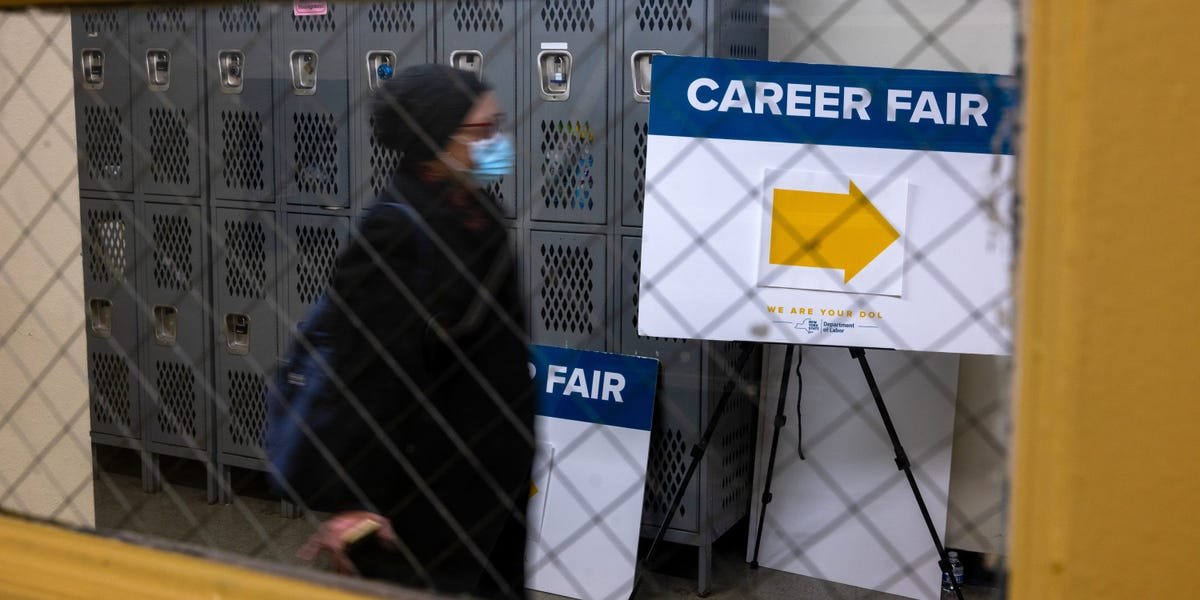
The-economy-is-growing-That-doesnt-mean-companies-are-hiring.jpeg

The economy is growing. That doesn’t mean companies are hiring more.

The US economy continues to surprise on the upside — except when it comes to jobs.

Hot growth, as seen in this week’s GDP report, typically corresponds to stronger hiring and personal earnings, which then enable consumers to continue spending. However, this year, the trend has been the opposite. Spending is driving the economy, but the job market is stuck in a “Great Freeze.”

As KPMG’s chief economist Diane Swonk wrote on Tuesday, “Growth and labor market outcomes have decoupled.”

It’s shaping up to be the story of 2026. The US has found itself in what some are calling a “jobless boom.” Money is flowing in and out of the economy at a healthy clip, but it’s not going toward creating a new job for you.

Instead, all eyes are on artificial intelligence, investment in which drove much of the year’s economic growth, along with still-strong consumer spending. The big AI investors were larger companies, including those that have led white-collar job cuts. In some cases, their profits have skyrocketed, and “do more with less” has been the mantra of the year.

“Firms are doing more with fewer workers,” Swonk wrote. “Many overshot on staffing during the hiring frenzy and are now using attrition or layoffs to bring staffing levels more in line with demand. Others are offsetting the squeeze on profit margins due to tariffs with layoffs and hiring freezes.”

Spend on essentials powered growth

Economists are still grappling with how the US ended up in this rare scenario. This year, although overall layoffs have crept up, they remain relatively low. Corporate America and Big Tech were the exceptions, with companies such as Amazon, Microsoft, Meta, Google, and Tesla announcing big cuts.

Business Insider has heard from dozens of white-collar job seekers who said that finding a new role has felt “impossible,” and those with jobs have, in many cases, held onto them for dear life.

In addition to a tough job market, consumers had no income growth last quarter. However, spending held strong — despite tariff uncertainty and stubborn inflation still above the Federal Reserve’s 2% target. A large percentage of this spending uptick was in healthcare and medical services, as costs for hospital and nursing services climbed. This year marks the most Americans have spent on healthcare services since 2022, when the Omicron wave of COVID-19 spread.

This suggests that, despite strong spending by affluent households, much of this rise in consumer spending wasn’t necessarily powered by confidence. In fact, consumer sentiment levels are among the lowest they have ever been, and many Americans have been cautious about spending because of tariff uncertainty.

The tough job market isn’t helping. Unemployment is at 4.6%, the highest since 2021. Total job growth has stayed slow.

Dozens of job seekers across generations told Business Insider this year that they were frustrated about suspected ageism, cumbersome hiring processes, competition with hundreds of others for a single role, and the suspected role of AI in screening out their applications. Some told reporters they’ve applied for thousands of roles with no interviews, while others said it took well over a year to get a single offer, often at a lower pay than their previous job.

2026 could be the year we see AI payoff — which may fuel an even bigger jobless boom

In his 2026 wish list for the business world, Business Insider’s Dan DeFrancesco asked for “ROI for AI.”

“I just want to see some noticeable returns on all these massive AI projects,” he wrote, referring to the eye-popping AI spending from Big Tech — and their plans for even more next year.

If that does come, the jobless boom may only grow. Companies want to use AI to boost productivity without hiring more people, which would only exacerbate a sluggish job market.

Although it’s difficult to determine if this year’s investments in AI have yielded results, the GDP’s spike to 4.3% in the third quarter is an encouraging sign overall. The largest growth since the third quarter of 2023 prompted President Donald Trump to say that the “Trump Economic Golden Age is FULL steam ahead.”

Still, many Americans may worry about what this means for their jobs. Some companies have cited the need to be efficient in an AI-driven future as justification for layoffs. The US already operates with fewer jobs than it had pre-COVID, and Federal Reserve Chair Jerome Powell has recently said that the grim jobs data may be overstating this year’s deflated gains.


Source link