
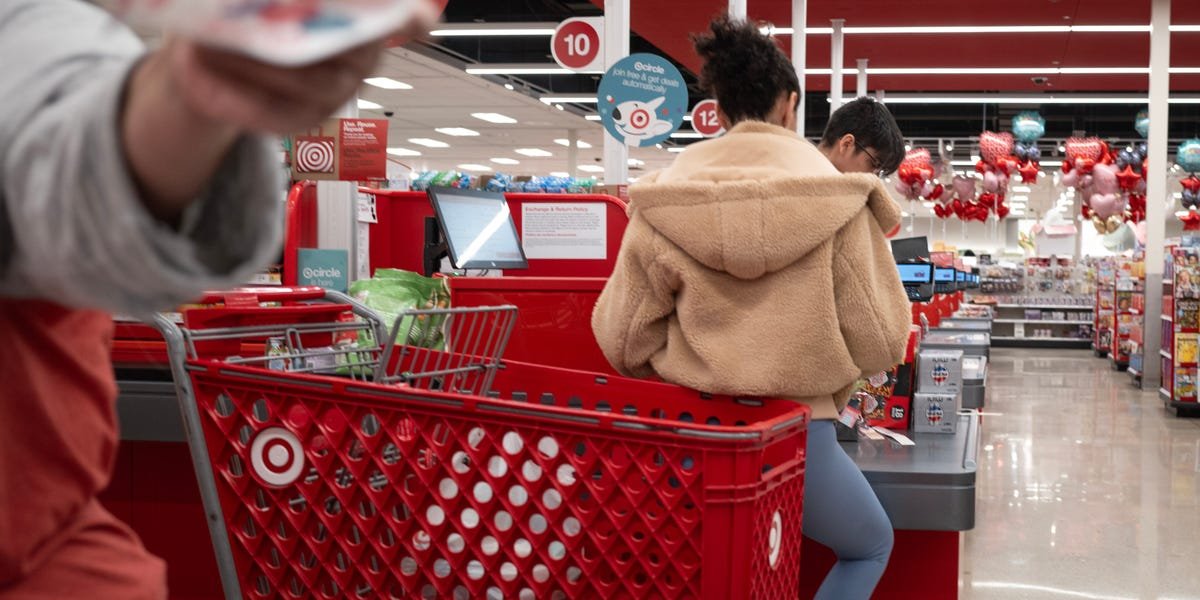
Target-finished-out-a-difficult-year-with-declining-sales-but.jpeg

Target finished out a difficult year with declining sales, but says growth is ahead

Target likely can’t wait to close the book on last year as it looks to turn the page and return to growth.

The bullseye retailer on Tuesday reported a 1.7% decline in total sales for the last fiscal year, which ended January 31, with a 1.5% drop for the quarter. That’s including the addition of a batch of new stores and growth in its digital business.

“I’m incredibly proud of how our team navigated through a challenging year in 2025,” CEO Michael Fiddelke said in a statement. “Our team is firmly focused on writing Target’s next chapter of growth.”

Adjusted fourth quarter earnings per share of $2.44 exceeded the Bloomberg analyst consensus of $2.13, but the outlook of less than a percentage point increase in comparable sales and first quarter EPS of $1.30 were less than Wall Street estimates.

While the fourth quarter’s results extend a three-year streak of flat or declining comparable sales, the company said traffic and transactions started to pick back up in December and January, and are on track to deliver net sales growth in every quarter of 2026.

“Target saw a healthy, positive sales increase in February, serving as an important milestone on our path back to growth this year, and reinforcing my confidence in the momentum we’re building and the future we’re creating together,” Fiddelke said.

Analysts said ahead of the earnings release that Fiddelke and his team have their work cut out for them.

“Time is Target’s greatest adversary,” Mizuho analyst David Bellinger said in a weekend note ahead of the release.

“While senior management is taking the necessary steps to re-position the business, others are not standing still,” he added, referring in particular to Walmart, which has been gaining momentum as Target struggles.

“Ultimately, the company needs to show how it can better compete and define its place in the market,” UBS analyst Michael Lasser said in a note leading up to the results.

Fiddelke is set to unveil his larger turnaround strategy Tuesday morning at Target’s headquarters in Minneapolis. One month into his new role, the CEO has said he’s focused on four key priorities: improving the merchandising, elevating the shopping experience, investing in tech, and supporting workers and communities.

The company also said it was seeing strong recent performance in non-merchandise sales, including its Roundel ads business, Target Plus membership, and same-day delivery services.



Source link

Lucia Moses

Peacock’s next growth bet: selling subscriptions for other streamers

Peacock’s next growth bet isn’t a blockbuster show or sports deal.

NBCU’s flagship streaming service is plotting to sell add-on subscriptions to other specialty streamers on its platform, four people familiar with the plans told Business Insider.

Peacock has approached streamers about selling subscriptions to offer viewers content that complements its reality and sports-heavy line-up, these people said. Peacock expects to start with one streamer this year and is likely to limit the offering to a small number of partners.

Starz, which already has multiple distribution partnerships, is one that’s being considered, two insiders said. Starz declined to comment.

Two people briefed on Peacock’s pitch saw it as a way for smaller streamers to reach new subscribers in a relatively uncluttered environment, and they hoped Peacock would eventually offer features such as the ability for streamers to offer free samples of their shows.

They described Peacock’s terms as favorable compared to Amazon, which has a large business selling subscriptions to programmers big and small, from HBO Max to Crunchyroll. Amazon’s channel terms vary by partner, but two partners told Business Insider in 2025 that Amazon’s subscription revenue cut was over 50% in their deals.

Peacock’s plans come at a time when streaming services — especially outside market leaders Netflix and Disney — face pressure to consolidate as they look to continue growing their subscriber bases while remaining profitable. Overall, paid streaming growth in the US has cooled, while cancellation rates have risen in the wake of price hikes.

Streamers like Peacock are trying to make themselves stickier

TV viewership growth for streamers in the US is largely stagnant, and subscribers are navigating an increasingly complex landscape. Streaming services are trying tactics like discounts and bundling to keep people from leaving their platforms.

Some other streaming platforms have adopted a marketplace approach that’s broader than what Peacock is contemplating. Amazon is by far the leader. Last year, Amazon reported that its “Channels” program accounted for about 25% of US streamer sign-ups, citing Antenna data. Roku, YouTube, and device makers like Samsung and LG also let people subscribe to streamers through their platforms.

Peacock, for its part, already sells add-on subscriptions to NBC Sports Regional Sports Networks, which it shares a corporate parent with. It also sells a bundle with Apple TV+ that involves cross-platform sampling and a discounted price.

Peacock, with less than 2% of TV watch time in the US, has struggled to grow its share of the TV pie, according to Nielsen. That makes it the second-smallest of the subscription streamers Nielsen measures, ahead only of Warner Bros. Discovery (1.4%), which includes Discovery+ and HBO Max.

US-only Peacock also has relatively few subscribers, with about 44 million. Its nearest rival, Paramount+, has around 79 million global subscribers, and both are well behind Netflix, which is No. 1 with more than 325 million subscribers.

Still, Peacock has far more subscribers than many specialty streamers. AMC Networks, for example, reported about 10 million subscribers across its portfolio of streamers, including AMC+, Acorn TV, and Shudder, as of the end of 2025.

“Peacock has been struggling,” said Alan Wolk, a media industry analyst. “There haven’t been a whole lot of reasons to watch it, so giving people another reason to subscribe is a smart idea. If you ask consumers what’s your biggest frustration with streamers, it’s always, ‘I can’t find anything.’ So the more you can put things together under one interface, the happier people will be.”

A global survey by Nielsen in November found more than 46% say it’s harder to find the content they want to watch because there are too many streamers, rising to 51% in the US, with people spending 14 minutes searching for what to watch and 49% likely to cancel because they can’t find something.

The survey also showed 66% of people expressed interest in a guide to present content information across all services.

James Faris contributed reporting.


Source link

Stacked column chart

Big Tech capex growth may be far slower than it looks — thanks to this overlooked metric

Big Tech’s latest capex projections have shocked investors. Look beneath the headline numbers, though, and spending may actually be growing far more slowly.

That’s according to new research on Monday from analysts at RBC Capital Markets.

Amazon, Google, Meta, and Microsoft are expected to spend almost $600 billion this year on data centers, chips, networking, and other related gear to meet surging AI demand.

On the surface, this may look like a relentless acceleration, but RBC’s analysis suggests these growth numbers are being flattered by an unusual culprit: runaway memory prices.

The RBC analysts found that soaring prices for data center memory chips — including DRAM, high-bandwidth memory (HBM), and NAND flash — could account for about 45% of the dollar growth in cloud capital expenditures for 2026. Crucially, most of that increase isn’t coming from companies buying dramatically more hardware, but from paying much more for the same components, the analysts said.

RBC estimates that data center memory spending across the top 10 hyperscalers will jump from about $107 billion in 2025 to roughly $237 billion in 2026. That $130 billion increase would represent about 45% of total capex growth at those companies. Even more striking, around three-quarters of the memory spend increase — roughly $98 billion — is attributable purely to higher prices, not higher unit volumes.

The price shock is severe. TrendForce projections cited by RBC show DRAM prices more than doubling in 2026, while NAND prices are expected to rise more than 85%. Memory has become one of the most constrained inputs in AI infrastructure, as advanced GPUs require large amounts of high-performance DRAM and HBM, while AI data centers consume massive quantities of flash storage.

When RBC strips memory out of the equation, Big Tech’s spending surge looks meaningfully different. Excluding memory costs, capex growth is projected to drop to about 40% in 2026, down from roughly 80% growth in 2025. That’s still a strong expansion, but far less explosive than the raw capex totals imply.

The analysts described this as “a notable deceleration,” while adding that “it’s not necessarily cause for alarm.”

RBC argued that underlying AI investment remains robust, but warned that memory pricing is now the biggest wild card for capex trends heading into 2027.

In effect, Big Tech may be spending vastly more on some equipment — without building proportionally more — as the AI arms race collides with an overheated memory market.

Sign up for Business Insider’s Tech Memo newsletter here. Reach out to me via email at abarr@businessinsider.com.


Source link

Taco-Bells-CEO-says-the-chains-magic-formula-is-fueling.jpeg

Taco Bell’s CEO says the chain’s ‘magic formula’ is fueling growth as rivals fall flat

Taco Bell CEO Sean Tresvant has a simple explanation for why his brand keeps winning while much of the fast-food industry is struggling: it’s doing more than one thing well at once.

“When you look at being a buzzy brand, you look at value, you look at digital, you look at category entry points and innovation, and all those things are working in concert with each other,” Tresvant told Business Insider. “Other brands can do one or two. When we do it, we get all four right, and we’re very good in each part of that magic formula.”

Yum! Brands, Taco Bell’s parent company, announced during its earnings report on Wednesday that the Mexican-inspired chain delivered 7% same-store sales growth in the fourth quarter, far outpacing the rest of the segment as consumers continue to pull back on dining out.

While much of the fast-food industry is grappling with slowing traffic as customers watch their wallets, Taco Bell’s growth was driven by bigger-ticket transactions, especially among younger diners, even as competitors relied heavily on discounting.

Foot-traffic data backs that up. A Placer.ai analysis of Yum Brands’ fourth-quarter performance found that Taco Bell locations held up better than many quick-service competitors during key value-driven periods, even as broader fast-food visits softened amid inflation fatigue.

Tresvant says Taco Bell’s advantage comes from combining the things competitors often struggle to balance: offering consistently good value rather than short-term deals, rapid-fire menu innovation, and a growing loyalty program that’s actually driving incremental visits. That formula, he told Business Insider, has allowed Taco Bell to keep growing traffic and relevance “in any environment,” even as other fast-food brands fight simply to stay flat.

Taco Bell’s numbers reflect its loyalty push. Tresvant said active loyalty members climbed 31% in the fourth quarter, while digital channels grew 29%, as app-exclusive drops and rewards nudged customers to visit more often. Tresvant said the goal isn’t just engagement, but turning loyalty into repeat traffic — which keeps the brand resilient.

Although value-focused options now make up 17% of Taco Bell’s menu, like its $5, $7, and $9 bundle offerings, what especially appeals to Taco Bell consumers is its pace of menu innovation — even when they’re full price. From the return of its Quesarito and recent launch of its sauce collaboration with Frank’s RedHot, to limited-time beverage offerings at its Live Más Café locations, every new rollout, Tresvant said, is “determined on consumer needs and wants.”

Fast food’s old playbook is breaking down

Across the restaurant industry, traditional quick-service strategies aren’t working as they once did because of the uneven pressure of the K-shaped economy, where lower-income consumers have pulled back on dining out while higher-income spending remains stable.

Many chains have leaned hard into deep discounting and short-term deals to lure customers back, but analysts and industry executives warn that constant promotions can erode pricing power and fail to drive meaningful traffic growth.

At the same time, competitors like Chipotle are recalibrating for smaller, wealthier consumer segments, underscoring how uneven the recovery has been across the sector.

That’s not the strategy for Taco Bell. Instead of narrowing its focus, the chain has leaned on loyalty perks and app-exclusive offers to keep a broad range of customers coming back — particularly younger diners who are more likely to engage digitally even as they cut costs elsewhere.

“We continue to innovate on the menu, but not only on the menu,” Tresvant added. “We’re going to make sure we’re innovating from a guest hospitality standpoint, we’re going to innovate in operations and innovate around the brand, not just in food.”

That means continued exploration of voice AI ordering systems, which are being tested at 600 Taco Bell locations, as well as other efficiency-optimizing technologies to streamline back-of-house operations and improve the guest experience.

It also means giving consumers new ways to stay connected to the Taco Bell brand, like its Y2K-era cross-brand collaboration with Hollister, which sold out late last year.

For Tresvant, that momentum has created rare room to experiment at a time when much of the fast-food industry is still focused on defense.

“The things we’re doing are working, and that just gives us a little bit of permission to take big swings in 2026,” Tresvant said.


Source link

This-one-activity-remained-the-largest-driver-of-GDP-growth.jpeg

This one activity remained the largest driver of GDP growth in 2025 — not AI, according to a new report

Worried about the AI bubble? A new report suggests AI was not the main leg propping up the economy in 2025.

Macro Research Board Partners, an economic research platform, published a report in January that contradicted the popular belief that AI is the main driver of GDP and that the “narrowly concentrated” and “extremely vulnerable” growth would tank the entire economy once it falters.

“In short, without an AI boom, there would have certainly been less GDP growth last year, but there would also be fewer imports, so that overall real growth would still have been decent,” wrote economic strategist Prajakta Bhide, who authored the report.

Bhide told Business Insider that personal consumption, meaning the spending of everyday people, was still the main pillar of GDP growth in 2025, and that despite the amount of investment in AI infrastructure, a lot of high-tech equipment is imported, and imports do not contribute to GDP.

The main categories that count toward GDP are personal consumption, private domestic investment, government spending, and net exports.

“Consumers continue to be the backbone of the economy,” Bhide told Business Insider. “Aggregate income growth is lower than it used to be, and so is job growth, which affected consumer sentiments. But there is a divide between what consumers say they feel and what they say that they’re going to do versus what they actually go and do.”

AI growth was an important secondary driver of GDP growth, the report found, but that is mostly from software investment, while the contribution of data centers is “negligible.”

“Although a negative shock to the optimism around AI implies a risk to GDP growth,” Bhide wrote in the report, “the more realistic (and smaller) estimate of AI’s growth impact after adjusting for imports dispels the popular notion that the US economy would falter without it.”

Beyond the GDP, concerns about the AI bubble are also tied to the stock market and people’s retirement funds. America’s eight most valuable public companies, including Nvidia, Alphabet, and Apple, are all betting heavily on AI and are worth $22 trillion altogether.

Business Insider has previously reported that historically, a pullback in consumer spending has rarely been the trigger for an economic downturn. Instead, spending typically weakens only after job losses mount and when a recession is already well underway.


Source link