Amanda Goh

Olympic skier Tess Johnson, 25, says one simple daily habit powers her performance — and it doesn’t involve the gym

Olympic skier Tess Johnson, 25, starts and ends every day with the same ritual that helps her perform under pressure.

In an interview with Town & Country Magazine published on Wednesday, the American mogul skier said she always packs her journal when she travels for competitions.

“I do a little bit of journaling in the morning to set my day, set my goals for the day and a little bit of gratitude, but then in the evening I let it all out and it’s a little bit like word vomit, but whatever I need to just get out to get a good night of sleep,” Johnson said.

Johnson made the US national team at 14 — the youngest athlete to do so at the time — and later became the youngest American freestyle skier to medal at the World Championships.

She debuted at the 2018 PyeongChang Olympics and reached the finals at the 2026 Milan Cortina Games, where she finished 10th.

Johnson, whose grandfather was a former Sports Illustrated writer who covered the Olympics, said journaling plays a key role in her mental preparation.

She believes she inherited her love of writing from her grandfather and now uses journaling as a practical training tool to track her progress in skiing.

“And also an emotional tool to just work through whatever anxieties are happening because this is a very intense sport and process that we’re going through,” Johnson said.

“It’s really helpful to get it all out on paper and sift through it just by putting pen to paper. So it does a lot for me. And at the very least, it’s just a way to stay present and get off my phone from time to time,” she continued.

Johnson added that she occasionally rereads her old journals, including those from the 2018 Olympics.

“It’s really cool to see the progress I’ve made over the years,” she said.

Apart from being a part of her daily routine, journaling is also a key part of her pre-race ritual.

“The night before I like to journal, whatever in training that day, any other thoughts that I need to get out. Then the morning of, I’ll write down three goals for the day, usually relating to my skiing or a mental performance goal, or just something even maybe not related to skiing, just that I have for the day, and then I’ll write down a couple things that I’m grateful for as well,” Johnson said, adding that she does her warm ups after that.

Johnson isn’t the only elite athlete who has embraced journaling as part of their routine.

Michael Phelps told Business Insider in 2023 that he uses writing to reflect and unwind, while WNBA star Caitlin Clark has incorporated journaling into her pregame ritual to clear her head and stay focused.

Meanwhile, other Olympians are leaning into surprisingly old-school hobbies in their downtime, including cross-country skier Ben Ogden, who said knitting helps him relax.


Source link

Im-81-years-old-and-I-still-love-going-to.jpeg

I’m 81 years old, and I still love going to the gym. It’s helped me stay social and physically healthy.

When our family moved to Oregon from Southern California in 1974 for my husband’s new job, I fell in love with the Pacific Northwest. But there was one problem: There wasn’t enough sunshine or swimming pools — both of which I had enjoyed in California.

When the community college where I taught offered free memberships at a new gym, I quickly signed up. I expected exercise, but I got so much more.

Over 30 years later, I’m 81, and still going to the gym every other day. It’s still an important part of my health routine.

I found that the gym isn’t just for young people

The weight room is full of young people lifting weights, and they pound their feet on treadmills like the start of the Kentucky Derby.

But the gym is also filled with older people. There’s the 87-year-old woman who runs up and down the stairs “because it feels good,” while her 91-year-old husband maintains a steady pace on the treadmill.

As a swimmer, I’ve met several people around my age, welcoming each other into the pool.

With a somewhat older crowd, I am pleasantly surprised at how disabilities and imperfections are of no consequence in the pool. Surgery scars, including mastectomies and even amputations, are not worthy of the slightest stare or question. The miracle of being in the water is that handicaps and age disappear.


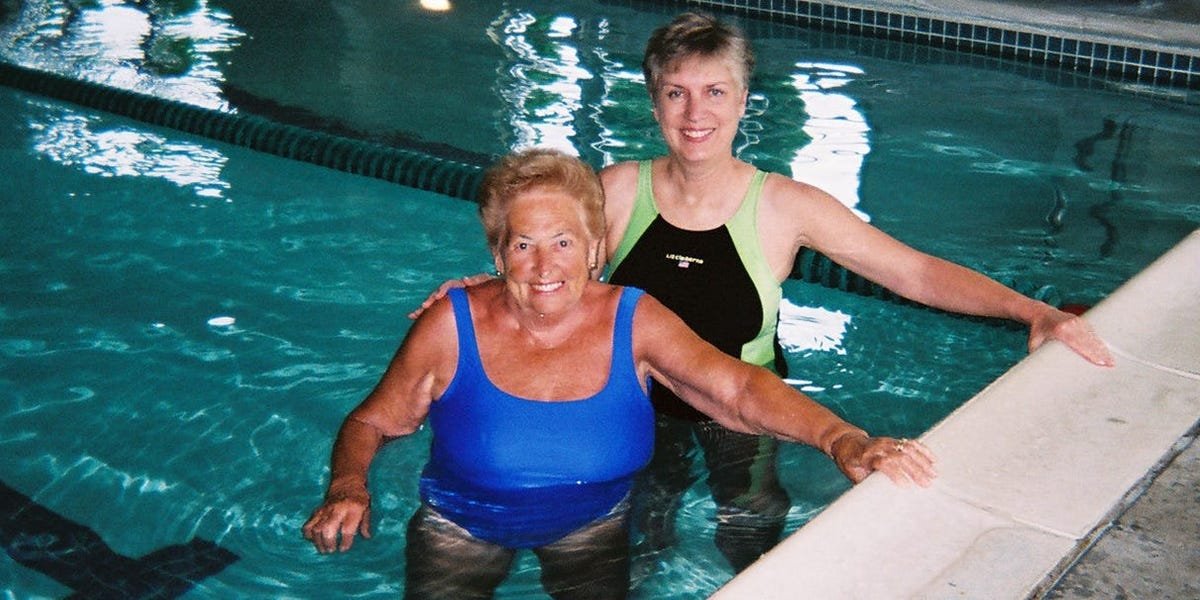
Cynthia Wall and her friends in the pool at her gym

The author says she’s stayed healthy thanks to the pool at her gym.

Courtesy of Cynthia Wall


Even those who enter the pool in a lift achieve equality once they are buoyant. I’ve witnessed physical challenges that make me realize how insignificant my own are.

I was surprised to find deep friendships at the gym

When I first came to the gym to exercise, I didn’t expect to make friends — acquaintances, yes, but not friendships that mattered.

But then I met Maria, an 80-year-old Austrian with an infectious laugh. I heard her in the locker room as she shared a recipe for Wiener Schnitzel with someone. I had seen her in the pool, swimming with her head held high to keep her beautifully coiffed hair dry. I smiled and said goodbye as I left. The next day, I swam alongside her. I switched to a slow breaststroke so I could keep my head out and hear her story — and what a story it was.

A well-to-do Austrian, married to a doctor, she, her husband, and three children were reduced to refugee status under the Russian occupation at the end of World War II. In 1957, they were able to emigrate to the US. Because of their belief in the American Dream, they thrived. Maria often commented on their good fortune; she also taught me European history. She taught me a little German and showed me that laughter is the best antidote for any problem.

Soon, our casual acquaintance became a dear friendship that lasted until her death at 103 in 2022. We spent over 20 years together at the gym, four days a week. I made other friends as well. All of us loved and admired Maria.

I believe moving my body and socializing are keeping me young

Going to the gym multiple times a week has kept me more than young; it’s kept me moving into my 80s.

I have fairly severe scoliosis, and it hurts. Without swimming and core strengthening at the gym, I don’t want to think about how much worse it would be.

Over the years, I’ve learned that going to the gym is the best thing I can do for myself.

I am stronger than yesterday — stronger in my body, stronger in friendships, and stronger in optimism.


Source link

Emily Stewart

Your boss is about to pull back your gym benefits

Much like office snacks and flashy holiday parties, corporate wellness programs have always struck me as a bit of a scam — nice to have, but not at the expense of my job, salary, or a decent healthcare plan. Maybe that makes me a cynic, but in the zero-sum world of corporate budgets, if it comes down to layoffs vs. avocados, I’m fine skipping the avocados. Unfortunately (or fortunately), I’m not the one making those decisions.

Workplace wellness programs have exploded over the past decade or so, with companies rolling out a suite of subsidized perks, such as gym discounts, mental health apps, and other benefits aimed at attracting and retaining workers. The pandemic upped the ante even more — in the face of a tight labor market and a hyper-stressed workforce, plenty of business leaders looked around and thought, “Well, a Zoom meditation session can’t hurt, right?”

Now, the ground is shifting. Corporations aren’t cutting their wellness programs altogether, but they are taking a hard look at what they’re paying for. They’re cutting excessive, underutilized benefits, scrutinizing ROI, and shifting to more cost-effective, targeted products. They’re trying to support employee well-being amid economic uncertainty and rising healthcare costs — without breaking the company piggybank.

Your job still wants to help you out with the gym, but it would rather you hit up Planet Fitness than Equinox. And, if it figures you’ve given up on your New Year’s resolution to exercise already, it doesn’t want to waste money on a benefit you’ll never use.


In the 2010s, the millennial-driven flurry of “work-life balance” chatter nudged companies to invest more in the life end of things. A low-interest-rate environment made such spending easy to justify. Perhaps a smaller player couldn’t compete with the tech giants’ lavish perks, but many of them did pour money into products and services they hoped might support employee health and morale, to varying degrees of success.

“I don’t know that anybody’s told me that it’s paid off. I mean, I don’t hear companies saying, ‘Our well-being program has been our secret to success,” says Josh Bersin, global industry analyst and CEO of The Josh Bersin Company, a consultancy. “So it does not surprise me that this got really overbuilt and overhyped.”

Returns are hard to track, employee uptake is limited, and costs often balloon.

Now that companies are tightening their belts again, many of these ancillary perks are on the chopping block. Wellness is a fairly straightforward place to make spending reductions, as it falls in the optional category. Returns are hard to track, employee uptake is limited, and costs often balloon.

Data Ramp Capital shows companies using its expense management platform have reduced wellness benefits for employees to $1,103 a year per worker in 2025 from $1,366 in 2023, a 20% decline. In turn, employees have upped their usage of budget-friendly apps such as Classpass and Wellhub and shifted toward lower-cost gyms.

“Benefits are being cut, and then as those benefits are being cut, people are spending at cheaper places on average,” says Ara Kharazian, an economist at Ramp.

The cuts to these side benefits come as the cost of companies’ major healthcare expenditure — the insurance they provide for their employees — continues to rise. Annual family premiums for employer insurance coverage increased by 6% to nearly $27,000 in 2025, per the Kaiser Family Foundation, and are expected to hit $30,000 this year. Employers say that controlling healthcare costs is their primary benefits objective, according to a recent MetLife survey, outweighing productivity, loyalty, and attracting talent.

“What they’re doing in light of really large increases is they are going through every benefit,” says Todd Katz, head of US group benefits at MetLife.

Cesar Carvalho, the CEO of Wellhub, which gives employees access to a network of gyms, studios, and classes, says one of the main appeals of his business is its price point, especially in this environment. “The value proposition of the company is very simple, they pay $2-$5 per employee per month, and that’s it,” he says.


If I had to make a bet, I would guess that you, the reader, do not fully understand the various wellness-related perks your job offers. That’s OK! Neither do I! Companies have been spending a lot of money on corporate wellness — by one estimate, nearly $95 billion worldwide this year — without always checking whether it’s effective.

One 2023 Deloitte survey found that 68% of workers don’t use the full value of their company’s well-being resources because the programs are too “time-consuming, confusing, or cumbersome” to access. A separate 2025 survey from Sapients Insights Group, a research and advisory firm, found that under a third of workers access their company’s digital wellness platform monthly. Much of this stuff hasn’t proven very impactful anyway: A 2024 study out of Oxford University in the UK found that employer offerings such as well-being apps, relaxation classes, and financial coaching generally didn’t make workers better off. The exception: providing opportunities to volunteer. (Resilience and stress management training actually had a negative impact.)

The way to build a healthy workplace culture is for the workplace to be holistically healthy

Zachary Chertok, a senior research manager for employee experience at IDC, a market-intelligence firm, tells me that spending on physical and mental well-being is growing more strategic. Decisions around these products and services have historically been “top down and driven by internal company initiatives,” he says. Essentially, someone in the C-suite or in HR decides there’s going to be a wellness push, picks out whatever app(s) to implement it, and everyone moves on. Now, companies are getting smarter at identifying and spending on what’s actually being used rather than what isn’t. What this looks like in practice is businesses enlisting vendors that offer a potential suite of services or a central hub to manage a set of offerings, rather than contracting with a bunch of ad hoc programs. The model lets them choose which options they do and don’t want to include and, over time, decipher what employees are using to refine the offer.

“As wellness spend matures, companies are thinking more about individual use and engagement cases and how spend can be mapped to it,” Chertok says. New platforms that collect data on what people are using and what they aren’t, he adds, helps “connect the dots on what is actually having an impact and working.”

Essentially, if my work wellness platform realizes I’m never going to download the mental health app, it will stop bugging me about it, and if enough people do the same, it will alert my employer to drop the benefit.


Employers don’t do all of this extra investing out of the kindness of their hearts. They do it because they think healthier employees will reduce their healthcare costs, take fewer sick days, and be more productive. That, in turn, saves the company money on their end of the insurance bill. From the employee perspective, it results in an awkward arrangement. For people who use the perks, the benefits are a plus, but workers can also feel like their bosses are simply trying to slap a band-aid-sized app onto a much larger problem of stress, burnout, and overwork.

A mindfulness workshop scheduled in the middle of the workday doesn’t help an employee who’s so overwhelmed they don’t have 20 minutes for lunch. It also fosters animosity, as they wonder exactly who among the ranks actually has time for that. The way to build a healthy workplace culture is for the workplace to be holistically healthy: a financial health app doesn’t do much if you’re severely underpaid, a gym membership is useless if you’re working 11-hour day, a video about stress management doesn’t help you figure out how you’re going to manage your new, sky-high insurance premiums.

“I think most people would rather have it go into their medical benefits because that’s the big cost,” Bersin says.

Business Insider is giving us ClassPass this year, and I am excited to use it — assuming I don’t forget, which, TBD. We lost the reimbursement fitness benefit that came with our health insurance last year, which was more financially advantageous. I remind myself this benefit is an extra, not a requirement, and I hope my bosses know I’m OK if they cut it. I can learn to run outside.


Emily Stewart is a senior correspondent at Business Insider, writing about business and the economy.

Business Insider’s Discourse stories provide perspectives on the day’s most pressing issues, informed by analysis, reporting, and expertise.




Source link

My-daughter-told-me-I-should-start-going-to-the.jpeg

My daughter told me I should start going to the gym. At 79, I’m in the best shape of my life.

This story is based on a conversation with Joan MacDonald, 79, a former driving examiner of Collingwood, Ontario. It has been edited for length and clarity.

January 2017 was a New Year I’ll never forget. It was one of the few times that my daughter, Michelle MacDonald, lost her cool with me.

She’d moved to Mexico the previous month and was visiting. “I won’t get to see you as often as I like,” she said. “And, every time I leave, I won’t know whether it will be the last time I see you.”

Then she made another blunt comment that changed my life. “Mom, why don’t you go to the gym?” she said.

I needed to improve my health

I had high blood pressure, kidney problems, and was at least 70 pounds overweight. Approaching my 71st birthday that March, I felt scared and miserable.

My doctor had already warned me that, if I didn’t make an effort to improve my health, I would end up on dialysis before very long. I was effectively dying.


An older woman standing in a clothing store

MacDonald, before she discovered the gym and became healthier.

Courtesy of Michelle MacDonald.


Growing up in Canada, I’d been an active child. I played ball, skated in the winter, and went bowling. I enjoyed doing them because they were fun. But I was by no means an athlete.

I got married a month before my 21st birthday and settled into married life while working as a driving examiner. I juggled work with motherhood, raising Michelle and her older and younger brothers.

Going to the gym really wasn’t a thing back then. None of my married friends worked out, or even thought about doing so.

I took medication for high blood pressure

I believe that your body changes every seven years or so. I went through variations in terms of shape and size, and enjoyed certain foods, then went off them.

I didn’t have regular meals, often eating just two meals a day at irregular times. In between, I’d snack.

Throughout my 60s, I was in poor health. I’d get bronchitis in the fall and spring — I had weaker lungs after contracting rheumatic fever as a child — and the kidney issues began.

The weight had grown to 200 pounds, which was far too heavy for my height of 5 feet 3 inches. And my blood pressure was high; I was put on medication.


An older woman flexes her muscles on a beach.

MacDonald, after taking up exercise and eating five small meals a day.

Courtesy of Michelle MacDonald


I’m lucky because Michelle is a certified strength and conditioning specialist and sports nutrition coach. She saw how unhealthy I’d become and was worried, especially because she’d moved thousands of miles away and couldn’t keep an eye on me.

Her recommendation struck home. It was enough to jolt me into action. My doctor also encouraged me to lose weight and reduce my blood pressure.

I’d half-heartedly attended the gym before, but not consistently. This time, I went five times a week.

My body slimmed down

I sought advice from Michelle and studied YouTube videos to learn how to use the machines and do strength training with free weights. At first, I couldn’t believe how hard it was to pick up 20 pounds.

I began with small weights and increased them by increments. I’ve since done a deadlift of 170 pounds and a hip thrust of 230 pounds.

It was amazing to see my body slim down and fit into clothes, like jeans, that I hadn’t worn in a very long time.

I lost 45 pounds in six months and a further 25 pounds during the rest of my 70s. I’ve gone from a size XL to a medium. I was able to quit my medications.


An older woman doing the splits.

MacDonald has become stronger and more flexible.

Courtesy of Michelle MacDonald


My current regimen involves spending two hours at the gym, with around 15 minutes of cardio, followed by using weights. I often work out with Michelle, whom I joined in Mexico for around a year after my husband died.

As for my diet, I eat five small meals a day, including oatmeal with egg whites, protein powder, and 1% coconut milk for breakfast.

Then I’ll have yogurt, an egg white omelette with ground beef, chicken, turkey, and ham, a protein bar, and a final, plain meal without starches. If I start my day at 7 am, I’ll stop eating by 7 pm.

A shoulder injury hasn’t stopped me

Unfortunately, I suffered a shoulder injury while biking outside on a rough surface and needed surgery three months ago. I’ve had to take things a bit easier as I recover. However, I feel 100% happier and healthier than I did before going to the gym.

Michelle and I established “Train With Joan” to help inspire people to take up exercise, regardless of their age.

It may slow you down a bit, but I’ve seen many seniors, even older than me, accomplish great things. They have resolved to do it for themselves. Nobody else is living in your body but you.


Source link