
GabbyLandsverkpic

A weight loss doctor, who specializes in helping high performers, shares her favorite hack to eat healthy without tracking every bite

On a recent trip to France, Dr. Meghan Garcia-Webb was struck by an age-old paradox.

Everywhere she looked, she saw people enjoying cheese, wine, and bread — yet the average person seemed much healthier than the typical American.

In France, despite their reputation for rich cuisine, the obesity rate is a fraction of what we see in the United States, for all our calorie-counting and protein maxxing.

“There isn’t this pervasive diet culture of going to a restaurant and seeing how many calories are in this and how many carbs,” Garcia-Webb told Business Insider. “I do find it is refreshing in the sense that there’s not this fear around food, and the food is very satisfying.”

It’s just one example of how stressing less about your diet can lead to better weight loss and long-term health, she said.

In her concierge medicine practice, Garcia-Webb specializes in helping high achievers, such as CEOs and attorneys, manage their weight. A lot of her job is pushing back on extreme diet fads, including the trend of tracking everything.

“I really enjoy food and the more I do this work, the more compelled I feel to show people that it actually is possible to be healthy and really like to eat,” she said.

Garcia-Webb said her favorite food hack makes it easy to eat well without turning your food journal into a full-time job. Here’s how to try it at home for more nutritious meals.

A stress-free guide to healthy eating

Everyone loves a food hack, and Garcia-Webb said hers is simple: when you prepare a meal, start by making half the plate fruits and non-starchy vegetables.


A colorful salad with greens, nuts, peppers, and grilled chicken.

Filling half your plate with produce is a simple way to eat well without measuring each bite, calorie, or gram of protein.

Magda Tymczyj/Getty Images


“It’s actually very easy,” she said. “You don’t even have to cook them if you don’t want to.”

Think carrots, cucumbers, peppers, greens, tomatoes, berries, grapes, citrus — anything you’d find in the produce aisle (except potatoes). To make it even easier, opt for pre-cut options that are ready to eat or frozen produce, which is as healthy as fresh.

From there, Garcia-Webb builds a full meal by adding a source of protein, like lean meats or fish, to fill another quarter of the plate. The last quarter of the plate is for starchy foods like whole grains, pasta, rice, or potatoes.

The strategy makes it simple to get five servings a day of fruits and veggies. Each serving is about a handful when you’re eyeballing it.

As you fill up on produce, the high-volume, high-fiber food keeps you full and satisfied after eating, so you’re less likely to reach for junk food later. That means you’ll find yourself eating healthier without having to count a single calorie or even measure a portion.

When to track your food for weight loss

There’s nothing inherently wrong with tracking your eating habits, and calculating every gram of protein is fine if that works for you.

Still, for most people, too much tracking can be a burden, taking away the enjoyment of food and making you less likely to stick to your healthy habits long-term.

Instead of trying to track everything you eat forever, Garcia-Webb recommends keeping a food log for a few days: it can give you a baseline sense of your current habits and what you can change to move toward your goals.

“You build this intuitive knowledge, and then you have a rough sense of what it looks like for you,” she said.

A temporary habit of food tracking can be helpful if you feel like you’re doing everything right and wonder why you aren’t losing weight.


A woman in a grocery store comparing two cartons of dairy

Food labels can mislead you by making a processed snack seem healthy because of added protein, but sneaking in extra sugars.

Luke Chan/Getty Images


Garcia-Webb said if you’ve never tracked your habits, it’s common to eat more and exercise less than you realize.

These days, plenty of convenience foods disguise ultra-processed junk with a “health halo” of added protein or other nutrients to make you believe you’re making a nutritious choice.

“People think that they’re eating healthier than they are,” Garcia-Webb said. “Something that we can all fall prey to is very good marketing.”



Source link

Im-81-years-old-and-I-still-love-going-to.jpeg

I’m 81 years old, and I still love going to the gym. It’s helped me stay social and physically healthy.

When our family moved to Oregon from Southern California in 1974 for my husband’s new job, I fell in love with the Pacific Northwest. But there was one problem: There wasn’t enough sunshine or swimming pools — both of which I had enjoyed in California.

When the community college where I taught offered free memberships at a new gym, I quickly signed up. I expected exercise, but I got so much more.

Over 30 years later, I’m 81, and still going to the gym every other day. It’s still an important part of my health routine.

I found that the gym isn’t just for young people

The weight room is full of young people lifting weights, and they pound their feet on treadmills like the start of the Kentucky Derby.

But the gym is also filled with older people. There’s the 87-year-old woman who runs up and down the stairs “because it feels good,” while her 91-year-old husband maintains a steady pace on the treadmill.

As a swimmer, I’ve met several people around my age, welcoming each other into the pool.

With a somewhat older crowd, I am pleasantly surprised at how disabilities and imperfections are of no consequence in the pool. Surgery scars, including mastectomies and even amputations, are not worthy of the slightest stare or question. The miracle of being in the water is that handicaps and age disappear.


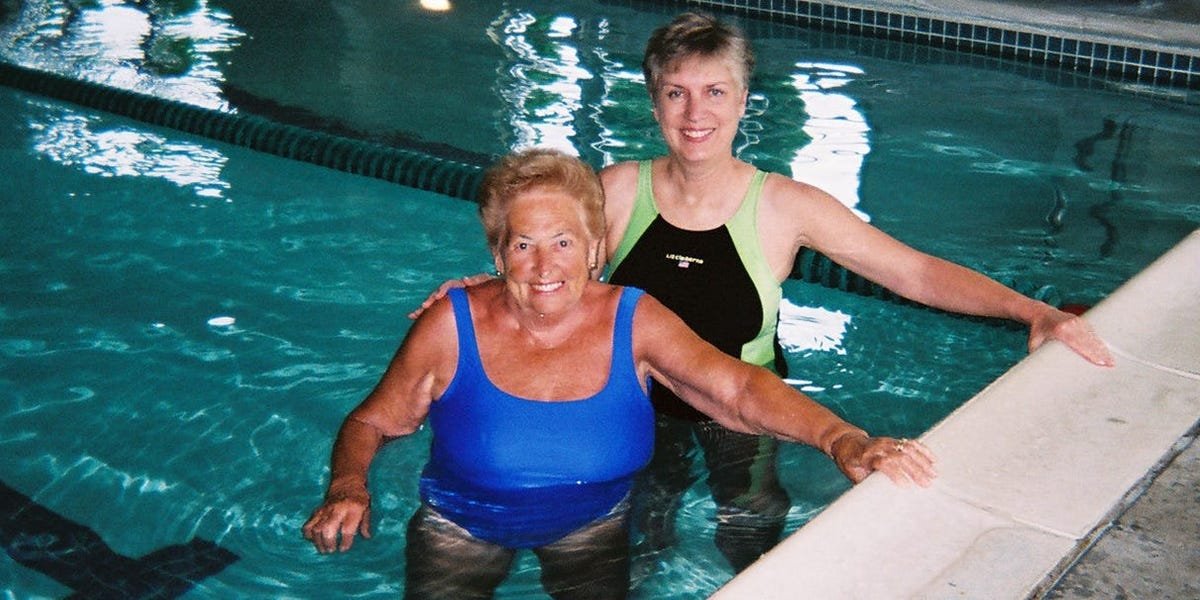
Cynthia Wall and her friends in the pool at her gym

The author says she’s stayed healthy thanks to the pool at her gym.

Courtesy of Cynthia Wall


Even those who enter the pool in a lift achieve equality once they are buoyant. I’ve witnessed physical challenges that make me realize how insignificant my own are.

I was surprised to find deep friendships at the gym

When I first came to the gym to exercise, I didn’t expect to make friends — acquaintances, yes, but not friendships that mattered.

But then I met Maria, an 80-year-old Austrian with an infectious laugh. I heard her in the locker room as she shared a recipe for Wiener Schnitzel with someone. I had seen her in the pool, swimming with her head held high to keep her beautifully coiffed hair dry. I smiled and said goodbye as I left. The next day, I swam alongside her. I switched to a slow breaststroke so I could keep my head out and hear her story — and what a story it was.

A well-to-do Austrian, married to a doctor, she, her husband, and three children were reduced to refugee status under the Russian occupation at the end of World War II. In 1957, they were able to emigrate to the US. Because of their belief in the American Dream, they thrived. Maria often commented on their good fortune; she also taught me European history. She taught me a little German and showed me that laughter is the best antidote for any problem.

Soon, our casual acquaintance became a dear friendship that lasted until her death at 103 in 2022. We spent over 20 years together at the gym, four days a week. I made other friends as well. All of us loved and admired Maria.

I believe moving my body and socializing are keeping me young

Going to the gym multiple times a week has kept me more than young; it’s kept me moving into my 80s.

I have fairly severe scoliosis, and it hurts. Without swimming and core strengthening at the gym, I don’t want to think about how much worse it would be.

Over the years, I’ve learned that going to the gym is the best thing I can do for myself.

I am stronger than yesterday — stronger in my body, stronger in friendships, and stronger in optimism.


Source link

hilary brueck backyard headshot

What ‘healthy fats’ actually are — and how to choose the right ones for your diet

US Health Secretary Robert F. Kennedy Jr. says his diet message is clear: “Eat real food.”

That was his main mantra during a White House press briefing on the new Dietary Guidelines for Americans, released Wednesday.

The new guidelines feature an inverted pyramid, with protein, dairy, and so-called “healthy fats” as the foundational corner of the new American diet.


new pyramid

Protein, dairy, and ‘healthy’ fats are the foundation for RFK Jr.’s new pyramid.

realfood.gov


“Protein and healthy fats are essential, and were wrongly discouraged in prior dietary guidelines,” Kennedy said.

If you’re trying to eat healthier, the problem isn’t that you need more fat — it’s that “healthy fat” is a vague term that means very different things depending on the source.

But what is a healthy fat, exactly? Here’s how nutrition experts say to tell the difference, and how to use that information when you shop, cook, and eat.

A ‘healthy fat’ isn’t just about fat — it’s about the whole food


olive tree

Olive oil is a healthy fat that everyone can agree on. Others spark more debate.

Philipp von Ditfurth/picture alliance via Getty Images


The new federal guidelines don’t provide a strict definition of “healthy” fat, only saying that healthy fats come from whole foods.

Business Insider reached out to the Department of Health and Human Services multiple times, asking for a clear definition of “healthy” fat, but didn’t get an answer.

Typically, when nutritionists talk about healthy fat, what they mean is sources that have:

  • More unsaturated fat and less saturated fat
  • Other nutrients traveling with the fat

Take olives. An olive is a fruit that includes a mix of both unsaturated and — to a much lesser extent — saturated fats. It also has other nutrients in it, including fiber, iron, and vitamin E, plus plant chemicals called polyphenols, which are good for your brain. That’s why olive oil is widely regarded as a healthy choice.

The same goes for chia seeds. They’re high in omega-3 fatty acids, an essential fatty acid that we need to consume because we can’t make it on our own. They’re naturally low in saturated fat, and also provide other nutritional benefits, including decent doses of both fiber and protein.

Walnuts provide another great example. Until the 1990s, they were thought to be bad for your heart, due to their high fat content. It turns out the opposite is true: walnuts are packed with polyunsaturated omega-3s, making them actively good for your heart.

Dr. Joan Sabaté, who pioneered that walnut research in the 90s, said the key is to think about your fats in a broader context, not just focusing on one metric.

“It’s not only the type of fat, but the source of the fat, and how the fat is together with [other nutrients],” Sabaté, a Blue Zone epidemiologist who directs the Center for Nutrition, Lifestyle and Disease Prevention at Loma Linda University, told Business Insider.

What’s the deal with saturated fat?


buttered bread

Butter is a classic example of a food that’s high in saturated fat. Fine, in moderation.

ArtMarie/Getty Images


Unveiling the new guidelines, Kennedy said, “We are ending the war on saturated fats.”

The new food pyramid features beef, butter, and whole milk high up.

“Eating a little bit of animal products is good,” Sabaté said. Red meat and full-fat dairy are packed with nutrients like vitamin B12 and iron, for example, which is hard to find in plants. Experts agree that a little saturated fat is not that bad for your body.

Still, it’s controversial that the new guidelines front-load meat and animal products as “healthy” fats, and mention them first.

Meat and dairy contain significantly more saturated fat than plants like olives and avocados. Research has linked diets rich in red meat and dairy to a higher incidence of chronic health issues, including heart disease and cancer. Animal products are also more pro-inflammatory than whole grains and vegetables.

“That is not the way to go,” Sabaté said, echoing concerns that many health experts shared this week.

(Plus, the new guidelines still recommend limiting your saturated fat consumption to 10% of total daily calories, which means you can’t actually live on a diet of butter, red meat, and cream.)

The takeaway: How to apply this to your diet


drizzle olive oil

Fat packs a punch, more than doubling the calories per gram of a protein or carbohydrate.

AzmanL/Getty Images


So, what should you cook with tonight?

Most days, consider swapping butter for olive oil in your frying pan. That will mean more heart-healthy fats get in your system.

The best change you can make, though, is to curb ultra-processed snacks. Packaged cakes and cookies are often loaded with saturated fat from cooking oils. If you had a buttery steak for dinner, and skipped after-dinner snacks, that could be a good thing.

Don’t fear fat — but don’t center your diet on it either.


Source link