Bill-Ackmans-hedge-fund-Pershing-Square-just-filed-for-an.jpeg

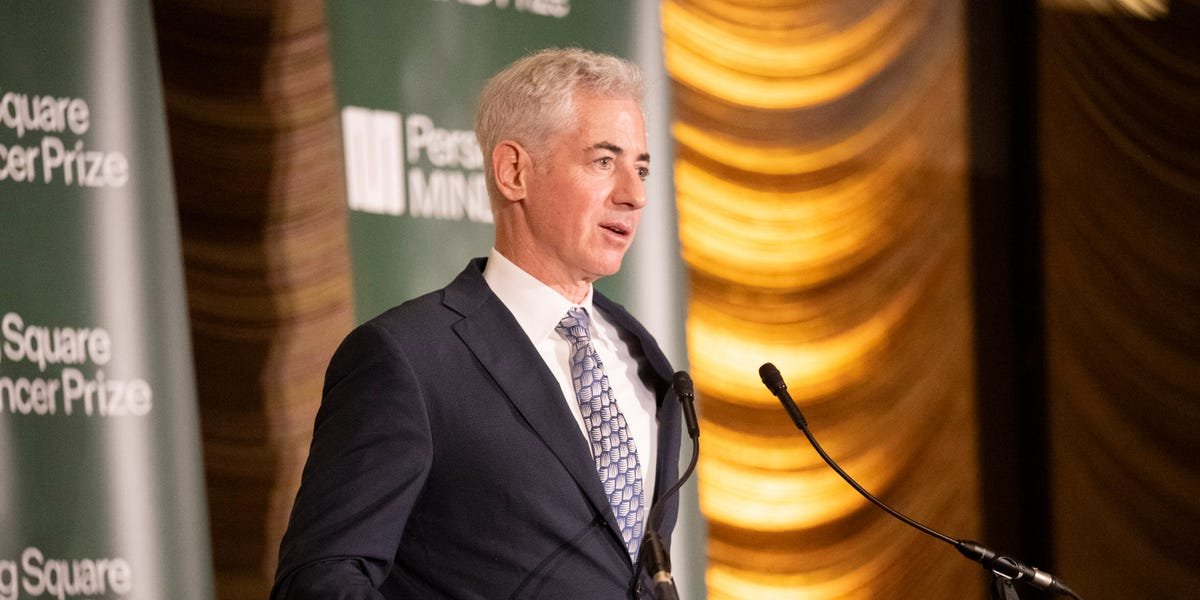
Bill Ackman’s hedge fund, Pershing Square, just filed for an IPO

  • Bill Ackman’s hedge fund, Pershing Square, is going public.
  • The company said in a Tuesday statement that it has filed for an IPO on the NYSE.
  • Pershing Square is seeking to raise at least $5 billion in the IPO, it said.

Pershing Square, the investment fund run by famed investor Bill Ackman, has filed for an IPO, it announced on Tuesday.

Ackman’s fund is planning a dual listing of Pershing Square and a closed-end investment company, Pershing Square USA, on the New York Stock Exchange.

The company is seeking to raise at least $5 billion in the IPO, it said in a statement announcing the planned listing.

“Shares are being offered at a price of $50.00 per PSUS Share and investors in the PSUS IPO will receive, for no additional consideration, 20 PSI Shares for every 100 PSUS Shares purchased,” the company said.

The planned company will be listed under the stock market tickers “PS” and “PSUS,” the statement added.

This is a developing story.


Source link

Bill Ackman attends 2025 Pershing Square Foundation MIND and Cancer Prize Award Dinner at The Pool on May 22, 2025 in New York.

Bill Ackman’s hedge fund reveals big stake in Meta — ‘one of the clearest beneficiaries of AI integration’


Michael Ostuni/Patrick McMullan via Getty Images

  • Bill Ackman’s Pershing Square has invested roughly 10% of its capital in Meta.
  • The fund told investors Meta is set to be “one of the clearest beneficiaries of AI integration.”
  • Meta has been plowing cash into data center projects, which Ackman’s firm expect to pay off long-term.

Bill Ackman is betting big on Meta — saying it believes it to be “one of the clearest beneficiaries of AI integration.”

The billionaire investor’s Pershing Square hedge fund revealed Wednesday that it has invested around 10% of its capital in Meta, or approximately $2 billion, as of the end of December.

“We believe Meta’s current share price underappreciates the company’s long-term upside potential from AI and represents a deeply discounted valuation for one of the world’s greatest businesses,” the presentation said.

At around $668 per share on Wednesday afternoon, Meta’s stock price is roughly flat in 2026 so far, and down approximately 7% from one year ago.

Pershing Square also revealed it had allocated 13% of its fund to Amazon as of the end of 2025, and a 2% position in Hertz in late 2024.

Wall Street has been less than enthusiastic about some of Big Tech’s planned capital expenditure plans, but Meta’s budget-busting $135 billion forecasted spend was rewarded last month with a short-lived 8% bump the share price.

Either way, Ackman’s team says they’re very much on board with the strategy.

“We believe concerns around META’s AI-related spending initiatives are underestimating the company’s long-term upside potential from AI,” the presentation said.


Pershing's Meta investment thesis

Pershing Square’s investment thesis for its stake in Meta.

Pershing Square


The presentation also said Meta’s 3.5 billion users are increasing at a steady clip, setting the company up as the “dominant” leader in digital ads.

“Meta’s business model is one of the clearest beneficiaries of AI integration,” the presentation said.


Source link

Bradley Saacks

Here’s how hedge funds like Citadel, Point72, and Balyasny performed in January

The biggest hedge funds in the $5 trillion industry started 2026 in the black, for the most part.

Steve Cohen’s $45.7 billion Point72 started the year strong with a 2.9% gain, a person close to the firm said.

Ken Griffin’s $65 billion Citadel returned 1% in its flagship Wellington fund in January, a person close to the Miami-based firm told Business Insider. Schonfeld also returned 1% in its flagship Partners fund last month, a person close to the firm said. Michael Gelband’s ExodusPoint, which had its best year in 2025, was up 1.8% in January, a person close to the manager said.

Multistrategy funds place bets across a diversified set of strategies to generate strong returns for investors. However, a trend started in 2025 seems to be continuing for some big names: Citadel and Schonfeld’s smaller funds outperformed their broader flagship offerings.

Citadel’s Tactical Trading fund, which blends its fundamental stockpicking strategies with its computer-run ones, was up 2% in January, a strong showing given the choppy start to the year quant funds have faced. The firm’s fixed-income-only fund was up 1.3%, the person close to the manager said.

Schonfeld’s Fundamental Equity fund was up 2.4% in January, and LMR’s convertibles-focused fund posted a 2.5% gain last month, people close to the two managers told Business Insider. Boothbay’s high-octane offering made 1.5% in January, while its flagship returned 1.3%, a person close to the New York-based firm said.

The S&P 500 index was up 1.4% last month, hitting all-time highs in the middle of January, before dipping slightly before the month’s end.

A bright spot in the industry was strategies focused on Asian markets. Two Asia-based multistrategy managers, $5 billion Dymon Asia and $3 billion Pinpoint Asset Management, had banner months, returning 5% and 4.8%, respectively.

For Pinpoint, it was the best monthly return since July 2020, a person close to the manager told Business Insider. Dymon Asia’s returns were driven by Asian equities and FX strategies, a senior executive at the firm told Business Insider.

Bobby Jain’s firm, meanwhile, continues to trail peers. At the start of the firm’s second full year of trading, Jain Global lost 0.9% in January, a person close to the manager said.

The firms mentioned declined to comment.

(Editor’s note: This story was originally published on February 2 at 12:33 p.m. New figures have been added to the table below as they have been learned.)



Source link

China-focused-hedge-funds-surged-in-2025-Heres-who-won-big.jpeg

China-focused hedge funds surged in 2025. Here’s who won big.

At the start of 2025, alarms were blaring about the risk of investing in China.

A new protectionist administration was taking over in the US at the same time China’s domestic real estate market was teetering. A possible US ban on TikTok, the popular social media app, imperiled ByteDance, one of the country’s biggest tech companies. American companies seemed to have surged ahead of Chinese rivals in artificial intelligence development.

Twelve months later, and many of the biggest fears appear to be overblown. The Chinese government has focused on stimulating the economy, leading public companies to significantly increase their buybacks. ByteDance sold a majority stake in its US TikTok operations and is now more valuable than ever, with HSG, the venture capital firm formerly known as Sequoia China, valuing the company at between $350 billion and $370 billion recently. And China’s AI scene, led by startup DeepSeek, is keeping pace with Western peers, and Nvidia will be permitted to sell its powerful H200 chips to Chinese companies, the US government said Tuesday.

Hedge funds willing to invest in the country last year were rewarded. Bridgewater, which manages $92 billion across all its strategies, generated a 34.2% return in its China Total Returns fund, a person close to the manager told Business Insider. Tekne Capital, managed by Beeneet Kothari, a onetime lieutenant of billionaire Stanley Druckenmiller, was up more than 50% last year, a person close to the manager said.

Kothari’s $1.5 billion firm is an investor in Chinese companies such as DiDi Global, recruiting firm Kanzhun, and data-center builder GDS, the person said. Kothari told Business Insider in an interview last year that the headwinds facing the country made strong companies very cheap.

According to HSBC’s Hedge Weekly report, funds based in China and investing in the country performed well. $3.4 billion Pinpoint’s China-focused strategy returned more than 24%, while its multistrategy offering, which invests across Asia, was up 11.6%. George Jiang’s long-running Golden China fund made close to 33%, and Epimelis Capital, run by Hutchin Hill and Goldman Sachs veteran Fei Sun, made 35% in its China-centric strategy.

The average China-focused fund was up close to 18%, according to Hedge Fund Research, outpacing the industry average of 10.7%.

Going into 2026, investors will be watching how the volatile relationship between the US and China evolves, especially around trade agreements connected to chips, as well as any indication that China might invade Taiwan.

ByteDance will also be a focus for funds — Tiger Global and Coatue are both backers — as the social media giant continues to grow.


Source link