A headshot of Insider's Pete Syme

Charts show how the Iran war has pushed ticket prices sharply higher on 3 major US airline routes

Your next flight could be twice as expensive because the Iran war is causing volatility in oil prices.

Brent crude is up more than 50% over the past month, to around $101 a barrel. Jet fuel costs are rising faster. The Argus US Jet Fuel Index is up 72% over the same period.

That spells difficulty for airlines because jet fuel is typically their biggest expense after labor. While many airlines around the world hedge against fuel costs, most American ones do not.

Using data from Deutsche Bank, Business Insider charted rising airfares in three major markets.

The data looks at the lowest available published fares 21 days in advance of the flights. The published fare doesn’t necessarily mean a ticket has been purchased for that amount, the Deutsche Bank research analysts said.

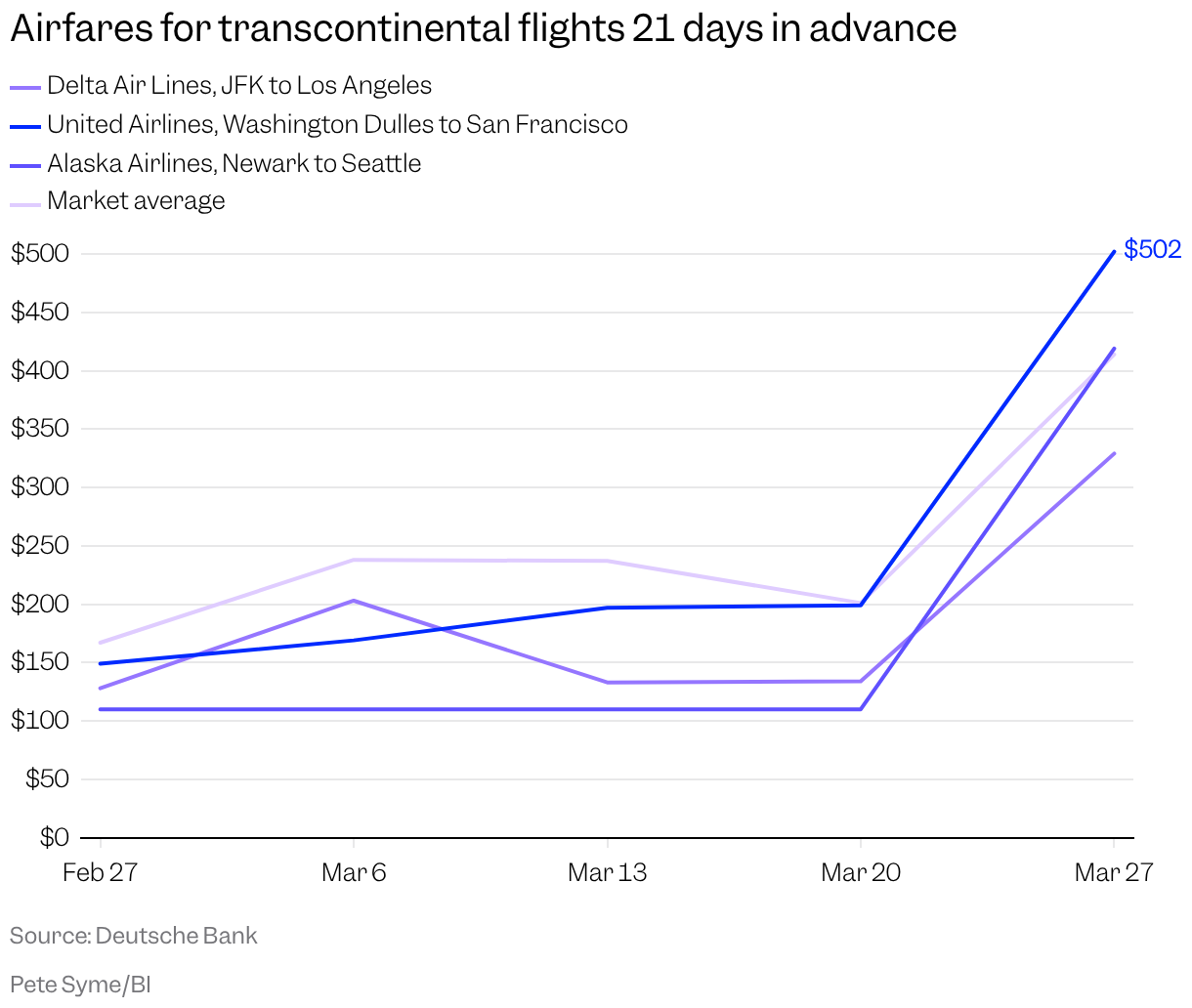
Cross-country flights, often known in the industry as transcontinental flights, have seen the biggest week-over-week spike — more than double, on average.

New York to Los Angeles is the country’s busiest domestic route, with a capacity of 3.4 million seats out of JFK Airport last year, according to OAG data.

The average price of a transcontinental flight has risen from $167 to $414, Deutsche Bank’s analysis showed. In the past week, the average has spiked 107%.

United Airlines is offering flights from Washington Dulles Airport to San Francisco for $502, up from $149 a month ago.

International business travellers are also seeing flight prices rise.

New York to London is the country’s most popular international route, and the 10th-busiest in the world. Nearly 4 million seats were scheduled on flights between JFK and Heathrow last year, per OAG.

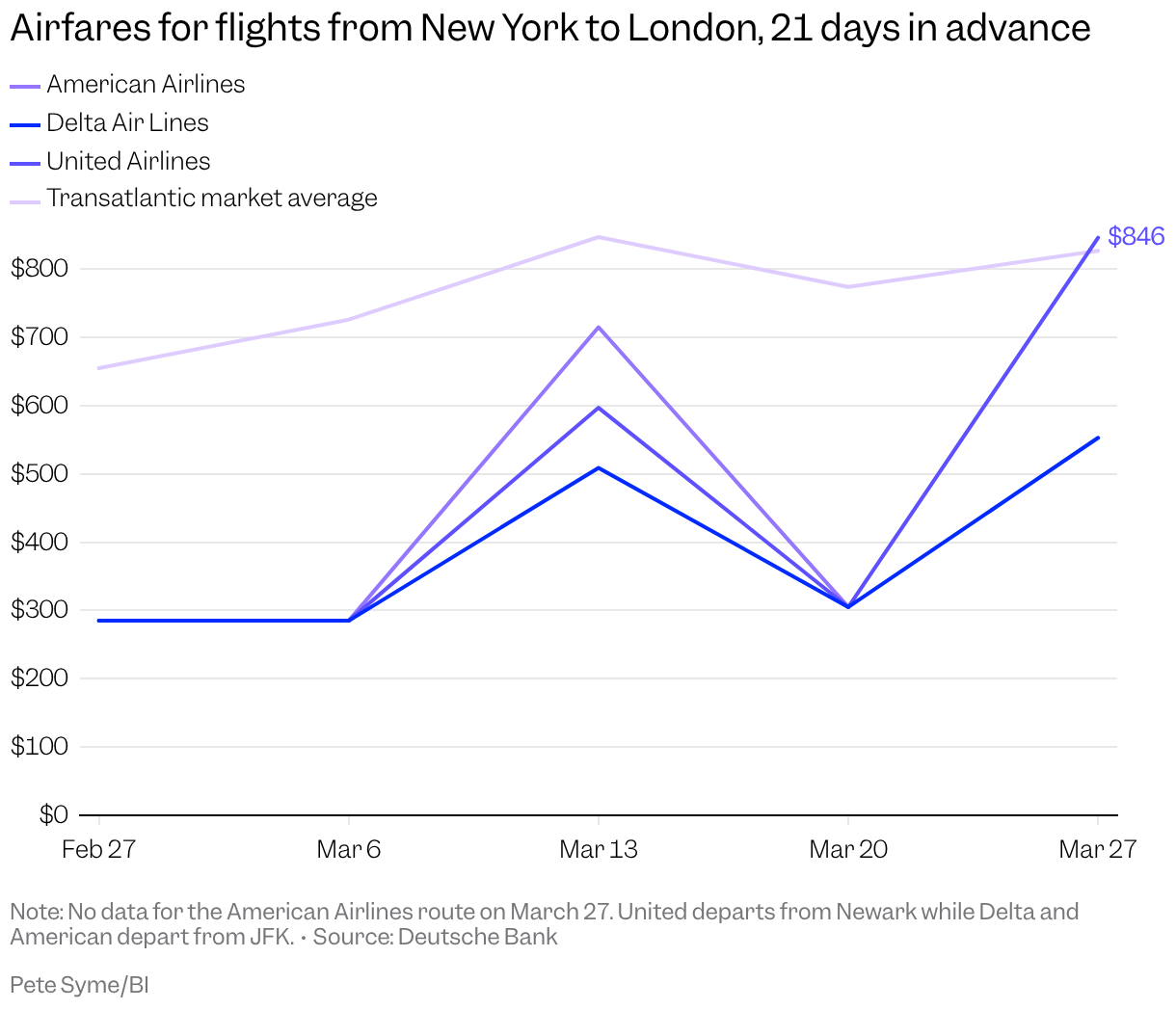
While the average Transatlantic flight is some 40% more expensive than a month ago, there are bigger rises for the New York-London route. However, it also appears more volatile here with a big dip last week.

Delta Air Lines’ service is up from $285 to $553 over the past month, while United’s is up to $846. That’s a 177% rise compared to a week earlier, according to Deutsche Bank’s analysis.

There’s bad news for vacationers, too.

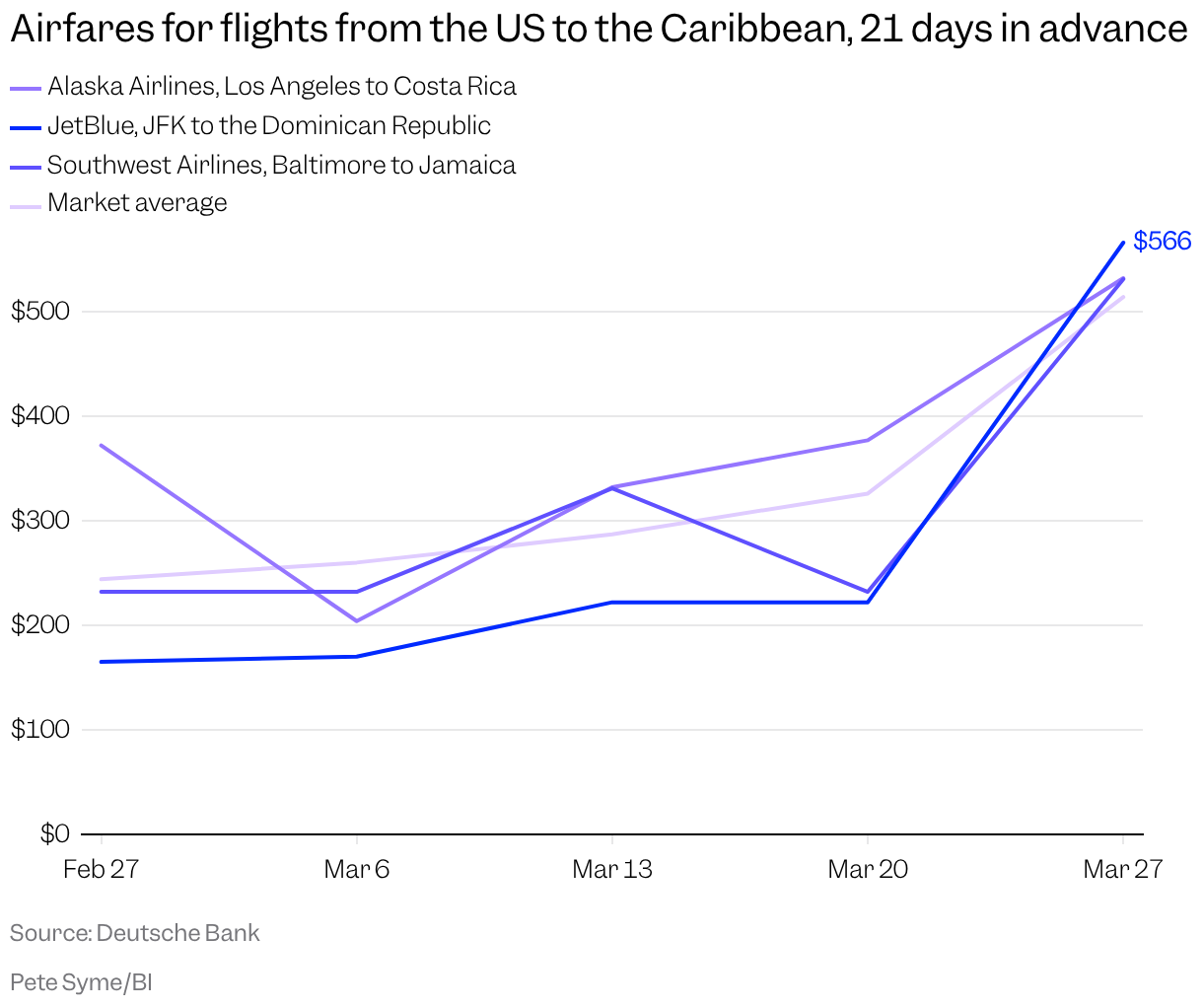
Flights to the Caribbean on March 27 are up 58% on average compared to a week before.

JetBlue’s flight from New York to Santo Domingo, Dominican Republic, has risen from $165 to $566 on March 27.

Compared to a year earlier, that’s a more than fourfold rise, Deutsche Bank found.

Southwest Airlines’ flight from Baltimore to Montego Bay, Jamaica, has more than doubled over the past week. And Alaska Airlines’ service from Los Angeles to San Jose, Costa Rica, is up 40% compared to a week earlier or 120% versus a year ago.


Source link

New-era-of-drone-warfare-creates-higher-risks-for-civilians.jpeg

New era of drone warfare creates higher risks for civilians

With wars in the Middle East and in Ukraine, a new era of drone warfare has arrived that’s harming more civilians.

Skies are full of large, powerful, and lethal drones that are much cheaper than cruise and ballistic missiles. That means more of them are being launched and need to be stopped.

The United Arab Emirates, for example, said that as of Wednesday, it had intercepted far more drones than missiles: 876, compared to 183 ballistic and cruise missiles.

The process of defeating drones and missiles can cause problems of its own. There are more targets to intercept, and US allies have said that objects hit in flight have killed civilians and damaged homes.


Sparks, smoke, and yellow light in a dark sky

Militaries want to shoot most incoming drones down, but that can still leave missile fragments and dangerous debris.

AP Photo/Evgeniy Maloletka, File


“Large-scale drone war is a civilian risk because there are more projectiles in the fight than if it were just missiles, thus inherently creating more debris,” Molly Campbell, a drone and counterdrone warfare expert at the Center for a New American Security, told Business Insider. It’s not that drone debris inherently causes more damage than missile debris, but there can be so much more of it.

The use of drones in warfare is surging. Ukraine says Russia attacks with about 6,000 Geran drones modeled after Iran’s Shaheds each month. A Shahed drone has a wingspan of roughly 8 feet and can carry a warhead up to 110 pounds.

Militaries want to stop attacks before they reach a military target, and that could be dangerous if they’re flying over populated areas.

The problem is that “what goes up must come down,” Mark Cancian, a senior advisor at the Center for Strategic and International Studies, told BI.


Black smoke rises into a blue sky, with a black tarmac road in the foreground

Iran has struck countries across the Middle East with its drones and missiles.

Mahmud HAMS / AFP via Getty Images


A missile that hits its target will typically cause more damage than a drone due to its higher speed and larger warhead.

It’s simply dangerous when “large numbers of drones are being intercepted over populated areas,” as James Patton Rogers, a drone expert at the Cornell Brooks Tech Policy Institute, put it to BI.

Most drone interceptions in the Middle East appear to be kinetic, which involves a projectile launched to hit and destroy them. “Kinetic interceptions create debris, and the risk of collateral damage is real and particularly complex in the urban settings we’re seeing in the Gulf,” said Campbell, the drone expert at the CNAS think tank.

Interception comes with its own risks. It could merely deflect the threat or achieve a partial hit that divides the missile into fragments that leaves its warhead active.

The problem of debris from intercepting an attack isn’t new, and it’s long been a factor in missile defense. In Europe, for example, Douglas Barrie, an air warfare expert at the International Institute for Strategic Studies, told BI that there has always been the knowledge of “if you try to intercept things at extended range, then you might be shooting something down effectively over somebody else’s airspace,” and cause damage to an ally.


A man in camouflage stands on the back of a black truck pointing weaponry in the air, with another man in camouflage standing beside it, all under a black sky

Ukraine uses systems like truck-mounted machine guns to take down incoming drones.

Pierre Crom/Getty Images


The problem with drones, Barrie said, is that “there are so many of them that if you intercept them at comparatively short range and it’s a kind of urban or a quasi-built-up environment, then some of them are going to fall in populated areas. It’s inevitable.”

Militaries can and do try to intercept attacks while causing minimal damage. Modern air defense systems track threats like drones and missiles to give air defense crews a sense of what they threaten and whether they should be countered.

Rogers said that civilians can often become better protected over time in a long conflict or war, as “a kind of bunkerisation begins to take place as societies adapt to the risk.” In Ukraine, for example, people receive alerts about bombardment and move to hardened shelters. But that’s also a negative outcome: “In that sense, drones don’t just kill people, they take the life out of a city.”

The low cost of drones enabled so many more of them to be used. Iran’s Shahed one-way attack drones cost an estimated $20,000 to $50,000 each, for example. Missiles cost far more: hundreds of thousands if not millions of dollars each.

The effects of large-scale drone warfare are clear in Ukraine, where drones are being used more than in any other conflict in history. Ukriane’s military relies on them, and Ukrainian President Volodymyr Zelenskyy said in January that Russia had fired more than 57,000 of its Shahed-style drones since the full-scale invasion began in 2022.

Russia’s drones have devastated Ukraine. Many still caused harm even after being intercepted.


A ruined house at night, with people in head torches searching outside

Russia’s drones have devastated Ukraine’s buildings and maimed its civilians.

Diego Herrera Carcedo/Anadolu via Getty Images


Both the Middle East and Ukraine show that “future conflicts will likely feature high-volume drone and missile attacks designed to saturate air defenses,” meaning more of them flying over and near civilian areas, Campbell said.

Countries will need to stop these attacks, making the debris risk unavoidable, Campbell said.

“Debris from kinetic interceptions compounds this risk — but it remains far preferable to allowing an armed drone or missile to hit its target.”


Source link

I-grew-my-tech-income-to-over-250000-in-8.jpeg

I grew my tech income to over $250,000 in 8 years. 1 move has helped me negotiate a higher salary.

This as-told-to essay is based on a conversation with Brian Jenney, 42, who lives in California. The following has been edited for length and clarity.

When I got into tech in my early 30s, I had no clue how crazy lucrative the industry was.

I started as a web application developer in 2015, earning roughly $60,000 a year.

Over the years, I became savvier at negotiating my salary, and by 2023, I was making over $250,000.

I’ve earned more than I could have ever imagined, without working in Big Tech, where people often assume the big money is made.

Here’s what I’ve learned along the way.

1. It was dumb not to negotiate a starting salary because it already sounded impressive

I used to have addiction issues, so I didn’t really work from the ages of 25 to 30 and lost knowledge that people gain from white collar jobs at this stage of life.

I was naive about the salary potential of my industry, and when people in tech said they were on $150,000, it blew my mind, and I began to feel underpaid.

In 2017, after two years in the web developer role, I landed a job at a startup. I was so impressed when I was offered $120,000 that I didn’t negotiate my salary, which was dumb in retrospect.

The environment was extremely fast-paced and high-caliber. I struggled with imposter syndrome as one of the team’s more junior members. I felt like one of the worst developers there and that I was already being paid more than I deserved. It discouraged me from asking for a raise.

In 2019, I joined the media intelligence company Zignal Labs. I was so happy about the job offer that I didn’t negotiate the salary, so my pay initially stayed roughly the same as in my previous job. It felt like I had plateaued, even though I had more money than I needed. An unfortunate symptom of working in tech is that you get drawn to wanting more.

Choosing this role turned out to be the right move, though. I had more room to grow and was in a better learning environment at a larger company.

During the tech hiring spree of 2020, my peers said they were getting crazy offers, and I didn’t want to miss out. That August, I joined The Clorox Company, a manufacturing firm, as a software engineer. By 2023, I was making over $250,000: the peak of my earnings in tech.

In 2024, I was laid off, and I’ve continued to work in various software engineering roles. I bought a business in 2023, and my focus has shifted to seeking out flexibility and time to build it, instead of maximizing corporate compensation.

2. I prepare for the pressure of job interviews by practicing with strangers

Interviews are like a carnival game where you can win big money by performing well, and you can’t get to the negotiation stage without passing them. They’re structured, learnable, and winnable with the right preparation.

When I have job interviews lined up, I do technical practice and use a platform called Pramp, which pairs you with strangers for practice interviews. I’ve found this helps simulate the nerves and pressure of real interviews better than practicing with friends.

I’ll try to do at least two mock interviews before an interview I really care about.


Brian Jenney is standing on a stage giving a talk.

Jenney uses a platform called Pramp to practice job interviews.

Courtesy of Brian Jenney


3. I learned to ‘play the game’ of salary negotiation. Now I ask for at least 10% more.

Over the years, I’ve benefited a lot from people in tech being open about their salaries and career paths, which helped me understand what was possible and gave me confidence to negotiate and aim higher.

I’ve learned that salary negotiation is a game you have to play, and if you don’t, you lose money.

I began consistently negotiating pay in the late 2010s. I usually tell the employer that I’m really excited to start the job, but that I was hoping to come in at a higher salary range, usually 10 to 20% more.

I’ve found this to be very effective, and it has never gone badly for me. If an employer sounds firm on their offer, I usually try to explore whether a sign-on bonus is possible instead, but I don’t push aggressively beyond that.

I have more money than I need, even though I never worked in Big Tech


Brian Jenney is pointing at a wall with computer code written on it.

Jenney said a salary of $150,000 is more than enough for him.

Courtesy of Brian Jenney


I’ve interviewed with but never been hired by the Big Tech companies. Besides, I like working at smaller startups and non-tech companies where I think you can have a greater impact.

Big Tech employees are going to “beat me” on pay because their stock compensation will outpace my earnings. But I see my current lifestyle as comparable to theirs. I believe there’s a reason software engineers aren’t driving around Mountain View in Ferraris: they can’t cash out all their stock money yet.

There’s always more you can earn, but when my salary hit the $150,000 mark, I knew it was more than I needed. I’d rather prioritize jobs where I’m happy, I’m learning, and I can cover my needs while still saving. That’s all I really need.

Do you have a story to share about growing your salary in tech? Contact this reporter at ccheong@businessinsider.com


Source link

Americans-arent-flocking-to-Florida-like-they-used-to-Higher.jpeg

Americans aren’t flocking to Florida like they used to. Higher prices are a big reason.

Kimberly Jones was born and raised in Miami, and planned to live her whole life there. It’s where she met her husband, raised her children, and built a four-decade career in logistics.

But in 2025, Jones did something she never expected: She and her husband left Plantation, Florida — nearly 20 minutes west of Fort Lauderdale — for a small rural town about an hour outside Charlotte, North Carolina.

“It was not an easy decision,” Jones, 60, told Business Insider. “Affordability was part of it, but we were also looking forward to having a slower pace of life. I lived in South Florida my entire life — and it’s not anything like what it used to be.”

Jones said Southern Florida’s population growth has made the area increasingly unrecognizable — and, for her, unlivable — pointing to hyper-development in residential construction and the gridlocked traffic she calls “ridiculous.”

“If there’s a corner available, they will build a high-rise on it,” she said. “It’s turning into an overly congested, expensive city. I used to spend two and a half hours a day in the car just going to and from work.”

People are still moving to Florida, but they’re not flocking to it like they used to. Net domestic migration — or the number of people moving into the state from elsewhere in the country minus those moving out to other parts of the US — has been steadily cooling in recent years.

There are a few likely reasons behind the cooler estimates in the Sunshine State. For some, the tax benefits of living in the state don’t outweigh the increase in cost of living. It’s more expensive to buy a home than a few years ago, and property insurance has been higher than in other states.

High housing costs have made Florida less attractive

In recent years, Florida has drawn an influx of newcomers chasing its affordability, driven in large part by its wide range of relatively lower-cost housing and lack of state income tax. Others are lured by its business-friendly tax environment and strong job market.

But the surge of newcomers has created a host of challenges for native and longtime residents who have watched home prices and rents climb, especially in popular cities like Miami and Orlando. It’s prompted some to move to less expensive cities and suburbs elsewhere in the state, or to leave Florida entirely.

“Affordability often drives a lot of domestic moves,” Jed Kolko, senior fellow at the Peterson Institute for International Economics, told Business Insider. “People tend to move toward less expensive places. In recent years, Florida’s gotten a lot more expensive, so Florida doesn’t look as affordable compared to other places as it did even just a few years ago.”

In December 2020, Florida’s median home-sale price was $298,100; by December 2025, the most recent month with available data, it had climbed to $412,100, Redfin data showed. In addition to higher home prices and rents squeezing residents, home and flood insurance costs have increased, as more frequent and severe natural disasters push homeowners’ premiums higher.


Homes flooded in Florida

Homes flooded in Florida.

Bilanol/Getty Images


Take Debra Pamplin, who moved from Florida back to the Midwest after 11 years. In 2013, Pamplin moved from her hometown of Missouri to Jacksonville, Florida. During her time there, though, she soured on the area’s traffic, high insurance costs, uncomfortable heat and humidity, and mosquitoes. Pamplin has valued living in the Midwest much more.

“I’d often have to cut spending in other parts of my life just to cover my high monthly insurance costs,” she said in a 2024 Business Insider story. “Now that I’m out of Florida, my monthly insurance expenses are lower, giving me breathing room to spend my money on more fun stuff.”

Florida hasn’t completely lost its appeal

Mariya Letdin, an associate professor of real estate at Florida State University, told Business Insider that even as net migration slows, Florida is “still a popular destination,” but she expects its population will continue to grow slowly.

Aside from slower growth, the profile of who’s moving to Florida is shifting, too.

Michael Martirena, a real estate agent with Compass in South Florida, told Business Insider he’s seen a change in the clients he works with, which he attributes in part to higher housing costs.

“Let’s go back three years ago, pre-pandemic, everyone was coming down here. It didn’t matter what socioeconomic class people were from; they just wanted to come to Florida.” Now, he said, he’s working with more buyers from abroad, as well as wealthy American buyers.

Hamilton Lombard, a demographic researcher based in Virginia, said immigrants moving elsewhere within the US could also be a factor as to why Florida’s domestic migration has weakened. Census data showed that non-citizens who moved between states in the past year from Florida increased from about 30,000 in 2022 to 53,500 in 2024, the latest year available.

Florida’s net international migration has also been cooling, but remains positive, meaning more people are immigrating to Florida from other countries than leaving for destinations outside the US.

“International and affluent buyers still continue to come down to Florida, whether it’s for tax purposes or geopolitical reasons or what’s going on in their states,” Martirena said, adding that a lot of his clientele comes from countries like Dubai, Madrid, and London.


Source link

Im-a-millionaire-living-in-California-Im-happy-to-pay.jpeg

I’m a millionaire living in California. I’m happy to pay higher taxes since I have more wealth — it just makes sense.

This as-told-to essay is based on a conversation with Scott Ellis, a 55-year-old millionaire who lives in Silicon Valley, about California’s proposed 5% billionaire wealth tax. Ellis is a member of Patriotic Millionaires, a collection of wealthy Americans who advocate for a fair tax system, a livable wage, and equal access to political power. The following has been edited for length and clarity.

I never thought I’d live in California. I grew up in Colorado, went to college in Boston, and lived in Texas. I came out here for business school because I wanted to be at Stanford, and because you could play golf during the winter.

Now I love it here. It has nothing to do with taxes; taxes have never been anywhere on our list of criteria for deciding where to live. I want to live where my family is and love the weather, the jobs, and the dynamism.

Taxes are the price that we pay to live in a civil society. We have to do this together. There are examples all around the world of the power of effective government, and just like anything else, government needs to be funded. We should make it effective and efficient.

I’m proud to pay the taxes I pay. I should pay taxes that are higher than other people because I have more wealth than other people — that makes sense.

My wife and I achieved financial success in our careers

A lot of our financial success has been due to my wife’s success, as well as mine at the beginning of our careers.

I went to Harvard undergrad, worked at McKinsey for three years, and then went to Stanford. I then worked at Hewlett-Packard for almost eight years.

In 2007, my wife was a VP at Yahoo and we had two small kids. I looked at my boss’s job, and at the CEO’s job, and decided I didn’t ever want those roles. I thought, “Uh-oh, I’m on this ladder, and it’s not really where I want to go.”

Ultimately, my wife and I decided that I would step back and be the stay-at-home parent. My wife continued her career, and she’s been very successful in consumer internet at Yahoo, Google, and Pinterest.

I developed an interest in social issues in college

I studied poverty, urban America, housing, transportation, and sociology in college, and started thinking more about questions like: What does fairness look like? What does justice look like? What would it look like to build a great society?

I got busy pursuing my career, meeting my wife, and raising our kids, but as time passed and we progressed in our careers, I got back into thinking about how we help others around us. I did a bunch of volunteer work in different contexts, eventually becoming the COO and then the CSO of a nonprofit called New Teacher Center, which does intensive mentoring programs for new teachers.

Since 2012, I’ve started and run several nonprofits in the education space, and advised almost 200 individuals and organizations on things like strategy, finance, operations, and culture.

I’m also really focused on addressing excessive wealth and its impact on society and thinking about a future vision for American democracy, which is how I came to Patriotic Millionaires, an organization of wealthy Americans who advocate for higher taxes on wealthy people like ourselves, a higher minimum wage, and a broader distribution of political power across our society.

I’ve been struck by the massive accumulation of wealth

In recent years, I’ve been struck by the massive accumulation of wealth enabled by the consumer internet space, globalization, and the structure of the finance industry. It’s different from what it used to be in the ’80s and ’90s; this is a whole new ballgame.

More recently, I’ve been looking around Silicon Valley at all these people who are so incredibly wealthy, talented, and successful, and realizing how few of them are thinking about choosing to build a better society together.

They’re excited about starting new companies and raising new funds, but these are all people who have more money than they could ever spend, and their next goal is to generate even more money, mainly for people who already have more money than they could ever spend.

Meanwhile, 10% of our society is in poverty. It really feels unfair and wrong, and we can do better.

People don’t need more than $30 million

The proposed billionaire wealth tax in California doesn’t impact me and my family directly. People may think, “You’re happy to raise taxes on other people.”

But we need to start with a different conversation, about how much wealth is enough, how much wealth is too much, and what is financial success?

I believe that if you have $30 million in wealth, congratulations, you won capitalism. If you do the analysis of reasonable investment returns and inflation, you can buy a really nice first house, a nice second house, your kids’ college is paid for, your end-of-life expenses are covered, and you have a very, very luxurious ongoing existence.

So much of success in life is luck. Yes, people absolutely get educated and work hard. But it’s been found that the wealthier people are, the more they tend to attribute their wealth to how good they are and how hard they worked.

I look at single moms working three jobs, working the night shift — a heck of a lot of people who have less than $190,000 [the median household wealth] in wealth are working very hard.

Once you get beyond $30 million — and almost no one ever gets there — you get to a point where your life is so good, you really can’t materially improve your life anymore. We should implement a very aggressive annual 50% tax on all household wealth over $30 million. Excessive wealth turns into excessive power through huge campaign donations, which threatens and undermines democracy and capitalism.

The wealth tax is a step in the right direction — but not enough

I’m absolutely delighted that we’re moving in this direction, but I believe changes to wealth taxes need to happen at the federal level.

When wealthy folks bring up moving out of California, it’s a distraction. All of a sudden, instead of us talking about the fact that millions of people are going to be either losing healthcare or paying much more for healthcare, we’re worried about the 200 really rich people who might move.

People move all the time. Companies move all the time for all kinds of reasons — it’s just part of business. These conversations happen all the time — like, “Oh my gosh, there won’t be any more companies in Silicon Valley.” Well, 20 years later, look around. There are still some companies here; it’s just fine.

It’s 65 degrees and sunny here. The CEO of Nvidia recently said they’ll be staying in California because that’s where the talent is. We’ve got the Golden Gate Bridge, Hollywood, Tahoe, the Redwoods, the beach, and great weather. I’m really not worried that people aren’t going to want to live in California.

I love it here. My wife and I are thinking about living in different cities for maybe a month at a time, but I have no plans to go anywhere else. Although I definitely love Colorado — I still have my Denver Broncos coasters and will be cheering for my Broncos — I’m from Silicon Valley now, and that’s where I’m going to stay.


Source link

Berkshire-Hathaways-new-CEO-has-a-higher-salary-than-Warren.jpeg

Berkshire Hathaway’s new CEO has a higher salary than Warren Buffett

  • Berkshire Hathaway disclosed that Greg Abel will make $25 million in his new CEO role.
  • Abel’s pay is a significant increase from Warren Buffett’s famous $100,000 salary.
  • Abel is expected to maintain Berkshire Hathaway’s investment philosophy.

Berkshire Hathaway is paying its new CEO, Greg Abel, $25 million each year, a big bump from Warren Buffett’s pay.

The company disclosed Abel’s annual cash salary in a filing with the Securities and Exchange Commission on Tuesday. He took on the role at the Omaha-based company on January 1.

Buffett, who retired last year, famously took an annual salary of $100,000 with no bonus or stock awards for over 40 years. Bloomberg estimates his net worth at $150 billion, the tenth-richest person in the world.

As Berkshire Hathaway’s former CEO and current chairman, Buffett recommended to his board of directors how much he should be paid and set compensation for Abel and other executives.

Abel, who was previously Buffett’s deputy, was paid $21 million last year. CEOs of S&P 500 companies were paid an average of $18.9 million in 2024.

At Berkshire’s annual shareholder meeting last year, Buffett, who is 95, announced that he would be stepping down after 55 years as the conglomerate’s CEO. Hours later, the board unanimously voted for Abel to replace him.

“I think the time has arrived where Greg should become the chief executive of the company at year end,” Buffett told the audience at the meeting.

Abel, 62, has been Berkshire Hathaway’s vice chair of non-insurance operations since 2018. He’s also chair of Berkshire Hathaway Energy, which Buffett hailed as one of the conglomerate’s four “jewels” in his annual shareholder letter in 2021, the same year Buffett first tapped Abel as his successor.

Investors expect Abel to maintain the company’s current investment philosophy. He is known for having a more hands-on leadership style than Buffett.


Source link