Flat-bats-spitballs-and-a-ban-on-licorice-These-are.jpeg

Flat bats, spitballs, and a ban on licorice: These are 10 of the weirdest rules in baseball history

Although “Three strikes, you’re out!” is perhaps the most basic rule in baseball, the fundamentals of the great American pastime weren’t always this clear-cut.

The sport likely derived from cricket and similar games played in England. Variations were brought over to the Thirteen Colonies, and by the early 19th century, baseball in the US was composed of a few regional styles with varying rules. The New York rules ultimately took precedence, codified in the “Knickerbocker rules” named after the Knickerbocker Base Ball Club.

This 1845 ruleset implemented many key standards that are still used today, such as the three-out inning, and later versions would come to serve as the basis for the National League and American League’s rules.

The original Knickerbocker rules were full of vague guidelines, such as bases being “forty-two paces” apart and teams being permitted to choose players from the crowd if they didn’t have enough members.

Needless to say, the sport would continue to evolve over the next 180 years into the multibillion-dollar industry we know today — the MLB reported $12.1 billion in revenue for the 2024 fiscal year, per Forbes. The New York Yankees alone are valued at $8.2 billion, leading Forbes to rank them the 10th most valuable sports franchise in the world in 2025.

Through two centuries of growth, the sport’s rules have seen their share of oddities and flat-out strange conventions.

As the 2026 MLB regular season officially kicks off this week, we’re looking back at 10 of the weirdest rules in baseball history, from 1840s regional rules to the current MLB rulebook.

Early on, fielders would throw the ball at baserunners for an out.

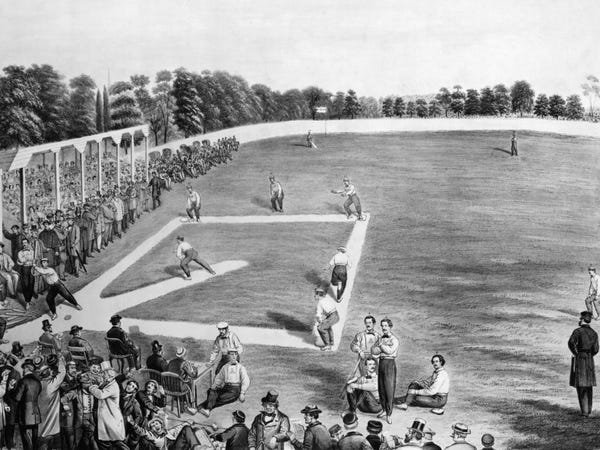
A lithograph of an 1860s baseball game between the Athletic Baseball Club of Philadelphia and the Brooklyn Atlantics. 

Bettmann Archive/Getty Images

In pre-Knickerbocker-rules baseball, different regional styles would have fielders “soak” or “plug” the baserunner, which meant hitting them with the ball and resulting in an out. This was used in the New England regional variant known as the “Massachusetts Game” and others, per the Baseball Almanac.

Though this added an extra contact element to the game, the ball was lighter than it is today and featured a softer leather surface.

This practice was outlawed in the Knickerbocker rules, in which a fielder had to tag the runner for an out.

Pitchers were required to throw underhand.


An old photograph shows a baseball player holding a ball.

A baseball player circa 1890 in Lake Chicago, Illinois. 

Sports Studio Photos/Getty Images

Pitchers originally had to throw underhand in the Knickerbocker rules, likely drawing inspiration from cricket players’ “underarm bowling” techniques at the time. The Knickerbocker rules made a distinction between pitching and throwing, noting, “The ball must be pitched, not thrown, for the bat.”

The rule stood in leagues for a few decades until changes allowed pitchers more freedom. According to the Baseball Almanac, the National League allowed pitchers to throw sidearm in 1882, and then with no limitations at all in 1884.

Games were played to 21 runs with no set number of innings.


Historic photograph of a baseball game.

A baseball game being played at a New England college campus, circa 1875. 

Transcendental Graphics/Getty Images

Per the original Knickerbocker rules, games were played until a team scored 21 runs, called “aces” at the time. This meant the length of games could vary substantially, and it was possible for a team to win with 21 runs without their opponents even getting to the plate.

Because of the rule, long games would sometimes end prematurely due to darkness, and it wouldn’t be until 1935 that the first night game under electric lights would be played in the major leagues, according to the National Baseball Hall of Fame.

As a result, the 9-inning standard we know today was implemented into the Knickerbocker rules in 1857.

Fielders could catch a ball on the first bounce for an out.


An 1880s baseball card illustrating a fielder making a

An 1880s baseball card illustrating a fielder making a “good pick up.” 

Transcendental Graphics/Getty Images

Contrary to the basic fundamentals of modern baseball, until 1864, the Knickerbocker rules allowed for fielders to catch the ball after one bounce or “bound” for an out.

In foul territory, the rule still stood until 1882, when it was changed to a regular fly-ball out by the National League.

Batters got to decide the height of a pitch.


Charlie Ferguson of the Philadelphia Quakers holding a bat.

Charlie Ferguson of the Philadelphia Quakers, 1885. 

Smith Collection/Gado/Getty Images

While a batter getting to choose the type of pitch they want seems unheard of in today’s game, it was once standard practice.

For roughly 20 years, the batter was required to request a “high,” “low,” or “fair” pitch upon coming up to bat. The pitcher would then have to throw accurately to this demand. The rule was disallowed in 1886.

It would take nine balls to walk a batter.


A wooden engraving from 1886 shows a player about to catch a ball and tag a runner out.

A wooden engraving shows a game between the Boston Beaneaters and the New York Giants in 1886. 

Stock Montage/Getty Images

The history of balls and strikes wasn’t always straightforward. Umpires would initially call “fair” and “unfair” pitches before strikes were introduced in 1858 and balls in 1863, per MLB.com. However, it took a whopping nine called balls before a batter would be sent to first base.

The number of called balls was gradually lowered in the National League until it became four in 1889, where it has stood ever since.

Flat bats were permitted for a period of time.


The New York Giants' Heinie Groh with his

The New York Giants’ Heinie Groh used a “bottle bat” in the 1920s, only a few decades after flat bats were banned. 

FPG/Getty Images

From 1885 to 1893, the National League allowed for the use of bats with a flat side. Players would mostly utilize the paddle-like bats for bunting, according to ESPN.

Though flat bats were eventually banned, baseball would see plenty of new, sometimes weird advancements in bat technology. Heinie Groh of the New York Giants hit with a “bottle bat,” notable for its large barrel. And in 2025, the Yankees set a trend around the MLB with their “torpedo bats,” which distribute the wood’s weight in a favorable way for the hitter.

“Spitballs” were allowed until 1920.


Lew Burdette puts his hand up to his mouth during the 1957 World Series.

Fans speculated that 1950s pitcher Lew Burdette of the Milwaukee Braves used a spitball decades after it was banned. 

Bettmann/Bettmann Archive via Getty Images

A “spitball” is exactly as it sounds. Pitchers used to be allowed to lubricate the ball with saliva to get a better pitch.

While players did literally use their own spit, the term also applies to any foreign substance applied to the ball, such as mud or petroleum jelly. The pitch reached peak popularity in the early 20th century, and safety concerns led to its ban in 1920, per Twins Daily.

Oddly, the MLB still allowed 17 legacy “spitters” to continue to throw the pitch until their retirement. Pitcher Burleigh Grimes played in the major leagues until 1934, using the spitball until the day he retired.

In the current MLB rulebook, a provision notes, “No player shall intentionally discolor or damage the ball by rubbing it with soil, rosin, paraffin, licorice, sand-paper, emery-paper or other foreign substance.”

Thanks to the legacy of the spitball, there’s now an official rule against licorice in the MLB.

The umpire can declare the away team the winner if a fan lingers on the field for 15 minutes.


MLB umpire Jen Pawol makes a

MLB umpire Jen Pawol. 

John Cordes/Icon Sportswire via Getty Images

In the current MLB rulebook, a quirk exists under the “Security” section, which provides guidelines on stadium protection and the procedure for when a person or group enters the playing field during a game.

The penalty in the section reads, “If the field is not cleared in a reasonable length of time, which shall in no case be less than 15 minutes after the visiting team’s refusal to play, the umpire-in-chief may forfeit the game to the visiting team.”

Even if such a scenario were to occur, it would be more likely that the game would be suspended and completed at a later time, as is commonly the case with rain delays. Alternatively, games suspended after 5 innings can be deemed “official,” with the current score standing as the final result.

Players on opposing teams can’t talk to each other.


Mike Trout of the Los Angeles Angels talks with Los Angeles Dodgers shortstop Mookie Betts during Spring Training.

Mike Trout of the Los Angeles Angels talks with Los Angeles Dodgers shortstop Mookie Betts during Spring Training. 

Brian Rothmuller/Icon Sportswire via Getty Images

Still on the books today, the MLB rule on “Fraternization” states, “Players of opposing teams shall not fraternize at any time while in uniform.” Perhaps the most unenforced rule in the major leagues, it’s broken on a nightly basis.

The rule also disallows players from interacting with spectators during or after a game. This means that anytime a first baseman tosses a foul ball to a wide-eyed kid in the stands, it’s technically in violation of the MLB rulebook.


Source link

The-best-live-action-short-film-Oscar-ended-in-a-rare.jpeg

The best live-action short film Oscar ended in a rare tie. Here are the 7 ties in Academy Awards history.

“The Singers,” directed by Sam A. Davis and produced by Jack Piatt, and “Two People Exchanging Saliva,” directed by Natalie Musteata and Alexandre Singh, tied for best live-action short film at the Oscars on Sunday night.

The award was presented by comedian Kumail Nanjiani, who opened the envelope and announced, “It’s a tie. I’m not joking. It’s actually a tie. So everyone, calm down, we’re going to get through this.”

Nanjiani said he would announce the winners one at a time, inviting each to the stage to accept their award. He first called “The Singers,” followed by “Two People Exchanging Saliva.”

“A tie. Wow. I didn’t know that was a thing. A tie, but we’re happy to be up here,” Davis said in his speech.

Musteata echoed the sentiment in her own remarks, saying she was “so happy to be sharing this Oscar with ‘The Singers.'”

Between the two acceptance speeches, Nanjiani also joked, “Ironic that the short film Oscar is going to take twice as long.”


Source link

World-War-II-museum-ships-suddenly-feel-less-like-history.jpeg

World War II museum ships suddenly feel less like history after a US submarine sank an Iranian warship

For Brian Auer, the operations manager at Historic Ships in Baltimore, the video of a US Navy submarine sinking an Iranian warship this week looked strikingly familiar.

“I saw the footage of that Iranian frigate getting torpedoed, and it looks like any picture I see from World War II of a similar attack happening,” he told Business Insider of the video released by the Department of Defense on Wednesday.

Before this week’s attack in the Indian Ocean, the last confirmed US Navy submarine to sink an enemy ship in combat was the USS Torsk, a World War II submarine that sank two Japanese vessels in 1945 before becoming part of the museum that Auer manages.

Since 1945, large-scale battles between warships have been rare. As naval warfare reemerges as a key strategy in Operation Epic Fury against Iran, museum ships that saw combat in World War II are finding new relevance, showing not just how naval war was fought, but how it might look today. Suddenly, the floating museums feel a lot less like history.

“Those of us who work on museum ships don’t like war,” Ryan Szimanski, the curator at Battleship New Jersey in Camden, New Jersey, told Business Insider. “In many cases, we work here to try and teach people about how awful wars were.

“However, the fact that the United States has fought a naval action — one of the first ones since World War II — is making museum ships like us relevant and part of the public discussion in a way that we haven’t been.”

Museum ships offer immersive experiences


Battleship New Jersey in Camden, New Jersey.

Battleship New Jersey in Camden, New Jersey.

Talia Lakritz/Business Insider


There are around 75 World War II-era museum ships open to the public across the US. These decommissioned battleships, submarines, destroyers, aircraft carriers, and other vessels offer visitors the chance to climb aboard and explore the interiors themselves.

Guided tours, often led by Navy veterans with firsthand experience serving on similar vessels, take visitors through combat areas, such as torpedo rooms, gun turrets, and command centers.

Battleship New Jersey, for example, offers a rare look into Tomahawk cruise missiles as the first surface warship to carry them in 1982. The long-range missiles have also been used to sink Iranian ships during Operation Epic Fury.


The combat engagement center on board the USS New Jersey, which features a Tomahawk Weapons System.

The combat engagement center on board the USS New Jersey features a Tomahawk Weapons System.

Talia Lakritz/Business Insider


“Because those are contemporary systems, to be able to see a Tomahawk missile, to be able to see Tomahawk missile launchers in a museum — there’s only a handful of museum ships like us that you could come and see to get that experience,” Szimanski said.

Some ships even offer sleepover experiences where guests can eat meals in the crew’s mess and spend the night in sailors’ bunks.

“It is highly unlikely that the average person will get the chance to visit an active-duty Navy ship,” Szimanski said. “So to experience the conditions, to see what it’s like to serve on a warship, particularly one that has seen combat, visiting a museum ship is your best chance.”

‘Remarkably similar’ to modern Navy ships


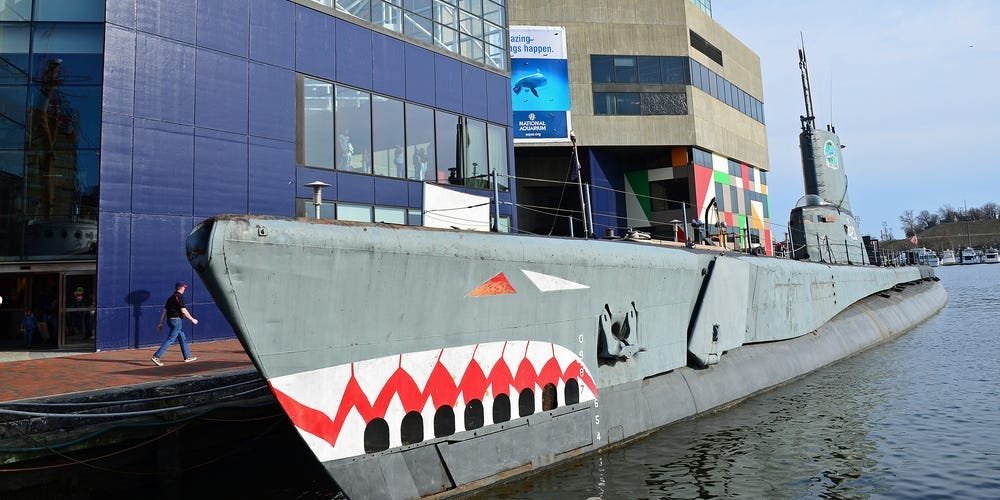
The USS Torsk in Baltimore.

The USS Torsk submarine in Baltimore.

Vacclav/Shutterstock


While some technologies and configurations found in World War II submarines may be outdated, many aspects of how they operate remain the same.

“It’s important to remember that the Navy, the military, all of us, operate in a world governed by laws of physics, and so there are some things that are just never going to change in how submarines work,” Auer said. “If you walk through a modern Ohio-class, ballistic missile submarine, you’re going to find things that are exactly the same, or done exactly the same way, on the USS Torsk. And what we can really show is where those things were first done, and why they were done that way, and why they are still done that way.”

Modern submarines still appear “remarkably similar” to their museum counterparts, Szimanski said. The layout of submarines hasn’t changed all that much since World War II. They largely still have the same spaces to eat, sleep, and fire torpedoes.

Auer says that when he leads tours of the USS Torsk for active-duty sailors, he often gets the response, “Huh, we’re still doing it this way.”


The forward torpedo room inside the USS Torsk submarine.

The forward torpedo room inside the USS Torsk.

Pixel Doc/Shutterstock


The biggest differences can be found in the ships’ capabilities, Hugh McKeever, the shipboard education manager at the Independence Seaport Museum in Philadelphia, told Business Insider.

Diesel-powered submarines like the USS Becuna, which sank 3,888 tons of shipping in World War II before arriving at the Independence Seaport Museum, had to spend most of their time on the surface with only about 12 hours’ worth of oxygen at a time. Today’s nuclear-powered submarines operate with an unlimited fuel supply and can stay submerged for upward of six months.

“As far as going out to sea, their ability is pretty much limited only by food,” McKeever said.

Overall, World War II-era submarines are less antiquated than one might assume. Some even still work. The USS Torsk’s sister ship, the USS Cutlass, was commissioned in 1945, sold to Taiwan in 1973, and remains operational as part of the Republic of China Navy.

“These boats, to us, are so outdated that they’re museums, but for the rest of the world, they’re relatively advanced,” Auer said. “They’re still very capable of doing the function they were originally designed for. So, were they implemented by some foreign threat, they would be a threat.”

Floating museums find new relevance


The USS Becuna, a World War II submarine, is part of the Independence Seaport Museum in Philadelphia.

The USS Becuna, a World War II submarine, is part of the Independence Seaport Museum in Philadelphia.

Talia Lakritz/Business Insider


For ship museum curators, the resurgence of naval battles in the US war with Iran underscores the contemporary relevance of World War II museum ships and the battle stars they earned. McKeever, for one, anticipates getting more questions about torpedoes as the summer tourist season ramps up.

“For the US as a maritime power, the economic prosperity of the country is tied to the sea and the Navy,” McKeever said. “Our museum vessels represent that constant need for change and growth as a country.”

After all, as Szimanski noted, it was just days ago that no active US Navy ships had ever sunk an enemy warship — the only Navy ships that had fought a naval battle were all museum ships. Despite some rust and peeling paint, it seems they still have a lot to teach us.


Source link

Israel-says-200-fighters-struck-Iran-in-the-largest-air.jpeg

Israel says 200 fighters struck Iran in the largest air operation in its history

Roughly 200 fighter jets participated in Israel’s widespread airstrikes against Iran on Saturday, the Israeli military said, calling the attack the largest air operation in its history.

The Israeli fighter jets dropped hundreds of bombs on 500 targets in western and central Iran, including air defense systems and missile launchers, the military said in a statement. The government earlier announced it had carried out a “preemptive” strike.

Attacks on the defensive systems — a tactic known as suppression of enemy air defenses, or SEAD — allowed Israel to expand its aerial superiority over Iranian territory, the military added.

“This is the largest military flyover in the history of the Israeli Air Force,” it said, adding that the operation was based on extensive planning and “high-quality intelligence.”

The strikes involved Israeli F-35 stealth fighters and F-15 jets. The full extent of the aircraft that participated is unclear.

Israeli warplanes attacked Iran alongside the US military. President Donald Trump described the American involvement as the start of “major combat operations” after nuclear talks between Tehran and Washington broke down.

A US official told Business Insider that American air, land, and naval forces were involved in the strikes against Iran and launched drones, rocket artillery, and cruise missiles, among other weapons.


An Israeli F-15C Buzz launches for a sortie in support of exercise Juniper Falcon, May 7, at Uvda Air Base, Israel.

Israeli F-15 fighter jets were involved in the strikes.

US Air Force photo by Tech. Sgt. Matthew Plew


US fighter aircraft also participated in the attacks, which targeted Iran’s Islamic Revolutionary Guard Corps command and control facilities, air defenses, missile and drone launch sites, and military airfields, the American military said.

Hundreds of Iranians have been killed and wounded in strikes so far, according to multiple reports.

Iran retaliated by launching waves of missiles against Israel and US bases across the Middle East, sending the region into an air defense frenzy.

US Central Command, which oversees Middle East operations, said its forces “successfully defended against hundreds of Iranian missile and drone attacks.”

Several Middle Eastern countries confirmed shooting down Iranian missiles as well, though some projectiles managed to slip past air defenses. CENTCOM said there are no reports of US casualties, nor has there been significant damage to American facilities.

Saturday’s strikes mark the second time in less than a year that the US has attacked Iran. American forces bombed the country’s nuclear facilities in June 2025 as part of Operation Midnight Hammer.

They also follow a steady buildup of US military forces in the Middle East and the Eastern Mediterranean Sea, including more than a dozen warships and hundreds of aircraft.


Source link

The-longest-State-of-the-Union-addresses-in-history-ranked.jpeg

The longest State of the Union addresses in history, ranked

  • The American Presidency Project tracks the length of presidents’ State of the Union speeches.
  • Donald Trump holds the record for the longest address at 1:39:32 in 2025.
  • Trump and Bill Clinton have given eight of the top 10 longest State of the Union speeches.

Some US presidents have more of the gift of the gab than others.

The American Presidency Project has tracked the length of every president’s State of the Union address since 1964, with the timer beginning when the president opens with “Mr. Speaker” or “Madam Speaker.”

In the State of the Union, which is mandated by the Constitution, presidents typically highlight their administration’s accomplishments and lay out their legislative agenda in a speech before a joint session of Congress.

Presidents usually also introduce their legislative priorities in a joint address during their first year in office, a tradition started by President Ronald Reagan. Though this speech doesn’t technically qualify as a State of the Union, it is widely regarded as such and is included in the American Presidency Project’s dataset.

On average, State of the Union speeches from 1964 onwards have lasted 56 minutes and 24 seconds, according to the American Presidency Project. President Richard Nixon gave the shortest-ever State of the Union speech in 1972 at 28 minutes and 55 seconds.

President Donald Trump and President Bill Clinton have given eight of the top 10 longest State of the Union speeches in history. In 2025, Trump broke Clinton’s record when his joint address to Congress clocked in at 1 hour, 39 minutes, and 32 seconds.

It’s a record Trump could break again when he delivers the State of the Union on February 24 at 9 p.m. ET.

Here’s how the top 10 longest State of the Union addresses stack up.

10. In 1967, President Lyndon B. Johnson’s State of the Union address lasted 1 hour, 11 minutes, and 16 seconds.

President Lyndon B. Johnson’s 1967 State of the Union address.

Warren K. Leffler/Library of Congress

9. President Joe Biden spoke for 1 hour and 13 minutes at his 2023 State of the Union address.


Joe Biden at the 2023 State of the Union.

President Joe Biden’s 2023 State of the Union address.

Kent Nishimura/Los Angeles Times via Getty Images

8. President Bill Clinton’s 1998 State of the Union address spanned 1 hour, 16 minutes, and 43 seconds.


President Bill Clinton's 1998 State of the Union address.

President Bill Clinton’s 1998 State of the Union address.

Douglas Graham/Congressional Quarterly/Getty Images

7. In 2020, Trump gave a 1-hour, 18-minute, and 4-second State of the Union address the night before the Senate voted in his impeachment trial.


President Donald Trump at the 2020 State of the Union address.

President Donald Trump’s 2020 State of the Union address.

Mark Wilson/Getty Images

6. Clinton’s 1999 State of the Union speech clocked in at 1 hour, 18 minutes, and 40 seconds.


President Bill Clinton's 1999 State of the Union address.

President Bill Clinton’s 1999 State of the Union address.

David Hume Kennerly/Getty Images

5. In 2018, Trump’s first State of the Union address ran for 1 hour, 20 minutes, and 32 seconds.


President Donald Trump's 2018 State of the Union address.

President Donald Trump’s 2018 State of the Union address.

Win McNamee/Getty Images

4. Trump spoke for 1 hour, 22 minutes, and 25 seconds at the 2019 State of the Union.


President Donald Trump's 2019 State of the Union address.

President Donald Trump’s 2019 State of the Union address.

Alex Wong/Getty Images

3. Clinton’s State of the Union address in 1995 lasted 1 hour, 24 minutes, and 58 seconds, making it the third-longest in history.


President Bill Clinton's 1995 State of the Union address.

President Bill Clinton’s 1995 State of the Union address.

Mark Reinstein/Corbis via Getty Images

2. Clinton’s final State of the Union address in 2000 was also the second-longest at 1 hour, 28 minutes, and 49 seconds.


President Bill Clinton's 2000 State of the Union address.

President Bill Clinton’s 2000 State of the Union address.

Douglas Graham/Congressional Quarterly/Getty Images

1. Trump’s address to a joint session of Congress in 2025 was the longest on record at 1 hour, 39 minutes, and 32 seconds.


President Donald Trump addressed a joint session of Congress.

President Donald Trump’s 2025 address to a joint session of Congress.

Bill Clark/CQ-Roll Call, Inc via Getty Images


Source link

17-of-the-biggest-scandals-in-Olympic-history.jpeg

17 of the biggest scandals in Olympic history

The women’s artistic gymnastics floor exercise final was full of drama. Team USA gymnast Jordan Chiles was initially awarded a score of 13.666, placing fifth.

Her coach, Cecile Landi, appealed the score based on the routine’s difficulty, and officials re-evaluated it, awarding Chiles a 13.766, bumping her from fifth to third place and allowing her to receive the bronze medal instead of Romania’s Ana Bărbosu.

After the competition, Team Romania filed an inquiry about Team USA’s request to review Chiles’ score, arguing that the challenge wasn’t submitted within the 60-second limit.

On August 10, the Court of Arbitration ruled that Team USA’s appeal was four seconds late and reinstated her original score of 13.666, putting Bărbosu back in third place.

The IOC agreed with the court and released a statement that it is “in touch with the NOC of Romania to discuss the reallocation ceremony and with USOPC regarding the return of the bronze medal.”

USA Gymnastics and the US Olympic & Paralympic Committee released a joint statement defending Chiles and Landi’s original inquiry, writing, “The inquiry into the Difficulty Value of Jordan Chiles’ floor exercise routine was filed in good faith and, we believed, in accordance with FIG rules to ensure accurate scoring.”

USA Gymnastics released an additional statement on X that Landi requested to file the inquiry 47 seconds after the publishing of Chiles’ score, writing, “The time-stamped video evidence submitted by USA Gymnastics Sunday evening shows Landi stated her request to file an inquiry at the inquiry table 47 seconds after the score is posted, followed by a second statement 55 scores after the score was originally posted.”

In January 2026, Switzerland’s federal court said the case would be returned to the Court of Arbitration for further review, in light of new video evidence.


Source link

The-history-of-Elon-Musk-and-Sam-Altmans-relationship-and.jpeg

The history of Elon Musk and Sam Altman’s relationship and feuds, which date back to the early days of OpenAI

SpaceX is planning a secondary share sale, according to an internal message to employees seen by multiple outlets, which would value the company at $800 billion, reclaiming the top spot among the world’s most valuable private companies from OpenAI.

OpenAI executed its own secondary share sale in October, valuing the company at $500 billion.

The letter to employees also says SpaceX is exploring an initial public offering to “raise a significant amount of capital,” The Wall Street Journal and other outlets reported. It would be the largest IPO in history.

“The thinking is that if we execute brilliantly and the markets cooperate, a public offering could raise a significant amount of capital,” SpaceX Chief Financial Officer Bret Johnsen told staff in the December 12 message.

Musk also hinted at an IPO earlier this week.

After journalist Eric Berger published an op-ed arguing that SpaceX is likely to go public soon, Musk replied, “as usual, Eric is accurate.”

The company is aiming to raise more than $25 billion through an initial public offering, a move that could push its valuation above $1 trillion, Reuters reported.


Source link