
Claudes-popularity-is-forcing-it-to-hit-the-brakes-on.jpeg

Claude’s popularity is forcing it to hit the brakes on users

All of that conquering is starting to stretch Claude thin.

Earlier this week, Anthropic adjusted its usage limits for Claude free, Pro, and Max subscribers. While weekly limits don’t change, it means users will approach their cap more quickly when they are using Claude during peak hours, which Anthropic defines as between 5 am to 11 am Pacific Time.

“We’ve landed a lot of efficiency wins to offset this, but ~7% of users will hit session limits they wouldn’t have before, particularly for pro tiers,” Thariq Shihipar, who works on Claude, wrote on X. “If you run token-intensive background jobs, shifting them to off-peak hours will stretch your session limits further.”

“I know this was frustrating,” Shihipar wrote. “We’re continuing to invest in scaling efficiently. I’ll keep you posted on progress.”

Anthropic has seen a surge in mainstream interest since CEO Dario Amodei refused to grant the Pentagon unfettered access to the company’s AI models. Amodei has previously said the company’s core focus is its enterprise business.

Like its competitors, Anthropic is experiencing growing pains as it tries to balance out its available compute. The reality of tools like OpenClaw, an open-source AI agent, is that users can tap into the full potential of AI models like never before. At the same time, the explosion of agents means users are blowing through compute like never before.

OpenAI announced earlier this week that it is jettisoning Sora, its once-popular TikTok-esque AI video generation app, as it refocuses its compute on core services.

In December, Amodei appeared to mock OpenAI CEO Sam Altman’s ambitious spending plans for mega data centers to meet future compute demands. AI frontier model makers and Big Tech, including Microsoft and Google, have dedicated enormous resources to keeping up in the AI race.

“I think there’s some amount of irreducible risk here, and I absolutely don’t want to deny this,” Amodei said during The New York Times’ Dealbook Summit. “But at the same time as that, I think there are some players who are not managing that risk well, who are taking unwise risks.”



Source link

Honda-takes-a-157-billion-hit-as-EV-retreat-continues.jpeg

Honda takes a $15.7 billion hit as EV retreat continues to batter legacy automakers

Honda is taking a massive financial hit as it pulls back on its electric-vehicle ambitions.

On Thursday, the Japanese automaker said it expects to write off up to 2.5 trillion yen — roughly $15.7 billion — as it reshapes its North American EV strategy. Honda expects the charge will push profits into the red in 2026, marking its first annual loss in nearly 7 decades.

It’s the latest in a growing list of legacy automakers to announce multibillion-dollar hits as the industry recalibrates its electric plans.

The EV pullback has gained momentum after the federal government ended the $7,500 tax credit for US-built EVs under the Inflation Reduction Act in September. The rebate was intended to spur both EV adoption and US auto manufacturing.

“Many automakers were investing in their EV platforms to align with the subsidies,” Seth Goldstein, an EV analyst at Morningstar, told Business Insider. “When these expired early last September, this led automakers to adjust their investments and EV strategies.”

Jeep maker Stellantis booked a $26 billion charge after discontinuing several EVs and plug-in hybrids. Ford reported a $19.5 billion hit in December and canceled its F-150 Lightning. General Motors took a $6 billion charge as it slowed production across its 11 EV models. Volkswagen also had a $5.7 billion charge.

In total, the five automaking behemoths have announced $72.9 billion in write-downs tied to EV portfolio adjustments.


A yellow Acura RSX EV with a black roof and black wheels sits on a well-manicured lawn.

Honda also said it would cancel US production of three cars, including the Acura RSX EV, shown above.

Acura


Honda said its EV reset stems from two main pressures: What it described as an “unfavorable impact” from changes in US tariff policies affecting its gasoline and hybrid business, and a decline in competitiveness in Asia.

As part of the shift, Honda is canceling three planned EVs for the US market: the Honda 0 Saloon, the Honda 0 SUV, and the Acura RSX crossover.

All three models were supposed to roll off the assembly line at the Marysville Auto Plant in Ohio.

The move leaves Honda with just one fully electric vehicle in its US lineup — the Prologue, which it developed in partnership with General Motors.

Acura, Honda’s luxury brand, also discontinued its ZDX electric SUV at the end of 2025, shortly after the federal tax credit was scrapped.

Still, analysts say the industry’s recent pullback doesn’t amount to a full retreat.

“No automaker is abandoning plans to sell EVs as a part of their product lineup,” Goldstein added. “While I see EV sales declining in 2026 from the tax credit expiration, I forecast a return to growth in 2027.”

Electric-only automakers are continuing to push forward with new models, including Rivian’s coming R2 and Tesla’s Cybercab, which could help lift overall EV sales.


A white Rivian R2 rolls onto a stage next to the automaker's CEO, RJ Scaringe.

An industry analyst said he expects EV sales to return to growth in 2027 as automakers’ focus shifts to mass appeal. He pointed to the launch of smaller, more affordable vehicles, such as the coming Rivian R2.

Phillip Faraone/Getty Images for Rivian


Legacy brands are also betting that smaller, more affordable EVs could reignite demand.

Toyota, Nissan, Ford, Chevrolet, and Subaru have all outlined plans to introduce cheaper electric models to US dealerships.

Honda, for its part, still has one EV in the US pipeline: the Afeela, a screen-heavy sedan developed in partnership with Sony, expected to start around $89,900.

Work at Honda? We want to hear from you. Contact Ben Shimkus at bshimkus@insider.com or Signal at bshimkus.41. Use a personal email address and a nonwork device; here’s our guide to sharing information securely.


Source link

Exploding-drone-boats-have-entered-the-Iran-fight-Oman-says.jpeg

Exploding drone boats have entered the Iran fight. Oman says one hit a tanker in a fatal blow.

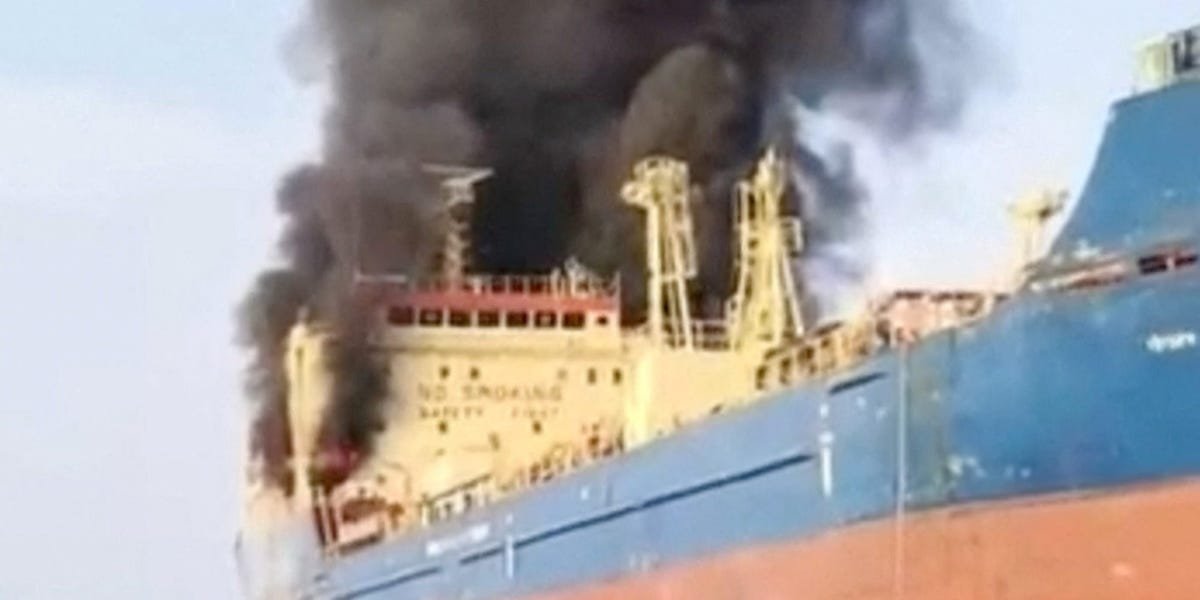
Exploding drone parts are now part of the growing fight between the US and its partners and Iran. Oman said one struck a tanker and resulted in the death of a crew member.

Oman News Agency, the state news agency of the Sultanate of Oman, said on Monday that an oil tanker flagged to the Republic of the Marshall Islands “was attacked by an unmanned surface vessel.”

It said “the attack triggered a fire and explosion within the main engine room, resulting in the fatality of one crew member of Indian nationality.”

The tanker, MKD VYOM, was around 52 nautical miles off the coast of Oman and had 21 crew members on board: 16 Indian nationals, four Bangladeshi nationals, and one Ukrainian national. They were evacuated by commercial vessel MV SAND, which flies Panama’s flag, the report said.

It said that a vessel from Oman was monitoring the condition of the tanker that was hit and that it was giving navigational warnings to ships nearby. The hit tanker was carrying an estimated 59,463 metric tons of cargo.

The use of drone boats adds to what was already a growingly precarious situation in highly strategic waters, with reports of vessels being targeted and hit by incoming munitions.

Oman did not say who the drone boat belonged to. Iranian officials have said that Iran has them in its arsenal, and Iran has also repeatedly tried to steal US drone boats. The Iranians and their proxies in the region have also previously threatened and attacked merchant vessels.

No naval force operating in the region has said it is using the technology in the conflict that boiled over this past weekend.

Drone boats are an increasingly prominent warfighting technology. They gained notoriety as Ukraine used them against Russia’s Black Sea Fleet, leveraging the low-cost assets to damage and destroy expensive Russian warships. Russia has since adopted the tech. Other actors, like the Houthi rebels, an Iranian proxy group in Yemen, have used them in attacks as well. Western militaries are using this technology too, but primarily for reconnaissance.

The waters around Oman and Iran are hugely important to global trade. They include the Strait of Hormuz, where around 20% of the world’s daily oil supply passes through.

Multiple ships came under fire in this area over the weekend and on Monday, with crews evacuated and some injured. Several major shipping companies have said that they are avoiding the area to keep crews safe.

The US and Israel launched attacks on Iran on Sunday, hitting aircraft, command and control centers, warships, missile sites, and killing Iran’s Supreme Leader. Iran retaliated by firing towards a host of nearby countries that have US bases. Fighting continues.


Source link

One-of-Amazons-data-centers-in-the-UAE-caught-fire.jpeg

One of Amazon’s data centers in the UAE caught fire after being hit by ‘objects’ amid the Middle East conflict

  • Amazon Web Services had a power outage at one of its facilities in the United Arab Emirates on Sunday.
  • The fire was caused by “objects” that impacted the facility at around 7:30 a.m. ET.
  • The impact sparked a fire. Firefighters cut power to the facility while they extinguished it.

Amazon Web Services said on Sunday that connectivity from one of its data centers in the United Arab Emirates was down after a fire at the facility.

AWS, Amazon’s cloud service, said that one of its “Availability Zones” had been “impacted by objects” at around 7:30 a.m. ET. The impact created “sparks and fire,” per AWS.

“The fire department shut off power to the facility and generators as they worked to put out the fire,” the company said.

The company did not say in its statement what the objects were.

According to Amazon’s website, an availability zone can comprise one or more data centers. The company has three availability zones in the UAE, per its coverage map.

The Sunday fire at the AWS facility happened amid US and Israeli military strikes on Iran and retaliatory attacks from the Iranian military on at least half a dozen Gulf states.

Read more about the US-Iran conflict

Photos and videos showed missiles streaking across the sky in Dubai on Saturday and Sunday. Fallout from intercepted missiles caused fires and other problems across the region. The Fairmont’s famed luxury property on the Palm saw damage, as did Dubai’s main airport and the Burj Al-Arab hotel.

Just before 7:30 p.m. ET, AWS said it was seeing “significant signs of recovery” for some systems, but power was still down at the center.

“We do not have an ETA for power restoration at this time. For customers that can, we recommend using alternate Availability Zones or other AWS Regions where applicable,” the company said in its Sunday evening statement.


Source link

Passengers-evacuated-Dubai-airport-after-it-was-hit-with-a.jpeg

Passengers evacuated Dubai airport after it was hit with a missile

  • Dubai International Airport was damaged in an attack on Saturday.
  • The airport said four staff members sustained injuries.
  • A passenger told Business Insider they’d received a missile warning before the incident.

One of the world’s busiest airports was just evacuated after a suspected air strike.

Dubai International Airport (DXB) said that the airport had “sustained minor damage in an incident, which was quickly contained.”

Videos online show debris on the ground and smoke filling the terminal as travelers rush to the exits. Others show emergency vehicles on site.

“Four staff sustained injuries and received prompt medical attention,” the airport said. “Due to contingency plans already in place, most of the terminals were previously cleared of passengers.”

The airport said more updates will be provided “as they become available.” It’s unclear if there were other injuries.

The attack came as Iran continues to send missiles across the Middle East in response to joint US-Israel strikes on Saturday, which Trump said had killed Iran’s Supreme Leader, Ayatollah Ali Khamenei.

Dubai’s other airport, Dubai World Center — Al Maktoum International (DWC), said its operations were suspended until further notice and told passengers not to go to the airport.

Kuwait’s Public Authority for Civil Aviation said a drone hit Kuwait International Airport earlier Saturday, causing injuries and damage. It added that the site was secure as the airport assessed the damage and needed repairs. It’s unclear if it was an Iranian drone.


Screenshot of alert.

A screenshot of Jaiveer Cheema’s phone showing the alert.

Courtesy of Jaiveer Cheema


Emirates passenger Jaiveer Cheema, who has been stuck in Dubai for hours after his flight was canceled amid the air strikes, told Business Insider that he got an alert on his phone around 12:30 a.m. local time that there was a potential missile threat.

The attack on DXB happened soon after. Cheema was at a hotel by then, but said “everyone is taking shelter in the bottom floor of the hotel.”

This is a developing story…


Source link

Trump-says-US-has-started-major-combat-operations-against-Iran.jpeg

Trump says US has started ‘major combat operations’ against Iran as strikes hit Tehran

President Donald Trump announced early Saturday that the US had begun “major combat operations in Iran.”

“Our objective is to defend the American people by eliminating imminent threats from the Iranian regime, a vicious group of very hard, terrible people,” he said in a video statement posted on Truth Social.

The US and Israel carried out airstrikes against Iran on Saturday, following months of tensions between Tehran and Washington.

The Israeli government first announced the airstrikes, which were carried out in broad daylight, as “preemptive.”

“The government of Israel has carried out a preemptive strike against the Islamic Republic to eliminate threats against the country of Israel,” Israeli Defense Minister Israel Katz said in a statement carried by government channels.

“As a result, a missile and drone attack against Israel and its civilian population is expected in the near future,” he added.

A US official confirmed to Business Insider that American forces were involved, adding that the strikes were ongoing.

Footage circulating on social media appeared to show explosions and plumes of smoke in Iran.

The attack marks the second time that the Trump administration has taken military action against Iran. In June 2025, the US bombed the country’s nuclear facilities as part of Operation Midnight Hammer, and Trump said at the time these had “obliterated” Iran’s nuclear sites.

This new round of strikes comes on the heels of negotiations between the US and Iran, part of the Trump administration’s efforts to pressure Tehran into a deal that would severely limit its nuclear and military capabilities. It also follows the withdrawal of Western diplomats from several Middle East countries.

In recent weeks, as Trump has issued repeated threats and warnings to Iran, pushing it to make a deal, the US has built up a large military footprint in the Middle East and nearby European waters.

The Pentagon has surged hundreds of fighter jets, aerial refueling tankers, reconnaissance planes, support aircraft, and warships into the region.

One complicating factor has been public resistance from US allies to operations against Iran. The UK barred the US from using its nearby bases, and Jordan said its bases couldn’t be used for attacks on Iran, despite imagery showing the US has shifted cargo planes and F-35 stealth fighters to one of its bases.

The significant US naval presence on station or taking up position in the area includes at least two aircraft carriers, more than a dozen guided-missile destroyers, and three littoral combat ships, which are designed for near-shore operations.

The two aircraft carriers — USS Abraham Lincoln and USS Gerald R. Ford — are each equipped with dozens of embarked fighters, electronic attack jets, early warning planes, and helicopters. The Lincoln’s air wing includes F-35 stealth fighters.

On Friday, a day after the Trump administration’s negotiations with Iranian officials in Geneva, White House official Dan Scavino posted a photograph on social media of eight B-2 Spirit stealth bombers on a runway, suggesting these aircraft could be used to strike Iran again.

This story is breaking. Please check back for updates.


Source link

Kelsey Baker, Military and Defense Reporting Fellow

Medal of Honor pilot was hit repeatedly by machine-gun fire during the Maduro raid, Trump says, revealing mission details

President Donald Trump shared vivid details Tuesday night of the firefight that erupted as an American helicopter reached Nicolás Maduro’s compound during the US raid into Venezuela last month.

As the Chinook helicopter carrying elite US ground troops and piloted by Chief Warrant Officer 5 Eric Slover approached what the president had previously described as a fortress, “enemy machine guns fired from every angle,” Trump said during his State of the Union Address.

“Eric was hit very badly in the leg and hip,” the president said as he awarded the military’s top valor award, the Congressional Medal of Honor, to Slover.

Immediately following the January 3 raid to capture the then-president of Venezuela, Trump said that a helicopter got hit “pretty hard” and that “a couple of guys were hit.” Official details of the injuries were limited. His speech on Tuesday shed new light on what happened that night.


US Air Force crew chiefs watch as F-35A Lightning II's taxi following military actions in Venezuela in support of Operation Absolute Resolve, Jan. 3, 2026.

Stealth fighters and supersonic bombers were among the aircraft involved in the mission.

US Air Force Photo


After numerous American warplanes, including advanced stealth fighters, suppressed Venezuela’s air defense network, helicopters carrying ground troops moved in, approaching Maduro’s fortified compound.

Slover’s helicopter encountered “two machine gunners who escaped the wrath of the previous planes,” Trump said. As the bullets hit the aircraft, Slover “absorbed four agonizing shots, shredding his leg into numerous pieces,” he continued. “He was gushing blood.”

Helicopter pilots rely on both a control stick and floor pedals for maneuvering. Most helicopters have one main rotor and a small tail rotor to keep them from spinning, but a Chinook has two large rotors that balance each other.

Despite his serious wounds, Slover managed to maneuver his helicopter into position so that onboard gunners could “take care of business” and “eliminate the threat,” the president said, crediting Slover with “saving the lives of his fellow warriors from what could have been a catastrophic crash, deep in enemy territory.”

After landing, Slover told his co-pilot, who was also wounded but not as gravely, to “take over,” saying, “I’m about ready to pass out.” A total of seven US troops were injured during the raid.


US First Lady Melania Trump presents US veteran Captain E. Royce Williams with the Medal of Honor

US First Lady Melania Trump was involved in presenting US veteran Captain E. Royce Williams with the Medal of Honor.

ANDREW CABALLERO-REYNOLDS / AFP via Getty Images


During his State of the Union address, Trump also presented a second Medal of Honor to centenarian US Navy pilot E. Royce Williams, a veteran of World War II and the Korean and Vietnam Wars.

Three years ago, Williams was awarded the Navy Cross for “extraordinary heroism” in a Korean War air battle in which he was outgunned and outmatched in his F9F Panther by Soviet MiG-15 fighters but still managed to shoot down four of them.

The 1952 dogfight was classified for decades.

The Congressional Medal of Honor is usually awarded in solemn, less politically charged ceremonies at the White House. The award can take years, or even decades, as was the case for Williams, to be bestowed. It requires eyewitness accounts and has strict criteria. Other valor awards, such as the Navy Cross or Silver Star, can occasionally be upgraded to a Medal of Honor, a notoriously lengthy process.

The top award is bestowed upon troops engaged against an enemy of the US or an “opposing foreign force,” according to the military’s awards manual.

That the medal was awarded during the State of the Union elicited reactions from some veterans online who felt that the timing dampened the gravity of the award’s significance.

During the event, Trump reiterated his previously stated desire to receive the Medal of Honor.

“I’ve always wanted the Congressional Medal of Honor, but I was informed, I’m not allowed to give it to myself,” Trump told the crowd. “I wouldn’t know why I’d be taking it, but if they ever open up that law, I will be there with you someday.”


Source link

Gary-Marcus-says-AI-fatigue-could-hit-coders-but-other.jpeg

Gary Marcus says AI fatigue could hit coders but other jobs may be spared — and even become more fun

AI fatigue won’t hit everyone the same way, AI researcher Gary Marcus said.

“In some domains, AI might actually make a person’s job more fun,” Marcus told Business Insider.

Software engineers are increasingly discussing how AI is draining them. Siddhant Khare, who builds AI tools, recently wrote about how he’s experiencing AI fatigue.

“If someone who builds agent infrastructure full-time can burn out on AI, it can happen to anyone,” Khare wrote.

Marcus said that not all industries are set to be disrupted in the same way AI has upended programming and engineering.

“If somebody needs to do some artistic work and they don’t really have artistic talent, it might be fun to get the system to make them feel like they have a superpower,” he said.

However, Marcus said he isn’t surprised that programmers are beginning to feel fatigued.

“Some people in coding, in particular, probably feel like constant pressure, and now they feel like what they’re doing is debugging somebody else’s code, instead of writing code,” he said. “Debugging somebody else’s code is not particularly fun.”

The feeling Marcus described echoed what Khare told Business Insider when asked to expand on his AI fatigue.

“We used to call it an engineer, now it is like a reviewer,” Khare said. “Every time it feels like you are a judge at an assembly line and that assembly line is never-ending.”

Steve Yegge, a veteran engineer, said companies should limit employees’ time spent on AI-assisted work to 3 hours. He said AI has “a vampiric effect.”

“I seriously think founders and company leaders and engineering leaders at all levels, all the way down to line managers, have to be aware of this and realize that you might only get three productive hours out of a person who’s vibe coding at max speed,” Yegge told The “Pragmatic Engineer” newsletter/podcast. “So, do you let them work for three hours a day? The answer is yes, or your company’s going to break.”


Source link