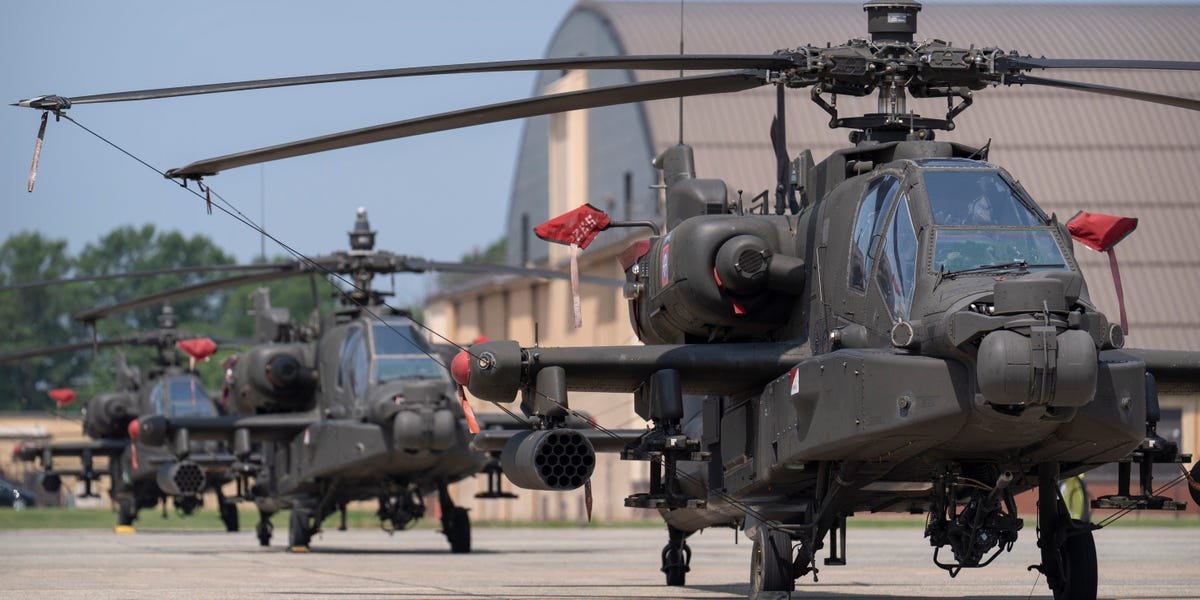
Defense Secretary Pete Hegseth said on Tuesday that the suspension of the flight crew members who hoveredApache helicoptersnear Kid Rock’s Nashville home over the weekend had been lifted.
Kid Rock, whose real name is Robert James Ritchie, is a vocal supporter of President Donald Trump. He posted a video on Saturday of an attack helicopter hovering near the poolside of his home in Nashville, while adding insults to the governor of California in his caption.
An Army spokesperson told Business Insider on Mondaythat the flyby maneuver would undergo an “administrative review” and that “appropriate action will be taken if any violations are found.’
On Tuesday, Army officials said the flight crew members involved in the matter were suspended while the investigation was conducted, an Army spokesperson told multiple outlets.
At 6:34 p.m. Eastern time, Hegseth wrote on X that there would be no probe and that the suspension was reversed.
“Thank you @KidRock. @USArmy pilots suspension LIFTED. No punishment. No investigation,” Hegseth wrote. “Carry on, patriots.”
A Pentagon spokesperson declined to provide further comment beyond Hegseth’s post. An Army spokesperson did not respond to a request for comment.
The AH-64 Apache is an attack helicopter equipped with Hellfire missiles, rockets, and a 30 mm chain gun. It is primarily used for anti-armor missions.
There’s no law that explicitly bars flying an attack helicopter near private residences. Training missions can include low-altitude flight in civilian airspace. The military’s aviation rulebook states that the aircraft are utilized for “authorized purposes only.”
Army spokesperson Maj. Jonathon Bless told the Associated Press that the helicopters were on a training mission when they hovered near Kid Rock’s home.
When asked about the incident during a press conference in the Oval Office, Trump said the crew members “probably shouldn’t have been doing it.”
“You’re not supposed to be playing games, right? But I’d take a look at it. They like Kid Rock. I like Kid Rock. Maybe they were trying to defend him, I don’t know,” Trump said.
A representative for Kid Rock did not respond to a request for comment.
I love showing my kids the world and learning alongside them. It’s one of my greatest joys as a parent, and the ability to do so is a privilege I don’t take for granted. So far, I’ve taken my children to 26 countries across six continents.
Over time, traveling with my kids has changed the way I parent, whether we’re at home or thousands of miles away. Here are six ways traveling has influenced the way I parent.
I realize how little my kids actually need
I used to be obsessed with getting my children the right type of toys to promote learning and development. I wondered if they had enough layers for playing in the snow and the best shoes for climbing at the playground. Through traveling, I saw firsthand how little children really need to be happy and thrive.
In Marrakesh, my son played soccer in the winding streets of the ancient medina with kids wearing worn, off-brand Crocs. They barely stayed on their feet, but the game went on, full of laughter. In India, I saw children in threadbare clothing happily playing with no special toys required.
I realized that, despite my incredible fortune to be able to get my children nearly whatever I wanted, they would be fine with the basics. I now know that my entire family is better off free from the pressures of always chasing more things and wanting more.
I’m not as hung up on what my children eat
Travel often involves unexpected cultural differences that require my family to adapt on the fly — especially when it comes to food. For breakfast in South Korea, we found ourselves with bowls of soup rather than cereal. In Egypt, we ate spaghetti mixed with lentils, rice, and chickpeas instead of meatballs. In Japan, our pizza came topped with honey.
Traveling has taught me that many of the food rules I once accepted as gospel are really arbitrary cultural practices. I no longer care if my children want grilled cheese for breakfast. If they want to experiment in the kitchen and mix items that don’t seem to go together, like putting jelly on samosas, I let them try it. I still care about nutrition, but I’m a lot less hung up on what they eat and when.
The author says that traveling internationally with her children helped her realize that her kids need fewer things to be content.
Courtesy of Jamie Davis Smith.
I’m more flexible with my children
I used to be hung up on strict bedtimes and mealtimes. While traveling, I witnessed parents around the world following very different rules than I did.
In Europe, I saw children out to dinner at 10:00 at night with even later bedtimes. These children were happy and thriving. I realized that the sky wouldn’t fall if I allowed my kids to stay up past their bedtime or if we didn’t eat lunch exactly at noon. Letting go of strict schedules has been incredibly freeing.
More on traveling with kids
I handle stress better
When it comes to travel, changes in plans are par for the course. Trains get canceled. Attractions may be sold out. Kids still get sick, even far from home. Traveling with my children has forced me to keep a level head as I navigate these challenges.
At home, I put these lessons into practice. If I have to deal with a last-minute change in plans because my son gets the flu or a playdate is called off, it’s no longer a big deal. When I am on the verge of panic, I remember the time I discovered the train I had planned on taking out of Venice wasn’t running. It could have been a catastrophe, but with some creative thinking, I got us to our next destination on time.
Once, I was told (incorrectly) that my son needed emergency surgery in Jamaica. I had to make sure he was well cared for in a country with a vastly different medical system than the one I am used to. He recovered in a couple of days with minimal intervention. Having the experience of navigating complex issues in countries where I don’t speak the language and must deal with cultural and administrative differences makes everyday problems easier to handle.
The author says that she’s learned to let traditional schedules go and embrace being in the moment.
Courtesy of Jamie Davis Smith.
I make more time for fun with my children
My role as a parent is often purely managerial. I drive my children to various activities and pick them up from school. I make their doctor’s appointments and feed them dinner.
When we travel, many of these responsibilities vanish. My children and I spend more time having fun and enjoying each other’s company. We play endless rounds of Uno and laugh at inside jokes. It can be challenging to find time to create joy amid the relentless pressures of everyday life. However, traveling has shown me that doing so is essential to building a strong, lasting relationship with them. It also helps provide moments of respite from the daily grind.
I look for new experiences closer to home
If it were up to me, I would travel full-time. However, I need to work, and my children need to attend school, so that’s not feasible. Instead, I look for more interesting experiences closer to home. I’ve learned that it’s possible to experience something new and joyful just about anywhere.
Even when I can’t travel, I try to act like a tourist in my hometown. I seek out new hikes, museum exhibits, plays, and events every month. This keeps life interesting, even when work and school schedules keep us closer to home.
In the fall of 2023, Taylor and her family were living in a condo that they loved. They knew they would buy a bigger property someday, but they weren’t in a rush. Then the algorithmic fates stepped in when Taylor spotted a historic home on Zillow that was a little over 3,500 square feet and built in the 1920s.
“It wasn’t too far from where we were in Detroit,” she told Business Insider of the house. “It’s in a historic neighborhood in the city.”
Since the four-bedroom house was nearby, Taylor and her husband decided to take a look, driving by it before setting up an actual tour. For Taylor, it was love at first sight.
“The moment we drove up, I just had a good gut feeling about it,” she said. She fell even more in love when they saw the interior layout.
Taylor and her husband put in an offer, and soon, the house was theirs.
In October 2022, they saw a 2,700-square-foot house built in 1979 that spoke to Martino. It had four bedrooms, two bathrooms, and two half bathrooms, one of which was in the three-car garage. It was clearly a family home.
“The owners were there for 20-something years,” she said. “It was just dated, but it was very well cared for.”
Martino knew she would want to make substantial changes to the house, but the land it sat on made it feel like the perfect place to turn into their home.
“On our property, we have dozens of 100-foot trees,” Martino said. “All of the properties that you find for a brand-new build have nothing on them.”
She also loved the surrounding area, which offers easy access to apple orchards and horseback riding while remaining within commuting distance of her partner’s restaurants.
“It was like right price, right location, and we can do what we need to do to make it look how we wanted to in the end,” she said.
The drones Iran is launching at US forces are the same ones Ukraine has fought for years. Ukrainian soldiers say their battlefield experience offers lessons that matter in this fight.
Alex Eine, the commander of a small Ukrainian drone unit, said it was “surprising” to see reports out of the Middle East of multimillion-dollar interceptors being used to combat cheap Iranian one-way attack drones.
“When long-range drones are flying at you, don’t shoot them down with $3 million PAC-3s from Patriots,” he said, referring to a top interceptor for the most advanced US surface-to-air missile system.
Through trial and error, Ukraine developed low-cost defenses to counter Russia’s Geran drones, copies of Iran’s Shahed drones. Ukrainians involved in defending their country and Western analysts say other countries facing these threats need to be doing the same.
A 122nd Brigade sergeant with Ukraine’s Territorial Defense Forces who asked to be identified only by their call sign Fast, said that Ukrainian soldiers “were sure the US had some secret weapon,” some foolproof shield for stopping Shaheds. They were expecting to see it in action when this new war began, he said.
Instead, what they saw were viral video clips of an Iranian delta-wing drone sailing past defenses and slamming into a US Navy base in Bahrain, causing serious damage.
Iran has been firing missiles and drones at US targets and its Middle East allies.
Stringer/Anadolu via Getty Images
“Now we see that it is a hard task, even for the US,” Fast said of defending against Shaheds.
On Wednesday, CNN reported, citing an unnamed source who attended a closed-door briefing, that Defense Secretary Pete Hegseth and the top general, Dan Caine, told congressional leaders that Shaheds pose a greater challenge for the US and allies than initially expected.
The Pentagon did not respond to requests for comment.
Speaking at a press conference on Thursday afternoon, Adm. Brad Cooper, the head of US Central Command, said that the US is “very familiar with the Iranian capabilities” and “planned for it right from the outset.”
He added that while he felt good about what the plan was, the military has been making adjustments.
Dimko Zhluktenko, a Ukrainian drone pilot with Ukraine’s Unmanned Systems Forces, said the US and others should lean more into the kind of low-cost systems that Ukraine has proven work against Shaheds.
Hard-won combat lessons
The reality of any major air defense battle is that some threats are likely to break through.
“I’m not surprised that some Iranian drones penetrated their defenses, as they act like a swarm,” said Ukrainian lawmaker Maryan Zablotskyy, who was an early advocate for interceptor drone air defenses. “It’s very difficult to intercept a whole bunch of them flying at the same time.”
Ukraine has developed mobile fire groups as part of its response to Shahed-style drones.
Andriy Dubchak/Frontliner/Getty Images
Last year, Ukraine saw Russian drones break through and kill over 500 civilians.
“There is no 100% counteraction,” said Oleksandr Skarlat, the director of the Sternenko Foundation, a crowdfunding organization for combat drones. “The question is no longer whether such drones will break through,” he argued, “but what the cost of destroying them will be and how quickly defense systems can adapt.”
Ukraine says it can intercept about 90% of Russia’s Shaheds. That rate isn’t perfect, but Kyiv is able to achieve largely effective coverage and do so with systems that are cheap enough to field at scale, helping it save its missiles like the Patriot and the National Advanced Surface-to-Air Missile Systems, or NASAMS, for Russia’s more dangerous threats.
Ukraine depends on a host of low-cost solutions against Shaheds, including electronic warfare, mobile gun teams, and interceptor drones.
A cofounder of Wild Hornets, the Ukrainian firm behind the popular Sting interceptor drone, said the Shahed threat “forced” their country to develop an entirely new branch of service dedicated to using drones to fight drones.
Ukraine began surging production of cheap interceptor drones, designed to fly at high speeds to intercept Shaheds, in 2025. It says it now produces over 1,000 of them a day.
Ukraine has developed interceptor drones designed to take out Shaheds and other drones.
Alex Nikitenko/Global Images Ukraine via Getty Images
Math problems
Hegseth said on Wednesday that theUS has “the most sophisticated air and missile defense network ever fielded” and that it has vaporized thousands of Iranian threats, both missiles and one-way attack drones.
“We have pushed every counter-UAS system possible forward, sparing no expense or capability,” he said, using an acronym for counter-Unmanned Aerial Systems.
Among the higher-end air defenses on the front lines of this multinational air defense fight are the MIM-104 Patriot and Terminal High Altitude Area Defense (THAAD) systems. Ship-based interceptors, like the SM-series missiles, and planes armed with air-to-air missiles are also in play.
Dara Massicot, a Carnegie Endowment for International Peace defense expert, wrote in an assessment on Monday that drone attacks are being intercepted “at an impressive rate,” but at the cost of “extensive resources of near-constant defensive counter air patrols and the use of ground-based air defense systems that are otherwise needed for intercepting inbound Iranian missiles.”
Zablotskyy,the Ukrainian lawmaker,said that the important thing is to “start thinking low-cost war.” Ukraine’s interceptor drones are priced at around $2,300 to $6,000 each, while Shaheds are generally estimated to cost $20,000 to $50,000 apiece.
Ukraine has more experience operating and stopping drones than any of its allies.
ROMAN PILIPEY/AFP via Getty Images
That cost ratio is much better than expending a multimillion-dollar interceptor missile on a drone costing only thousands. American military leadership says that they are working to address past imbalances.
“Interceptors, in general, we’ve had a number of new capabilities being fielded,” Cooper said on Thursday. “I think you have seen over a period of time us kind of get on the other side of this cost curve on drones.”
“If I just walk back a couple of years, you remember you used to always hear: ‘We’re shooting down a $50,000 drone with a $2 million missile.’ These days, we’re spending a lot of time shooting down $100,000 drones with $10,000 weapons,” he said.
The admiral declined to go into specifics on the new capabilities being fielded.
The US and Israel are flying over Iran and destroying as much as they can of Iran’s missile arsenal to try to limit its offensive attacks — a state-of-the-art air campaign that Ukraine can’t match, and it has cut both missile and drone attacks down tremendously since the war began.
Offers to help
The US military has taken broader drone lessons from Ukraine; however, observers say it has not adopted Kyiv’s low-cost interception architecture at the scale it needs for this and future wars.
The US military’s Patriot air defense system is powerful, but every use is costly.
Thomas Frey/picture alliance via Getty Images
Ukrainians told Business Insider that the US should invest deeply in interceptor drones like the ones they use while also layering in electronic warfare and short-range air defenses.
“The use of interceptor drones might be the key to the Shahed challenge in the Middle East and elsewhere,” said Taras Tymochko, who led the Dronefall project, a program under the charity foundation ComeBackAlive that funded early development of interceptor drones in Ukraine.
“Of course, there is not much time to learn how to use interceptors,” he said. “But it is better to be late than very late.”
On Thursday, Ukrainian President Volodymyr Zelenskyy said that Ukraine “received a request from the United States for specific support in protection against ‘shaheds’ in the Middle East region.” At the same time, reports emerged that the US and other partners were considering purchasing Ukrainian interceptor drones.
In the past, the cost of interception was often vastly more expensive than the target. Cheap interceptor drones are designed to change that.
Jack GUEZ/AFP via Getty Images
Massicot said that while this deeper “learning should have started long ago, now is the time to start — and catch up quickly.”
Several Ukrainians said the urgency for the US to learn from their country extends past the fighting with Iran or the threat from Russia. These countries aren’t its only foes that might rely on Shahed-type drones or swarms.
“Air defense in the Middle East is already unable to withstand the intensity of Shahed attacks,” Skarlat said. “Imagine what will happen if China gets involved” in the drone swarm way of war, he said.
“The world is not ready for massive attacks by Iranian drones,” he said.