
James Rodriguez

The housing market has been brutal for millennials. So why are first-time homebuyers getting younger?

Buying a first home is generally considered a young person’s game. If your 20s are for stumbling through adulthood, then your 30s are for settling down with a family and a mortgage. Your 40s are for reaping the fruits of that labor: as you watch your home equity swell, maybe you think about splurging for more bedrooms and a bigger yard.

A report released last fall by the National Association of Realtors upended this basic assumption. For several decades, the typical age of first-time homebuyers bounced around the early 30s, never surpassing 33. Last year, though, the group’s annual survey found the median age of first-timers had hit a record high of 40, capping off a four-year surge that began during the pandemic-era housing shuffle. The message was loud and clear: Picking up the keys to your first place is no longer an “early adult” thing. Now it’s part of your midlife crisis.

Cue the hand-wringing. “First-home homebuyers are older than ever,” declared headlines from The New York Times and Axios. “Many would-be buyers are frozen out of the housing market,” warned another. For my own story, I dubbed this new era the “age of the geriatric homebuyer.” I spoke with a woman who placed her first winning bid on a home at 42 and couldn’t shake the feeling that she was behind. In light of the NAR’s latest data dump, however, she appeared to be merely another example of the sea change in real estate.

The splashy number seemed to confirm our worst fears about the housing market: only old, rich people are having any luck, and younger generations are struggling to break in. The optimists’ take was that elder millennials still had some breathing room. For those inclined to doomerism, though, it was more proof that a classic marker of adult success was drifting further out of reach.

“It is very consistent with this idea that housing affordability is very strained,” says Chen Zhao, a senior economist at the brokerage firm Redfin, “and therefore you have to be older to afford a house right now.”

There’s just one problem: The death of the thirtysomething homebuyer may have been greatly exaggerated. A new analysis from Redfin, shared exclusively with Business Insider, found that the median age of the first-time buyer last year was 35 — a slight decrease from the year prior. It adds to the growing pile of evidence that the new median of 40 was a mirage. While millennials, now 29 to 45, generally lag behind boomers on the homeownership front, the purchasing milestone hasn’t shifted nearly as much as the NAR report suggests.


If you want to understand the housing market’s ebbs and flows over the past couple of decades, Redfin’s analysis is a helpful starting point. Economists there found the median age of first-time buyers climbed slowly but steadily from 2008 to 2018, peaking at 38, before bouncing around the mid-30s in the following years. Zhao tells me the trend makes intuitive sense: banks tightened up lending standards after the housing bubble burst in 2008, making it tougher to get a mortgage and buy a house. Then mortgage rates began ticking downward before plummeting in 2020 and 2021, reaching a 50-year low as the Federal Reserve slashed borrowing costs to fight inflation. All those cheap home loans made it easier for younger people to break into the market, and the first-time homebuying age fell to 34 in 2021 and 2022. Then rates jumped, and the median age of first-timers followed suit, rising to 35 in 2023 and 36 the following year. Affordability improved slightly in 2025, thanks to slower home-price growth, rising wages, and marginally lower mortgage rates, which could explain last year’s decrease in the median age.
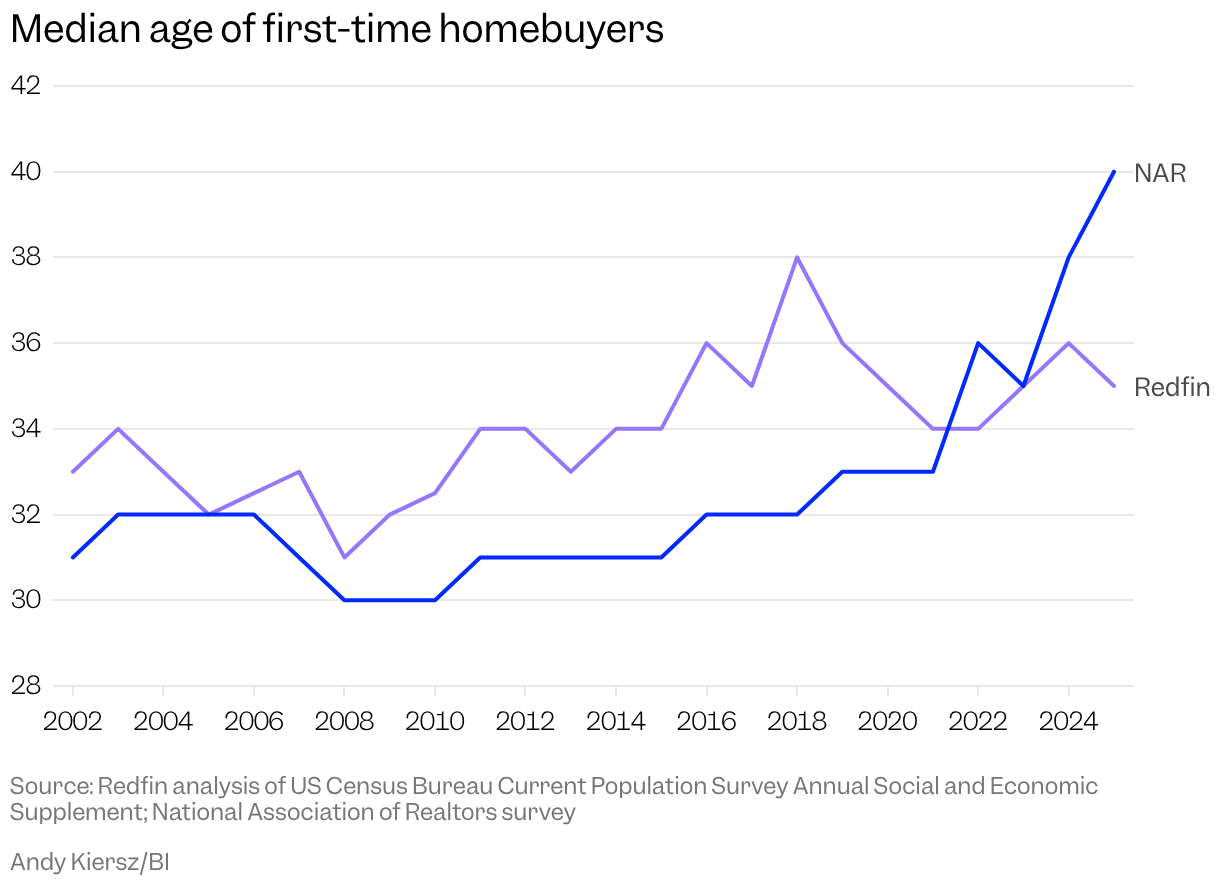
While the NAR and Redfin analyses both point to first-time homebuyers generally getting older, the latter’s numbers are way less dramatic. Redfin isn’t the only one pushing back on the idea that the typical buying age skyrocketed over the past few years. A growing number of economists have chimed in to suggest the situation isn’t nearly so dire. Studies by the Federal Reserve Bank of New York and the American Enterprise Institute found that the median age of first-timers was basically unchanged at 33 between 2019 and 2024, before rising slightly last year to 34. Researchers at the Mortgage Bankers Association similarly found a modest increase from 30 to 33 over the decade leading up to 2024, followed by a dip to 32 in 2025.
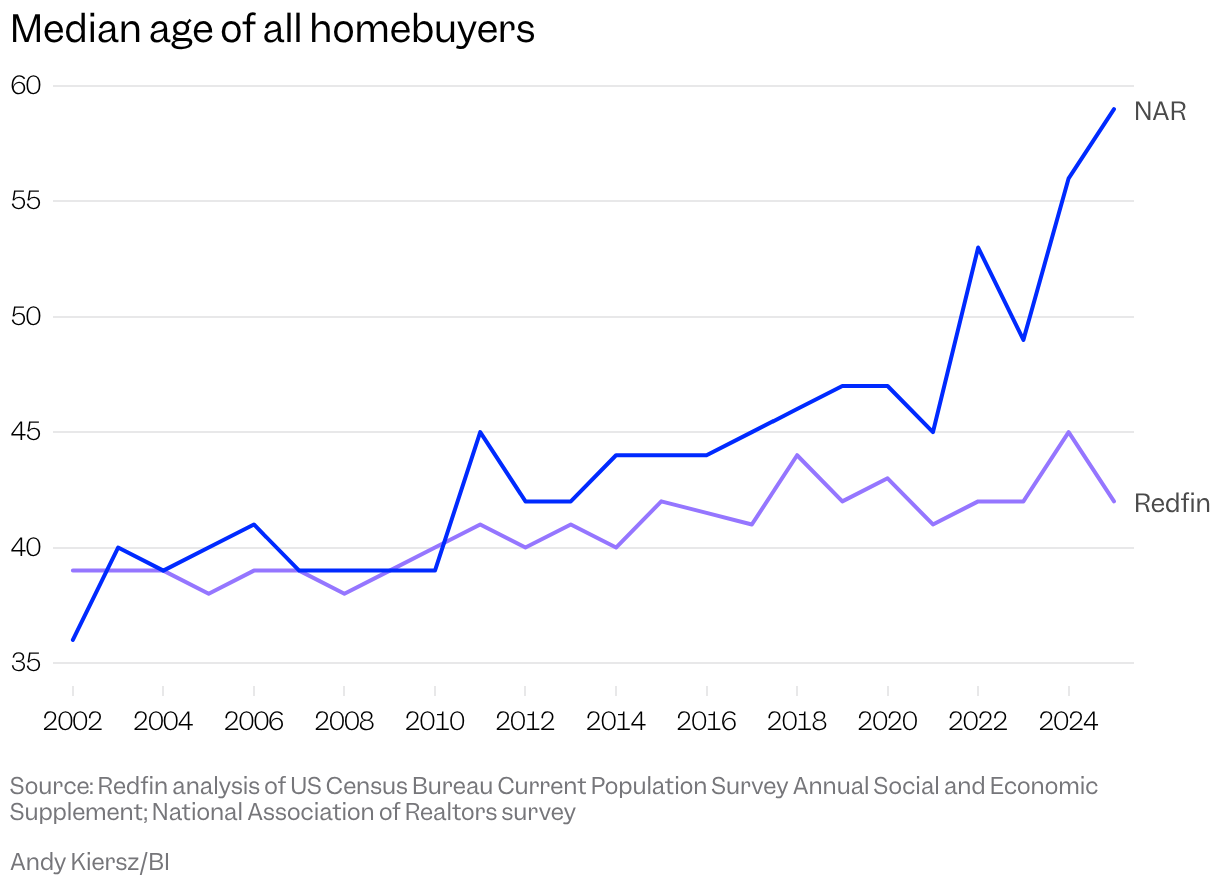
Connor O’Brien, a fellow at the DC-based think tank Institute for Progress, analyzed the Census Bureau’s American Housing Survey and American Community Survey and found that the median age for all buyers had ticked up since 2000 but hovered around 42 in 2023, while NAR reported a median age for all buyers of 49 that year and a stunning increase to 59 just two years later. That Census data only runs until 2023, but O’Brien says he doesn’t see any reason to believe that the typical buying ages would have undergone a seismic shift in two short years, given the housing market’s stasis.

“It seemed totally implausible,” O’Brien tells me.

So why the discrepancy? The rebuttals to NAR’s data all draw upon national data sources that researchers say are far more robust than the Realtors’ annual survey of recent homebuyers, which is conducted via mail and text message. In July of last year, the NAR sent the 120-question survey to a nationally representative sample of more than 173,000 recent homebuyers but received just 6,103 back, a response rate of 3.5% (the census’ American Community Survey, by contrast, sees a response rate of more than 80%). The New York Fed and the Mortgage Bankers Association relied on the Consumer Credit Panel and the National Mortgage Database, which sample millions of underlying documents, like mortgages and credit reports, to take the temperature of the American homebuyer.

It seemed totally implausible.Connor O’Brien, fellow at the Institute for Progress

Redfin’s analysis also uses Census data, specifically an annual supplement to its Current Population Survey, which asks households who moved in the past year why they did so. The survey doesn’t separate first-time buyers from repeat buyers, so Redfin used a proxy: it counted respondents as “first-time buyers” if they said they moved because they wanted to own rather than rent, or to start their own household, implying they’d previously been living with roommates or parents.


A red for-sale sign from the brokerage firm Redfin in front of a house

A Redfin analysis of census data shows the typical age of first-time homebuyers actually decreased slightly last year to 35.

Smith Collection/Gado/Getty Images


Jessica Lautz, the NAR’s deputy chief economist and vice president of research, says in an emailed statement that the organization stands by its methodology. Lautz describes the NAR’s survey as “the only national survey that asks primary residence buyers if they are a first-time buyer or repeat buyer,” and points out that analyses of mortgage and census data must rely on varying degrees of assumptions in order to parse first-timers from the rest of the pack — mortgage data, for example, doesn’t include all-cash buyers. Some of those assumptions, she says, no longer match the reality of the new housing market.

“Marriage and divorce do happen, inheritances are gifted, all-cash buyers happen, and sometimes a household may have to rent temporarily before owning again,” Lautz says in the statement. “Homeownership has become out of reach for the typical young adult in America.”

Redfin’s methodology isn’t perfect — taken on its own, I’m not sure it would unseat the NAR’s estimates. It’s important to pay attention, however, because it adds to the mountain of evidence that first-time buyers aren’t suddenly getting way older.

“Because no data source is perfect, what you really want to do is say, What is the bulk of the evidence showing me?” Zhao tells me. “When we compare our results to analyses that other people have done looking at credit bureau data or mortgage data, it seems to support the idea that the age of the first-time buyer has not increased all that much.”


This might sound like a bunch of bickering and hair-splitting, a squabble among housing nerds. But the conclusion — that people are still buying homes at roughly the same age they were a couple of decades ago — has far-reaching implications.

“People are potentially going to make policy based on their view of how the economy and housing market are developing,” O’Brien tells me. “If their views are fundamentally incorrect, that could be a big problem.”


A real estate broker brings in a sign at the end of an open house for a modern, single-family row house in Chicago's Woodlawn neighborhood

The homeownership rate for millennials in their early 30s still lags well behind that of baby boomers at the same age.

Eileen T. Meslar/Chicago Tribune/Tribune News Service via Getty Images


The takeaway shouldn’t be that things are fine and dandy for millennial homebuyers, though.

We don’t have enough housing where people want to live, and where people find the job markets that they want to participate in.Ben Glasner, senior economist at the Economic Innovation Group

A recent analysis of census data by Ben Glasner, a senior economist at the Economic Innovation Group, found that while millennials and boomers were about as likely to own homes at 44, the ownership rate among 32-year-old millennials (41.3%) was well below the 54.7% for boomers at that age. And while Redfin and NAR pulled vastly different homebuying ages from their data, both groups advocate for more housing construction. Glasner draws a similar conclusion.

“We don’t have enough housing where people want to live, and where people find the job markets that they want to participate in,” he tells me.

The “40-year-old” finding had all the proper ingredients for virality: a nice, big number that confirmed what everyone already felt to be true about the dismal state of the world. Things are rough out there for millennial homebuyers, no doubt. But the goalposts haven’t moved as much as we thought — at least, not yet.

“I think a lot of times people feel like, Well, if I can’t achieve the homeownership step, it’s kind of like I can’t move forward with my life,” Zhao tells me. “And I think that’s why people are very hung up on this number.”


James Rodriguez is a correspondent on Business Insider’s Discourse team.


Source link

Eliza Relman

Three generations live next door — and it’s helping this family afford both housing and elder care

Lauren McCadney had always wanted to live next door to friends or family. In her late 50s, she finally made that happen, though not the way she’d planned.

In 2020, Lauren’s mother, who had been living with her brother and his family in Frederick, Maryland, died. Lauren, who was going through a difficult divorce and doesn’t have children, decided she wanted to be closer to her family and help her brother care for their dad, who was dealing with his own health challenges.

In 2021, she moved from her home in Chicago to Maryland, renting a house a few blocks away from her brother, James, her sister-in-law, Lorri, and twin 20-year-old nephews, Drew and Carter. In 2023, the five-bedroom house next door to James and Lorri went on the market, and Lauren bought it and moved in with her sister, Cheryl.


Lauuren McCadney's family home.

Seven family members across three generations live next door.

Charlotte Kesl for BI


Now the seven family members live between the two houses, sharing caregiving responsibilities for James Sr., the family patriarch, and forming what they call a family compound.

Multigenerational living was once the norm in the US. Before World War II, it was almost unheard of for older adults to live independently or to receive care outside their families, while younger people often waited until marriage to move out. That changed for millions of American families as they lived farther apart, independent living services for older people became more accessible, and more women joined the workforce.

Now, as the costs of housing, long-term care for seniors, and childcare soar, that trend is beginning to reverse. The McCadneys are one of a growing number of American families moving back in together — or never separating in the first place. The number of people in the US living in multigenerational households — those with two or more adult generations — quadrupled between 1971 and 2021, according to Pew Research.

“I feel very blessed and fortunate that we have the situation we have,” Lauren said, “because I have friends who are the primary solo caregiver, and that is hard.”


Lauuren McCadney and family.

The McCadneys split caregiving duties and expenses.

Charlotte Kesl for BI


Sharing caregiving and expenses

The McCadney family splits caregiving duties — and everyone saves money in their arrangement.

Lauren, who retired from her career in tech marketing in 2024, renovated her house to suit her family’s needs, refinishing the basement into a separate living space for Cheryl and making the first floor accessible for their father, who has a neurological condition that makes walking difficult and affects his memory.

Cheryl, who pays below-market rent, takes care of Lauren’s dog while she’s on vacation. Their brother manages most of their father’s personal and medical care, while Cheryl spends a lot of time with him during the day. Lauren likes to take her father, who uses a scooter, to restaurants, breweries, and concerts.

When any family member goes on vacation or is otherwise occupied, they know another family member will be there to take care of the elder James.

By not putting the elder James in assisted living or a nursing home, the family is saving significant sums. “Unless you’re a billionaire, I don’t think that most people have the luxury of saying cost is not a consideration,” Lauren said.


Lauuren McCadney's father.

The family is saving a significant amount of money by taking care of the elder James at home.

Charlotte Kesl for BI


They also appreciate the peace of mind that comes from knowing their dad is being cared for by family. Plus, James Sr. wasn’t keen on moving into a facility.

“We know that he’s going to get much better care, and from a socialization perspective, from a stimulation perspective, from having a reason to get out of bed perspective,” Lauren said. “That’s something you cannot put a price on.”

Drew and Carter, who save on rent by living at home, also chip in, including by helping Lauren. They mow their aunt’s lawn, give her rides to the airport, and recently drove her to and from eye surgery.

“I do love that my boys have lived their formative years in a multigenerational household,” said Lorri, who’s a teacher. “It is, hopefully, clear to them that love is an action.”

Navigating challenges and an uncertain future

There are real challenges with caring for an aging family member. The siblings don’t have as much flexibility or privacy as they otherwise would. Cheryl said that before she moved in with Lauren, she “had grown accustomed to living alone and having flexibility to decide when to or not to interact with others.” Living with family has changed that.


Lauuren McCadney

The family aims to strike a balance between all three generations.

Charlotte Kesl for BI


James and Lorri are sandwiched between caring for their kids and their parents, all while juggling full-time jobs. Even as the couple is on the precipice of becoming empty-nesters, they’re responsible for someone who’s ever more dependent on them.

“I know there are times when James is exhausted and or frustrated,” Lorri said, “and as his wife, that’s hard to watch.”

James, who works for Maryland’s Department of Human Services, said there’s a constant balance to strike in doing right by all of his family members.

“Am I taking anything away from my children, or did I take anything away from them?” he said. “We hope that we’re doing all the right things.”


Lauuren McCadney and family.

Multigenerational living is on the rise.

Charlotte Kesl for BI


The McCadneys don’t know how long they’ll stay where they are. Lauren’s house requires a lot of maintenance that she’d rather not have to deal with as she ages. Lorri and James hope to someday downsize and spend more time at the beach in their travel trailer. As long as the elder James is living with them, the couple said they’ll stay in their home.

Lauren doesn’t know who will take care of her when she’s older. She and her friends talk about buying a piece of land and building several small homes on it, creating their own communal living arrangement where they could share a caregiver and help each other out.

“A lot of my friends are sitting around right now having this conversation, which is, ‘We don’t have kids, who’s taking care of us? How do we do this?'” she said.

While so much about the future is uncertain, she’s taking one day at a time for now.

“I’m just happy that everything works for right now,” she said.


Source link

Inside-the-hell-on-earth-Brooklyn-jail-reportedly-housing-Nicolas.jpeg

Inside the ‘hell on earth’ Brooklyn jail reportedly housing Nicolás Maduro

Venezuelan President Nicolás Maduro and his wife Cilia Flores are reportedly awaiting their first court appearance at a Brooklyn jail famous for its poor conditions.

Numerous publications, including The Wall Street Journal, have reported that the pair were escorted to the Metropolitan Detention Center late Saturday after arriving by plane in New York.

MDC, which has yet to confirm the transfer to Business Insider, has been home to numerous high-profile defendants facing trial in New York City, including music mogul Sean “Diddy” Combs, Sam Bankman-Fried, the founder of fallen bitcoin exchange FTX, and Ghislaine Maxwell, who was convicted of aiding the sex trafficking operation of the deceased sex offender Jeffrey Epstein.

Luigi Mangioni has been housed at MDC while awaiting trial for the murder of UnitedHealthcare CEO Brian Thompson. He has pleaded not guilty.

The jail has been widely criticized over the years for its poor conditions, having been described as “inhumane” and “hell on earth.”

Last year, the Legal Aid Society issued a press release lamenting the jail’s “documented history of violence, medical neglect, and human and civil rights violations.” It cited reports of no heat during the winter and “maggot-infested food.”

In 2024, a federal judge in Brooklyn made headlines when he carved out a special exemption during sentencing to help a defendant avoid the MDC. The judge ruled that if the 74-year-old, convicted of tax fraud, were assigned to the MDC, he could serve his time under house arrest, The New York Times reported.

In March, Brooklyn federal prosecutors announced charges against 25 defendants in 12 separate cases tied to violence and contraband smuggling at the jail, which is located in the Sunset Park neighborhood of Brooklyn.

“Over the years, MDC has become synonymous with egregious neglect and abuse with the people incarcerated,” the Legal Aid Society said in a June press release opposing ICE detentions at the jail.

President Donald Trump shocked the world on Saturday when he announced that the US had captured the Venezuelan president and his wife after a “large-scale strike” on Venezuela.

Trump has said the US is “going to run the country” until it can facilitate a safe transition of power, and that US oil companies will now be free to “spend billions” on development in the South American nation.

Maduro has been in the US Department of Justice’s crosshairs for years, and in 2020, Manhattan federal prosecutors indicted him as a leader of the Cartel de Las Soles, its name for the alleged drug-trafficking organization run by Venezuela’s military and political elite.

An expanded indictment unsealed on Saturday added as defendants Maduro’s wife and son, Nicolás Ernesto Maduro Guerra, identified in the indictment as “The Prince.” It accused them of participating in a wide-ranging effort to traffic drugs to the US to enrich themselves.


Source link

3-things-homebuyers-should-do-to-hack-the-unaffordable-housing.jpeg

3 things homebuyers should do to hack the unaffordable housing market, according to Fannie Mae’s chief economist

Doug Duncan, chief economist of the government-sponsored mortgage finance giant, noted the challenging environment for first-time homebuyers, with mortgage rates hovering near 20-year highs and a dearth of inventory keeping home prices elevated.

The 30-year fixed mortgage rate has been stuck around 7% all year. Single-family home prices, meanwhile, climbed 7.4% in the first quarter.

“Supply-constrained,” Duncan said of the housing market, speaking to Yahoo Finance on Thursday. “That’s been a theme for several years, it’s kind of repeating the story, but it’s the story.”

Duncan outlined his top tips for homebuyers in today’s market:

1. Have a good credit score

Mortgage rates are elevated, and having a poor credit score makes borrowing costs even steeper, Duncan said.

“No matter who you talk to, there’s different kinds of lenders. All of them are going to look, first of all, at what’s your credit? Do you have a good credit score?” he said. “They want to know, what’s your risk profile?”

Real estate economists say mortgage rates likely won’t come down significantly anytime soon. Mortgage rates are influenced by real interest rates in the economy, and Fed officials aren’t in a rush to cut rates while inflation remains above their target and the economy remains strong.

2. Shop around with multiple lenders

Homebuyers should talk to multiple lenders before locking in their mortgage. Buyers who shop around tend to score better deals and more affordable rates, Duncan said.

“Make them compete. They don’t make money if they don’t make a loan to you, so they have an interest in satisfying you, just like you have an interest in getting a good deal. So shop around for sure,” he added.

3. Don’t try to time the market

You be in the market for a home because you can afford it at the moment — not because you’re waiting for prices or mortgage rates to come down, Duncan said.

“What I always give people as advice when they ask, ‘Is now a good time to buy a house?’ is if you have a family budget or a household budget. That’s the most important clause, because any lender is going to ask you things that’s going to come out of that budget, and if you can budget it all out, you know how to immediately answer those questions and you’ll get a better deal at the end of the day,” Duncan said.

People betting that mortgage rates or home prices will come down soon are taking a gamble. Some homebuyers can afford to speculate on the market, but most first-time homebuyers cannot, Duncan noted.

“You want to take a well-educated financial management approach to that decision because you’d like to be able to sustain it,” he said.

First-time homebuyers accounted for 32% of all home sales in 2023, well below the historical average of 38%, according to data from the National Association of Realtors.

The good news is that some real estate experts see a recovery slowly forming for the housing market. Supply is expanding and home prices are starting to fall in key metros, Charles Schwab said in a recent note.


Source link