
Nvidia-CEO-Jensen-Huang-says-every-company-needs-to-have.jpeg

Nvidia CEO Jensen Huang says every company ‘needs to have an OpenClaw strategy’

Nvidia CEO Jensen Huang says companies can’t ignore the OpenClaw moment.

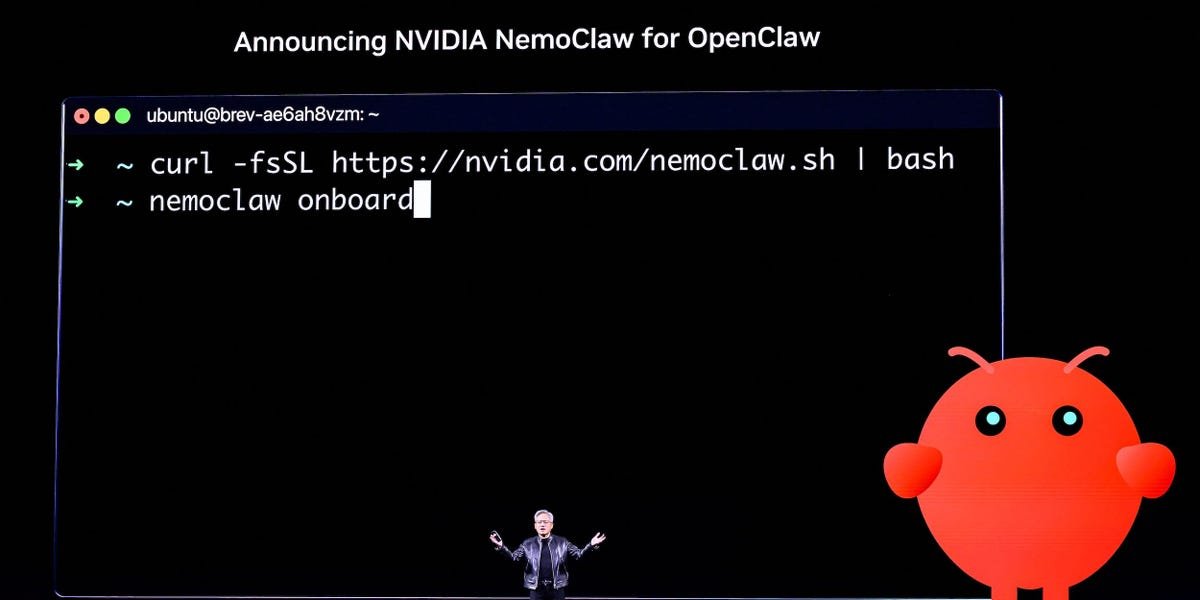
“Every company in the world today needs to have an OpenClaw strategy, an agentic system strategy,” Huang said during Nvidia’s 2026 GTC conference in San Jose on Monday. “This is the new computer.”

Huang offered deep praise for OpenClaw, previously known as Clawdbot and Moltbot, an open-source AI agent that has taken Silicon Valley by storm. Though OpenAI lured away OpenClaw creator Peter Steinberger, the service will live on as an open-source project.

“OpenClaw has made it possible for us to create personal agents,” he said. “The implication is incredible.”

Huang said that OpenClaw “gave the industry exactly what it needed at exactly the time.”

OpenClaw will do for AI what Windows did for personal computing, Huang said. He also compared OpenClaw to other influential technologies, such as the Linux operating system, the Kubernetes cloud project, and HTML.

“It made it possible for the entire industry to grab onto this open-source stack and go do something with it,” Huang said.

Huang said there’s one big caveat about using OpenClaw that Nvidia has been working to address: security. Nvidia announced its spin on OpenClaw, called NemoClaw, which allows users to add privacy and security controls to their AI agents, or “claws.”

“It has a network guardrail, it has a privacy router, and as a result, we could protect and keep the claws from executing inside our company, and do it safely,” Huang said.

Nvidia is promoting NemoClaw at its conference by hosting a “build-a-claw” event where attendees can develop their own custom-made AI agent.

“OpenClaw brings people closer to AI and helps create a world where everyone has their own agents,” Steinberger said in a statement released by Nvidia. “With Nvidia and the broader ecosystem, we’re building the claws and guardrails that let anyone create powerful, secure AI assistants.”

Huang made a host of other announcements at Nvidia GTC on Monday, including a new inference system that incorporates technology from Groq, an AI chip startup with which Nvidia made a $20 billion deal. He also projected $1 trillion in demand for its Blackwell and Rubin AI chips through 2027.



Source link

Chong Ming Lee, Junior News Reporter at Business Insider's Singapore bureau.

Jensen Huang says Nvidia would love to back an OpenAI IPO, and there’s ‘no drama’ with Sam Altman

Jensen Huang says Nvidia would love to invest in a future OpenAI IPO.

Huang said in an interview on CNBC’s “Mad Money” on Tuesday that there was “no drama” between Nvidia and OpenAI CEO Sam Altman, pushing back against recent chatter of tension in the relationship between the two companies.

“The first deal is on,” the Nvidia CEO said, referring to the company’s September deal with OpenAI, under which the company said it planned to invest up to $100 billion in the AI startup.

“​​And then there’s, of course, an IPO in the future,” he added. “We love to be participating in that as well,” he added.

Huang also described OpenAI as a “once in a generation company” and said Nvidia is “delighted to invest in it.”

His comments come amid reports suggesting internal unease around the deal.

The Wall Street Journal reported on Saturday that the investment had sparked internal concerns at Nvidia, with some executives questioning the deal, according to people familiar with the matter.

Separately, Reuters reported on Tuesday that OpenAI had been unhappy with certain newer Nvidia chips and had looked at alternatives since last year, citing people familiar with the matter.

Huang told reporters in Taipei on Saturday that speculation of any dissatisfaction with OpenAI was “nonsense.”

“We will invest a great deal of money, probably the largest investment we’ve ever made,” he added.

Altman has also pushed back on rumors of tension.

“We love working with NVIDIA and they make the best AI chips in the world,” wrote Altman in a post on X on Tuesday.

“We hope to be a gigantic customer for a very long time. I don’t get where all this insanity is coming from,” he added.

OpenAI is one of the world’s most valuable private AI companies and a major customer for Nvidia’s chips, which power the training and deployment of large language models.

The startup has not announced plans for an IPO, but its fundraising and computing needs have fueled speculation about how it will finance future growth.

“Big Short” investor Michael Burry said in a Substack exchange in January that he was surprised that ChatGPT “kicked off a multi-trillion-dollar infrastructure race.”

“It’s like someone built a prototype robot and every business in the world started investing for a robot future,” he wrote.


Source link

Ayelet Sheffey

What Jensen Huang, and Larry Page’s reactions to the California wealth tax reveal

It’s a classic fight-or-flight response — with a billionaire’s twist.

A proposed wealth tax in California prompted the state’s resident billionaires to consider whether they wanted to continue their residency if the one-time 5% tax is approved.

Their reactions, said CFP professional Don Hilario, who works with financial planning clients in California, boil down to risk tolerance.

The tax, as proposed, would only apply to assets in the state during the 2026 tax year. Google’s billionaire cofounder, Larry Page, moved some of his assets out of California ahead of the January 1, 2026, deadline to avoid facing the tax, Business Insider first reported. Meanwhile, Nvidia’s billionaire CEO Jensen Huang said he has “not even thought about it once.”

“We chose to live in Silicon Valley, and whatever taxes they would like to apply, so be it,” Huang told Bloomberg TV’s Ed Ludlow. “I’m perfectly fine with it.”

Hilario, whose financial planning clients include individuals in Big Tech, said that the lingering uncertainty of the tax can trigger a need for certainty and autonomy.

“People who want to have a greater sense of control will do the Larry Page route,” he said, “versus people who have the temperament to endure will take Jensen’s route.”

Hilario described a hypothetical scenario in which individuals with high net worths are considering purchasing a home. In a period where the economy and interest rates are uncertain, do you want to put the lion’s share of your expenses toward the home in the event that rates will be higher in the future, or do you hold out and continue accumulating your wealth in the event that economic conditions improve?

“That’s the same type of emotions that exist with this tax bill because the fear of not taking any action is unsettling,” Hilario said.

The proposal, put forth by the union SEIU-United Healthcare Workers West to offset potential budget cuts to healthcare and education, is far from being implemented — it would require 870,000 signatures to make it onto the November 2026 ballot.

The SEIU said in its proposal that the concentration of billionaire wealth in California makes the state “uniquely positioned to address both the well-documented crisis of wealth inequality in the United States and the emerging and interrelated crises the state faces” with the budget cuts.

In addition to Huang and Page, other billionaires are voicing their opinions on the proposed wealth tax. LinkedIn’s cofounder, Reid Hoffman, wrote in a post on X that the proposal has “massive flaws.”

“Poorly designed taxes incentivize avoidance, capital flight, and distortions that ultimately raise less revenue,” he said.

Alex Spiro, an attorney who has previously represented billionaires, wrote in a letter to California Gov. Gavin Newsom that his clients would “permanently relocate” if the tax were to become law. Hilario said that the significant uncertainty surrounding the proposal, including how assets will be valued and whether the tax would change over time, likely forced billionaires to decide how risk-averse they really are.

“I still think ultimately it’s unclear. And I think when it’s unclear, it’ll make people, in this case, investors, be more cautious and defensive,” Hilario said. “And then a big part of it is, how do we respond emotionally? I think whether you’re taking early action or enduring, you do want to gather information and avoid making a decision that would ultimately be irreversible.”


Source link